

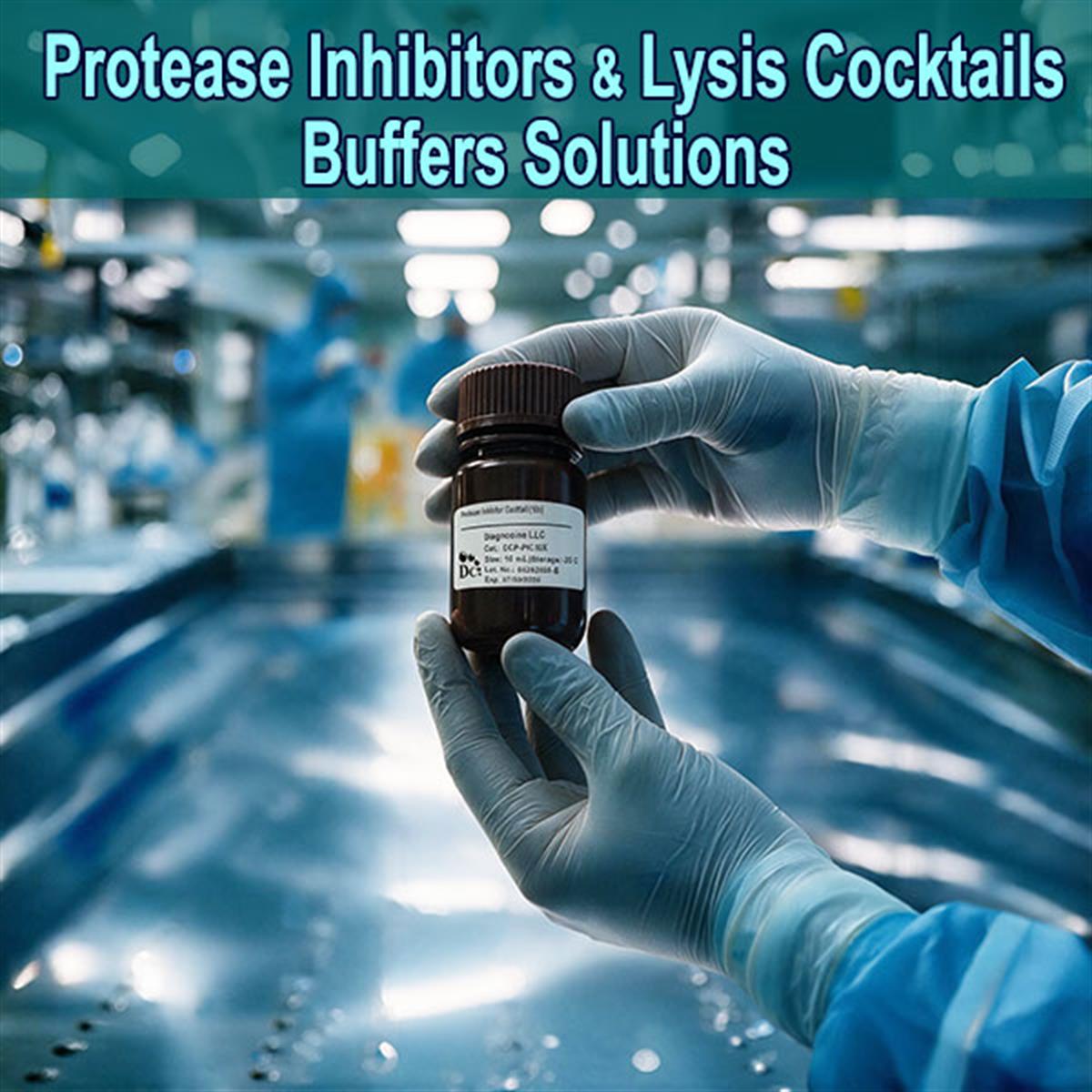
Protease Inhibitors & Lysis Cocktails - Category Selection Guide
Fourteen catalog items, one page. Pick the format your lysis protocol needs and go straight to its product page — the class coverage, formulation reference, and application guidance follow below.
| Product | Cat. No. | Format & Base | Product Page |
|---|---|---|---|
| Protease Inhibitor Cocktail (100X) | DCP-PIC100X | Concentrated master cocktail · broad-spectrum, no detergent | Viewarrow_forward |
| Protease Inhibitor Cocktail (10X) | DCP-PIC10X | Concentrated master cocktail · broad-spectrum, no detergent | Viewarrow_forward |
| Protease Inhibitor Cocktail with DPBS NP-40 Buffer | DCP-PICDPNP1X | Dulbecco’s PBS with Ca2+ and Mg2+ · NP-40 | Viewarrow_forward |
| Protease Inhibitor Cocktail with DPBS Triton-X Buffer | DCP-PICDPTX1X | Dulbecco’s PBS with Ca2+ and Mg2+ · Triton X-100 | Viewarrow_forward |
| Protease Inhibitor Cocktail with DPBS Tween 20 Buffer | DCP-PICDPT201X | Dulbecco’s PBS with Ca2+ and Mg2+ · Tween-20 | Viewarrow_forward |
| Protease Inhibitor Cocktail with EDTA (100X) | DCP-PICEDTA100X | Concentrated master cocktail · broad-spectrum + EDTA | Viewarrow_forward |
| Protease Inhibitor Cocktail with EDTA (10X) | DCP-PICEDTA10X | Concentrated master cocktail · broad-spectrum + EDTA | Viewarrow_forward |
| Protease Inhibitor Cocktail with NP-40 Buffer | DCP-PICTNP1X | NP-40 core · lysate fractionation | Viewarrow_forward |
| Protease Inhibitor Cocktail with PBS NP-40 Buffer | DCP-PICPNP1X | PBS · NP-40 (gentle non-ionic) | Viewarrow_forward |
| Protease Inhibitor Cocktail with PBS Triton-X Buffer | DCP-PICPTX1X | PBS · Triton X-100 (non-ionic) | Viewarrow_forward |
| Protease Inhibitor Cocktail with PBS Tween 20 Buffer | DCP-PICPT201X | PBS · Tween-20 (ultra-mild) | Viewarrow_forward |
| Protease Inhibitor Cocktail with RIPA Buffer | DCP-PICTRIPA1X | RIPA · SDS, Na-deoxycholate, NP-40 | Viewarrow_forward |
| Protease Inhibitor Cocktail with Tris Triton-X Buffer | DCP-PICTTX1X | Tris (phosphate-free) · Triton X-100 | Viewarrow_forward |
| Protease Inhibitor Cocktail with Tris Tween 20 Buffer | DCP-PICTT201X | Tris (phosphate-free) · Tween-20 | Viewarrow_forward |
Not sure which format? See what broad-spectrum coverage means · See applications by workflow · Read the FAQ
What this category does, in one paragraph
The moment cells are lysed, their compartments rupture, releasing a flood of endogenous proteases. Left unchecked, these enzymes rapidly digest your target proteins, ruining Western blots, mass spectrometry, and activity assays. Protease inhibitors bind and deactivate these enzymes, effectively freezing the proteome at the instant of lysis.
The attributes that decide which of the fourteen catalog items belongs in your protocol.
- Three product formats: pre-blended lysis buffer plus inhibitor (ready-to-use), balanced-salt and phosphate-free alternatives, and concentrated detergent-free master cocktails.
- Four protease classes are grouped by active-site chemistry — serine, cysteine, aspartic (acid), and metalloproteases — and broad-spectrum blends control them simultaneously.
- The detergent core sets the harshness: SDS / Na-deoxycholate / NP-40 (RIPA) for total hard extraction, Triton X-100 and NP-40 for membrane work and immunoprecipitation, Tween-20 for ultra-gentle solubilization.
- The buffer base sets the compatibility: PBS, Dulbecco’s PBS with Ca2+ and Mg2+ for targets that need divalent cations, and phosphate-free Tris for kinase and phosphorylation studies.
- EDTA is a deliberate choice: it adds full metalloprotease inhibition via metal-cofactor chelation, but must be avoided for His-tag IMAC purification because it strips nickel from the column.
- Concentrates carry no detergent and are added directly to your own custom lab buffers, at 10X or 100X.
- Pairing note: phosphoprotein studies are often paired with phosphatase inhibitors to preserve post-translational modifications.
- Catalog items in this category14
- Protease classes addressed4 (serine, cysteine, aspartic, metallo)
- Pre-blended ready-to-use formats5
- Balanced-salt / phosphate-free formats5
- Detergent-free master cocktails4
- Concentrations offered (concentrates)10X and 100X
- Detergent cores representedSDS / Na-deoxycholate / NP-40, Triton X-100, NP-40, Tween-20
- Buffer bases representedPBS, DPBS (Ca2+ / Mg2+), Tris (phosphate-free)
- EDTA-containing options2 (10X and 100X)
- His-tag IMAC compatibilityAvoid the EDTA formats — EDTA strips nickel
Four classes of enzyme, one window of opportunity
Proteases are efficient catalytic enzymes grouped by active-site chemistry into four main classes. Because a cell expresses many proteases across all four, a blend that covers only one class still leaves the target exposed.
The instant of lysis
When cells are lysed, their compartments rupture and release a flood of endogenous proteases. Biochemists extracting protein from tissue noticed yields dropping within minutes of disruption, and traced it to those endogenous enzymes digesting the extract.
Serine proteases
One of the four active-site classes. Trypsin- and chymotrypsin-like proteases sit here, and PMSF is the small-molecule inhibitor the field adopted for them — it remains one of the most common serine-protease inhibitors in routine use.
Cysteine proteases
A second active-site class that a broad-spectrum blend must cover. Lysosomal cathepsins are among the enzymes released into the extract on disruption and were part of the original post-lysis proteolysis problem.
Aspartic (acid) proteases
The third active-site class. Modern cocktails blend serine, cysteine, aspartic (acid), and metalloprotease inhibitors into a single optimized solution precisely so this class is not the one that escapes.
Metalloproteases
The fourth class, controlled by metal chelators such as EDTA, which switch the enzymes off by removing the metal cofactor their active site depends on. This is why the EDTA formats exist as a separate line item.
Yield & integrity
Inhibitors bind protease active sites covalently or noncovalently and switch off proteolytic activity. That preserves full-length proteins and prevents the clipping that produces degraded fragments and misleading “ghost bands” on gels.
Class-specific tools solved one problem and created another. Each early inhibitor addressed only one protease class, which forced tedious, hazardous manual mixing of multiple powders before every experiment. Broad-spectrum blending replaced that bench ritual with total-proteome protection from one bottle, eliminating individual weighing and mixing.
How a bench workaround became one bottle
Each step in this chronology explains something you still see on a modern cocktail label — why PMSF is in it, why EDTA is optional, and why it ships pre-blended.
-
1
Mid-20th century The problem is identified
Biochemists extracting proteins from tissue noticed yields dropping within minutes of disruption, and traced it to endogenous enzymes — trypsin- and chymotrypsin-like proteases, and lysosomal cathepsins — digesting the extract. This framed post-lysis proteolysis as the central obstacle in protein isolation.
-
2
1963 The sulfonyl fluoride mechanism
Fahrney & Gold characterized the reaction kinetics of sulfonyl fluorides — including PMSF — as serine-esterase / protease inhibitors, establishing the mechanism of active-site serine sulfonylation. This provided the mechanistic basis for PMSF, still one of the most common serine-protease inhibitors.
-
3
1960s–1970s Class-specific tools arrive
Small-molecule inhibitors entered routine use: PMSF for serine proteases, and metal chelators such as EDTA for metalloproteases. Microbial-derived inhibitors — leupeptin, pepstatin, antipain, chymostatin — were discovered and characterized, notably by Umezawa and colleagues. Researchers now had class-specific tools, but each addressed only one protease class, forcing tedious, hazardous manual mixing of multiple powders before each experiment.
-
4
1990s onward Broad-spectrum cocktails
Reagent manufacturers began blending broad-spectrum cocktails combining serine, cysteine, aspartic (acid), and metalloprotease inhibitors into a single optimized solution — delivering total-proteome protection from one bottle and eliminating individual weighing and mixing.
What “broad-spectrum” actually covers
The four active-site classes named on this page, and the inhibitor chemistry this source attributes to each. Where the source names no class-specific compound, the cell is left blank rather than filled by inference.
| Protease class | Inhibitor chemistry named for this class | What the source states |
|---|---|---|
| Serine | PMSF (a sulfonyl fluoride) | PMSF entered routine use for serine proteases; its mechanistic basis is active-site serine sulfonylation, and it is still one of the most common serine-protease inhibitors. |
| Cysteine | — | Named as one of the four classes a broad-spectrum blend must control simultaneously. Lysosomal cathepsins are identified among the enzymes released on disruption. |
| Aspartic (acid) | — | Named as one of the four classes a broad-spectrum blend must control simultaneously. |
| Metallo | EDTA (metal chelator) | Metal chelators such as EDTA address metalloproteases; the EDTA formats add full metalloprotease inhibition via metal-cofactor chelation. |
| Class-spanning, microbial origin | Leupeptin, pepstatin, antipain, chymostatin | Discovered and characterized in the 1960s–1970s, notably by Umezawa and colleagues; they remain core components of modern cocktails. |
Which configuration for which bench workflow
Select a workflow to see what the source states about it and which format it points to.
- Protecting lysates during extraction for clean, full-length bands.
- Routine Western blotting requiring complete extraction with no degradation: the RIPA format is the harsh denaturing buffer, pulling out nuclear, cytoplasmic, and membrane proteins.
- Immunoprecipitation (IP): the PBS NP-40 format leaves protein–protein interactions intact for pulling down whole complexes while preventing background clipping.
- Lysate fractionation: the pure NP-40 core separates cytoplasmic contents from nuclear pellets without disrupting complexes.
- Mass spectrometry and proteomics: ensuring detected peptides are authentic, not post-lysis degradation artifacts.
- Multi-class protection matters most here, because a cell expresses many proteases across all four classes and any one of them left uncontrolled generates spurious peptides.
- Structural biology: keeping fragile complexes intact for X-ray crystallography or cryo-EM.
- Where divalent cations are needed to maintain target stability or activity during lysis, the Dulbecco’s PBS formats supply Ca2+ and Mg2+.
- Where a His-tagged construct will go on to IMAC purification, avoid the EDTA formats — EDTA strips nickel from the column.
- Reporter and enzyme assays: preserving the activity of extracted target proteins.
- Ultra-gentle solubilization for sensitive functional assays where stronger non-ionic detergents might perturb structure — the Tween-20 formats.
- Membrane-protein solubilization: Triton X-100 breaks down lipid membranes gently without full denaturation, preserving native structures.
- Phosphoprotein studies: often paired with phosphatase inhibitors to preserve post-translational modifications.
- The Tris (phosphate-free) formats are essential for kinase and phosphorylation studies where phosphate would interfere with the assay.
- Where you already run a validated in-house lysis buffer, the detergent-free 10X and 100X master cocktails are added directly to it.
The three product groups side by side
The source’s own grouping, reproduced row-for-row. Group headings are the source’s labels, preserved exactly.
Pre-Blended Lysis + Inhibitor (Ready-to-Use)
| Product | Detergent Core | Best Use |
|---|---|---|
| Protease Inhibitor Cocktail + RIPA Buffer | SDS, Na-deoxycholate, NP-40 | Total hard extraction — harsh denaturing buffer pulls out nuclear, cytoplasmic, and membrane proteins; ideal for routine Western blotting requiring complete extraction with no degradation |
| Protease Inhibitor Cocktail + PBS Triton X-100 | Triton X-100 (non-ionic) | Membrane-protein solubilization — breaks down lipid membranes gently without full denaturation, preserving native structures |
| Protease Inhibitor Cocktail + PBS NP-40 | NP-40 (gentle non-ionic) | Immunoprecipitation (IP) — leaves protein–protein interactions intact for pulling down whole complexes while preventing background clipping |
| Protease Inhibitor Cocktail + NP-40 (pure) | NP-40 core | Lysate fractionation — separating cytoplasmic contents from nuclear pellets without disrupting complexes |
| Protease Inhibitor Cocktail + PBS Tween-20 | Tween-20 (ultra-mild) | Ultra-gentle solubilization — for sensitive functional assays where stronger non-ionic detergents might perturb structure |
Balanced-Salt & Phosphate-Free Alternatives
| Product | Buffer Base | Best Use |
|---|---|---|
| Cocktail + DPBS (Triton X-100 / NP-40 / Tween-20) | Dulbecco’s PBS with Ca2+ and Mg2+ | For targets that require divalent cations to maintain stability or activity during lysis |
| Cocktail + Tris (Triton X-100 / Tween-20) | Tris (phosphate-free) | Essential for kinase / phosphorylation studies where phosphate would interfere with the assay |
Concentrated Master Cocktails (detergent-free)
| Product | Composition | Best Use |
|---|---|---|
| Protease Inhibitor Cocktail (10X / 100X) | Broad-spectrum, no detergent | Add directly to your own custom lab buffers |
| Protease Inhibitor Cocktail + EDTA (10X / 100X) | Broad-spectrum + EDTA | Adds full metalloprotease inhibition via metal-cofactor chelation. Avoid for His-tag IMAC purification — EDTA strips nickel from the column. |
Frequently asked questions
The questions that come up most often when a lysis protocol meets a purchasing decision.
The primary literature behind the cocktail
The sources behind the mechanism, the microbial inhibitor components, and the protease classification used above.
- Fahrney, D. E., & Gold, A. M. (1963). Sulfonyl fluorides as inhibitors of esterases. I. Rates of reaction with acetylcholinesterase, α-chymotrypsin, and trypsin. Journal of the American Chemical Society, 85(7), 997–1000. — The foundational study establishing the serine-protease inhibition mechanism behind PMSF. doi:10.1021/ja00890a037
- Umezawa, H. (1972). Enzyme Inhibitors of Microbial Origin. University of Tokyo Press. — The classic monograph classifying microbial small-molecule inhibitors (leupeptin, pepstatin, antipain, chymostatin) that remain core components of modern cocktails. (See also: Umezawa, H. (1982). Low-molecular-weight enzyme inhibitors of microbial origin. Annual Review of Microbiology, 36, 75–99.)
- Rawlings, N. D., & Salvesen, G. (Eds.). (2013). Handbook of Proteolytic Enzymes (3rd ed.). Academic Press/Elsevier. — The definitive reference mapping every protease class, active-site chemistry, and corresponding inhibitor. (Long associated with founding editor A. J. Barrett.)