
Protease Inhibitor Cocktail with NP-40 Buffer
FluxMPS™ Protease Inhibitor Cocktail with NP-40 Buffer
A ready-to-use, MPS-grade lysis buffer pairing Tris-buffered saline and 1% NP-40 detergent with a broad-spectrum protease inhibitor cocktail. Quadruple-stage filtered — 0.1 µm membrane twice and 0.04 µm membrane twice — through ultrapure Type 1 water for microchannel-safe purity that protects sensitive protein samples from proteolytic degradation during extraction.
- Quadruple-stage filtered: 0.1 µm membrane twice and 0.04 µm membrane twice
- Broad-spectrum protease inhibitor cocktail preserves protein integrity and protein-protein interactions
- 1% NP-40 mild detergent solubilizes cytoplasmic and membrane-associated proteins
- Tris-buffered saline base: 50 mM Tris-base, 150 mM Sodium Chloride
- Manufactured with Ultrapure Type 1 water (18.2 MΩ·cm)
- DNase- and RNase-negative, sterile-filtered, clear solution
- Compatible with microfluidic and organ-on-a-chip lysis workflows
- Custom concentrations, pH, and additives available on request
- Format10 x 10 mL
- Filtration0.1 µm x2 + 0.04 µm x2
- DetergentNP-40, 1%
- Buffer BaseTris-base 50 mM / NaCl 150 mM
- Protease InhibitorsBroad-spectrum cocktail
- SterilitySterile-filtered
- DNase / RNaseNot detected
- AppearanceClear solution
- Storage-80°C
- Shelf Life3 months
Engineered where standard lysis buffers fail
Conventional 0.22 µm-filtered lysis buffers carry subvisible particulates and residual bioburden that accumulate in microfluidic channels, interfere with sensitive downstream assays, and can compromise protein-protein interactions during extraction. FluxMPS™ addresses each failure mode directly.
Microchannel-safe purity
Final 0.04 µm pore size and USP <788> particulate control keep the buffer safe for narrow microfluidic channels and sensitive optical readouts.
Precise, stable formulation
Defined Tris-base (50 mM) and Sodium Chloride (150 mM) concentrations deliver a consistent buffering background for reproducible lysis.
Ultrapure-grade water
Manufactured with Ultrapure Type 1 water (18.2 MΩ·cm), aligned to USP <85>, to eliminate ionic and organic background.
Low background for downstream assays
Sterile filtration and DNase/RNase-negative release support clean Western blotting, immunoprecipitation, and enzymatic assay results.
Defined, traceable composition
Each protease inhibitor and buffer salt is added at a controlled concentration and is fully disclosed in the composition table below.
Customization on demand
Alternative concentrations, tracking dyes, pH, and formulation modifications are available — contact support@diagnocine.com.
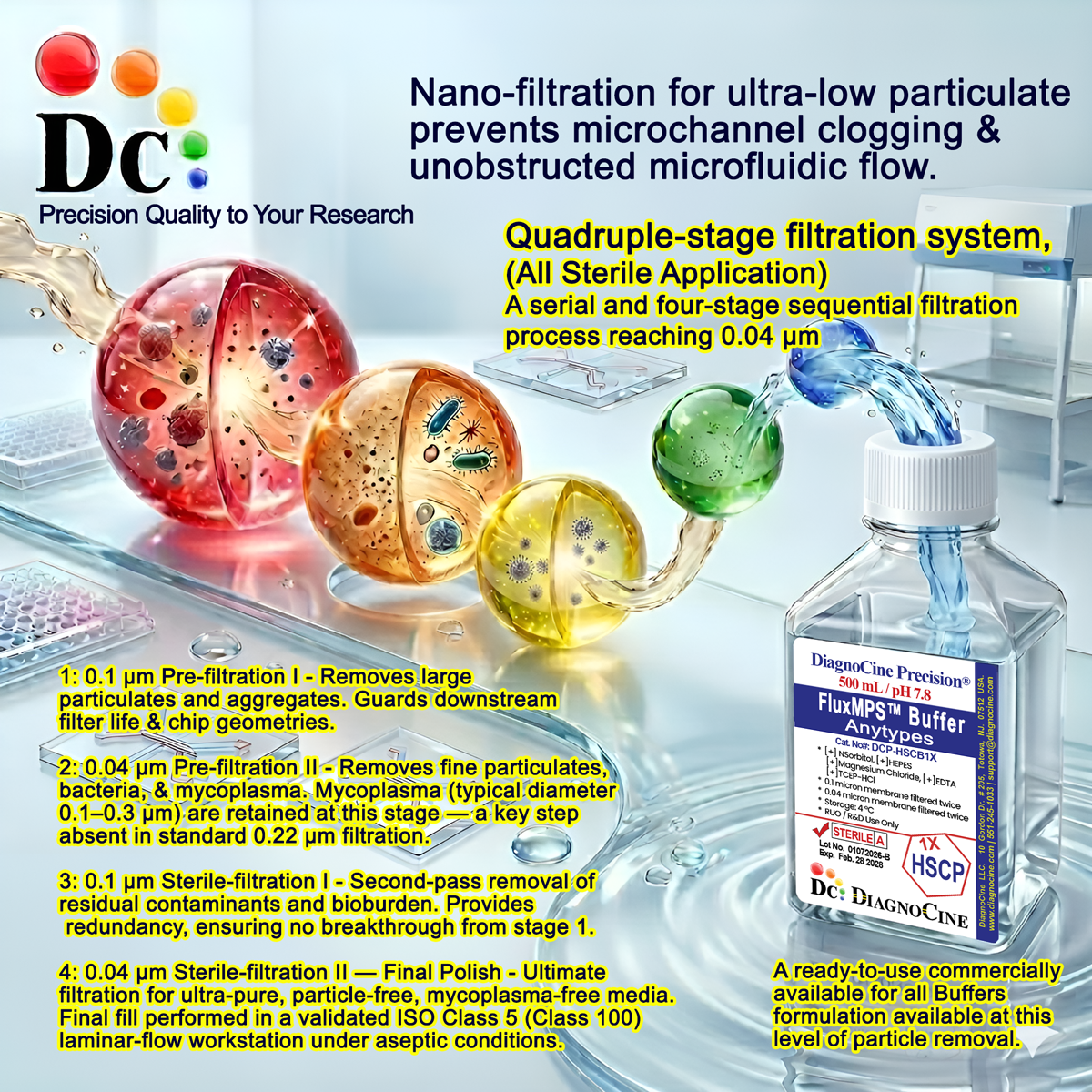
Quadruple-stage filtration system
Every lot of DCP-PICTNP1X passes through four sequential filtration stages — 0.1 µm membrane filtration twice and 0.04 µm membrane filtration twice — delivering microchannel-safe, ultra-low particulate lysis buffer for sensitive protein extraction workflows.
- 1
0.1 µm
Pre-filtration I
Removes large particulates and aggregates, extending the service life of downstream filters.
- 2
0.04 µm
Pre-filtration II
Retains fine particulates and bioburden ahead of final sterile filtration.
- 3
0.1 µm
Sterile-filtration I
Second-pass redundancy through a 0.1 µm sterile membrane in a controlled environment.
- 4
0.04 µm
Sterile-filtration II — Final Polish
Ultimate polish below the size of the smallest known mycoplasma (approximately 0.2 µm), performed under aseptic ISO Class 5 (Class 100) fill conditions.
Performance vs. conventional buffer
Sequential 0.1 µm and 0.04 µm filtration, applied twice each, removes finer particulates than a single 0.22 µm pass used in conventional lysis buffers — supporting cleaner downstream Western blotting, immunoprecipitation, and enzymatic assay results.
© Diagnocine® — DCP-PICTNP1X
Where DCP-PICTNP1X is used
A ready-to-use NP-40 lysis buffer with integrated protease inhibitors, suited to protein extraction, cell lysis, and downstream protein analysis across research settings, including microfluidic and organ-on-a-chip platforms.
Automated Bioreactors & Robotics
An optional 0.01 µm (10 nm) ultra-filtered variant of this lysis buffer is available for automated bioreactor and robotic liquid-handling systems where valve and sensor protection is critical.
- Total Particulate Exclusion for closed-system automated lysis workflows
- Valve & Sensor Protection in robotic liquid handlers
- Extended Perfusion Stability for continuous-flow protein extraction setups
Inquiry Required: contact support@diagnocine.com to request the 0.01 µm ultra-filtered grade.
Micro Physiological System (MPS) & Chip
Compatible with lysis and protein recovery steps in microfluidic and organ-on-a-chip platforms.
Cell Lysis & Protein Extraction
NP-40 solubilizes cytoplasmic and membrane-associated proteins while the inhibitor cocktail prevents degradation.
iPSC-Derived Model Handling
Preserves protein integrity during lysis of iPSC-derived cell models for downstream analysis.
Endothelial & Primary Cell Perfusion
Effective for animal, plant, and select microbial samples in vascular and primary cell research.
Western Blotting & Immunoprecipitation
Maintains protein-protein interactions required for immunoprecipitation and clean Western blot signal.
Enzymatic Assays & Optical Sensing
Low-background lysate supports enzymatic assays and optical/biosensor-based readouts.
DCP-PICTNP1X specifications
Measured and declared values for the FluxMPS™ Protease Inhibitor Cocktail with NP-40 Buffer.
| Parameter | Specification |
|---|---|
| Formulation | Tris-buffered saline with NP-40 detergent and a broad-spectrum protease inhibitor cocktail |
| Appearance | Clear solution |
| Tris-base molarity | 50 mM |
| Sodium Chloride molarity | 150 mM |
| NP-40 detergent content | 1% |
| Parameter | Specification |
|---|---|
| Sterility USP <71> | Filtered 0.1 µm membrane twice and 0.04 µm membrane twice in a sterile environment |
| DNase activity | None detected (plasmid DNA, 18 hours, room temperature) |
| RNase activity | None detected (ribosomal RNA, 18 hours, room temperature) |
| Water quality | Ultrapure Type 1 water (18.2 MΩ·cm) USP <85> |
| Manufacturing standard ISO 13485 | ISO 13485-certified, CE-approved facilities |
| Parameter | Specification |
|---|---|
| Storage temperature | -80°C |
| Shelf life | 3 months |
| Parameter | Specification |
|---|---|
| Manufacturing facility | ISO 13485-certified, CE-approved (Suppliers of DiagnoCine Precision) |
| QA & testing location | DiagnoCine R&D and Quality Testing Center |
| Customization & assembly location | DiagnoCine Precision, Totowa, New Jersey, USA |
| Intended use | Research Use Only (RUO) |
Full composition
Every component and concentration in the DCP-PICTNP1X formulation, as released.
| Component | CAS Number | Concentration |
|---|---|---|
| AEBSF.HCl | 30827-99-7 | 100 uM |
| Aprotinin | 9087-70-1 | 0.8 uM |
| Bestatin | 58970-76-6 | 0.05 mM |
| E-64 | 66701-25-5 | 1 uM |
| EDTA | 60-00-4 | 5 mM |
| Leupeptin | 103476-89-7 | 0.01 mM |
| Pepstatin A | 26305-03-3 | 1 uM |
| NP-40 | 9016-45-9 | 1% |
| Tris-base | 77-86-1 | 50 mM |
| Sodium Chloride | 7647-14-5 | 150 mM |
Manufacturing & compliance
DCP-PICTNP1X is manufactured, tested, and packaged under a controlled quality system spanning multiple facilities.
ISO 13485:2016 QMS
Manufactured under ISO 13485-certified and CE-approved supplier facilities.
Ultrapure Type 1 Water
Formulated with Ultrapure Type 1 water (18.2 MΩ·cm).
ISO Class 5 Fill & Finish
Final sterile filtration and fill performed under aseptic ISO Class 5 (Class 100) conditions.
Micro-Batch Precision
All specific customization requests and assembly completed at DiagnoCine Precision in Totowa, New Jersey, USA.
Sterility & Filtration USP <71>
Filtered 0.1 µm membrane twice and 0.04 µm membrane twice in a sterile environment.
DNase / RNase Release QC Tested
No DNase or RNase activity detected after 18-hour room-temperature incubation.
Appearance & Formulation
Released as a clear solution with defined Tris-base, Sodium Chloride, and NP-40 content.
Documentation / CoA
Certificate of Analysis available for this lot.
How DCP-PICTNP1X compares
FluxMPS™ quadruple-stage filtration versus conventional protease inhibitor lysis buffers.
| Parameter | DCP-PICTNP1X (FluxMPS™) | Conventional Lysis Buffer (0.22 µm filtered) | Standard Alternative (0.22 µm filtered) |
|---|---|---|---|
| Final filtration pore size | 0.04 µm | 0.22 µm | 0.22 µm |
| Number of filtration stages | 4 | 1 | 1 |
| Integrated protease inhibitor cocktail | check_circle | cancel | cancel |
| DNase / RNase tested | check_circle | cancel | check_circle |
| Water quality | Ultrapure Type 1 (18.2 MΩ·cm) | Not specified | Not specified |
| Manufacturing QMS | ISO 13485:2016 | Not specified | Not specified |
| Microfluidic channel compatibility | check_circle | cancel | cancel |
| Custom formulation | check_circle | cancel | cancel |
Frequently asked questions
Common questions about DCP-PICTNP1X.
Supporting literature
Curated literature relevant to protease inhibitor cocktails, NP-40 lysis, and microfluidic protein extraction.
- Ingham, K.C. Protease inhibitors in cell lysis and protein purification. Methods Enzymol.doi:10.1016/0076-6879(90)82018-w
- Powers, J.C., et al. Irreversible inhibitors of serine, cysteine, and threonine proteases. Chem. Rev.doi:10.1021/cr010182v
- Ausubel, F.M., et al. Current Protocols in Molecular Biology: Cell Lysis and Protein Extraction.doi:10.1002/0471142727
- Umezawa, H., et al. Bestatin, an inhibitor of aminopeptidase B, produced by actinomycetes. J. Antibiot.doi:10.7164/antibiotics.29.97
- Barrett, A.J., Kembhavi, A.A. E-64 as a cysteine protease inhibitor. Biochem. J.doi:10.1042/bj2010271
- Huang, Y., et al. Organ-on-a-chip microdevices for protein and biomarker analysis. Lab Chip.doi:10.1039/c7lc00810d
- Bollag, D.M., et al. Protein Methods: Cell Lysis and Extraction Techniques.doi:10.1002/9780470119825
- Green, M.R., Sambrook, J. Molecular Cloning: Preparation of Cell Lysates for Western Blotting.doi:10.1101/pdb.top093450
- Zaman, S., et al. Microfluidic platforms for high-purity biological reagent handling. Anal. Chem.doi:10.1021/acs.analchem.9b02967
- Beynon, R.J., Bond, J.S. Proteolytic Enzymes: A Practical Approach.doi:10.1093/oso/9780199636387.001.0001