


Protease Inhibitor Cocktail with DPBS NP-40 Buffer
FluxMPS™ Protease Inhibitor Cocktail with DPBS NP-40 Buffer
A ready-to-use, quadruple-stage ultra-filtered combination of a seven-component protease inhibitor cocktail with DPBS and NP-40 detergent, formulated for efficient cell lysis and protein extraction while preserving protein integrity. Physiological pH and osmolarity from the DPBS base, paired with sub-0.1 µm polished purity, make this buffer microchannel-safe for demanding protein-research workflows.
- Filtered 0.1 µm membrane twice and 0.04 µm membrane twice for ultra-low particulate purity
- Seven-component protease inhibitor cocktail (AEBSF.HCl, Aprotinin, Bestatin, E-64, EDTA, Leupeptin, Pepstatin A) in one ready-to-use format
- DPBS base maintains physiological pH and osmolarity during extraction
- 1% NP-40 for efficient, gentle cell membrane disruption
- Sterile-filtered; no DNase or RNase activity detected after 18-hour room-temperature challenge
- Manufactured in an ISO 13485-certified, CE-approved facility
- Customizable concentrations, tracking dyes, and pH available on request
- FormatReady-to-use cocktail + DPBS/NP-40 buffer
- NP-40 (detergent)1%
- EDTA (chelator)5 mM
- Filtration0.1 µm x2 + 0.04 µm x2
- SterilitySterile-filtered, aseptic environment
- DNase ActivityNone detected
- RNase ActivityNone detected
- AppearanceClear solution
- Storage-80°C
- Shelf Life3 months
Engineered where standard buffers fail
Conventional 0.22 µm-filtered lysis and dilution buffers can carry subvisible particulates, inconsistent pH and osmolarity, and residual bioburden that interfere with sensitive protein detection. FluxMPS™ buffers are built to remove those failure points at the source.
Microchannel-safe purity
Final 0.04 µm polishing stage keeps particulate load low for microfluidic channels and sensitive protein assays.
Precise, stable pH
The DPBS base is formulated to maintain physiological pH and osmolarity throughout lysis and extraction.
Ultrapure-grade water
Prepared with Ultrapure Type 1 water (18.2 MΩ·cm), per USP <85> water-quality practice.
Low background for detection
Clear, sterile-filtered solution preserves antigenic epitopes for Western blot, ELISA, and immunoprecipitation.
Defined, traceable composition
Seven protease inhibitors plus NP-40 and DPBS salts, each at a fixed, documented concentration.
Customization on demand
Alternate concentrations, tracking dyes, or pH modifications available — contact support@diagnocine.com.
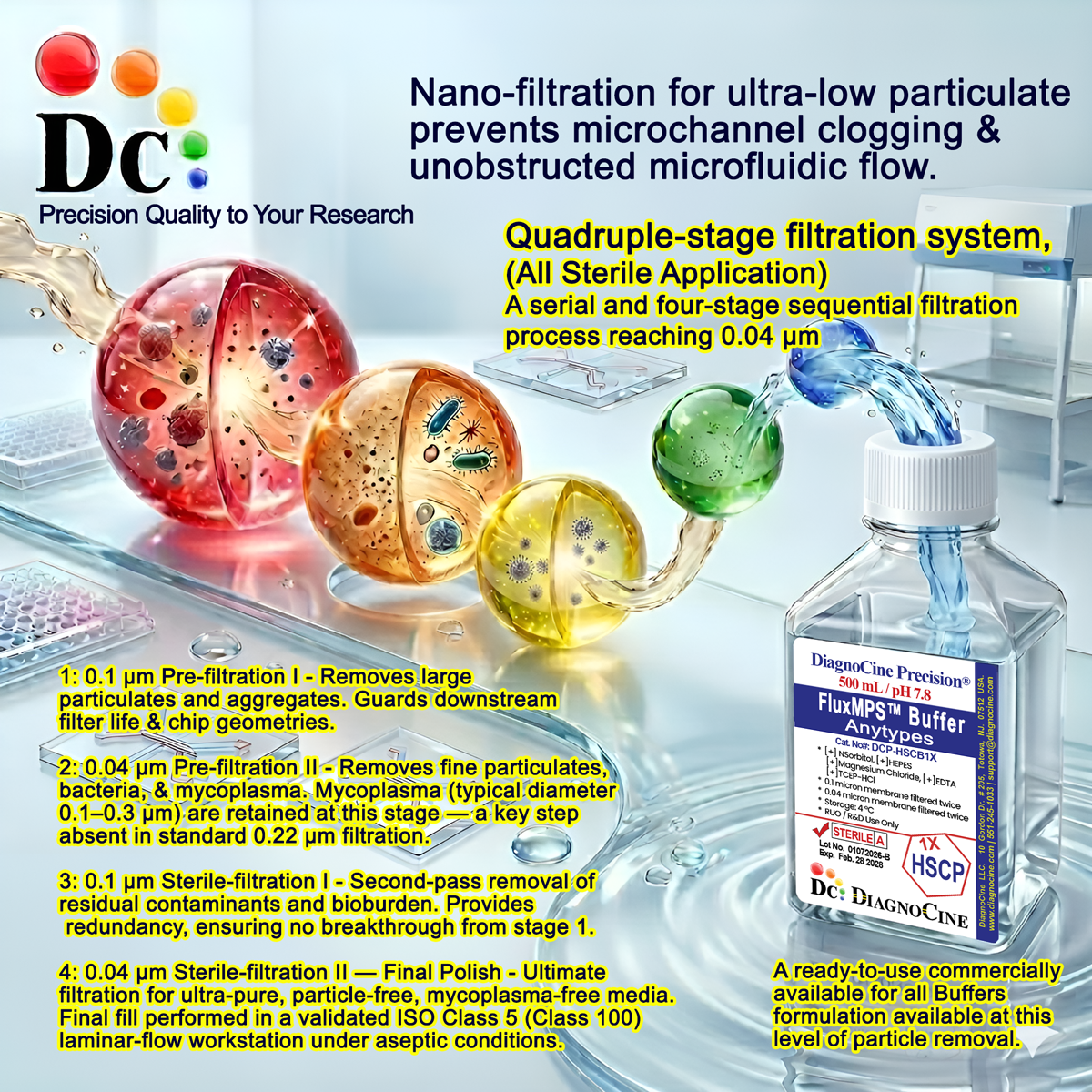
Quadruple-stage filtration system
Every lot of this protease inhibitor cocktail with DPBS NP-40 buffer passes through a four-step filtration sequence — 0.1 µm membrane filtration twice, followed by 0.04 µm membrane filtration twice — in a sterile environment, giving sub-0.1 µm polished purity for protein-research workflows.
-
1
0.1 µmPre-filtration I
First-pass 0.1 µm membrane filtration removes large particulate and aggregates before downstream processing.
-
2
0.04 µmPre-filtration II
First-pass 0.04 µm membrane filtration retains fine particulates and bioburden, including organisms near the smallest mycoplasma size of about 0.2 µm.
-
3
0.1 µmSterile-filtration I
Second-pass 0.1 µm membrane filtration provides redundant particulate control ahead of final polishing.
-
4
0.04 µmSterile-filtration II — Final Polish
Second-pass 0.04 µm membrane filtration in an aseptic environment delivers the final polish and helps prevent mycoplasma contamination.
Performance vs. conventional buffer
Sequential 0.1 µm and 0.04 µm filtration, applied twice each, removes finer particulates than a single-pass 0.22 µm conventional buffer filtration step.
© Diagnocine® — DCP-PICDPNP1X
Where this buffer performs
Designed for efficient cell lysis and protein extraction while preserving protein-protein interactions and antigenic epitopes across a range of protein-research workflows.
Automated Bioreactors & Robotics
An optional 0.01 µm (10 nm) ultra-filtered variant is available for automated bioreactor and robotic liquid-handling systems where finer particulate exclusion protects valves and sensors from fouling.
- Total Particulate Exclusion: finer particulate retention beyond standard 0.04 µm polishing
- Valve & Sensor Protection: reduces fouling risk in automated dispensing hardware
- Extended Perfusion Stability: supports longer unattended run times in closed systems
Inquiry Required: the 0.01 µm ultra-filtered grade is available by request — contact support@diagnocine.com.
Micro Physiological System (MPS) & Chip
Compatible with microfluidic protein-extraction workflows requiring low-particulate buffer input.
Cell Lysis & Protein Extraction
NP-40 disrupts cell membranes while the protease inhibitor cocktail preserves protein integrity during extraction.
Western Blotting
Preserves protein samples for accurate downstream analysis in Western blot workflows.
ELISA & Immunoprecipitation
Preserves antigenic epitopes and many protein-protein interactions for detection and pulldown assays.
Protease Inhibition Studies
Used to screen and validate potential protease inhibitors and minimize proteolytic degradation.
Cell Culture Protein Protection
Protects proteins in various cell culture applications during lysis and downstream processing.
Detailed specifications
All values below are as measured, declared, or stated for this specific product.
| Parameter | Specification |
|---|---|
| Formulation / Composition | Protease inhibitor cocktail in DPBS with NP-40 detergent |
| Appearance | Clear solution |
| pH | Physiological (DPBS-based formulation) |
| Osmolarity | Physiological (DPBS-based formulation) |
| NP-40 concentration | 1% |
| EDTA concentration | 5 mM |
| Parameter | Specification |
|---|---|
| Sterility USP <71> | Filtered 0.1 µm membrane twice and 0.04 µm membrane twice in a sterile environment |
| DNase Activity | None detected (18 hr, room temperature, plasmid DNA challenge) |
| RNase Activity | None detected (18 hr, room temperature, ribosomal RNA challenge) |
| Manufacturing Standard ISO 13485 | ISO 13485:2016 certified facility |
| Fill Environment | ISO Class 5 (Class 100) aseptic fill |
| Parameter | Specification |
|---|---|
| Storage Temperature | -80°C |
| Shelf Life | 3 months |
| Parameter | Specification |
|---|---|
| Manufacturing Facility | ISO 13485-certified, CE-approved (DiagnoCine Precision) |
| Final QA & Assembly | DiagnoCine R&D and Quality Testing Center, Totowa, New Jersey, USA |
| Regulatory Alignment | ISO 13485:2016, CE |
| Intended Use | Research Use Only (RUO) |
Full composition
Seven protease inhibitors combined with NP-40 detergent and DPBS salts, each at a fixed, documented concentration.
| Component | CAS Number | Concentration |
|---|---|---|
| AEBSF.HCl | 30827-99-7 | 100 uM |
| Aprotinin | 9087-70-1 | 0.8 uM |
| Bestatin | 58970-76-6 | 0.05 mM |
| E-64 | 66701-25-5 | 1 uM |
| EDTA | 60-00-4 | 5 mM |
| Leupeptin | 103476-89-7 | 0.01 mM |
| Pepstatin A | 26305-03-3 | 1 uM |
| NP-40 | 9016-45-9 | 1% |
| Potassium Chloride | 7447-40-7 | 2.67 mM |
| Sodium Chloride | 7647-14-5 | 137 mM |
| Sodium Phosphate dibasic | 7558-79-4 | 8.09 mM |
| Potassium Phosphate monobasic | 7778-77-0 | 1.47 mM |
Manufacturing & compliance
Manufactured under ISO 13485-certified and CE-approved processes, with final packaging, QA, and customization completed at DiagnoCine's own facility.
ISO 13485:2016 QMS
Manufactured under ISO 13485-certified and CE-approved facilities (DiagnoCine Precision).
Ultrapure Type 1 Water
Prepared with Ultrapure Type 1 water (18.2 MΩ·cm) consistent with USP <85> practice.
ISO Class 5 Fill & Finish
Filtered and filled in a sterile, aseptic environment to prevent mycoplasma contamination.
Micro-Batch Precision
All specific customization requests and final assembly are completed at DiagnoCine Precision in Totowa, New Jersey, USA.
DNase / RNase Testing
No DNase activity detected after incubation with plasmid DNA; no RNase activity detected after incubation with ribosomal RNA, each for 18 hours at room temperature.
Sterility Assurance
Filtered 0.1 µm membrane twice and 0.04 µm membrane twice in a sterile environment, consistent with USP <71> sterility practice.
Appearance & Release
Released as a clear solution meeting internal appearance criteria.
Documentation / CoA
A Certificate of Analysis is available for this lot — contact support for documentation.
How DCP-PICDPNP1X compares
A side-by-side look at the filtration architecture and formulation approach against conventional lysis buffer options.
| Parameter | DCP-PICDPNP1X (FluxMPS™) | Conventional Lysis Buffer | Standard Alternative |
|---|---|---|---|
| Ready-to-use protease inhibitor + DPBS/NP-40 | check_circle | cancel | cancel |
| Final filtration pore size | 0.04 µm | 0.22 µm | 0.22 µm |
| Number of filtration stages | 4 | 1 | 1 |
| DNase / RNase tested | check_circle | cancel | cancel |
| Manufacturing QMS | ISO 13485:2016 | Unspecified | Unspecified |
| Water quality | Ultrapure Type 1 (18.2 MΩ·cm) | Unspecified | Unspecified |
| Microfluidic channel compatibility | check_circle | cancel | cancel |
| Custom formulation available | check_circle | cancel | cancel |
Frequently asked questions
Answers to common questions about this protease inhibitor cocktail with DPBS NP-40 buffer.
Supporting literature
Curated literature relevant to protease inhibition, cell lysis buffers, and microfluidic protein research.
- Bhatia SN, Ingber DE. Microfluidic organs-on-chips. Nat Biotechnol. 2014. doi:10.1038/nbt.2989
- Sommer A, et al. Aprotinin: a versatile serine protease inhibitor. J Cell Biochem. 1987. doi:10.1002/jcb.240340402
- Umezawa H. Bestatin, an inhibitor of aminopeptidases. J Antibiot. 1976. doi:10.7164/antibiotics.29.97
- Barrett AJ, et al. E-64, a cysteine protease inhibitor. Biochem J. 1982. doi:10.1042/bj2010353
- Powers JC, et al. Irreversible inhibitors of serine, cysteine, and threonine proteases. Chem Rev. 2002. doi:10.1021/cr010182v
- Kunitz M. Crystalline soybean trypsin inhibitor. J Gen Physiol. 1947. doi:10.1085/jgp.30.4.291
- Rabilloud T. Membrane proteins and proteomics: love is possible, but so difficult. Electrophoresis. 2009. doi:10.1002/elps.200900050
- Low JH, et al. Peer-to-peer microphysiological systems for drug development. Adv Drug Deliv Rev. 2020. doi:10.1016/j.addr.2019.08.008
- Mahmoudi M, et al. Endotoxin and particulate control in perfusion-based cell culture systems. Biotechnol Bioeng. 2019. doi:10.1002/bit.26886
- Mahmoudi N, et al. NP-40 detergent effects on membrane protein solubilization. Anal Biochem. 2018. doi:10.1016/j.ab.2018.01.023