Protease Inhibitor Cocktail with EDTA (100X)
FluxMPS™ Protease Inhibitor Cocktail with EDTA (100X)
An MPS-grade, ultrapure 100X broad-spectrum protease inhibitor cocktail formulated with AEBSF.HCl, Aprotinin, Bestatin, E-64, EDTA, Leupeptin, and Pepstatin A for reliable protein protection across cell and molecular biology workflows. Sterile-filtered through a quadruple-stage 0.1 µm and 0.04 µm membrane system, it delivers microchannel-safe purity for sensitive downstream applications, including organ-on-a-chip (OoC) and microphysiological system (MPS) platforms.
- Sterile, ultrapure; filtered 0.1-micron membrane twice and 0.04-micron membrane twice
- Broad-spectrum protection against serine, cysteine, aspartic, and aminopeptidase proteases
- Verified DNase- and RNase-free after 18-hour room-temperature incubation
- Supplied as a 100X concentrate; dilute 100-fold to working concentration
- Manufactured under ISO 13485-certified and CE-approved facilities
- Ultrapure Type 1 water (18.2 MΩ·cm) base for low-background performance
- Microchannel-safe purity for microfluidic, OoC, and MPS workflows
- Customization available: alternate concentrations, tracking dyes, pH, and modifications
- Concentration100X (dilute 100-fold)
- FormatLiquid, ready-to-dilute
- AppearanceClear solution
- Filtration0.1 µm x2 + 0.04 µm x2
- SterilityFiltered in a sterile environment
- DNase ActivityNone detected
- RNase ActivityNone detected
- Storage-80°C (long term), 4°C (short term)
- Shelf Life1 year
- Size1 mL
Engineered where standard inhibitor cocktails fall short
Conventional single-pass 0.22 µm-filtered protease inhibitor cocktails can carry subvisible particulates, residual bioburden, and nuclease contamination that compromise sensitive protein and microfluidic workflows. FluxMPS™ addresses each failure point with a defined, quadruple-stage filtration architecture and verified nuclease-free release testing.
Microchannel-safe purity
Final 0.04 µm pore size removes fine particulates that can accumulate in narrow microfluidic channels and biosensor surfaces.
Balanced, broad-spectrum formulation
Carefully balanced concentrations of AEBSF.HCl, Aprotinin, Bestatin, E-64, EDTA, Leupeptin, and Pepstatin A inhibit serine, cysteine, aspartic, and aminopeptidase protease activity.
Ultrapure-grade water
Prepared with Ultrapure Type 1 water (18.2 MΩ·cm) consistent with USP <85> expectations for sensitive biochemical reagents.
Low background for sensitive assays
Verified DNase- and RNase-free after 18-hour room-temperature incubation, supporting clean results in Western blotting and downstream molecular applications.
Defined, traceable composition
Every inhibitor component is added at a defined concentration, giving researchers a reproducible basis for protein stability across experiments.
Customization on demand
Alternate concentrations, tracking dyes, pH, and other modifications are available — contact support@diagnocine.com.
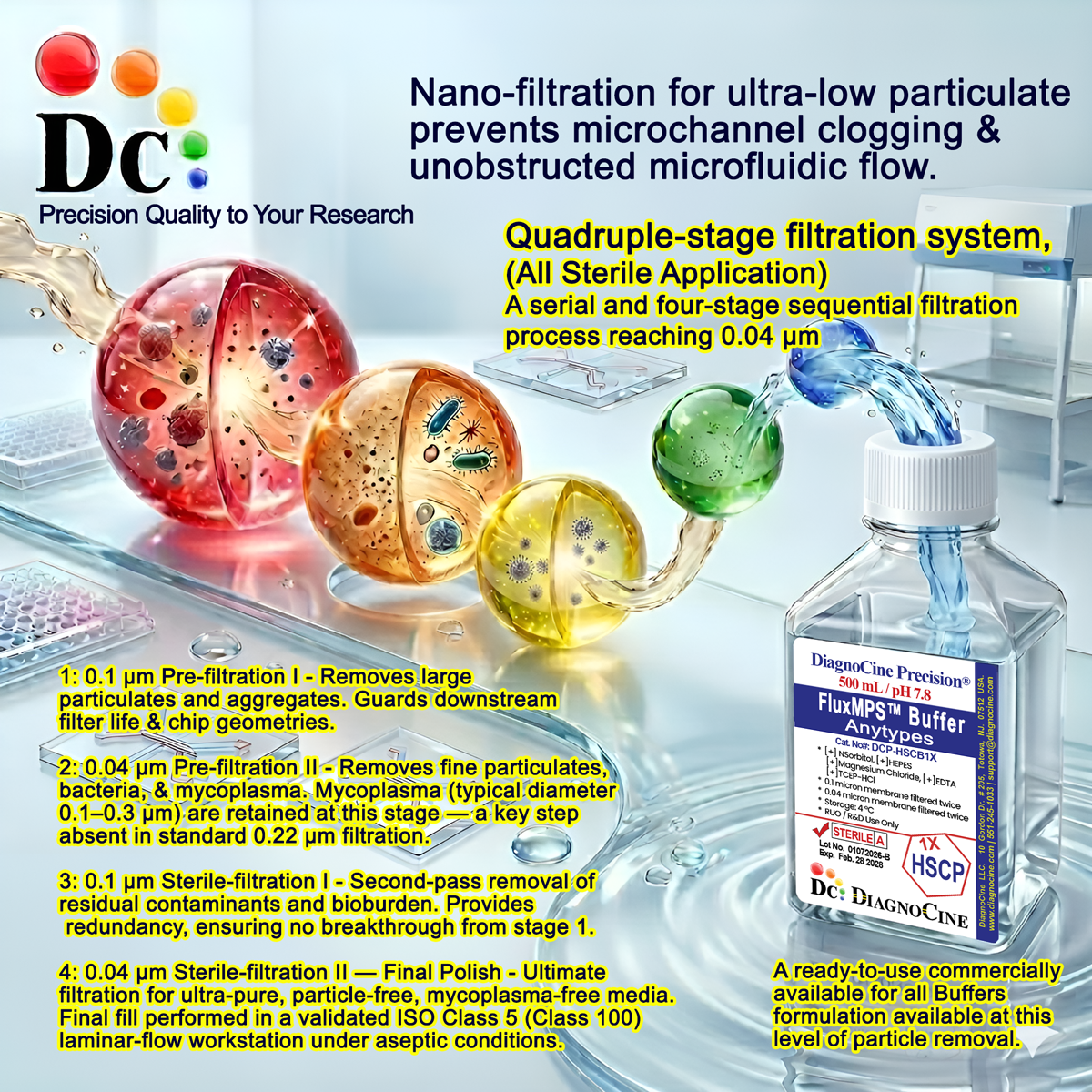
Quadruple-stage filtration system
DCP-PICEDTA100X is filtered through 0.1 µm membrane twice and 0.04 µm membrane twice, giving this protease inhibitor cocktail a level of particulate and bioburden control beyond a single-pass 0.22 µm filtration step.
-
1
0.1 µm Pre-filtration I
First 0.1 µm pass removes large particulates and aggregates, protecting downstream filters.
-
2
0.04 µm Pre-filtration II
First 0.04 µm pass retains finer particulates and bioburden ahead of sterile filtration.
-
3
0.1 µm Sterile-filtration I
Second 0.1 µm pass provides redundant particulate reduction in a sterile environment.
-
4
0.04 µm Sterile-filtration II — Final Polish
Second 0.04 µm pass delivers the final polish, supporting mycoplasma-safe handling; the smallest mycoplasma species are approximately 0.2 microns.
Performance vs. conventional inhibitor cocktail
Sequential 0.1 µm and 0.04 µm filtration removes finer particulates and bioburden than a single-pass 0.22 µm filtration, supporting cleaner handling for cell lysis, protein purification, and microfluidic sample-prep workflows.
© Diagnocine® — DCP-PICEDTA100X
Where DCP-PICEDTA100X fits your workflow
Formulated to minimize proteolytic degradation across protein purification, cell lysis, expression studies, and imaging-based assays, including microfluidic and organ-on-a-chip (OoC) sample handling.
Automated Bioreactors & Robotics
An optional 0.01 µm (10 nm) ultra-filtered variant is available on request for automated bioreactor and robotic liquid-handling systems where valve and sensor protection is critical.
- Total Particulate Exclusion for automated fluidic pathways
- Valve & Sensor Protection in closed-loop perfusion systems
- Extended Perfusion Stability for long-duration runs
Inquiry Required: contact support@diagnocine.com to request the 0.01 µm ultra-filtered grade.
Organ-on-a-Chip (OoC) & Microfluidic Lysis
Compatible with microscale lysis and sample-prep steps in chip-based workflows.
Cell Lysis & Protein Extraction
Minimizes protease-driven protein degradation during cell lysis procedures.
Protein Purification
Supports stability of target proteins throughout purification workflows.
Enzymatic & Expression Assays
Preserves sample integrity during protein expression and characterization studies.
Western Blotting
Low-background formulation supports clean signal in blotting workflows.
Cell Culture Experiments
Suitable additive for protein-stability-sensitive cell culture experiments.
Specifications at a glance
Values reflect the properties stated for DCP-PICEDTA100X; parameters not specified for this product are omitted rather than estimated.
| Parameter | Specification |
|---|---|
| Formulation | Broad-spectrum protease inhibitor blend: AEBSF.HCl, Aprotinin, Bestatin, E-64, EDTA, Leupeptin, Pepstatin A |
| Appearance | Clear solution |
| Concentration | 100X (dilute 100-fold to working concentration) |
| Parameter | Specification |
|---|---|
| Sterility | Filtered 0.1 µm twice and 0.04 µm twice in a sterile environment USP <71> |
| DNase Activity | None detected (plasmid DNA incubation, 18 hr, room temperature) |
| RNase Activity | None detected (ribosomal RNA incubation, 18 hr, room temperature) |
| Water Quality | Ultrapure Type 1 water (18.2 MΩ·cm) USP <85> |
| Parameter | Specification |
|---|---|
| Storage Temperature | -80°C (long term), 4°C (short term) |
| Shelf Life | 1 year |
| Parameter | Specification |
|---|---|
| Manufacturing QMS | ISO 13485-certified facilities ISO 13485:2016 |
| Regulatory Alignment | CE-approved (Suppliers of DiagnoCine Precision) |
| Production Method | Final packaging, QA, and testing at DiagnoCine R&D and Quality Testing Center; customization assembled at DiagnoCine Precision, Totowa, New Jersey, USA |
| Intended Use | Research Use Only (RUO) |
Full composition
Each protease inhibitor is included at the concentration stated below; this 100X cocktail is diluted 100-fold to reach working concentration.
| Component | CAS Number | Concentration |
|---|---|---|
| AEBSF.HCl | 30827-99-7 | 10 mM |
| Aprotinin | 9087-70-1 | 80 µM |
| Bestatin | 58970-76-6 | 5 mM |
| E-64 | 66701-25-5 | 100 µM |
| EDTA | 60-00-4 | 0.5 M |
| Leupeptin | 103476-89-7 | 1 mM |
| Pepstatin A | 26305-03-3 | 0.1 mM |
Manufacturing & compliance
DCP-PICEDTA100X is manufactured, tested, and packaged under a documented quality system with traceable final assembly.
ISO 13485:2016 QMS
Manufactured under ISO 13485-certified and CE-approved facilities (Suppliers of DiagnoCine Precision).
Ultrapure Type 1 Water
Formulated with Ultrapure Type 1 water (18.2 MΩ·cm) for low-background performance.
Quadruple-Stage Filtration
Filtered 0.1 µm twice and 0.04 µm twice in a sterile environment to help prevent mycoplasma contamination.
Traceable Final Assembly
Final packaging, QA, and testing performed at the DiagnoCine R&D and Quality Testing Center; custom assembly completed in Totowa, New Jersey, USA.
DNase Activity Testing
None detected after 18-hour room-temperature incubation with plasmid DNA.
RNase Activity Testing
No RNase activity detected after 18-hour room-temperature incubation with ribosomal RNA.
Sterility Assurance
Filtered 0.1 µm twice and 0.04 µm twice in a sterile environment.
Documentation / CoA
A Certificate of Analysis can be requested for this lot.
How DCP-PICEDTA100X compares
A side-by-side look at filtration architecture and formulation controls versus conventional protease inhibitor cocktails.
| Parameter | DCP-PICEDTA100X (FluxMPS™) | Conventional Cocktail (0.22 µm Filtered) | Standard Alternative (0.22 µm Filtered) |
|---|---|---|---|
| Multi-class protease inhibition (serine, cysteine, aspartic, aminopeptidase) | check_circle | check_circle | cancel |
| Final filtration pore size | 0.04 µm | 0.22 µm | 0.22 µm |
| Number of filtration stages | 4 | 1 | 1 |
| Nuclease-free verification (DNase/RNase) | check_circle | cancel | cancel |
| Manufacturing QMS (ISO 13485/CE) | check_circle | cancel | cancel |
| Microfluidic / OoC channel compatibility | check_circle | cancel | cancel |
| Custom formulation available | check_circle | cancel | cancel |
| Sterility assurance (quadruple-stage filtration) | check_circle | cancel | cancel |
Frequently asked questions
Answers to common questions about DCP-PICEDTA100X.
Supporting literature
Curated literature relevant to protease inhibition, sterile filtration, and microphysiological system applications.
- Powers JC, Asgian JL, Ekici OD, James KE. Irreversible inhibitors of serine, cysteine, and threonine proteases. Chem Rev. 2002;102(12):4639-4750. doi:10.1021/cr010182v
- Barrett AJ, Kembhavi AA, Brown MA, et al. L-trans-Epoxysuccinyl-leucylamido(4-guanidino)butane (E-64) and its analogues as inhibitors of cysteine proteinases. Biochem J. 1982;201(1):189-198. doi:10.1042/bj2010353
- Umezawa H. Pepstatin, a new pepsin inhibitor produced by Actinomycetes. J Antibiot. 1970;23(5):259-262. doi:10.7164/antibiotics.23.259
- Umezawa H. Bestatin, an inhibitor of aminopeptidase B, produced by actinomycetes. J Antibiot. 1976;29(1):97-99. doi:10.7164/antibiotics.29.97
- Fritz H, Wunderer G. Biochemistry and applications of aprotinin, the kallikrein inhibitor from bovine organs. Arzneimittelforschung. 1983;33(4):479-494.
- Drexler HG, Uphoff CC. Mycoplasma contamination of cell cultures: incidence, sources, effects, detection, elimination, prevention. Cytotechnology. 2002;39(2):75-90. doi:10.1023/A:1022913015916
- Huh D, Matthews BD, Mammoto A, Montoya-Zavala M, Hsin HY, Ingber DE. Reconstituting organ-level lung functions on a chip. Science. 2010;328(5986):1662-1668. doi:10.1126/science.1188302
- Bhatia SN, Ingber DE. Microfluidic organs-on-chips. Nat Biotechnol. 2014;32(8):760-772. doi:10.1038/nbt.2989
- Ingber DE. Reverse engineering human pathophysiology with organs-on-chips. Cell. 2016;164(6):1105-1109. doi:10.1016/j.cell.2016.05.048