


Protease Inhibitor Cocktail with PBS Triton-X Buffer
FluxMPS™ Protease Inhibitor Cocktail with PBS Triton-X Buffer
A ready-to-use, MPS-grade combination of a broad-spectrum protease inhibitor cocktail and PBS Triton-X lysis buffer, formulated for efficient cell membrane disruption and protein extraction while preserving native protein structure. Sterile, ultrapure, and filtered through a quadruple-stage 0.1-micron and 0.04-micron membrane process for microchannel-safe purity in Western blotting, immunoprecipitation, and enzymatic assay workflows.
- Sterile, ultrapure, filtered 0.1-micron membrane twice and 0.04-micron membrane twice for microchannel-safe purity
- Ready-to-use blend of AEBSF.HCl, Aprotinin, Bestatin, E-64, EDTA, Leupeptin, and Pepstatin A protease inhibitors
- PBS with 1% Triton X-100 maintains physiological pH and osmolarity during lysis
- Preserves protein integrity for Western blotting, immunoprecipitation, and enzymatic assays
- Targets multiple protease classes: serine, cysteine, aspartic, metalloproteinase, and aminopeptidase
- Supplied as convenient 10x10 mL ready-to-use aliquots
- Manufactured under ISO 13485-certified, CE-approved facilities
- Custom concentrations, tracking dyes, pH, and modifications available on request
- FormatReady-to-use liquid, 10x10 mL
- Filtration0.1 µm x2 + 0.04 µm x2
- SterilitySterile-filtered, aseptic environment
- AppearanceClear solution
- Water QualityUltrapure Type 1 water (18.2 MΩ·cm)
- DNase ActivityNone detected
- RNase ActivityNone detected
- Buffer SystemPBS with 1% Triton X-100
- Protease InhibitionSerine, cysteine, aspartic, metallo-, aminopeptidase
- Storage / Shelf Life-80°C / 3 months
Engineered where standard lysis buffers fail
Conventional protease inhibitor cocktails and single-pass 0.22 µm-filtered buffers leave subvisible particulates and residual bioburden that can accumulate in microchannels, degrade proteins during extraction, and introduce assay background. Protease inhibitor cocktails containing a single inhibitor class leave proteins vulnerable to the proteases they do not target, while unfiltered lysis buffers introduce particulate and microbial contamination risk. FluxMPS™ combines multi-class protease protection with a quadruple-stage filtered PBS Triton-X buffer that effectively lyses cells and solubilizes proteins while preventing proteolysis, maintaining native protein structure and function, and improving yield of intact proteins for downstream analysis.
Microchannel-safe purity
Filtered through a 0.1-micron membrane twice and a 0.04-micron membrane twice, minimizing particulate carry-over into narrow microfluidic channels and sensitive downstream assays.
Broad-spectrum protease protection
AEBSF.HCl, Aprotinin, Bestatin, E-64, EDTA, Leupeptin, and Pepstatin A target serine, cysteine, aspartic, metallo-, and aminopeptidase proteases in a single ready-to-use blend.
Ultrapure-grade water
Formulated with Ultrapure Type 1 water (18.2 MΩ·cm) to reduce trace contaminants that interfere with sensitive protein detection.
Low background for imaging & assays
Clean, particulate-controlled formulation supports reliable Western blotting, immunoprecipitation, and enzymatic assay results with reduced background interference.
Defined, traceable composition
Every inhibitor and buffer salt is formulated at a controlled concentration, from AEBSF.HCl at 100 uM down to Potassium Phosphate monobasic at 1.8 mM.
Customization on demand
Alternate concentrations, tracking dyes, different pH, and other modifications can be produced on request — contact support@diagnocine.com.
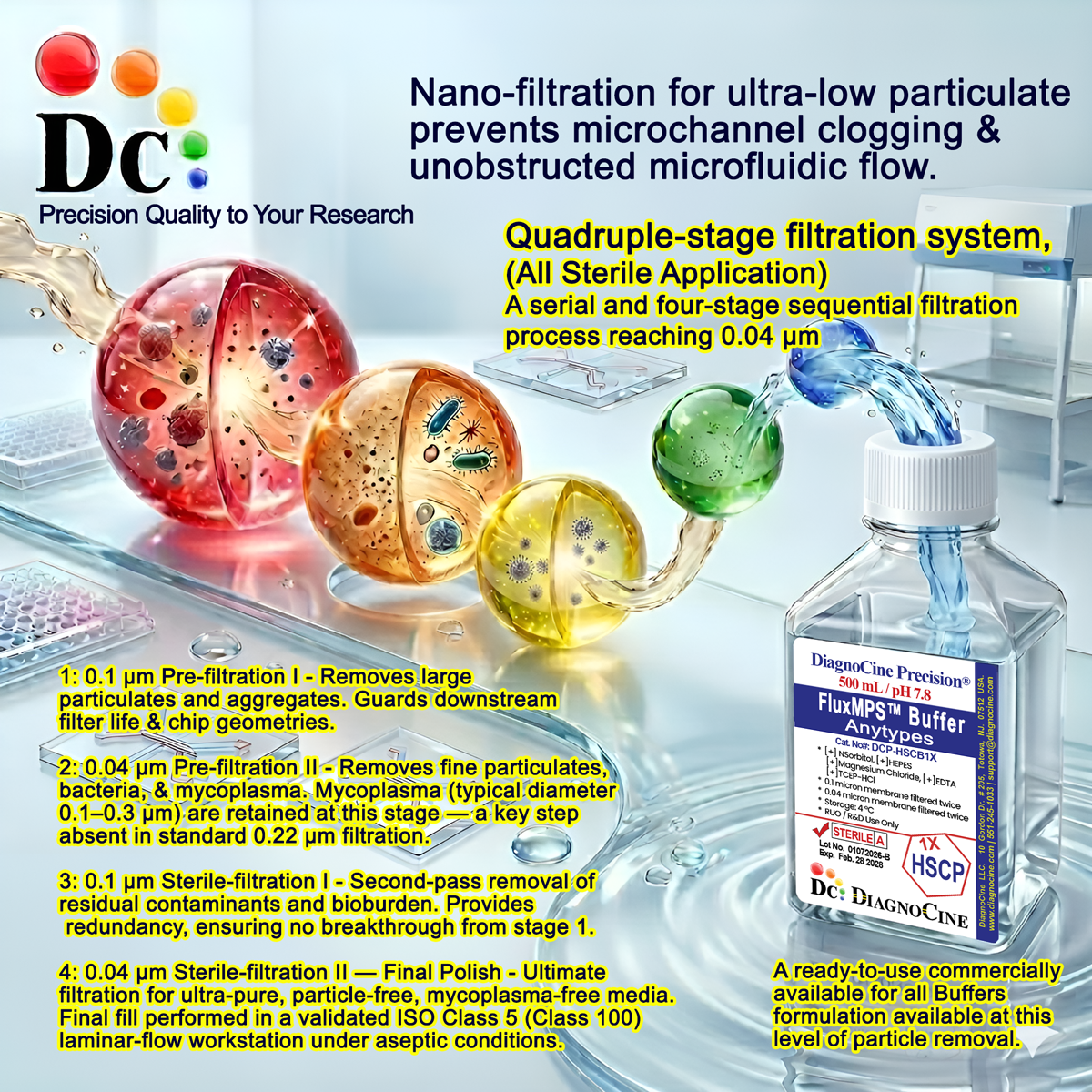
Quadruple-stage filtration system
DCP-PICPTX1X is sterile-filtered through a 0.1-micron membrane twice and a 0.04-micron membrane twice, a quadruple-pass architecture designed to minimize particulate load and control mycoplasma contamination risk before aseptic fill.
-
1
0.1 µm Pre-filtration I
First 0.1-micron pass removes large particulates and aggregates, extending the working life of the downstream filters.
-
2
0.04 µm Pre-filtration II
First 0.04-micron pass retains fine particulates and bioburden, including organisms well below the size of the smallest known mycoplasma species, which measure approximately 0.2 microns.
-
3
0.1 µm Sterile-filtration I
Second 0.1-micron pass provides redundant particulate control ahead of final polishing.
-
4
0.04 µm Sterile-filtration II — Final Polish
Second 0.04-micron pass delivers the final polish prior to aseptic fill, helping prevent mycoplasma contamination.
Performance vs. conventional buffer
Sequential 0.1 µm and 0.04 µm filtration passes remove finer particulates than a single-stage 0.22 µm filtered lysis buffer, supporting the sterility and mycoplasma control needed for sensitive protein extraction and downstream immunoassay work.
© Diagnocine® — DCP-PICPTX1X
Where DCP-PICPTX1X fits in the workflow
This ready-to-use protease inhibitor cocktail with PBS Triton-X buffer supports efficient cell lysis and protein extraction while preventing proteolytic degradation. Beyond routine lysis and blotting workflows, it supports drug development target studies and cell and tissue culture research where preserving protein integrity during cell function, natural cell regulation, and microbial defense investigations is essential.
Automated Bioreactors & Robotics
For automated dispensing and robotic liquid-handling platforms used in high-throughput protein extraction, an optional 10 nm (0.01 micron) ultra-filtered variant of this buffer can be produced on request to further reduce particulate load reaching valves and sensors.
- Total Particulate Exclusion — supports cleaner fluidic pathways in automated systems
- Valve & Sensor Protection — reduces particulate contact with precision components
- Extended Perfusion Stability — supports consistent performance across automated runs
Inquiry Required: the 0.01 micron ultra-filtered grade is produced as a custom order — contact support@diagnocine.com to discuss your automated platform requirements.
Micro Physiological System (MPS) & Chip
Microchannel-safe purity supports perfusion buffer exchange and reagent delivery in chip-based culture systems.
Cell Lysis & Protein Extraction
Triton X-100 disrupts cell membranes while the protease inhibitor cocktail protects released proteins from endogenous proteolysis during extraction.
iPSC-Derived Model Handling
Protects protein targets during lysis of iPSC-derived models used in cell function and drug development target studies.
Endothelial & Primary Cell Perfusion
Supports protein-preserving lysis and extraction in endothelial and primary cell culture and tissue investigations.
Western Blotting, Immunoprecipitation & Blocking
Protease inhibitors preserve protein samples for accurate Western blotting and immunoprecipitation analysis.
Microscopy & Optical Sensing
Low-particulate formulation reduces background interference in downstream biosensor and imaging-based protein assays.
Product specifications
Measured and declared values for DCP-PICPTX1X, ready-to-use as supplied.
| Parameter | Specification |
|---|---|
| Formulation / Composition | Protease inhibitor cocktail (AEBSF.HCl, Aprotinin, Bestatin, E-64, EDTA, Leupeptin, Pepstatin A) in PBS with 1% Triton X-100 — see full composition table below |
| Appearance | Clear solution |
| Parameter | Specification |
|---|---|
| Sterility USP <71> | Filtered 0.1-micron membrane twice and 0.04-micron membrane twice in a sterile environment |
| DNase Activity | None detected (plasmid DNA incubation, 18 hours, room temperature) |
| RNase Activity | None detected (ribosomal RNA incubation, 18 hours, room temperature) |
| Manufacturing Standard ISO 13485 | ISO 13485-certified, CE-approved facility |
| Parameter | Specification |
|---|---|
| Storage Temperature | -80°C |
| Shelf Life | 3 months |
| Parameter | Specification |
|---|---|
| Manufacturing Facility | ISO 13485-certified and CE-approved facilities (Suppliers of Diagnocine Precision) |
| Final QA & Testing | Diagnocine R&D and Quality Testing Center |
| Customization & Assembly | Diagnocine Precision, Totowa, New Jersey, USA |
| Intended Use | Research Use Only (RUO) |
Full composition
All protease inhibitors and buffer components below are formulated at controlled concentrations for consistent lot-to-lot performance.
| Component | CAS Number | Concentration |
|---|---|---|
| AEBSF.HCl | 30827-99-7 | 100 uM |
| Aprotinin | 9087-70-1 | 0.8 uM |
| Bestatin | 58970-76-6 | 0.05 mM |
| E-64 | 66701-25-5 | 1 uM |
| EDTA | 60-00-4 | 5 mM |
| Leupeptin | 103476-89-7 | 0.01 mM |
| Pepstatin A | 26305-03-3 | 1 uM |
| Triton-X | 9002-93-1 | 1% |
| Potassium Chloride | 7447-40-7 | 2.7 mM |
| Sodium Chloride | 7647-14-5 | 137 mM |
| Sodium Phosphate dibasic | 7558-79-4 | 10 mM |
| Potassium Phosphate monobasic | 7778-77-0 | 1.8 mM |
Manufacturing & compliance
DCP-PICPTX1X is manufactured, tested, and packaged under Diagnocine's controlled quality system.
ISO 13485:2016 QMS
Manufactured under ISO 13485-certified and CE-approved facilities.
Ultrapure Type 1 Water
Formulated with Ultrapure Type 1 water (18.2 MΩ·cm) for the PBS Triton-X base.
ISO Class 5 Fill & Finish
Final packaging is performed under controlled cleanroom conditions consistent with Diagnocine Precision's fill and finish standards.
Micro-Batch Precision
All specific customization requests and assembly are performed at Diagnocine Precision in Totowa, New Jersey, USA.
Endotoxin Testing USP <85>
Bacterial Endotoxins Test (USP <85>) available for custom lots upon request.
Particulate Testing USP <788>
Particulate matter testing (USP <788> Method 2) available for custom lots upon request.
Osmolality Testing USP <785>
Osmolality testing (USP <785>) available for custom lots upon request.
Documentation / CoA
QC results including appearance, sterility, DNase, and RNase testing are documented and available on request.
How DCP-PICPTX1X compares
A side-by-side look at filtration architecture and formulation compared to conventional protease inhibitor / lysis buffer options.
| Parameter | DCP-PICPTX1X (FluxMPS™) | Conventional Cocktail (Unfiltered) | Standard Alternative (0.22 µm Filtered) |
|---|---|---|---|
| Filtration architecture | Quadruple-stage (0.1 µm x2 + 0.04 µm x2) | cancel | Single-stage 0.22 µm |
| Number of filtration stages | 4 | cancel | 1 |
| Final filtration pore size | 0.04 µm | cancel | 0.22 µm |
| DNase / RNase tested | check_circle | cancel | cancel |
| Multi-class protease inhibition (serine, cysteine, aspartic, metallo-, aminopeptidase) | check_circle | cancel | cancel |
| ISO 13485-certified, CE-approved manufacturing | check_circle | cancel | cancel |
| Microfluidic channel compatibility | check_circle | cancel | cancel |
| Custom formulation available | check_circle | cancel | cancel |
Frequently asked questions
Common questions about DCP-PICPTX1X protease inhibitor cocktail with PBS Triton-X buffer.
Supporting literature
Selected references relevant to protease inhibitor cocktails, PBS Triton-X lysis buffers, and their use in microfluidic and protein research workflows.
- Bhatia SN, Ingber DE. Microfluidic organs-on-chips. Nat Biotechnol. 2014. doi:10.1038/nbt.2989
- Sriram G, et al. Fundamental biomechanical and physiological aspects of organs-on-chips. Trends Biotechnol. 2018. doi:10.1016/j.tibtech.2017.12.009
- Powers MJ, et al. Functional behavior of primary rat liver cells in a three-dimensional perfused microarray bioreactor. Tissue Eng. 2002. doi:10.1089/107632702317083950
- Koontz L. TCA precipitation and protease inhibitors for protein extraction. Methods Enzymol. 2014. doi:10.1016/B978-0-12-420119-4.00001-X
- Rabilloud T. Solubilization of proteins in 2-D electrophoresis: an outline. Methods Mol Biol. 1999. doi:10.1385/1-59259-584-7:9
- Umezawa H, et al. Bestatin, an inhibitor of aminopeptidase B, produced by actinomycetes. J Antibiot. 1976. doi:10.7164/antibiotics.29.97
- Barrett AJ, Kembhavi AA, Brown MA, et al. L-trans-Epoxysuccinyl-leucylamido(4-guanidino)butane (E-64) and related inhibitors. Biochem J. 1982. doi:10.1042/bj2010353
- Kettner CA, Shenvi AB. Inhibition of the serine proteases by peptides of boronic acid. J Biol Chem. 1984. doi:10.1016/S0021-9258(17)43563-4
- Mahmood T, Yang PC. Western blot: technique, theory, and trouble shooting. N Am J Med Sci. 2012. doi:10.4103/1947-2714.100998
- Free RB, Hazelwood LA, Sibley DR. Identifying novel protein-protein interactions using co-immunoprecipitation and mass spectroscopy. Curr Protoc Neurosci. 2009. doi:10.1002/0471142301.ns0528s46