Protease Inhibitor Cocktail with DPBS Tween 20 Buffer
FluxMPS™ Protease Inhibitor Cocktail with DPBS Tween 20 Buffer
An MPS-grade, ready-to-use combination of a broad-spectrum protease inhibitor cocktail with DPBS Tween 20 Buffer, quadruple-stage filtered (0.1-micron membrane twice, 0.04-micron membrane twice) for microchannel-safe purity. DPBS delivers physiological pH and ionic strength while 0.1% Tween 20 gently lyses cells and solubilizes proteins, so native protein structure is preserved for downstream analysis.
- Quadruple-stage filtered — 0.1-micron membrane twice and 0.04-micron membrane twice for ultra-clean, microchannel-safe buffer
- Broad-spectrum protease inhibitor cocktail — AEBSF.HCl, Aprotinin, Bestatin, E-64, EDTA, Leupeptin and Pepstatin A protect native protein structure
- DPBS with 0.1% Tween 20 provides physiological pH and ionic strength while lysing cells and solubilizing proteins
- Manufactured with Ultrapure Type 1 water (18.2 MΩ·cm)
- Sterile; DNase- and RNase-free per in-house QC testing
- ISO 13485:2016 certified, CE-approved manufacturing
- Ready-to-use 10x10 mL format for Western blotting, immunoprecipitation, and enzymatic assays
- Custom concentrations, tracking dyes, and pH adjustments available on request
- Size10 x 10 mL
- Filtration0.1 µm x2 + 0.04 µm x2
- AppearanceClear solution
- Storage-80°C
- Shelf Life3 months
- DNase ActivityNone detected
- RNase ActivityNone detected
- Water QualityUltrapure Type 1 (18.2 MΩ·cm)
- ManufacturingISO 13485:2016 / CE-approved
- Intended UseRUO
Engineered where standard protease inhibitor buffers fail
Conventional 0.22 µm-filtered lysis buffers can carry subvisible particulates into microchannels, drift in pH and ionic strength, and introduce assay background. FluxMPS™ addresses each failure mode directly.
Microchannel-safe purity
Quadruple-stage filtration down to a 0.04 µm final pass reduces particulate carryover that can clog or foul microfluidic channels and valves.
Precise, stable pH
DPBS provides the physiological pH and ionic strength background needed to keep extracted proteins in their native conformation during lysis.
Ultrapure-grade water
Formulated with Ultrapure Type 1 water (18.2 MΩ·cm), consistent with USP <85> water-quality expectations.
Low background for downstream assays
Sterile, DNase- and RNase-free formulation minimizes interference in Western blotting, immunoprecipitation, and enzymatic assays.
Defined, traceable composition
Seven protease inhibitors (AEBSF.HCl, Aprotinin, Bestatin, E-64, EDTA, Leupeptin, Pepstatin A) target serine, cysteine, aspartic, and metalloprotease activity in one cocktail.
Customization on demand
Alternate concentrations, tracking dyes, and pH modifications are available — contact support@diagnocine.com.
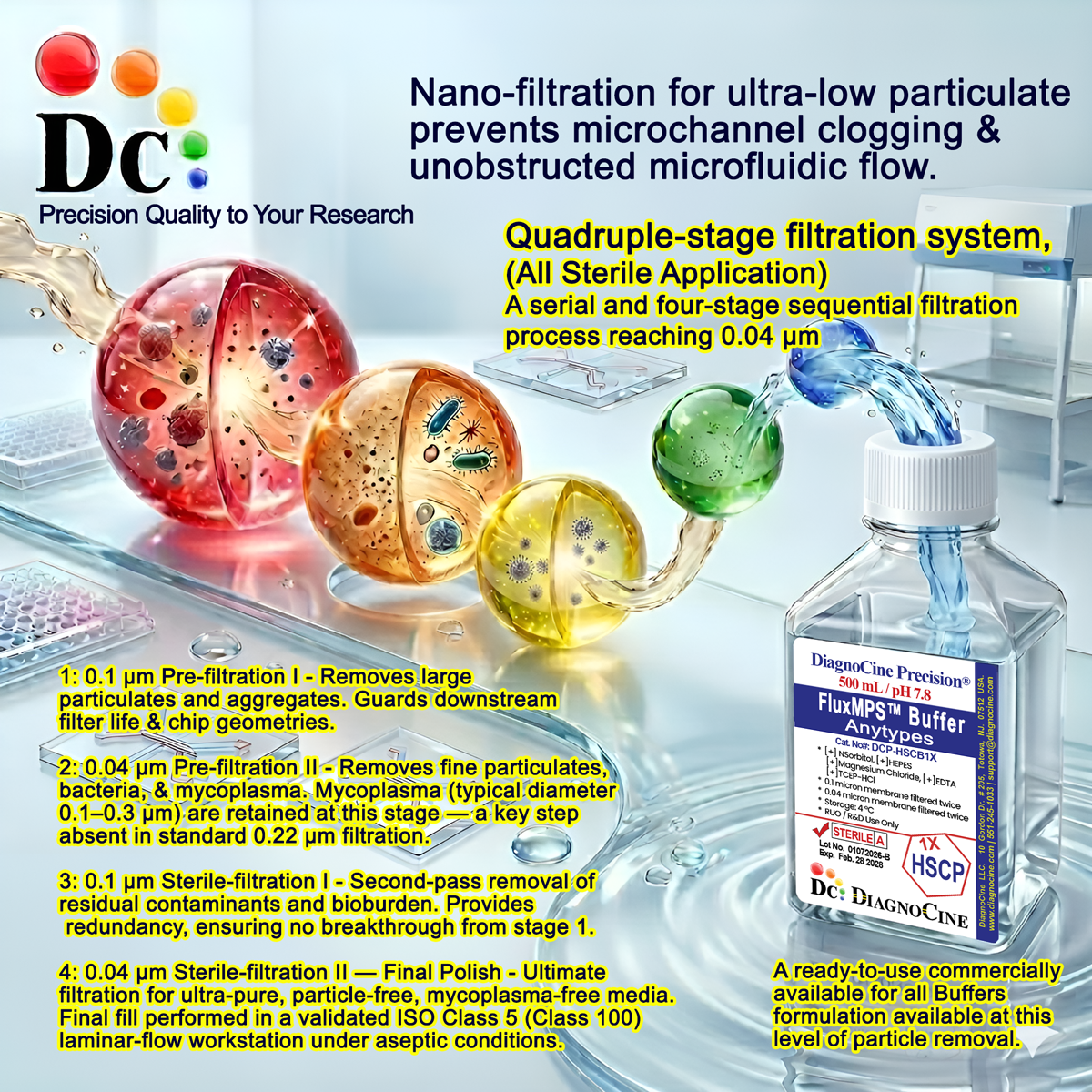
Quadruple-stage filtration system
This buffer is filtered 0.1-micron membrane twice and 0.04-micron membrane twice under sterile conditions, providing four sequential membrane passes before fill.
-
1
0.1 µm Pre-filtration I
Removes large particulates and aggregates, extending the life of downstream filters.
-
2
0.04 µm Pre-filtration II
Retains fine particulates and bioburden ahead of the final sterile passes.
-
3
0.1 µm Sterile-filtration I
A second 0.1 µm pass provides redundant sterile assurance.
-
4
0.04 µm Sterile-filtration II — Final Polish
A second 0.04 µm pass delivers the final polish under ISO Class 5 (Class 100) fill conditions.
Performance vs. conventional buffer
Sequential 0.1 µm and 0.04 µm filtration passes remove finer particulates than a single 0.22 µm pass used in conventional protease inhibitor buffers. The smallest known mycoplasma types measure approximately 0.2 micron, which this final 0.04 µm polish is designed to exclude.
© Diagnocine® — DCP-PICDPT201X
Where this buffer is used
Ready-to-use for cell lysis and protein extraction workflows where preserving native protein structure is essential, from bench assays to microphysiological platforms.
Automated Bioreactors & Robotics
For automated perfusion and robotic liquid-handling platforms, an optional 0.01 µm (10 nm) ultra-filtered variant of this buffer can further protect sensitive valves and sensors.
- Total Particulate Exclusion for closed-loop automated systems
- Valve & Sensor Protection in robotic dispensing lines
- Extended Perfusion Stability for long-running automated protocols
Inquiry Required: the 0.01 µm (10 nm) ultra-filtered grade is available by request — contact support@diagnocine.com.
Micro Physiological System (MPS) & Chip
Quadruple-filtered buffer compatible with microchannel geometries used in tissue and organ-on-a-chip platforms.
Lysis, Wash & Reconstitution
DPBS with 0.1% Tween 20 lyses cells and solubilizes proteins while the inhibitor cocktail prevents proteolytic degradation.
iPSC-Derived Model Handling
Preserves native protein structure during lysis of sensitive iPSC-derived cell models for downstream protein analysis.
Endothelial & Primary Cell Perfusion
Physiological pH and ionic strength support handling of primary and endothelial cell lysates without proteolytic loss.
Western Blotting, IP & Blocking
Protease inhibitors preserve protein samples through lysis, immunoprecipitation, and enzymatic assay workflows.
Microscopy & Optical Sensing
Low-particulate, sterile formulation supports clean backgrounds for on-chip optical readouts.
Specifications at a glance
Values below reflect this product's stated formulation and quality-control results.
| Parameter | Specification |
|---|---|
| Formulation Type | Protease inhibitor cocktail in DPBS with Tween 20 detergent |
| Appearance | Clear solution |
| pH | Physiological (DPBS-based) |
| Detergent Content | 0.1% Tween 20 |
| Size / Format | 10 x 10 mL |
| Parameter | Specification |
|---|---|
| Sterility | Filtered 0.1-micron membrane twice and 0.04-micron membrane twice in a sterile environment USP <71> |
| DNase Activity | None detected after 18-hour incubation with plasmid DNA at room temperature |
| RNase Activity | None detected after 18-hour incubation with ribosomal RNA at room temperature |
| Water Quality | Ultrapure Type 1 water (18.2 MΩ·cm) USP <85> |
| Manufacturing Standard | ISO 13485:2016 certified, CE-approved facilities ISO 13485 |
| Fill Environment | ISO Class 5 (Class 100) |
| Parameter | Specification |
|---|---|
| Storage Temperature | -80°C |
| Shelf Life | 3 months |
| Parameter | Specification |
|---|---|
| Manufacturing QMS | ISO 13485:2016 |
| Regulatory Alignment | CE-approved facilities (Suppliers of DiagnoCine Precision) |
| Production Site | Final packaging, QA, and testing at the DiagnoCine R&D and Quality Testing Center; customization and assembly at DiagnoCine Precision, Totowa, New Jersey, USA |
| Intended Use | Research Use Only (RUO) |
Full composition
Every protease inhibitor and buffer component is listed below with its stated concentration.
| Component | CAS Number | Concentration |
|---|---|---|
| AEBSF.HCl | 30827-99-7 | 100 uM |
| Aprotinin | 9087-70-1 | 0.8 uM |
| Bestatin | 58970-76-6 | 0.05 mM |
| E-64 | 66701-25-5 | 1 uM |
| EDTA | 60-00-4 | 5 mM |
| Leupeptin | 103476-89-7 | 0.01 mM |
| Pepstatin A | 26305-03-3 | 1 uM |
| Component | CAS Number | Concentration |
|---|---|---|
| Tween 20 | 9005-64-5 | 0.1% |
| Potassium Chloride | 7447-40-7 | 2.67 mM |
| Sodium Chloride | 7647-14-5 | 137 mM |
| Sodium Phosphate dibasic | 7558-79-4 | 8.09 mM |
| Potassium Phosphate monobasic | 7778-77-0 | 1.47 mM |
Manufacturing & compliance
Every lot is produced, tested, and released under a documented quality system.
ISO 13485:2016 QMS
Manufactured under ISO 13485-certified, CE-approved supplier facilities.
Ultrapure Type 1 Water
Formulated with 18.2 MΩ·cm water for a low-background buffer base.
ISO Class 5 Fill & Finish
Final fill performed under ISO Class 5 (Class 100) conditions after quadruple-stage filtration.
Micro-Batch Precision
All final packaging, QA, and testing performed at the DiagnoCine R&D and Quality Testing Center; customization assembled in Totowa, New Jersey, USA.
DNase / RNase Testing
No DNase activity detected after 18-hour incubation with plasmid DNA at room temperature; no RNase activity detected after 18-hour incubation with ribosomal RNA at room temperature.
Sterility
Filtered 0.1-micron membrane twice and 0.04-micron membrane twice in a sterile environment, consistent with USP <71> sterility expectations.
Appearance
Released as a clear solution per in-house visual inspection.
Documentation / CoA
A Certificate of Analysis is available for each lot — contact support@diagnocine.com.
How DCP-PICDPT201X compares
A side-by-side look at filtration architecture and formulation traceability.
| Parameter | DCP-PICDPT201X (FluxMPS™) | Conventional protease inhibitor buffer (0.22 µm filtered) | Standard alternative (0.22 µm filtered) |
|---|---|---|---|
| Final filtration pore size | 0.04 µm | 0.22 µm | 0.22 µm |
| Number of filtration stages | 4 | 1 | 1 |
| Protease inhibitor spectrum | Broad-spectrum (serine, cysteine, aspartic, metalloprotease) | Varies by supplier | Varies by supplier |
| DNase / RNase verified | check_circle | cancel | cancel |
| Water quality | Ultrapure Type 1 (18.2 MΩ·cm) | Standard purified water | Standard purified water |
| Manufacturing QMS | ISO 13485:2016 | Not typically certified | Not typically certified |
| Microfluidic / MPS channel compatibility | check_circle | cancel | cancel |
| Custom formulation available | check_circle | cancel | cancel |
Frequently asked questions
Answers to common questions about DCP-PICDPT201X.
Supporting literature
Curated literature relevant to protease inhibitor cocktails, DPBS-based lysis buffers, and microfluidic sample preparation.
- Ingber, D.E. Human organs-on-chips for disease modeling, drug development and personalized medicine. doi:10.1038/s41576-022-00466-9
- Bhattacharya, S. et al. Protease inhibitor cocktails in proteomic sample preparation: a review of practice. doi:10.1002/pmic.201200133
- Towbin, H., Staehelin, T., Gordon, J. Electrophoretic transfer of proteins from polyacrylamide gels to nitrocellulose sheets: procedure and some applications. doi:10.1073/pnas.76.9.4350
- Mahmood, T., Yang, P.C. Western blot: technique, theory, and trouble shooting. doi:10.4103/1947-2714.100998
- Rath, A. et al. Detergent binding explains anomalous SDS-PAGE migration of membrane proteins. doi:10.1073/pnas.0813167106
- Powers, J.C. et al. Irreversible inhibitors of serine, cysteine, and threonine proteases. doi:10.1021/cr010182v
- Rawlings, N.D., Barrett, A.J. Families of aspartic peptidases, and those of unknown catalytic mechanism. doi:10.1016/0076-6879(95)48016-1
- Halder, S.K. et al. Chelating agents as metalloproteinase inhibitors: role of EDTA in protein preservation. doi:10.1016/j.ab.2018.02.002
- Low, L.A. et al. Organs-on-chips: into the next decade. doi:10.1038/s41573-020-0079-3