


Protease Inhibitor Cocktail with Tris Tween 20 Buffer
FluxMPS™ Protease Inhibitor Cocktail with Tris Tween 20 Buffer
A ready-to-use combination of a broad-spectrum protease inhibitor cocktail with Tris-Tween 20 (TBST) buffer, engineered to preserve native protein structure and activity during cell lysis, Western blotting, immunoprecipitation, and enzymatic assays. Built on a Tris-HCl / sodium chloride buffer base with Tween 20 for reduced non-specific binding, and finished through DiagnoCine's quadruple-stage filtration for microchannel-safe purity.
- Quadruple-stage filtration: 0.1 µm membrane twice and 0.04 µm membrane twice
- Ready-to-use protease inhibitor cocktail plus Tris-Tween 20 (TBST) buffer
- Broad-spectrum inhibition of serine, cysteine, aspartic, and metalloproteases
- Formulated with ultrapure Type 1 water (18.2 MΩ·cm)
- Supports Western blotting, immunoprecipitation, cell lysis, and enzymatic assays
- Filtered and sterility-tested in a controlled sterile environment
- Customizable concentrations, pH, and tracking dyes on request
- Manufactured under ISO 13485-certified, CE-approved facilities
- FormatReady-to-use liquid cocktail
- Size10 x 10 mL
- Buffer SystemTris-HCl, 50 mM
- Ionic StrengthSodium Chloride, 150 mM
- DetergentTween 20, 0.1%
- AppearanceClear solution
- Filtration0.1 µm x2 + 0.04 µm x2
- SterilityFiltered in a sterile environment
- Storage-80°C
- Shelf Life3 months
Engineered where standard lysis buffers fail
Conventional 0.22 µm-filtered lysis and wash buffers can carry subvisible particulates, inconsistent lot-to-lot composition, and background-raising contaminants into sensitive protein workflows. FluxMPS™ Protease Inhibitor Cocktail with Tris Tween 20 Buffer is built to remove those failure points at the source.
Microchannel-safe purity
Quadruple-stage filtration — 0.1 µm membrane twice and 0.04 µm membrane twice — polishes the buffer for use in fine-bore tubing and microfluidic channels.
Stable Tris-HCl buffering
A 50 mM Tris-HCl / 150 mM NaCl base maintains a consistent, physiologically relevant buffering environment suited to protein handling and immunoassay steps.
Ultrapure-grade water
Formulated with Type 1 ultrapure water (18.2 MΩ·cm) to minimize background contaminants in downstream assays.
Low background for imaging & assays
Tween 20 reduces non-specific protein-protein interactions, lowering background in Western blotting, immunoprecipitation, and other immunoassays.
Defined, traceable composition
A broad-spectrum inhibitor cocktail combined with Tris-Tween 20 buffer salts, formulated to defined concentrations for reproducible protease inhibition.
Customization on demand
Alternate concentrations, tracking dyes, pH, and other modifications are available on request — contact support@diagnocine.com.
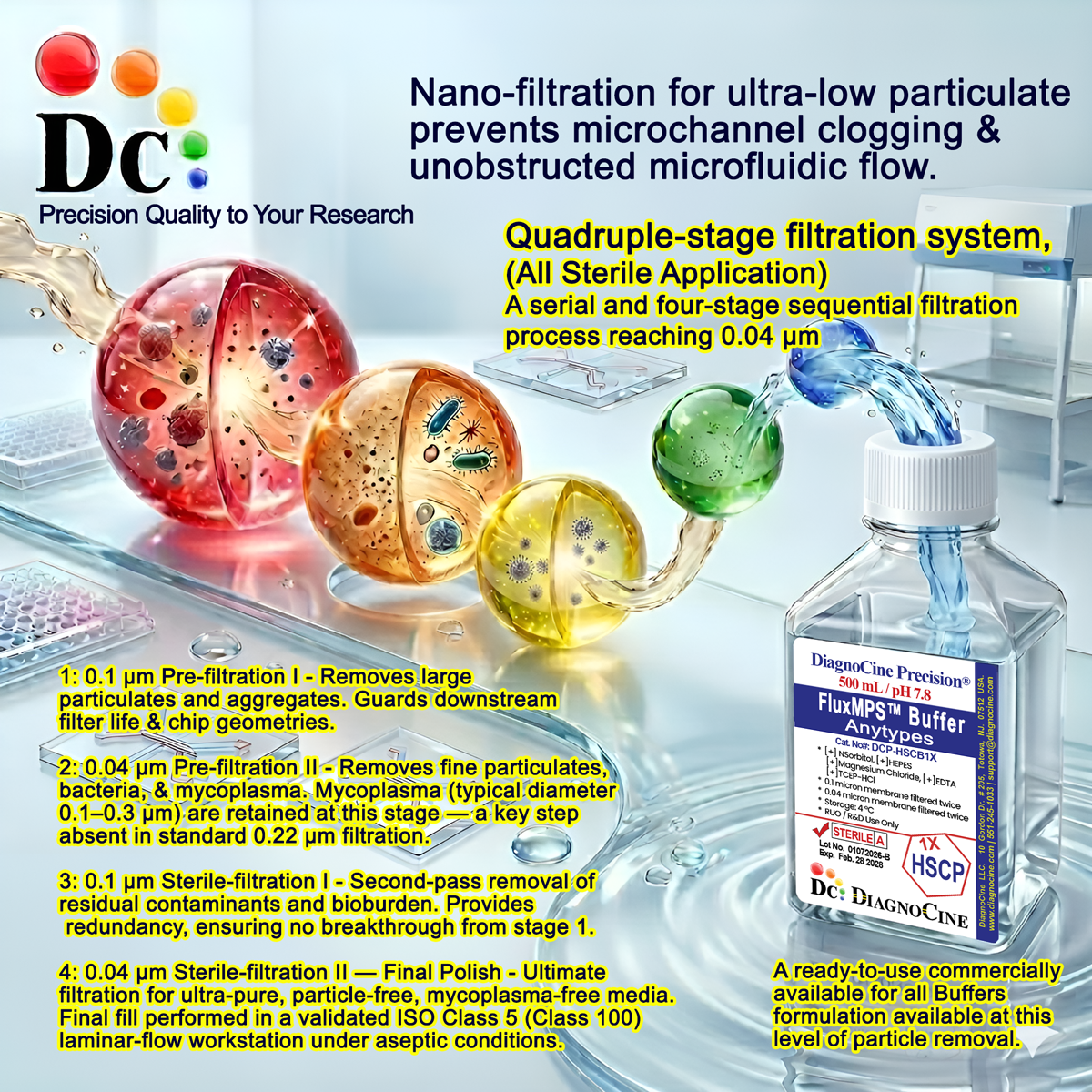
Quadruple-stage filtration system
Every lot of DCP-PICTT201X is filtered through a 0.1 µm membrane twice and a 0.04 µm membrane twice, providing redundant particulate and bioburden reduction ahead of aseptic fill.
-
1
0.1 µm Pre-filtration I
Removes large particulates and aggregates, extending the service life of downstream filters.
-
2
0.04 µm Pre-filtration II
Retains finer particulates and bioburden ahead of the sterile filtration passes.
-
3
0.1 µm Sterile-filtration I
A second 0.1 µm pass provides redundant sterile filtration in a controlled environment.
-
4
0.04 µm Sterile-filtration II — Final Polish
A second 0.04 µm pass delivers the final polish, helping prevent mycoplasma contamination — the smallest mycoplasma types are about 0.2 microns.
Performance vs. conventional buffer
Sequential 0.1 µm and 0.04 µm filtration passes remove finer particulates than a single 0.22 µm pass, supporting a mycoplasma-conscious formulation for sensitive protein workflows.
© Diagnocine® — DCP-PICTT201X
Where this buffer is used
Formulated for protein extraction and immunoassay workflows where preserving native protein structure and activity is critical.
Automated Bioreactors & Robotics
For automated bioreactor and robotic liquid-handling platforms, an optional 0.01 µm (10 nm) ultra-filtered variant is available on request to further protect sensitive valves and sensors.
- Total Particulate Exclusion for closed-loop fluidic systems
- Valve & Sensor Protection in automated dispensing hardware
- Extended Perfusion Stability for long-run protein extraction protocols
Inquiry Required: Contact support@diagnocine.com to request the 0.01 µm ultra-filtered grade.
Micro Physiological System (MPS) & Chip Lysate Prep
Ultrapure, quadruple-filtered TBST-based buffer well suited for protein extraction workflows from microfluidic and organ-on-a-chip cell culture systems.
Cell Lysis & Protein Extraction
Extracts proteins from cells while the protease inhibitor cocktail prevents proteolytic degradation during and after lysis.
iPSC-Derived Model Handling
Supports protein extraction from iPSC-derived cell models where preserving native protein structure is important for downstream analysis.
Endothelial & Primary Cell Lysate Prep
Applicable to protein extraction from endothelial and primary cell cultures ahead of Western blot or IP analysis.
Western Blotting, Immunoprecipitation & Washing
The TBST formulation improves washing efficiency in Western blotting and maintains protein integrity during immunoprecipitation binding and wash steps.
Enzymatic Assays & Protein Characterization
Compatible with enzymatic assays and protein characterization studies requiring inhibition of proteolytic activity.
Product specifications
Measured and declared values for DCP-PICTT201X, as provided by DiagnoCine Precision.
| Parameter | Specification |
|---|---|
| Formulation | Protease inhibitor cocktail in Tris-HCl / Tween 20 (TBST) buffer |
| Appearance | Clear solution |
| Molarity (Tris-HCl) | 50 mM |
| Ionic Strength (Sodium Chloride) | 150 mM |
| Detergent (Tween 20) | 0.1% |
| Parameter | Specification |
|---|---|
| Sterility | Filtered 0.1 µm membrane twice and 0.04 µm membrane twice in a sterile environment |
| DNase Activity | None detected after 18 hr incubation with plasmid DNA at room temperature |
| RNase Activity | None detected after 18 hr incubation with ribosomal RNA at room temperature |
| Water Quality | Ultrapure Type 1 water, 18.2 MΩ·cm |
| Parameter | Specification |
|---|---|
| Storage Temperature | -80°C |
| Shelf Life | 3 months |
| Parameter | Specification |
|---|---|
| Manufacturing QMS | ISO 13485-certified, CE-approved facility (DiagnoCine Precision) |
| Production Method | Final packaging, QA, and testing at the DiagnoCine R&D and Quality Testing Center; custom assembly at DiagnoCine Precision, Totowa, New Jersey, USA |
| Intended Use | Research Use Only (RUO) |
Full composition
Broad-spectrum protease inhibitor cocktail combined with a Tris-Tween 20 (TBST) buffer base.
| Component | CAS Number | Concentration |
|---|---|---|
| AEBSF.HCl | 30827-99-7 | 100 uM |
| Aprotinin | 9087-70-1 | 0.8 uM |
| Bestatin | 58970-76-6 | 0.05 mM |
| E-64 | 66701-25-5 | 1 uM |
| EDTA | 60-00-4 | 5 mM |
| Leupeptin | 103476-89-7 | 0.01 mM |
| Pepstatin A | 26305-03-3 | 1 uM |
| Tween 20 | 9005-64-5 | 0.1% |
| Tris-HCl | 1185-53-1 | 50 mM |
| Sodium Chloride | 7647-14-5 | 150 mM |
Manufacturing & compliance
DCP-PICTT201X is manufactured, tested, and released under a controlled quality system spanning supplier and DiagnoCine facilities.
ISO 13485:2016 QMS
Manufactured under ISO 13485-certified and CE-approved supplier facilities (DiagnoCine Precision).
Ultrapure Type 1 Water
Formulated with Type 1 ultrapure water (18.2 MΩ·cm) for a low-background buffer matrix.
Sterile Filtration & QC Testing
All final packaging, quality assurance, and testing are performed at the DiagnoCine R&D and Quality Testing Center.
Custom Assembly at DiagnoCine Precision
Custom concentration, pH, and dye requests are engineered and assembled at DiagnoCine Precision, Totowa, New Jersey, USA.
DNase Activity Testing
None detected after 18-hour incubation with plasmid DNA at room temperature.
RNase Activity Testing
No activity detected after 18-hour incubation with ribosomal RNA at room temperature.
Sterility & Filtration
Filtered through a 0.1 µm membrane twice and a 0.04 µm membrane twice in a sterile environment.
Documentation / CoA
A Certificate of Analysis is available upon request via support@diagnocine.com.
How DCP-PICTT201X compares
A side-by-side look at filtration architecture and formulation versus conventional protease inhibitor / TBST buffers.
| Parameter | DCP-PICTT201X (FluxMPS™) | Conventional Buffer | Standard Alternative |
|---|---|---|---|
| Filtration architecture | Quadruple-stage (0.1 µm x2 + 0.04 µm x2) | Single 0.22 µm pass | Single 0.22 µm pass |
| Final filtration pore size | 0.04 µm | 0.22 µm | 0.22 µm |
| Number of filtration stages | 4 | 1 | 1 |
| Broad-spectrum protease inhibition | check_circle | cancel | cancel |
| TBST formulation (Tris + Tween 20) | check_circle | cancel | check_circle |
| ISO 13485-certified manufacturing | check_circle | cancel | cancel |
| Sterile-filtered in controlled environment | check_circle | cancel | cancel |
| Custom formulation available | check_circle | cancel | cancel |
Frequently asked questions
Answers to common questions about DCP-PICTT201X.
Supporting literature
Curated literature relevant to protease inhibition, TBST buffer use, and sterile filtration practice.
- Towbin H, Staehelin T, Gordon J. Electrophoretic transfer of proteins from polyacrylamide gels to nitrocellulose sheets: procedure and some applications. doi:10.1073/pnas.76.9.4350
- Burnette WN. Western Blotting: electrophoretic transfer of proteins from sodium dodecyl sulfate-polyacrylamide gels. doi:10.1016/0003-2697(81)90281-5
- Powers JC, Asgian JL, Ekici OD, James KE. Irreversible inhibitors of serine, cysteine, and threonine proteases. doi:10.1021/cr010182v
- Turk B. Targeting proteases: successes, failures and future prospects. doi:10.1038/nrd2092
- Umezawa H, et al. Bestatin, an inhibitor of aminopeptidase B, produced by actinomycetes. doi:10.7164/antibiotics.29.97
- Barrett AJ, Kembhavi AA, Brown MA, et al. L-trans-Epoxysuccinyl-leucylamido(4-guanidino)butane (E-64) and related inhibitors of cysteine proteinases. doi:10.1042/bj2010353
- Umezawa H. Pepstatin, a new pepsin inhibitor produced by actinomycetes. doi:10.7164/antibiotics.23.259
- Rabilloud T. Membrane proteins and proteomics: love is possible, but so difficult. doi:10.1002/elps.200900351
- Mannello F, Tonti GA, Papa S. Matrix metalloproteinase inhibitors as anticancer therapeutics. doi:10.2174/1568009054064674
- Drexler HG, Uphoff CC. Mycoplasma contamination of cell cultures: incidence, sources, effects, detection, elimination, prevention. doi:10.1023/A:1022913015916