


Protease Inhibitor Cocktail with PBS NP-40 Buffer
FluxMPS™ Protease Inhibitor Cocktail with PBS NP-40 Buffer
FluxMPS™ Protease Inhibitor Cocktail with PBS NP-40 Buffer is an MPS-grade, ready-to-use lysis and extraction reagent that pairs a broad-spectrum protease inhibitor cocktail with a physiological PBS/NP-40 buffer base. Every lot is filtered through a 0.1 µm membrane twice and a 0.04 µm membrane twice for ultra-low particulate purity, then filled under sterile conditions to protect sensitive proteins from degradation and contamination during downstream research.
- Quadruple-stage filtration: 0.1 µm membrane twice and 0.04 µm membrane twice for ultra-low particulate purity
- Ready-to-use protease inhibitor cocktail combined with PBS and 1% NP-40 for efficient cell lysis and protein extraction
- Broad-spectrum inhibition of serine, cysteine, aspartic, and metalloproteases via AEBSF.HCl, Aprotinin, Bestatin, E-64, EDTA, Leupeptin, and Pepstatin A
- Physiological PBS formulation helps preserve protein structure and protein-protein interactions during extraction
- Sterile, and DNase/RNase activity not detected on incubation testing
- Compatible with Western blotting, immunoprecipitation, ELISA, and enzymatic assays
- Manufactured under ISO 13485-certified, CE-approved facilities
- Customizable concentrations, tracking dyes, and pH available on request
- FormatReady-to-use protease inhibitor cocktail with PBS + NP-40
- DetergentNP-40, 1%
- Buffer BasePBS (NaCl, KCl, Na2HPO4, KH2PO4)
- Protease InhibitionSerine, cysteine, aspartic & metalloprotease inhibitors
- AppearanceClear solution
- SterilitySterile, filtered
- Filtration0.1 µm membrane x2 + 0.04 µm membrane x2
- Nuclease TestingDNase & RNase not detected
- Storage-80°C
- Shelf Life3 months
Engineered where standard lysis buffers fail
Conventional 0.22 µm-filtered lysis buffers can carry subvisible particulates, uncontrolled bioburden, and inconsistent pH/osmolarity into sensitive protein workflows — degrading yield, generating background in immunoassays, and accumulating in fine microfluidic channels. FluxMPS™ addresses each failure mode directly.
Microchannel-safe purity
Sequential 0.1 µm and 0.04 µm membrane filtration removes finer particulates than a single 0.22 µm pass, protecting fine microfluidic geometries and sensitive assay readouts.
Physiological, stable buffer base
A defined PBS formulation (NaCl, KCl, Na2HPO4, KH2PO4) maintains physiological pH and osmolarity to protect native protein structure during extraction.
Ultrapure-grade water
Formulated with Type 1 ultrapure water, 18.2 MΩ·cm, minimizing trace contaminants that can interfere with downstream biochemistry.
Low background for imaging & assays
Clean, sterile-filtered composition supports reliable Western blotting, ELISA, and other immunoassay readouts without particulate interference.
Defined, traceable composition
Each protease inhibitor and buffer salt is present at a documented concentration, giving researchers a reproducible, traceable formulation lot to lot.
Customization on demand
Other concentrations, additional tracking dyes, different pH, and other modifications can be produced on inquiry.
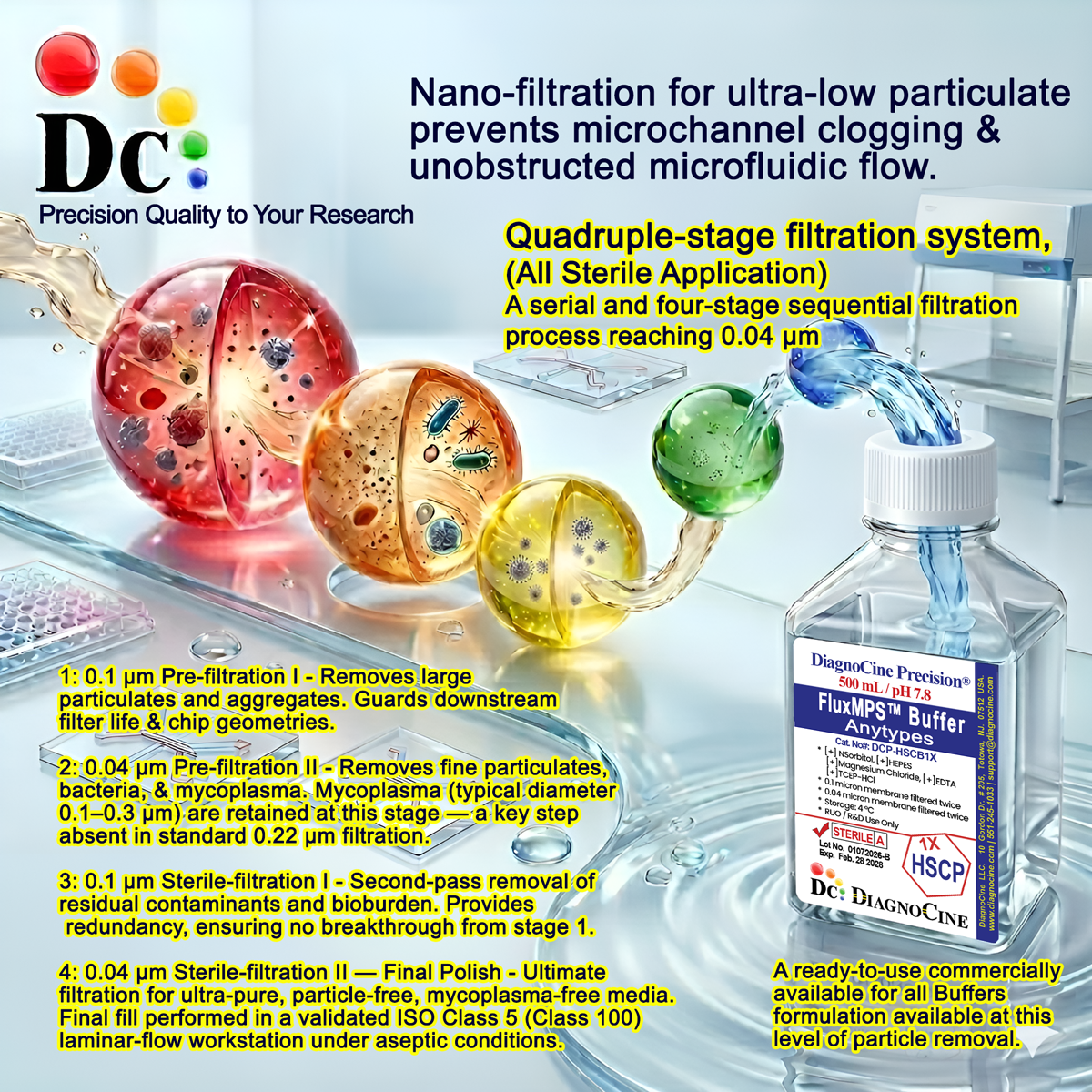
Quadruple-stage filtration system
DCP-PICPNP1X is filtered through a 0.1 µm membrane twice and a 0.04 µm membrane twice, then filled in a sterile environment. This staged approach is designed to remove particulates and bioburden well beyond what a single 0.22 µm pass captures, which helps guard against contamination by organisms as small as mycoplasma — the smallest of which are about 0.2 microns in size.
- 1
0.1 µm Pre-filtration I
Removes large particulates and aggregates, extending the working life of downstream filters.
- 2
0.04 µm Pre-filtration II
Retains fine particulates and bioburden ahead of the second filtration pass.
- 3
0.1 µm Sterile-filtration I
A second 0.1 µm pass provides redundant particulate and bioburden reduction.
- 4
0.04 µm Sterile-filtration II — Final Polish
A second 0.04 µm pass delivers the final polish under sterile fill conditions.
Performance vs. conventional buffer
Sequential 0.1 µm and 0.04 µm filtration, applied twice each, removes finer particulates and reduces bioburden beyond what a single 0.22 µm pass achieves, supporting cleaner lysates for sensitive downstream protein assays.
© Diagnocine® — DCP-PICPNP1X
Where DCP-PICPNP1X performs
A ready-to-use combination reagent for protein extraction and preservation across a range of cell and molecular biology workflows.
Automated Bioreactors & Robotics
An optional 0.01 µm (10 nm) ultra-filtered variant is available for automated bioreactor and robotic liquid-handling platforms where valve and sensor protection is critical.
- Total Particulate Exclusion: minimizes subvisible particulate load entering automated fluidic paths
- Valve & Sensor Protection: reduces fouling risk on precision dosing and sensing components
- Extended Perfusion Stability: supports longer unattended run times in perfusion-based systems
Inquiry Required: contact support@diagnocine.com to request the 0.01 µm ultra-filtered grade for automated bioreactor and robotics applications.
Micro Physiological System (MPS) & Chip
Sterile, ultra-filtered composition compatible with OoC, ToC, BoC, LoC, and MPS platforms.
Cell Lysis & Protein Extraction
NP-40 disrupts cell membranes while the protease inhibitor cocktail preserves protein integrity during extraction.
Western Blotting
Preserves protein samples for accurate Western blot analysis by minimizing proteolytic degradation.
Cell Culture Protein Protection
Protects proteins in various cell culture experiments and primary cell handling workflows.
ELISA & Other Immunoassays
Preserves antigenic epitopes for reliable detection in ELISA and related immunoassay formats.
Protease Inhibition Studies
Used for screening potential protease inhibitors and studying proteolytic activity.
Specifications at a glance
Key physical, purity, and handling parameters for DCP-PICPNP1X, sourced directly from lot documentation.
| Parameter | Specification |
|---|---|
| Formulation | Protease inhibitor cocktail (AEBSF.HCl, Aprotinin, Bestatin, E-64, EDTA, Leupeptin, Pepstatin A) in PBS with 1% NP-40 detergent |
| Appearance | Clear solution |
| pH | Physiological pH (PBS-based formulation) |
| Sodium Chloride | 137 mM |
| Potassium Chloride | 2.7 mM |
| Sodium Phosphate dibasic (Na2HPO4) | 10 mM |
| Potassium Phosphate monobasic (KH2PO4) | 1.8 mM |
| NP-40 detergent | 1% |
| Parameter | Specification |
|---|---|
| Sterility USP <71> | Sterile; filtered 0.1 µm membrane twice and 0.04 µm membrane twice in a sterile environment |
| DNase activity | None detected after incubation of plasmid DNA for 18 hours at room temperature |
| RNase activity | None detected after incubation of ribosomal RNA for 18 hours at room temperature |
| Water quality | Ultrapure Type 1 water, 18.2 MΩ·cm |
| Manufacturing standard ISO 13485 | ISO 13485-certified, CE-approved facilities |
| Parameter | Specification |
|---|---|
| Storage temperature | -80°C |
| Shelf life | 3 months |
| Pack size | 10 x 10 mL |
| Parameter | Specification |
|---|---|
| Manufacturing QMS | ISO 13485-certified facility (Suppliers of DiagnoCine Precision) |
| Regulatory alignment | CE-approved facilities |
| Production method | Final packaging, quality assurance, and testing performed at the DiagnoCine R&D and Quality Testing Center; customization and assembly at DiagnoCine Precision, Totowa, New Jersey, USA |
| Customization | Other concentrations, tracking dyes, pH, and modifications available on inquiry |
| Intended use | Research Use Only (RUO) |
Full composition
DCP-PICPNP1X combines a defined protease inhibitor cocktail with a PBS and NP-40 buffer base. Every component below is documented at its formulated concentration.
| Component | CAS Number | Concentration |
|---|---|---|
| AEBSF.HCl | 30827-99-7 | 100 uM |
| Aprotinin | 9087-70-1 | 0.8 uM |
| Bestatin | 58970-76-6 | 0.05 mM |
| E-64 | 66701-25-5 | 1 uM |
| EDTA | 60-00-4 | 5 mM |
| Leupeptin | 103476-89-7 | 0.01 mM |
| Pepstatin A | 26305-03-3 | 1 uM |
| Component | CAS Number | Concentration |
|---|---|---|
| NP-40 | 9016-45-9 | 1% |
| Potassium Chloride (KCl) | 7447-40-7 | 2.7 mM |
| Sodium Chloride (NaCl) | 7647-14-5 | 137 mM |
| Sodium Phosphate dibasic (Na2HPO4) | 7558-79-4 | 10 mM |
| Potassium Phosphate monobasic (KH2PO4) | 7778-77-0 | 1.8 mM |
Manufactured under controlled conditions
DCP-PICPNP1X is produced, filtered, and quality tested under a documented quality management system.
ISO 13485:2016 QMS
Manufactured under ISO 13485-certified and CE-approved facilities (Suppliers of DiagnoCine Precision).
Ultrapure Type 1 Water
Formulated with Type 1 ultrapure water, 18.2 MΩ·cm, supporting a clean buffer background.
Sterile Fill
Filtered 0.1 µm membrane twice and 0.04 µm membrane twice, then filled in a sterile environment.
Custom Assembly & Testing
Final packaging, quality assurance, and testing are performed at the DiagnoCine R&D and Quality Testing Center; customization and assembly at DiagnoCine Precision, Totowa, New Jersey, USA.
DNase Activity
None detected after incubation of plasmid DNA for 18 hours at room temperature.
RNase Activity
None detected after incubation of ribosomal RNA for 18 hours at room temperature.
Sterility USP <71>
Sterile; filtered 0.1 µm membrane twice and 0.04 µm membrane twice in a sterile environment.
Documentation / CoA
Certificate of Analysis available on request, documenting appearance, sterility, and nuclease testing results.
How DCP-PICPNP1X compares
A side-by-side look at filtration architecture and quality attributes versus conventional lysis buffer options.
| Parameter | DCP-PICPNP1X (FluxMPS™) | Conventional Buffer (0.22 µm filtered) | Standard Alternative (0.22 µm filtered) |
|---|---|---|---|
| Final filtration pore size | 0.04 µm | 0.22 µm | 0.22 µm |
| Number of filtration stages | 4 | 1 | 1 |
| Broad-spectrum protease inhibitor cocktail | check_circle | cancel | cancel |
| DNase/RNase tested | check_circle | cancel | cancel |
| Ultrapure Type 1 water | check_circle | cancel | check_circle |
| ISO 13485 manufacturing | check_circle | cancel | check_circle |
| Microfluidic channel compatibility | check_circle | cancel | cancel |
| Custom formulation | check_circle | cancel | cancel |
Frequently asked questions
Answers to common questions about DCP-PICPNP1X.
Supporting literature
Curated references relevant to protease inhibitor chemistry, PBS-based buffers, and microfluidic/organ-on-a-chip applications.
- Ingber DE. Reverse engineering human pathophysiology with organs-on-chips. Cell. 2016. doi:10.1016/j.cell.2016.06.037
- Bhatia SN, Ingber DE. Microfluidic organs-on-chips. Nat Biotechnol. 2014. doi:10.1038/nbt.2989
- Umezawa H, et al. Pepstatin, a new pepsin inhibitor produced by Actinomycetes. J Antibiot. 1970. doi:10.7164/antibiotics.23.259
- Hanada K, et al. Isolation and characterization of E-64, a new thiol protease inhibitor. Agric Biol Chem. 1978. doi:10.1271/bbb1961.42.523
- Fritz H, Wunderer G. Biochemistry and applications of aprotinin, the kallikrein inhibitor from bovine organs. Arzneimittelforschung. 1983;33(4):479-494.
- Aoyagi T, et al. Bestatin, an inhibitor of aminopeptidase B, produced by actinomycetes. J Antibiot. 1976. doi:10.7164/antibiotics.29.600
- Powers JC, et al. Irreversible inhibitors of serine, cysteine, and threonine proteases. Chem Rev. 2002. doi:10.1021/cr010182v
- Huh D, et al. Reconstituting organ-level lung functions on a chip. Science. 2010. doi:10.1126/science.1188302
- Mahmoudi M, et al. Protein-nanoparticle interactions: opportunities and challenges. Chem Rev. 2011. doi:10.1021/cr100440g