Protease Inhibitor Cocktail with RIPA Buffer
FluxMPS™ Protease Inhibitor Cocktail with RIPA Buffer
An MPS-grade, ready-to-use combination of broad-spectrum protease inhibitor cocktail and RIPA lysis buffer engineered for efficient cell lysis and high-integrity protein extraction. Quadruple-stage filtered through a 0.1 µm membrane twice and a 0.04 µm membrane twice, this ultra-clean formulation minimizes proteolysis and particulate carry-over for microfluidic sample-prep and downstream protein workflows.
- Quadruple-stage filtered: 0.1 µm membrane twice and 0.04 µm membrane twice for microchannel-safe purity
- Ready-to-use RIPA buffer (Tris-HCl, NaCl, NP-40, sodium deoxycholate, SDS) pre-combined with a 7-inhibitor protease cocktail
- Broad-spectrum protection against serine, cysteine, and aspartic proteases
- DNase- and RNase-tested for 18 hours at room temperature with no activity detected
- Manufactured with Ultrapure Type 1 water (18.2 MΩ·cm)
- Supplied sterile-filtered in a clear, ready-to-pipette 10x10 mL format
- Compatible with Western blotting, immunoprecipitation, Co-IP, and protein assay workflows
- pH, molarity, and additive customization available on request
- Format / Size10x10 mL
- Filtration0.1 µm x2 + 0.04 µm x2
- SterilityFiltered, aseptic environment
- AppearanceClear solution
- DNase ActivityNone detected (18 hr, RT)
- RNase ActivityNone detected (18 hr, RT)
- Buffer SystemTris-HCl 50 mM, NaCl 150 mM
- Storage-80°C
- Shelf Life3 months
- Intended UseWestern blot, IP/Co-IP, protein assays
Engineered where standard lysis buffers fail
Conventional 0.22 µm-filtered lysis buffers can carry subvisible particulates, inconsistent detergent/salt content, and undocumented nuclease activity into sensitive protein workflows. FluxMPS™ addresses each failure mode with a quadruple-stage filtered, quality-tested formulation built for microfluidic and chip-based protein preparation.
Microchannel-safe purity
Final 0.04 µm membrane pass reduces particulate load below what a single 0.22 µm filtration step achieves, protecting downstream microfluidic channels and assay wells.
Precise, stable formulation
Tris-HCl 50 mM and NaCl 150 mM buffer system paired with defined detergent and chelator concentrations delivers consistent lysis performance lot to lot.
Ultrapure-grade water
Formulated with Ultrapure Type 1 water (18.2 MΩ·cm), aligned with USP <85> water-quality expectations for sensitive biochemical assays.
Low background for downstream assays
Sterile-filtered, DNase- and RNase-tested formulation supports clean Western blot, immunoprecipitation, and reporter assay backgrounds.
Defined, traceable composition
Every protease inhibitor and RIPA component is lot-released at a stated concentration, fully documented in the composition table below.
Customization on demand
Alternate concentrations, tracking dyes, pH, and other modifications are available — contact support@diagnocine.com.
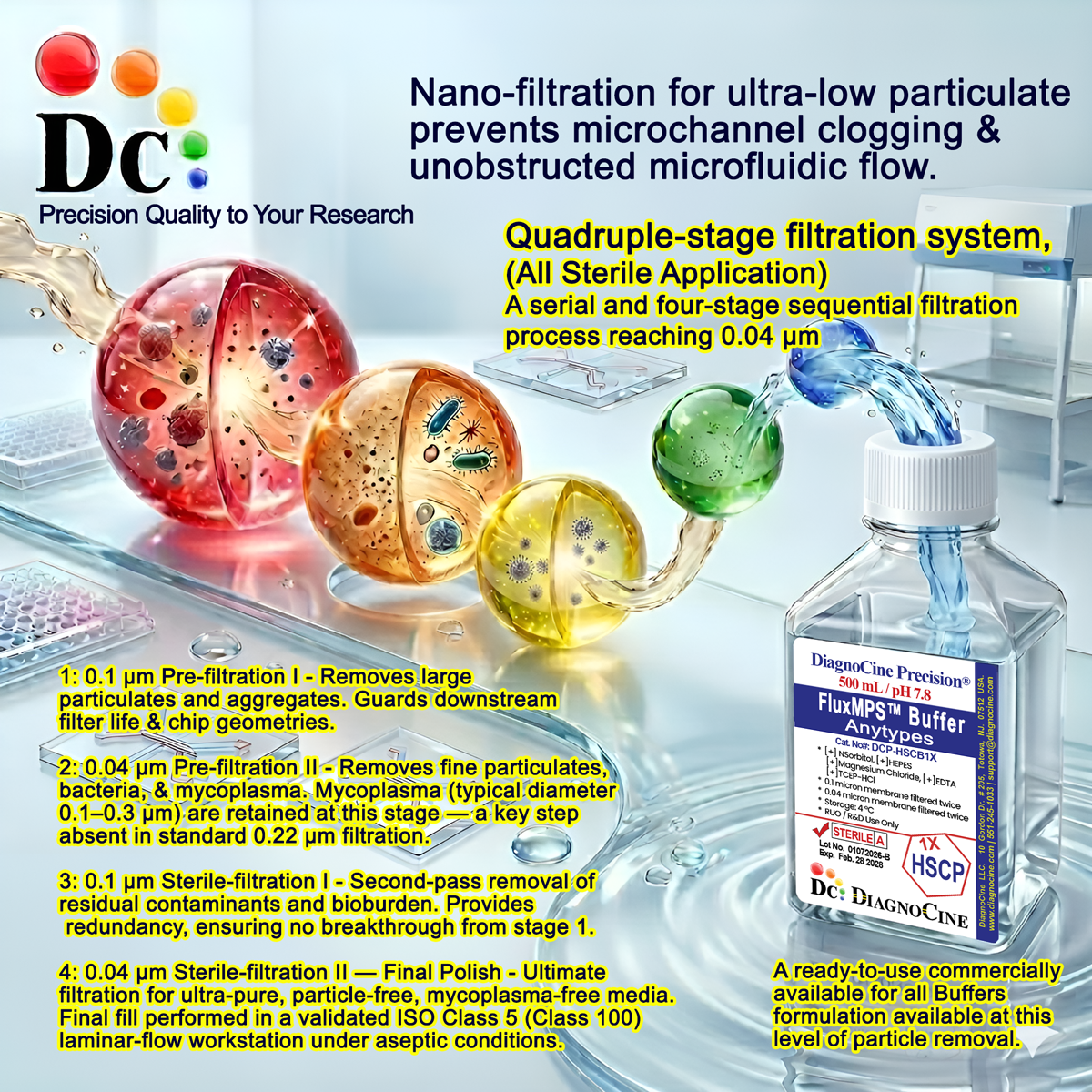
Quadruple-stage filtration system
Every lot of Protease Inhibitor Cocktail with RIPA Buffer is filtered 0.1 µm membrane twice and 0.04 µm membrane twice, delivering microchannel-safe purity for protein extraction workflows sensitive to particulate and bioburden contamination.
-
1
0.1 µmPre-filtration I
Removes large particulates and aggregates, extending the working life of downstream filters.
-
2
0.04 µmPre-filtration II
Retains fine particulates and bioburden ahead of final sterile filtration; the smallest mycoplasma types are on the order of 0.2 micron, well above this pore size.
-
3
0.1 µmSterile-filtration I
Second-pass redundancy through a 0.1 µm membrane in a sterile environment.
-
4
0.04 µmSterile-filtration II — Final Polish
Ultimate polish pass through a 0.04 µm membrane prevents mycoplasma contamination and completes the aseptic fill.
Performance vs. conventional buffer
Sequential 0.1 µm and 0.04 µm filtration removes finer particulates than a single 0.22 µm pass used in conventional lysis buffers, supporting cleaner downstream Western blot, immunoprecipitation, and protein assay results.
© Diagnocine® — DCP-PICTRIPA1X
Built for protein extraction and MPS-adjacent workflows
From microfluidic sample preparation to classical protein biochemistry, Protease Inhibitor Cocktail with RIPA Buffer supports efficient lysis and degradation-free protein recovery.
Automated Bioreactors & Robotics
For automated liquid-handling and robotic dispensing systems, an optional 0.01 µm (10 nm) ultra-filtered variant is available to further minimize particulate load into sensitive valves and sensors.
- Total Particulate Exclusion — supports automated pipetting lines with minimal clogging risk
- Valve & Sensor Protection — reduces particulate accumulation in robotic dispensing hardware
- Extended Perfusion Stability — supports consistent performance across long automated runs
Inquiry Required: the 0.01 µm ultra-filtered variant is available upon request — contact support@diagnocine.com.
Micro Physiological System (MPS) & Chip
Ultra-clean lysis buffer suitable for on-chip protein extraction steps within microfluidic and organ-on-a-chip workflows.
Cell Lysis & Protein Extraction
Ready-to-use RIPA buffer with protease inhibitors disrupts cell membranes and solubilizes cytoplasmic, membrane, and nuclear proteins while preventing proteolysis.
iPSC-Derived Model Handling
Applicable to lysis and protein recovery from iPSC-derived neuron, cardiomyocyte, and hepatocyte cultures for downstream protein analysis.
Endothelial & Primary Cell Lysis
Supports protein extraction from endothelial and primary cell cultures used in vascular and perfusion-based research models.
Western Blot, IP & Co-IP
Ideal for preparing lysates for Western blot analysis and for immunoprecipitation/Co-IP applications requiring minimized non-specific interactions.
Downstream Microscopy & Biosensing
Clean protein extracts support reporter assays and biosensor-based readouts following lysis.
Detailed product specifications
All values below are as measured or declared for this specific lot-released formulation.
| Parameter | Specification |
|---|---|
| Formulation / Composition | RIPA lysis buffer combined with a protease inhibitor cocktail (serine, cysteine, and aspartic protease inhibitors) |
| Appearance | Clear solution |
| Buffer System | Tris-HCl, 50 mM |
| Salt Concentration | Sodium Chloride, 150 mM |
| Detergent System | NP-40 1%, Sodium deoxycholate 0.5%, SDS 0.1% |
| Chelating Agent | EDTA, 5 mM |
| Parameter | Specification |
|---|---|
| Sterility USP <71> | Filtered 0.1-micron membrane twice and 0.04-micron membrane twice in a sterile environment |
| DNase Activity | None detected (plasmid DNA incubation, 18 hours, room temperature) |
| RNase Activity | None detected (ribosomal RNA incubation, 18 hours, room temperature) |
| Water Quality | Ultrapure Type 1 water (18.2 MΩ·cm) |
| Manufacturing Standard ISO 13485 | ISO 13485-certified, CE-approved manufacturing facility |
| Fill Environment | ISO Class 5 (Class 100) aseptic fill |
| Parameter | Specification |
|---|---|
| Storage Temperature | -80°C |
| Shelf Life | 3 months |
| Parameter | Specification |
|---|---|
| Manufacturing QMS | ISO 13485-certified facility (Suppliers of DiagnoCine Precision) |
| Regulatory Alignment | CE-approved manufacturing facility |
| Production Method | Final packaging, quality assurance, and testing performed at the DiagnoCine R&D and Quality Testing Center; customization and assembly performed at DiagnoCine Precision, Totowa, New Jersey, USA |
| Intended Use | Research Use Only (RUO); not for clinical, diagnostic, or therapeutic use |
Full composition
Complete list of protease inhibitor cocktail components and RIPA buffer components with stated concentrations, released per lot.
| Component | CAS Number | Concentration |
|---|---|---|
| AEBSF.HCl | 30827-99-7 | 100 uM |
| Aprotinin | 9087-70-1 | 0.8 uM |
| Bestatin | 65391-42-6 | 0.05 mM |
| E-64 | 66701-25-5 | 1 uM |
| EDTA | 60-00-4 | 5 mM |
| Leupeptin | 103476-89-7 | 0.01 mM |
| Pepstatin A | 26305-03-3 | 1 uM |
| NP-40 | 9016-45-9 | 1% |
| Tris-HCl | 1185-53-1 | 50 mM |
| Sodium Chloride | 7647-14-5 | 150 mM |
| Sodium deoxycholate | 302-95-4 | 0.5% |
| SDS | 151-21-3 | 0.1% |
Manufacturing & compliance
Every lot is manufactured, tested, and packaged under controlled, quality-assured conditions.
ISO 13485:2016 QMS
Manufactured under ISO 13485-certified and CE-approved facilities (Suppliers of DiagnoCine Precision).
Ultrapure Type 1 Water
Formulated with 18.2 MΩ·cm Type 1 water for low-background biochemical performance.
ISO Class 5 Fill & Finish
Aseptic fill performed in an ISO Class 5 (Class 100) environment following quadruple-stage filtration.
Micro-Batch Precision
Final packaging, quality assurance, and testing performed at the DiagnoCine R&D and Quality Testing Center; customization and assembly at DiagnoCine Precision, Totowa, New Jersey, USA.
Sterility & Filtration Validation
Filtered 0.1-micron membrane twice and 0.04-micron membrane twice in a sterile environment, per USP <71> principles.
Nuclease Activity Testing
No DNase or RNase activity detected after 18-hour incubation at room temperature with plasmid DNA and ribosomal RNA respectively.
Facility Compliance
ISO 13485-certified, CE-approved manufacturing facility.
Documentation / CoA
Lot-specific Certificate of Analysis documenting composition, filtration, and nuclease testing is available on request.
How DCP-PICTRIPA1X compares
See how this quadruple-stage filtered, protease-inhibitor-supplemented RIPA buffer compares to conventional and standard alternatives.
| Parameter | DCP-PICTRIPA1X (FluxMPS™) | Conventional RIPA Buffer | Standard Lysis Buffer |
|---|---|---|---|
| Protease inhibitor cocktail included | check_circle | cancel | cancel |
| Final filtration pore size | 0.04 µm | 0.22 µm | 0.22 µm |
| Number of filtration stages | 4 | 1 | 1 |
| DNase / RNase tested | check_circle | cancel | cancel |
| Water quality | Ultrapure Type 1 (18.2 MΩ·cm) | Standard purified water | Standard purified water |
| Manufacturing QMS | ISO 13485:2016 | cancel | cancel |
| Microfluidic / OoC compatibility | check_circle | cancel | cancel |
| Custom formulation available | check_circle | cancel | cancel |
Frequently asked questions
Common questions about Protease Inhibitor Cocktail with RIPA Buffer.
Supporting literature
Curated references relevant to RIPA lysis buffer, protease inhibition, protein detection, and microfluidic sample preparation.
- Laemmli UK. Cleavage of structural proteins during the assembly of the head of bacteriophage T4. Nature. 1970.doi:10.1038/227680a0
- Towbin H, Staehelin T, Gordon J. Electrophoretic transfer of proteins from polyacrylamide gels to nitrocellulose sheets: procedure and some applications. PNAS. 1979.doi:10.1073/pnas.76.9.4350
- Powers JC, Asgian JL, Ekici OD, James KE. Irreversible inhibitors of serine, cysteine, and threonine proteases. Chem Rev. 2002.doi:10.1021/cr010375x
- Rawlings ND, Barrett AJ. Evolutionary families of peptidases. Biochem J. 1993.doi:10.1042/bj2900205
- Green MR, Sambrook J. Preparation of protein extracts from mammalian cells. Cold Spring Harb Protoc. 2018.doi:10.1101/pdb.top100479
- Huh D, Matthews BD, Mammoto A, Montoya-Zavala M, Hsin HY, Ingber DE. Reconstituting organ-level lung functions on a chip. Science. 2010.doi:10.1126/science.1188302
- Ingber DE. Reverse engineering human pathophysiology with organs-on-chips. Cell. 2016.doi:10.1016/j.cell.2016.06.020
- Bonifacino JS, Dell'Angelica EC, Springer TA. Immunoprecipitation. Curr Protoc Cell Biol. 2001.doi:10.1002/0471143030.cb0702s00
- Kilkenny C et al. Improving bioscience research reporting: the ARRIVE guidelines for reporting animal research. PLoS Biol. 2010.doi:10.1371/journal.pbio.1000412
- Whitesides GM. The origins and the future of microfluidics. Nature. 2006.doi:10.1038/nature05058