Protease Inhibitor Cocktail with DPBS Triton-X Buffer
FluxMPS™ Protease Inhibitor Cocktail with DPBS Triton-X Buffer
A ready-to-use, MPS-grade combination of a broad-spectrum protease inhibitor cocktail with DPBS Triton X-100 buffer, purpose-built for efficient cell lysis and protein extraction while preserving native protein structure. Quadruple-stage filtered for ultra-clean, sterile performance, it maintains physiological pH and osmolarity for reliable downstream results in Western blotting, immunoprecipitation, and enzymatic assay workflows.
- Quadruple-stage filtered: 0.1 µm membrane filtration twice and 0.04 µm membrane filtration twice for ultra-clean, sterile buffer
- Broad-spectrum protease inhibitor cocktail combining AEBSF.HCl, Aprotinin, Bestatin, E-64, EDTA, Leupeptin, and Pepstatin A
- DPBS base maintains physiological pH and osmolarity during lysis and extraction
- Triton X-100 detergent enables efficient cell membrane disruption and protein solubilization
- No DNase or RNase activity detected after 18-hour incubation at room temperature
- Manufactured under ISO 13485-certified, CE-approved facilities
- Microchannel-safe purity suited to microfluidic and organ-on-a-chip (OoC) sample handling
- Customizable concentrations, tracking dyes, and pH available on request
- Catalog No.DCP-PICDPTX1X
- Size10x10 mL
- FormatReady-to-use liquid
- AppearanceClear solution
- Filtration0.1 µm x2 + 0.04 µm x2
- SterilitySterile-filtered
- DNase ActivityNone detected
- RNase ActivityNone detected
- Storage-80°C
- Shelf Life3 months
Engineered where standard lysis buffers fail
Conventional 0.22 µm-filtered lysis buffers can carry subvisible particulates, inconsistent detergent dispersion, and variable protease-inhibitor activity into sensitive protein workflows. FluxMPS™ addresses each failure mode with tightly controlled filtration, defined composition, and lot-released quality control.
Microchannel-safe purity
Quadruple-stage 0.1 µm and 0.04 µm membrane filtration removes particulates that can clog microfluidic channels, valves, and sensors.
Balanced, physiological buffer
DPBS base maintains physiological pH and osmolarity so lysed proteins remain in a stable, near-native chemical environment.
Ultrapure-grade water
Formulated with Ultrapure Type 1 water (18.2 MΩ·cm) to minimize background interference in downstream assays.
Low background for imaging & assays
Clean, sterile-filtered formulation supports reliable results in Western blotting, immunoprecipitation, and enzymatic assays.
Defined, traceable composition
Seven protease inhibitors and buffer salts are each present at a carefully balanced, documented concentration.
Customization on demand
Alternate concentrations, tracking dyes, and pH modifications are available — contact support@diagnocine.com.
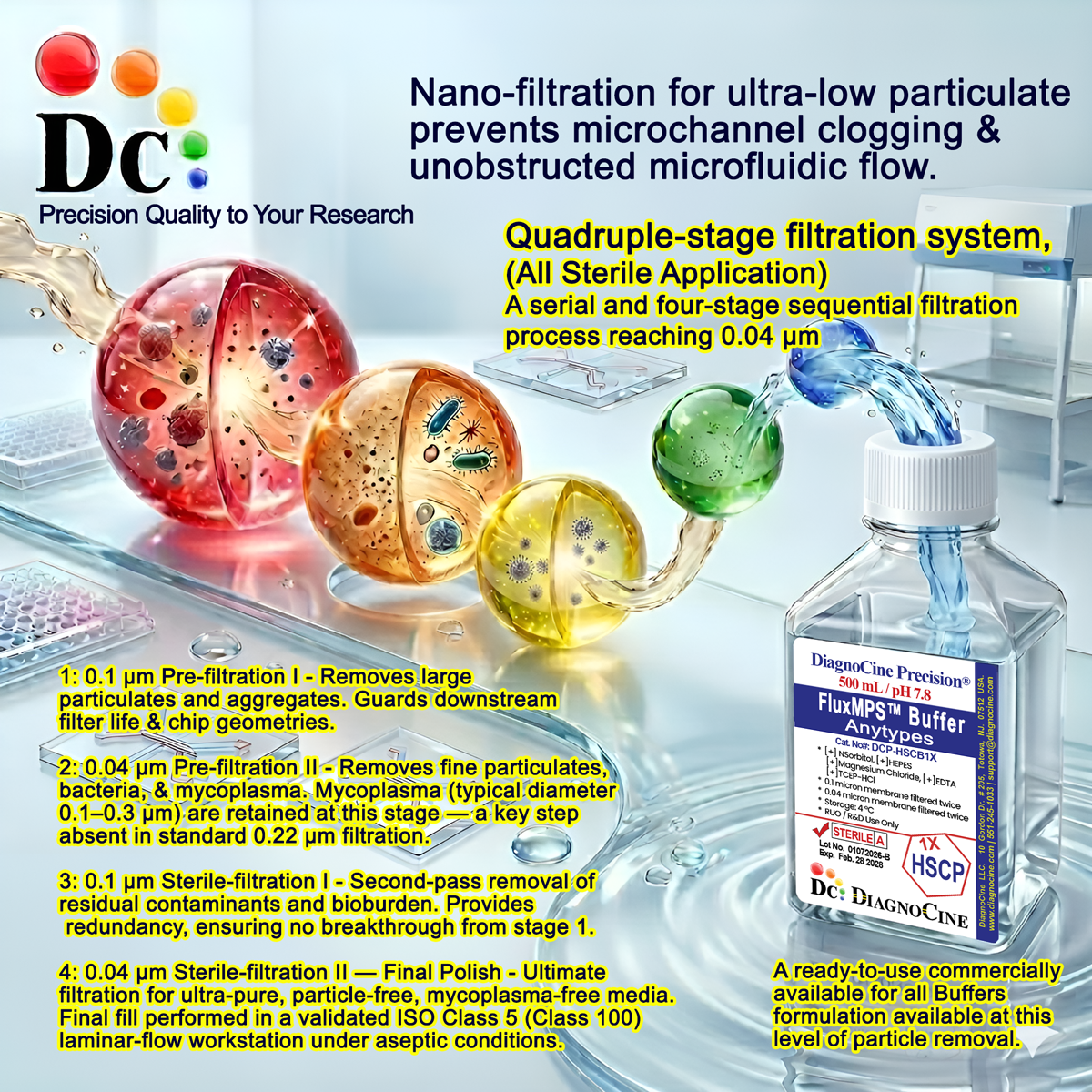
Quadruple-stage filtration system
Every lot of DCP-PICDPTX1X is filtered 0.1 µm membrane twice and 0.04 µm membrane twice, delivering a sterile, ultra-clean buffer suitable for sensitive protein extraction and microfluidic sample handling.
-
1
0.1 µm Pre-filtration I
Removes large particulates and aggregates, extending the life of downstream filters.
-
2
0.04 µm Pre-filtration II
Retains fine particulates and bioburden ahead of the final sterile passes.
-
3
0.1 µm Sterile-filtration I
A second 0.1 µm pass adds redundancy to the sterilization process.
-
4
0.04 µm Sterile-filtration II — Final Polish
A second 0.04 µm pass provides the final polish, performed in a sterile filling environment.
Performance vs. conventional buffer
Sequential 0.1 µm and 0.04 µm filtration, each applied twice, removes finer particulates than a single 0.22 µm pass, supporting cleaner downstream protein analysis.
© Diagnocine® — DCP-PICDPTX1X
Where DCP-PICDPTX1X is used
This ready-to-use protease inhibitor cocktail with DPBS Triton-X buffer supports protein research from bench-scale lysis to microfluidic and organ-on-a-chip sample handling.
Automated Bioreactors & Robotics
An optional 0.01 µm (10 nm) ultra-filtered variant of this buffer is available for automated bioreactor and robotic liquid-handling systems where narrow-bore tubing and sensitive valves demand the lowest achievable particulate load.
- Total Particulate Exclusion — supports long-run automated protocols
- Valve & Sensor Protection — reduces fouling risk in closed-loop systems
- Extended Perfusion Stability — maintains consistent flow in continuous processes
Inquiry Required: Contact support@diagnocine.com to request the 0.01 µm ultra-filtered grade.
Micro Physiological System (MPS) & Chip
Sterile, low-particulate buffer suited to on-chip protein extraction and lysis steps.
Cell Lysis & Protein Extraction
Triton X-100 in DPBS disrupts cell membranes while the protease inhibitor cocktail protects released proteins from degradation.
iPSC-Derived Model Handling
Preserves protein integrity during lysis of iPSC-derived cell models for downstream analysis.
Endothelial & Primary Cell Perfusion
Supports protein extraction from primary and endothelial cell cultures used in vascular research.
Western Blotting, Immunoprecipitation & Enzymatic Assays
Protease inhibitors preserve protein samples for accurate analysis in Western blotting, immunoprecipitation, and enzymatic assays.
Protein Target Studies & Tissue Culture
Used in studying protein targets for therapeutic development and in cell/tissue culture work involving cell function and microbial defense investigations.
Detailed specifications
Every value below is drawn directly from this product's release documentation.
| Parameter | Specification |
|---|---|
| Formulation | Protease inhibitor cocktail in DPBS with Triton X-100 detergent |
| Appearance | Clear solution |
| Triton X-100 Concentration | 1% |
| Sodium Chloride Concentration | 137 mM |
| Potassium Chloride Concentration | 2.67 mM |
| Sodium Phosphate dibasic Concentration | 8.09 mM |
| Potassium Phosphate monobasic Concentration | 1.47 mM |
| Parameter | Specification |
|---|---|
| Sterility USP <71> | Filtered 0.1 µm membrane twice and 0.04 µm membrane twice in a sterile environment |
| DNase Activity | None detected after incubation of plasmid DNA for 18 hours at room temperature |
| RNase Activity | None detected after incubation of ribosomal RNA for 18 hours at room temperature |
| Manufacturing Standard ISO 13485 | ISO 13485-certified, CE-approved facilities |
| Parameter | Specification |
|---|---|
| Storage Temperature | -80°C |
| Shelf Life | 3 months |
| Size | 10x10 mL |
| Parameter | Specification |
|---|---|
| Manufacturing QMS ISO 13485 | ISO 13485-certified supplier facilities |
| Regulatory Alignment | CE-approved facilities |
| Production Method | Final packaging, quality assurance, and testing at the Diagnocine R&D and Quality Testing Center; customization and assembly at Diagnocine Precision, Totowa, New Jersey, USA |
| Intended Use | Research Use Only (RUO) |
Full composition
Every protease inhibitor and buffer component is listed below with its release concentration.
| Component | CAS Number | Concentration |
|---|---|---|
| AEBSF.HCl | 30827-99-7 | 100 µM |
| Aprotinin | 9087-70-1 | 0.8 µM |
| Bestatin | 58970-76-6 | 0.05 mM |
| E-64 | 66701-25-5 | 1 µM |
| EDTA | 60-00-4 | 5 mM |
| Leupeptin | 103476-89-7 | 0.01 mM |
| Pepstatin A | 26305-03-3 | 1 µM |
| Triton-X | 9002-93-1 | 1% |
| Potassium Chloride | 7447-40-7 | 2.67 mM |
| Sodium Chloride | 7647-14-5 | 137 mM |
| Sodium Phosphate dibasic | 7558-79-4 | 8.09 mM |
| Potassium Phosphate monobasic | 7778-77-0 | 1.47 mM |
Manufacturing & compliance
DCP-PICDPTX1X is manufactured, filtered, and packaged under a controlled quality system.
ISO 13485:2016 QMS
Manufactured under ISO 13485-certified and CE-approved supplier facilities.
Ultrapure Type 1 Water
Formulated with Ultrapure Type 1 water (18.2 MΩ·cm).
Sterile Fill & Finish
Filtered 0.1 µm membrane twice and 0.04 µm membrane twice in a sterile environment.
Micro-Batch Precision
Final packaging, QA, and testing performed at the Diagnocine R&D and Quality Testing Center; customization and assembly at Diagnocine Precision, Totowa, New Jersey, USA.
DNase Activity
None detected after incubation of plasmid DNA for 18 hours at room temperature.
RNase Activity
None detected after incubation of ribosomal RNA for 18 hours at room temperature.
Appearance
Clear solution.
Documentation
A Certificate of Analysis is available for this lot.
How DCP-PICDPTX1X compares
A side-by-side look at filtration architecture and quality attributes versus conventional lysis buffer preparations.
| Parameter | DCP-PICDPTX1X (FluxMPS™) | Conventional Buffer | Standard Alternative |
|---|---|---|---|
| Protease inhibitor cocktail included | check_circle | cancel | cancel |
| Final filtration pore size | 0.04 µm | 0.22 µm | 0.22 µm |
| Number of filtration stages | 4 | 1 | 1 |
| DNase/RNase activity verified | check_circle | cancel | cancel |
| Water quality | Ultrapure Type 1 (18.2 MΩ·cm) | Not specified | Not specified |
| Manufacturing QMS | ISO 13485-certified | Not specified | Not specified |
| Microfluidic channel compatibility | check_circle | cancel | cancel |
| Physiological pH/osmolarity buffer base | check_circle | check_circle | cancel |
| Custom formulation available | check_circle | cancel | cancel |
Frequently asked questions
Answers to common questions about DCP-PICDPTX1X.
Supporting literature
Curated literature relevant to protease inhibition, protein extraction, and microfluidic sample handling.
- Laemmli UK. Cleavage of structural proteins during the assembly of the head of bacteriophage T4. Nature. 1970;227:680-685. doi:10.1038/227680a0
- Bradford MM. A rapid and sensitive method for the quantitation of microgram quantities of protein utilizing the principle of protein-dye binding. Anal Biochem. 1976;72:248-254. doi:10.1016/0003-2697(76)90527-3
- Towbin H, Staehelin T, Gordon J. Electrophoretic transfer of proteins from polyacrylamide gels to nitrocellulose sheets: procedure and some applications. Proc Natl Acad Sci USA. 1979;76:4350-4354. doi:10.1073/pnas.76.9.4350
- Mahmood T, Yang PC. Western blot: technique, theory, and trouble shooting. N Am J Med Sci. 2012;4:429-434. doi:10.4103/1947-2714.100998
- Huh D, Hamilton GA, Ingber DE. From 3D cell culture to organs-on-chips. Trends Cell Biol. 2011;21:745-754. doi:10.1016/j.tcb.2011.09.005
- Bhatia SN, Ingber DE. Microfluidic organs-on-chips. Nat Biotechnol. 2014;32:760-772. doi:10.1038/nbt.2989
- Drucker E, Krapfenbauer K. Pitfalls and limitations in translation from biomarker discovery to clinical utility in predictive and personalised medicine. EPMA J. 2013;4:7. doi:10.1186/1878-5085-4-7
- Malm J, Fehniger TE, Danmyr P, et al. Developments in biobanking workflow standardization providing sample integrity and stability. J Proteomics. 2013;95:38-45. doi:10.1016/j.jprot.2012.10.030