


Protease Inhibitor Cocktail with Tris Triton-X Buffer
FluxMPS™ Protease Inhibitor Cocktail with Tris Triton-X Buffer
A ready-to-use, MPS-grade combination of a broad-spectrum protease inhibitor cocktail with Tris-HCl (pH 7.5), sodium chloride, and Triton X-100 buffer, engineered for microchannel-safe protein extraction and preservation. Quadruple-stage filtered — 0.1 µm membrane twice and 0.04 µm membrane twice — for an ultra-clean lysis reagent that protects protein integrity from cell to chip.
- Quadruple-stage filtration: 0.1 µm membrane twice and 0.04 µm membrane twice for ultra-clean, microchannel-safe buffer
- Broad-spectrum protease inhibitor cocktail (AEBSF.HCl, aprotinin, bestatin, E-64, EDTA, leupeptin, pepstatin A) blocks serine, cysteine, aspartic, and metalloprotease activity
- Tris-HCl (pH 7.5) buffering system with 150 mM sodium chloride for a consistent, stable pH during lysis
- 1% Triton X-100 solubilizes both cytosolic and membrane-bound proteins in a non-denaturing environment
- DNase- and RNase-negative — verified after 18-hour incubation at room temperature
- Manufactured under ISO 13485-certified, CE-approved facilities, with final packaging and customization completed at Diagnocine Precision in Totowa, New Jersey, USA
- Customizable concentrations, tracking dyes, and pH available on request
- pH7.5
- Tris-HCl50 mM
- Sodium Chloride150 mM
- Triton X-1001%
- Protease InhibitorsAEBSF.HCl, Aprotinin, Bestatin, E-64, EDTA, Leupeptin, Pepstatin A
- Filtration0.1 µm membrane (twice), 0.04 µm membrane (twice)
- SterilityDNase / RNase negative
- AppearanceClear solution
- Storage-80°C
- Shelf Life3 months
Engineered where standard lysis buffers fail
Conventional 0.22 µm-filtered lysis buffers can carry subvisible particulates, inconsistent pH, and residual bioburden into sensitive downstream assays. FluxMPS™ addresses each failure mode with a quadruple-stage filtered, tightly formulated protease inhibitor / Tris-Triton X system built for microfluidic and organ-on-a-chip workflows.
Microchannel-safe purity
Final 0.04 µm pore size and USP <788> particulate testing keep the buffer safe for narrow microfluidic channels and sensors.
Precise, stable pH
Tris-HCl buffered at pH 7.5 with 150 mM NaCl maintains a consistent ionic environment throughout lysis and downstream handling.
Ultrapure-grade water
Formulated with Ultrapure Type 1 water (18.2 MΩ·cm) consistent with USP <85> water-quality expectations.
Low background for imaging & assays
DNase- and RNase-negative formulation supports clean readouts in western blotting, immunoprecipitation, and enzymatic assays.
Defined, traceable composition
Seven protease inhibitors plus Tris-HCl, NaCl, and Triton X-100 are formulated to stated concentrations and lot-documented.
Customization on demand
Alternate concentrations, tracking dyes, or pH can be prepared on request — contact support@diagnocine.com.
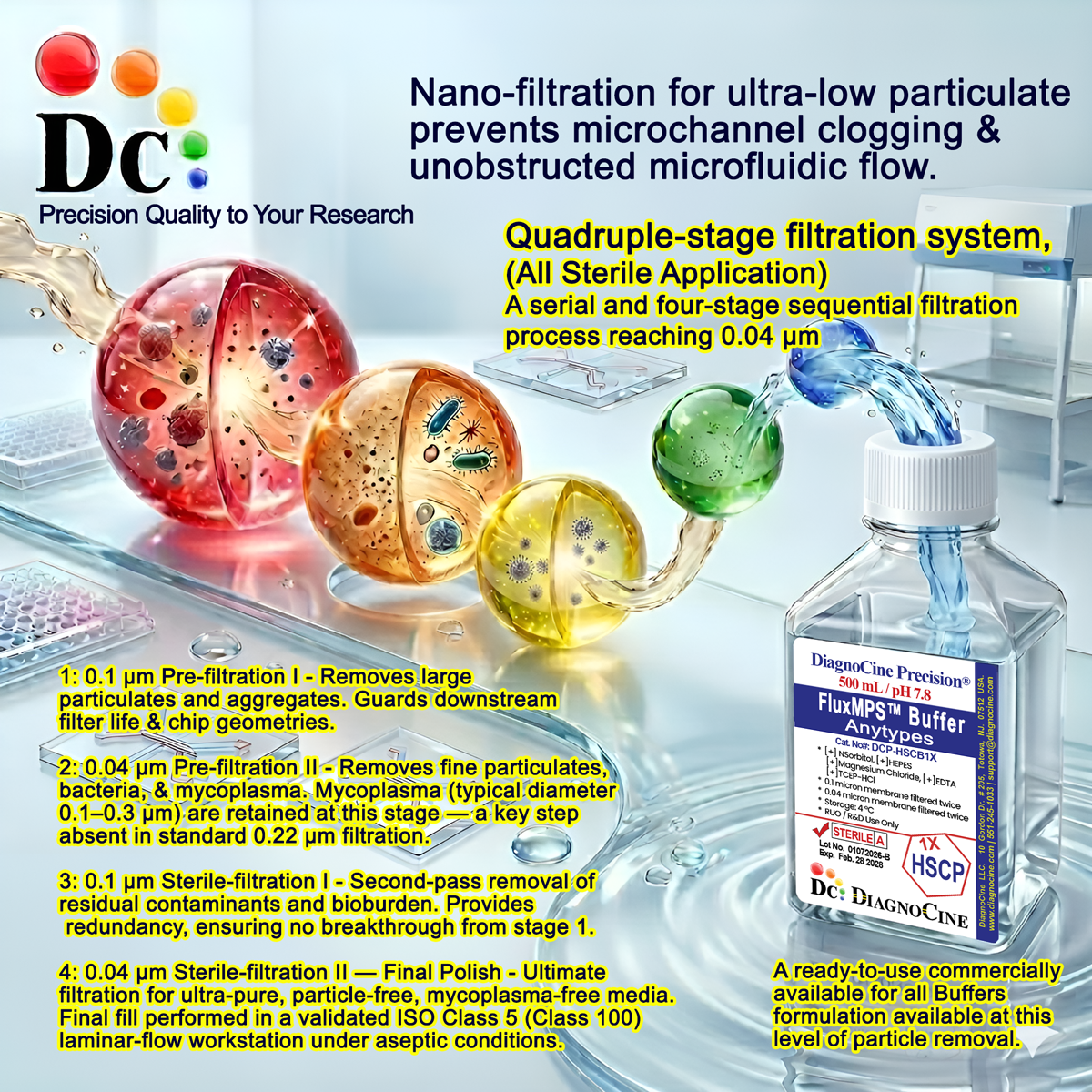
Quadruple-stage filtration system
This buffer is filtered 0.1 µm membrane twice and 0.04 µm membrane twice, in a sterile environment, giving it a level of particulate control well beyond a single conventional pass.
-
1
0.1 µm Pre-filtration I
Removes large particulates and aggregates, extending the life of downstream filters.
-
2
0.04 µm Pre-filtration II
Retains fine particulates and bioburden, including organisms in the size range near mycoplasma, which can be about 0.2 micron.
-
3
0.1 µm Sterile-filtration I
A second 0.1 µm pass provides redundancy ahead of final polishing.
-
4
0.04 µm Sterile-filtration II — Final Polish
A second 0.04 µm pass in an ISO Class 5 (Class 100) environment delivers the final polish and sterile fill.
Performance vs. conventional buffer
Sequential 0.1 µm and 0.04 µm filtration, each applied twice, removes finer particulates and reduces bioburden more thoroughly than a single 0.22 µm pass used in conventional lysis buffers.
© Diagnocine® — DCP-PICTTX1X
Where this buffer is used
The protease inhibitor cocktail and Tris-Triton X buffer combination supports protein extraction, preservation, and analysis across a wide range of research workflows, from bench-scale lysis to microfluidic tissue-chip platforms.
Automated Bioreactors & Robotics
For automated perfusion and robotic liquid-handling platforms, an optional 0.01 µm (10 nm) ultra-filtered variant of this buffer can further protect fine-bore tubing, valves, and inline sensors from particulate accumulation.
- Total Particulate Exclusion: sub-10 nm filtration for the most sensitive fluidic paths
- Valve & Sensor Protection: minimizes particulate fouling in automated systems
- Extended Perfusion Stability: supports longer unattended run times
Inquiry Required: the 0.01 µm (10 nm) ultra-filtered grade is available on request — contact support@diagnocine.com.
Micro Physiological System (MPS) & Chip
Ultra-filtered protease-inhibitor buffer for lysis and protein recovery on tissue-chip and organ-on-a-chip platforms.
Cell Lysis & Protein Extraction
Tris-Triton X buffer lyses cells and solubilizes proteins while the protease inhibitor cocktail prevents degradation.
iPSC-Derived Model Handling
Preserves protein integrity during lysis of iPSC-derived neurons, cardiomyocytes, and hepatocytes for downstream analysis.
Endothelial & Primary Cell Perfusion
Supports protein extraction from endothelial and primary cell cultures used in perfusion and vascular models.
Western Blotting, IP & Blocking
Efficiently lyses cells and solubilizes proteins for SDS-PAGE, western blotting, and immunoprecipitation workflows.
Downstream Microscopy & Assays
Preserved native protein structure supports accurate downstream analysis in imaging and enzymatic assay workflows.
Complete product specifications
Formulation, sterility, storage, and traceability details for DCP-PICTTX1X.
| Parameter | Specification |
|---|---|
| Formulation | Protease inhibitor cocktail (AEBSF.HCl, aprotinin, bestatin, E-64, EDTA, leupeptin, pepstatin A) in Tris-HCl / Triton X-100 / NaCl buffer |
| Appearance | Clear solution |
| pH USP <791> | 7.5 |
| Tris-HCl concentration | 50 mM |
| Sodium Chloride concentration | 150 mM |
| Triton X-100 concentration | 1% |
| Parameter | Specification |
|---|---|
| Sterility | Filtered 0.1 µm membrane twice and 0.04 µm membrane twice in a sterile environment |
| DNase activity | None detected (plasmid DNA, 18 hr, room temperature) |
| RNase activity | None detected (ribosomal RNA, 18 hr, room temperature) |
| Water purity | Ultrapure Type 1 water (18.2 MΩ·cm) |
| Manufacturing standard ISO 13485 | ISO 13485-certified, CE-approved facilities |
| Fill environment | ISO Class 5 (Class 100) |
| Parameter | Specification |
|---|---|
| Storage temperature | -80°C |
| Shelf life | 3 months |
| Parameter | Specification |
|---|---|
| Raw material grade | Manufactured under ISO 13485-certified, CE-approved supplier facilities (Diagnocine Precision) |
| Traceability | Final packaging, quality assurance, and testing performed at the Diagnocine R&D and Quality Testing Center |
| Manufacturing QMS | ISO 13485-certified |
| Regulatory alignment | CE-approved facilities |
| Production method | Customization and assembly at Diagnocine Precision, Totowa, New Jersey, USA |
| Intended use | Research Use Only (RUO) |
Full composition
A broad-spectrum protease inhibitor cocktail formulated with a Tris-HCl / Triton X-100 / NaCl lysis buffer.
| Component | CAS Number | Concentration |
|---|---|---|
| AEBSF.HCl | 30827-99-7 | 100 µM |
| Aprotinin | 9087-70-1 | 0.8 µM |
| Bestatin | 58970-76-6 | 0.05 mM |
| E-64 | 66701-25-5 | 1 µM |
| EDTA | 60-00-4 | 5 mM |
| Leupeptin | 103476-89-7 | 0.01 mM |
| Pepstatin A | 26305-03-3 | 1 µM |
| Triton X-100 | 9002-93-1 | 1% |
| Tris-HCl | 1185-53-1 | 50 mM |
| Sodium Chloride | 7647-14-5 | 150 mM |
Manufacturing & compliance
DCP-PICTTX1X is manufactured, tested, and packaged under a controlled quality system.
ISO 13485:2016 QMS
Manufactured under ISO 13485-certified, CE-approved supplier facilities (Diagnocine Precision).
Ultrapure Type 1 Water
Formulated with Ultrapure Type 1 water (18.2 MΩ·cm) consistent with USP <85> water-quality expectations.
ISO Class 5 Fill & Finish
Final sterile filtration and fill are performed in an ISO Class 5 (Class 100) environment.
Micro-Batch Precision
Final packaging, quality assurance, testing, and customization are completed at Diagnocine Precision in Totowa, New Jersey, USA.
DNase Activity
None detected after incubation of plasmid DNA with this product for 18 hours at room temperature.
RNase Activity
No RNase activity detected after incubation of ribosomal RNA with this product for 18 hours at room temperature.
Sterility
Filtered 0.1 µm membrane twice and 0.04 µm membrane twice in a sterile environment.
Documentation / CoA
Certificate of Analysis available on request.
How DCP-PICTTX1X compares
A side-by-side look at the filtration architecture and formulation controls that set this buffer apart from conventional protease inhibitor / lysis buffer products.
| Parameter | DCP-PICTTX1X (FluxMPS™) | Conventional Lysis Buffer | Standard Alternative |
|---|---|---|---|
| Ready-to-use protease inhibitor + buffer combination | check_circle | cancel | cancel |
| Final filtration pore size | 0.04 µm | 0.22 µm | 0.22 µm |
| Number of filtration stages | 4 | 1 | 1 |
| DNase / RNase tested | check_circle | cancel | cancel |
| Water quality | Ultrapure Type 1 (18.2 MΩ·cm) | Standard purified water | Standard purified water |
| Manufacturing QMS | ISO 13485:2016 | Not specified | Not specified |
| Microfluidic channel compatibility | check_circle | cancel | cancel |
| Custom formulation available | check_circle | cancel | cancel |
Frequently asked questions
Common questions about DCP-PICTTX1X.
Supporting literature
Curated peer-reviewed references relevant to protease inhibition, cell lysis buffers, and microfluidic / organ-on-a-chip protein workflows.
- Bhatia SN, Ingber DE. Microfluidic organs-on-chips. Nat Biotechnol. 2014. doi:10.1038/nbt.2989
- Sackmann EK, Fulton AL, Beebe DJ. The present and future role of microfluidics in biomedical research. Nature. 2014. doi:10.1038/nature13118
- Powers MJ, Domansky K, Kaazempur-Mofrad MR, et al. A microfabricated array bioreactor for perfused 3D liver culture. Biotechnol Bioeng. 2002. doi:10.1002/bit.10553
- Rawlings ND, Barrett AJ, Bateman A. MEROPS: the database of proteolytic enzymes, their substrates and inhibitors. Nucleic Acids Res. 2012. doi:10.1093/nar/gkr987
- Powers JC, Asgian JL, Ekici OD, James KE. Irreversible inhibitors of serine, cysteine, and threonine proteases. Chem Rev. 2002. doi:10.1021/cr010182v
- Umezawa H, Aoyagi T, Suda H, et al. Bestatin, an inhibitor of aminopeptidase B, produced by actinomycetes. J Antibiot. 1976. doi:10.7164/antibiotics.29.97
- Koide T, Ikenaka T. Studies on soybean trypsin inhibitors and related protease inhibitors. Eur J Biochem. 1973. doi:10.1111/j.1432-1033.1973.tb02839.x
- Mahmood T, Yang PC. Western blot: technique, theory, and trouble shooting. N Am J Med Sci. 2012. doi:10.4103/1947-2714.100998
- Seddon AM, Curnow P, Booth PJ. Membrane proteins, lipids and detergents: not just a soap opera. Biochim Biophys Acta. 2004. doi:10.1016/j.bbamem.2004.04.011
- Wells JA, McClendon CL. Reaching for high-hanging fruit in drug discovery at protein-protein interfaces. Nature. 2007. doi:10.1038/nature06526