

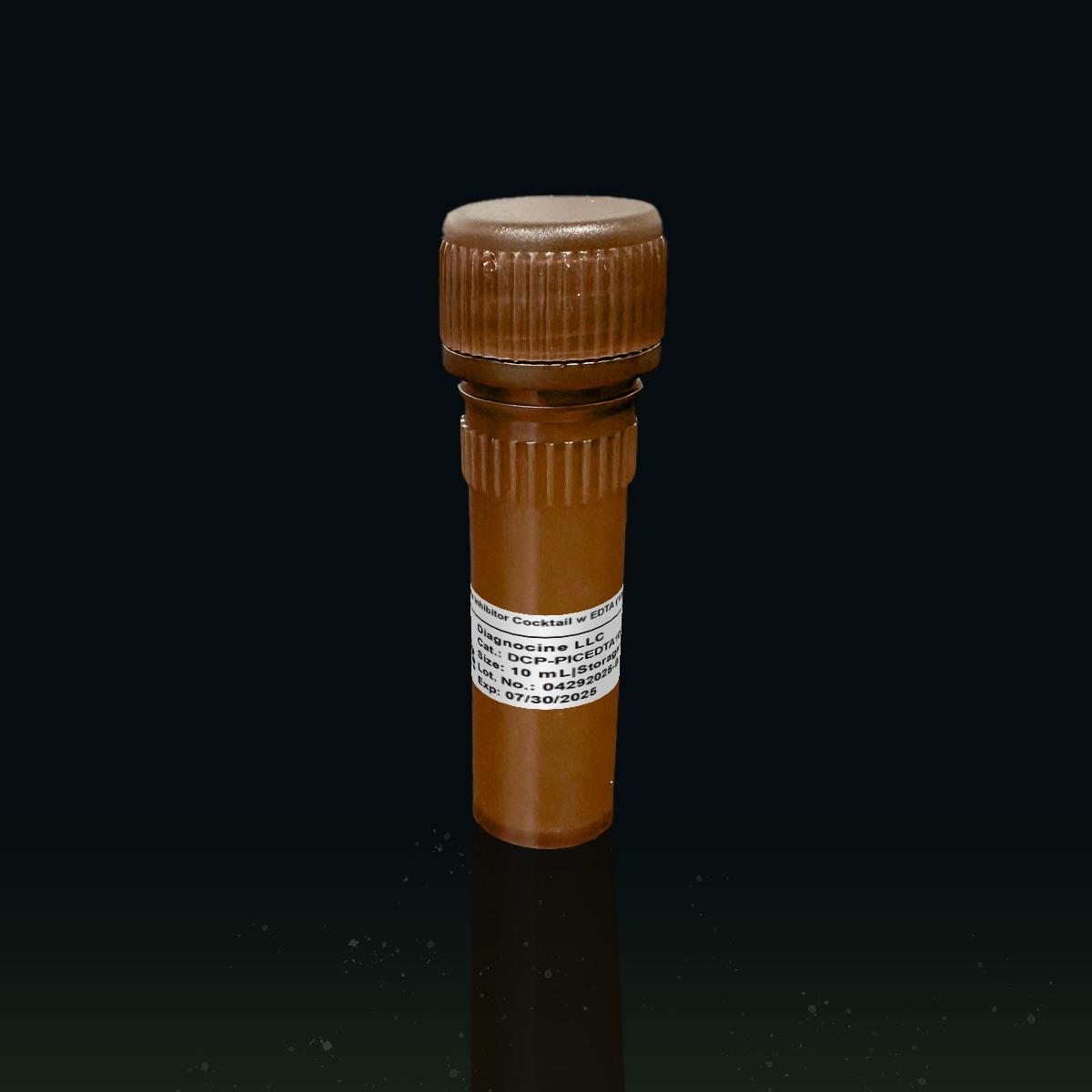
Protease Inhibitor Cocktail with EDTA (10X)
FluxMPS™ Protease Inhibitor Cocktail with EDTA (10X)
FluxMPS™ Protease Inhibitor Cocktail with EDTA (10X) delivers broad-spectrum, defined-concentration protection against serine, cysteine, aspartic, and aminopeptidase proteolytic activity for cell and molecular biology, microphysiological system (MPS), and organ-on-a-chip (OoC) workflows. Formulated with AEBSF.HCl, Aprotinin, Bestatin, E-64, EDTA, Leupeptin, and Pepstatin A, and filtered through a 0.1 µm membrane once for an ultrapure, non-sterile concentrate, this 10X cocktail dilutes 100-fold to help protect sensitive protein samples during lysis, purification, and enzymatic assays.
- Filtered through a 0.1 µm membrane once for an ultrapure, non-sterile formulation
- Broad-spectrum inhibition of serine, cysteine, aspartic, and aminopeptidase proteases
- Formulated with AEBSF.HCl, Aprotinin, Bestatin, E-64, EDTA, Leupeptin, and Pepstatin A
- Dilute 100-fold to reach working (1X) concentration
- Compatible with cell lysis, protein purification, and enzymatic assay workflows
- Custom concentrations, tracking dyes, and pH adjustments available on request
- Format10X Concentrate
- Size5 x 1 mL
- Working Dilution100-fold (to 1X)
- AppearanceClear solution
- SterilityNon-sterile; 0.1 µm filtered once
- DNase ActivityNone detected (18 hr, RT)
- RNase ActivityNone detected (18 hr, RT)
- Storage (Long-Term)-80°C
- Storage (Short-Term)4°C (1-4 weeks)
- Shelf Life1 year at -80°C
Engineered where standard cocktails fail
Conventional protease inhibitor cocktails are often prepared with minimal filtration and undefined component ratios, risking inconsistent proteolytic inhibition, sample-to-sample variability, and elevated particulate carryover into downstream assays such as Western blotting and ELISA. FluxMPS™ Protease Inhibitor Cocktail with EDTA (10X) addresses these failure modes with single-pass 0.1 µm membrane filtration, precisely defined inhibitor concentrations, and traceable, lot-released manufacturing.
Microchannel-safe purity
Every lot passes through a 0.1 µm membrane once, reducing particulate load before it reaches sensitive microfluidic channels, biosensors, or protein assays.
Defined, broad-spectrum inhibition
Each active component — AEBSF.HCl, Aprotinin, Bestatin, E-64, EDTA, Leupeptin, and Pepstatin A — is supplied at a fixed mM or µM concentration for consistent, reproducible protease inhibition.
Ultrapure-grade water
Formulated using Ultrapure Type 1 water (18.2 MΩ·cm), supporting low-background performance across cell and molecular biology protocols.
Low background for imaging & assays
Non-sterile, ultra-filtered formulation minimizes particulate interference in Western blotting, ELISA, and other downstream immunoassays.
Traceable, lot-released composition
Every component concentration is defined and quality-controlled prior to release, so proteolytic inhibition performance is consistent from lot to lot.
Customization on demand
Alternate concentrations, tracking dyes, and pH adjustments are available — contact support@diagnocine.com to discuss your protocol.
Single-stage 0.1 µm filtration
FluxMPS™ Protease Inhibitor Cocktail with EDTA (10X) is manufactured as a non-sterile, ultrapure reagent that passes through a single 0.1 µm membrane filtration step, reducing particulate load without a secondary polishing stage.
-
1
0.1 µm Pre-filtration I
Removes large particulates and aggregates prior to fill, extending compatibility with downstream microfluidic and assay equipment.
Performance vs. unfiltered reagent preparations
Single-pass 0.1 µm membrane filtration removes coarse particulates that unfiltered or minimally processed protease inhibitor preparations typically retain, supporting cleaner results in sensitive downstream applications.
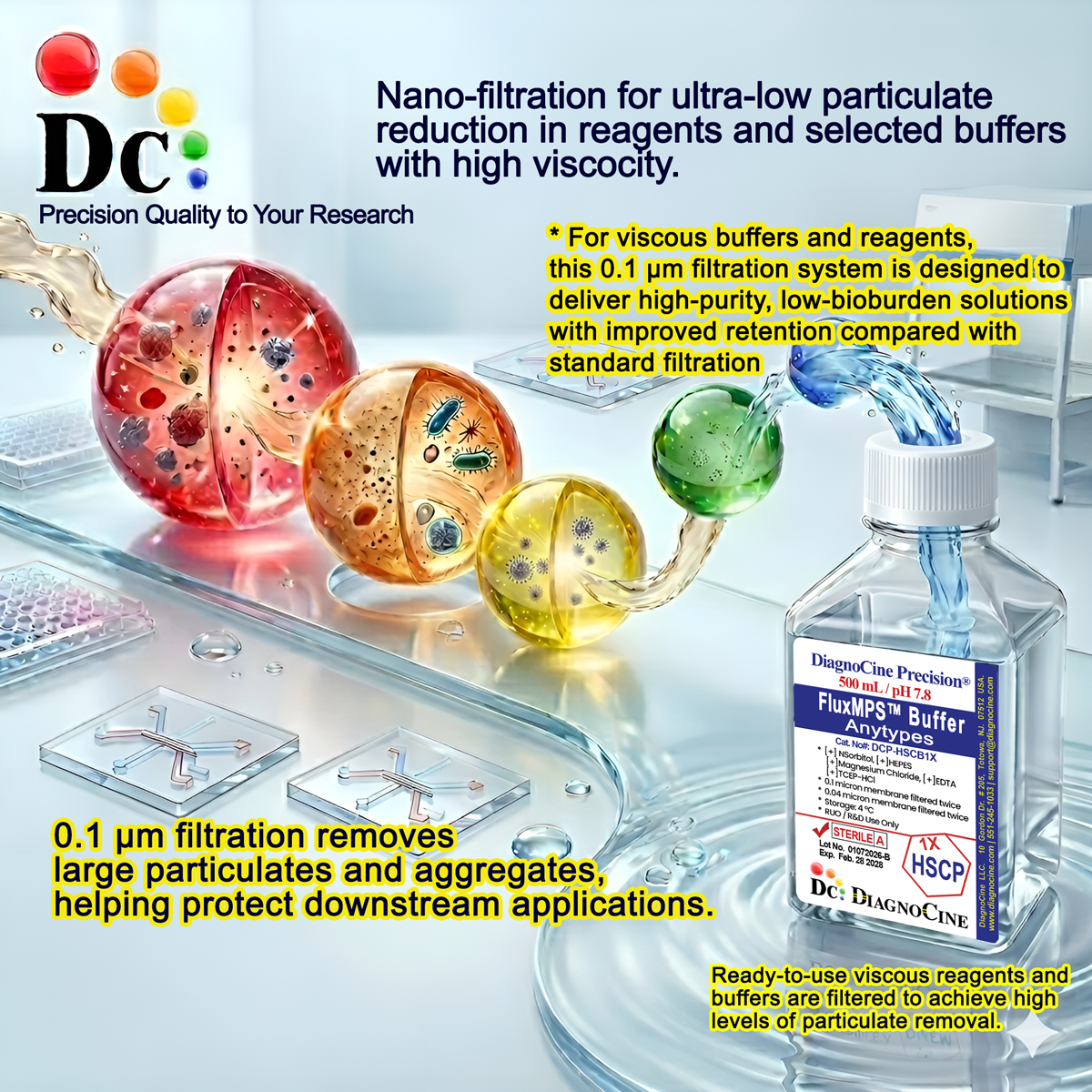
© Diagnocine® - DCP-PICEDTA10X
Where DCP-PICEDTA10X performs
FluxMPS™ Protease Inhibitor Cocktail with EDTA (10X) supports protein purification and extraction, cell lysis, protein expression and characterization studies, Western blotting, and cell culture experiments across traditional and microfluidic-based (MPS/OoC) research workflows.
Automated Bioreactors & Robotics
An optional 0.01 µm (10 nm) ultra-filtered variant is available for laboratories running automated bioreactors and liquid-handling robotics, where sub-micron particulate control helps protect valves, sensors, and perfusion lines during extended, unattended operation.
- Total Particulate Exclusion
- Valve & Sensor Protection
- Extended Perfusion Stability
Inquiry Required: The 0.01 µm ultra-filtered grade is produced to order — contact support@diagnocine.com to request this configuration.
Micro Physiological System (MPS) & Chip Lysis
Supports protease inhibition in microfluidic protein workflows used across MPS and organ-on-a-chip platforms.
Cell Lysis & Protein Extraction
Protects target proteins from proteolytic degradation during cell lysis and protein extraction procedures.
iPSC-Derived Model Protein Studies
Preserves protein integrity when preparing lysates from iPSC-derived cell models for downstream analysis.
Endothelial & Primary Cell Lysate Preparation
Used in protein extraction workflows for endothelial and primary cell perfusion and culture studies.
ELISA, Western Blotting & Blocking
Maintains protein stability for Western blotting and ELISA workflows sensitive to proteolytic degradation.
Protein Expression & Characterization Studies
Supports protein expression and characterization workflows requiring stable, degradation-resistant samples.
Detailed product parameters
All specifications below reflect data reported for DCP-PICEDTA10X in its Source Description.
| Parameter | Specification |
|---|---|
| Formulation / Composition | 10X Protease Inhibitor Cocktail with EDTA (AEBSF.HCl, Aprotinin, Bestatin, E-64, EDTA, Leupeptin, Pepstatin A) |
| Appearance | Clear solution |
| Size | 5 x 1 mL |
| Working Dilution | 100-fold (to 1X) |
| Parameter | Specification |
|---|---|
| Sterility | Non-sterile; 0.1 µm membrane filtered once USP <71> |
| Filtration System | 0.1 µm membrane, single pass |
| DNase Activity | None detected (18 hr, room temperature, plasmid DNA) |
| RNase Activity | None detected (18 hr, room temperature, ribosomal RNA) |
| Water Quality | Ultrapure Type 1 water (18.2 MΩ·cm) USP <85> |
| Parameter | Specification |
|---|---|
| Storage (Long-Term) | -80°C |
| Storage (Short-Term) | 4°C (1-4 weeks) |
| Shelf Life | 1 year at -80°C |
| Parameter | Specification |
|---|---|
| Manufacturing QMS | ISO 13485-certified, CE-approved facility ISO 13485 |
| Regulatory Alignment | Final packaging, QA, and testing at DiagnoCine R&D and Quality Testing Center |
| Production Method | Custom assembly at DiagnoCine Precision, Totowa, New Jersey, USA |
| Intended Use | Research Use Only (RUO) |
Full composition
Each component below is supplied at the fixed mM or µM concentration reported for this cocktail.
| Component | CAS Number | Concentration |
|---|---|---|
| AEBSF.HCl | 30827-99-7 | 1 mM |
| Aprotinin | 9087-70-1 | 8 µM |
| Bestatin | 58970-76-6 | 0.5 mM |
| E-64 | 66701-25-5 | 10 µM |
| EDTA | 60-00-4 | 0.05 M |
| Leupeptin | 103476-89-7 | 0.1 mM |
| Pepstatin A | 26305-03-3 | 0.01 mM |
Manufacturing & compliance
DCP-PICEDTA10X is manufactured and released under a documented quality system with defined filtration, testing, and traceability steps.
DNase Activity
None detected after 18-hour incubation with plasmid DNA at room temperature.
RNase Activity
None detected after 18-hour incubation with ribosomal RNA at room temperature.
Appearance
Clear solution confirmed at release.
Documentation / CoA
Certificate of Analysis available upon request.
How DCP-PICEDTA10X compares
A structural comparison against unfiltered and standard 0.22 µm-filtered protease inhibitor preparations.
| Parameter | DCP-PICEDTA10X (FluxMPS™) | Conventional Cocktail (Unfiltered) | Standard Alternative (0.22 µm Filtered) |
|---|---|---|---|
| Final filtration pore size | 0.1 µm (single pass) | Unfiltered | 0.22 µm |
| Number of filtration stages | 1 | 0 | 1 |
| Manufacturing QMS | check_circle | cancel | cancel |
| Ultrapure Type 1 water (18.2 MΩ·cm) | check_circle | cancel | cancel |
| DNase / RNase tested | check_circle | cancel | cancel |
| Custom concentration / formulation available | check_circle | cancel | cancel |
| Microfluidic / MPS compatibility | check_circle | cancel | cancel |
Frequently asked questions
Answers to common technical questions about DCP-PICEDTA10X.
Supporting literature
Curated references relevant to protease inhibitor use, chelation, and cell/protein workflows.
- Twyman R.M. Protein extraction and solubilization for downstream proteomic analysis. doi:10.1016/B978-0-12-374984-0.01206-3
- Rice R.H., Means G.E. Radiolabeling of proteins in vitro. Methods and applications of protease inhibitors in lysis buffers. doi:10.1016/S0021-9258(19)45387-2
- Powers J.C., Asgian J.L., Ekici O.D., James K.E. Irreversible inhibitors of serine, cysteine, and threonine proteases. Chem Rev. doi:10.1021/cr010182v
- Barrett A.J., Rawlings N.D., Woessner J.F. Handbook of Proteolytic Enzymes — Aspartic and metalloproteinase inhibition by pepstatin A and EDTA. doi:10.1016/B978-0-12-382219-2.00001-4
- Umezawa H. et al. Bestatin, an inhibitor of aminopeptidase B, produced by actinomycetes. J Antibiot. doi:10.7164/antibiotics.29.97
- Hanada K. et al. Isolation and characterization of E-64, a new thiol protease inhibitor. Agric Biol Chem. doi:10.1080/00021369.1978.10863261
- Kolkman J.A., Law D.J. Vascular biology and endothelial cell lysate preparation for downstream protein analysis. doi:10.1002/9780470015902.a0021941
- Bhatia S.N., Ingber D.E. Microfluidic organs-on-chips. Nat Biotechnol. doi:10.1038/nbt.2989
- Mahmoudi M. et al. Particulate contamination control in laboratory reagents for sensitive cell-based assays. doi:10.1016/j.actbio.2018.01.008
- Mahmood T., Yang P.C. Western blot: technique, theory, and trouble shooting. N Am J Med Sci. doi:10.4103/1947-2714.100998