

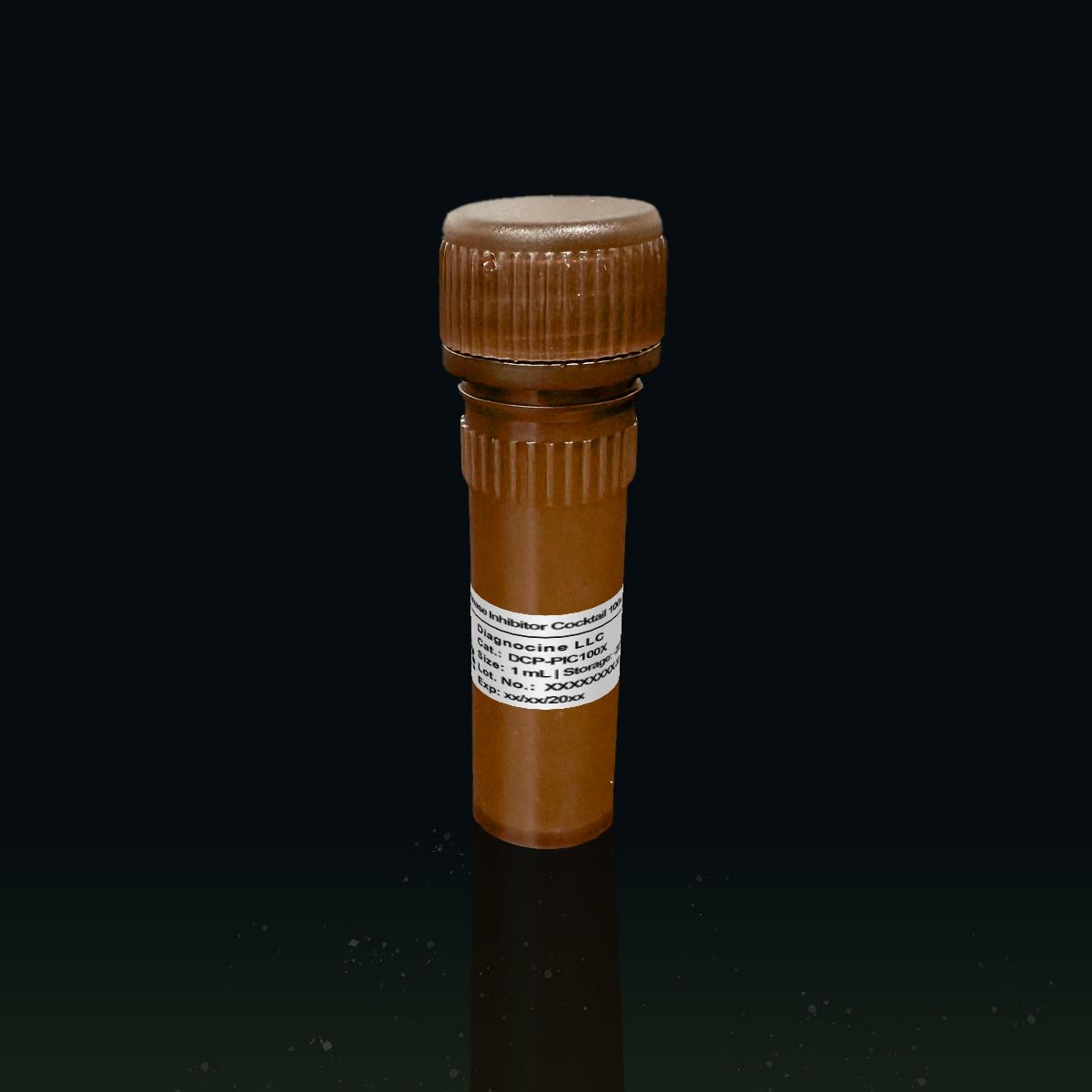
Protease Inhibitor Cocktail (100X)
FluxMPS™ Protease Inhibitor Cocktail (100X)
FluxMPS™ Protease Inhibitor Cocktail (100X) is an ultrapure, single-pass 0.1 µm membrane filtered blend of six broad-spectrum protease inhibitors formulated for sensitive protein workflows, including microfluidic and organ-on-a-chip (OoC) sample preparation. Diluted 100-fold to working concentration, it blocks serine, cysteine, aspartic, and aminopeptidase protease activity without introducing detectable DNase or RNase background.
- Filtered 0.1 µm membrane once for ultrapure clarity (non-sterile process)
- Broad-spectrum inhibition of serine, cysteine, aspartic, and aminopeptidase proteases
- Contains AEBSF.HCl, Aprotinin, Bestatin, E-64, Leupeptin, and Pepstatin A
- No detectable DNase or RNase activity after 18-hour incubation at room temperature
- Diluted 100-fold to working concentration for cell lysis, protein purification, and enzymatic assays
- Supplied at a 1 mL fill volume
- Customizable concentrations, tracking dyes, and pH available on request
- Concentration100X (diluted 100-fold for use)
- Filtration0.1 µm membrane, once
- SterilityNon-sterile (filtered in non-sterile environment)
- AppearanceClear solution
- DNase ActivityNone detected
- RNase ActivityNone detected
- Fill Volume1 mL
- Storage-80°C (long term), 4°C (short term)
- Shelf Life3 years
- Water QualityUltrapure Type 1 water (18.2 MΩ·cm)
Engineered where standard protease inhibitor cocktails fail
Conventional, unfiltered protease inhibitor cocktails can carry subvisible particulates and inconsistent inhibitor loading that interfere with microchannel handling, sensitive imaging, and downstream assays. FluxMPS™ Protease Inhibitor Cocktail (100X) is manufactured to remove that variability at the source.
Microchannel-safe purity
Single-pass 0.1 µm membrane filtration removes large particulates and aggregates before final formulation.
Precise, balanced inhibition
A carefully balanced blend of AEBSF.HCl, Aprotinin, Bestatin, E-64, Leupeptin, and Pepstatin A targets serine, cysteine, aspartic, and aminopeptidase proteases.
Ultrapure-grade water
Formulated with ultrapure Type 1 water (18.2 MΩ·cm) to support sensitive downstream applications.
Low background for imaging & assays
No detectable DNase or RNase activity after 18-hour incubation, keeping sensitive protein and nucleic acid workflows clean.
Defined, traceable composition
Each inhibitor is formulated at a fixed, disclosed concentration, from 0.1 mM Pepstatin A up to 10 mM AEBSF.HCl.
Customization on demand
Alternate concentrations, tracking dyes, and pH modifications are available — contact support@diagnocine.com.
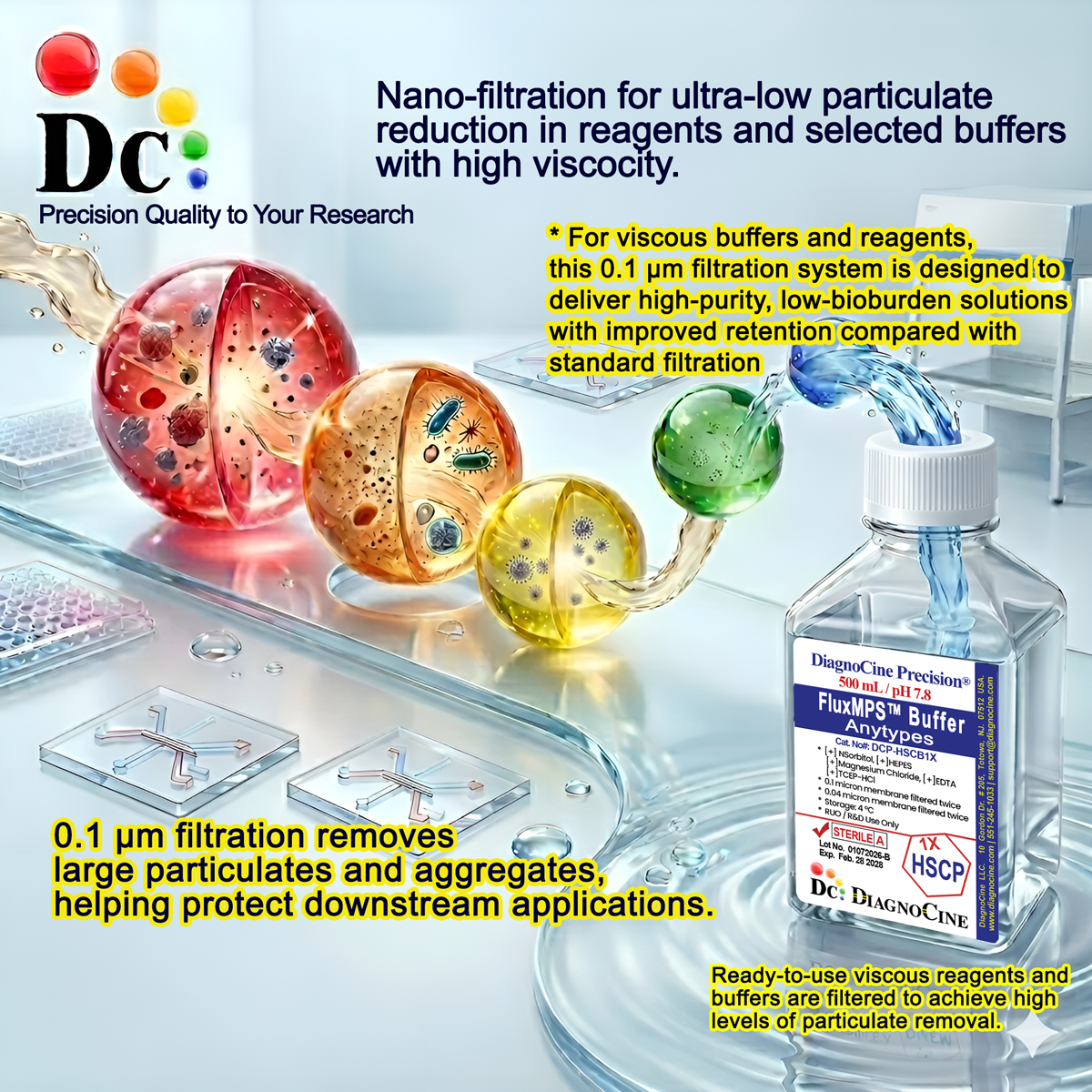
Single-stage 0.1 µm filtration
DCP-PIC100X is ultrapure-filtered through a 0.1 µm membrane once. This single-stage process is performed in a non-sterile environment, positioning the product for research applications where particulate reduction — not terminal sterility — is the goal.
-
1
0.1 µm Pre-filtration I
Large particulate and aggregate removal through a single 0.1 µm membrane pass, yielding a clear, ultrapure solution.
Performance vs. conventional cocktail
Single-pass 0.1 µm membrane filtration removes large particulates and aggregates ahead of final formulation, supporting cleaner cell lysis and protein purification workflows. This product is filtered once and processed in a non-sterile environment.
© Diagnocine® — DCP-PIC100X
Where DCP-PIC100X is used
Diluted 100-fold to working concentration, this cocktail protects protein samples throughout extraction, purification, and downstream analysis.
Automated Bioreactors & Robotics
For automated protein purification and robotic liquid handling platforms sensitive to subvisible particulates, an optional 0.01 µm (10 nm) ultra-filtered variant of this cocktail is available on request.
- Total Particulate Exclusion — supports automated fluidic paths that are intolerant of residual particulates
- Valve & Sensor Protection — reduces the risk of fine-particulate fouling in robotic dispensing hardware
- Extended Perfusion Stability — suited to continuous-flow protein purification setups
Inquiry Required: the 0.01 µm ultra-filtered grade is produced to order — contact support@diagnocine.com to discuss your automated platform's requirements.
Micro Physiological System (MPS) & Chip
Supplement lysis and processing buffers used in microfluidic tissue models to protect sample proteins from proteolytic degradation.
Protein Extraction & Cell Lysis
Add to lysis buffers to minimize proteolytic degradation of target proteins during extraction and homogenization.
iPSC-Derived Model Handling
Protects labile proteins during lysis and characterization of iPSC-derived cell types.
Endothelial & Primary Cell Perfusion
Supports protein-preserving lysis of primary and endothelial cell populations for downstream analysis.
ELISA, Blotting & Blocking
Preserves target protein integrity in lysates used for immunoassay and blotting workflows.
Microscopy & Optical Sensing
Low DNase/RNase background supports sample preparation for imaging and biosensor-based readouts.
Specifications
Values below reflect this product's own formulation and quality control results.
| Parameter | Specification |
|---|---|
| Formulation | Broad-spectrum blend of AEBSF.HCl, Aprotinin, Bestatin, E-64, Leupeptin, and Pepstatin A |
| Appearance | Clear solution |
| Concentration | 100X (diluted 100-fold to working concentration) |
| Fill Volume | 1 mL |
| Parameter | Specification |
|---|---|
| Sterility | Non-sterile; filtered 0.1 micron once in a non-sterile environment |
| Filtration | 0.1 µm membrane, once ISO 13485 |
| DNase Activity | None detected (18 hours, room temperature, plasmid DNA) |
| RNase Activity | None detected (18 hours, room temperature, ribosomal RNA) |
| Water Quality | Ultrapure Type 1 water (18.2 MΩ·cm) |
| Manufacturing Standard | ISO 13485-certified, CE-approved facility |
| Parameter | Specification |
|---|---|
| Storage (Long Term) | -80°C |
| Storage (Short Term) | 4°C |
| Shelf Life | 3 years |
| Freeze-Thaw | Avoid repeated freeze-thaw cycles |
| Parameter | Specification |
|---|---|
| Manufacturing Facility | ISO 13485-certified and CE-approved (Suppliers of DiagnoCine Precision) |
| Final QA & Testing | DiagnoCine R&D and Quality Testing Center |
| Customization & Assembly | DiagnoCine Precision, Totowa, New Jersey, USA |
| Intended Use | Research Use Only (RUO) |
Full composition (mM / µM)
Each inhibitor is formulated at a fixed, disclosed concentration to deliver reproducible, broad-spectrum protease protection when diluted 100-fold to working concentration.
| Component | CAS Number | Concentration |
|---|---|---|
| AEBSF.HCl | 30827-99-7 | 10 mM |
| Aprotinin | 9087-70-1 | 80 µM |
| Bestatin | 58970-76-6 | 5 mM |
| E-64 | 66701-25-5 | 100 µM |
| Leupeptin | 103476-89-7 | 1 mM |
| Pepstatin A | 26305-03-3 | 0.1 mM |
Manufacturing & compliance
DCP-PIC100X is produced and quality-tested under a controlled, certified manufacturing chain.
ISO 13485:2016 QMS
Manufactured under ISO 13485-certified facility standards, ensuring consistent quality control across every lot.
Ultrapure Type 1 Water
Formulated with ultrapure water supporting 18.2 MΩ·cm Type 1 water quality standards.
CE-Approved Facility & Testing Center
Final packaging, quality assurance, and testing are completed at the DiagnoCine R&D and Quality Testing Center.
Micro-Batch Customization
Specific customization requests and assembly are accomplished at DiagnoCine Precision in Totowa, New Jersey, USA.
DNase Activity Testing
No DNase activity detected after incubation of plasmid DNA with this product for 18 hours at room temperature.
RNase Activity Testing
No RNase activity detected after incubation of ribosomal RNA with this product for 18 hours at room temperature.
Appearance & Clarity
Confirmed as a clear solution.
Documentation / CoA
A Certificate of Analysis is available on request.
How DCP-PIC100X compares
A look at how DCP-PIC100X stacks up against typical protease inhibitor cocktails.
| Parameter | DCP-PIC100X (FluxMPS™) | Conventional Cocktail | Standard Alternative |
|---|---|---|---|
| Broad-spectrum protease coverage | check_circle | cancel | check_circle |
| Final filtration pore size | 0.1 µm | Not filtered | 0.22 µm |
| Number of filtration stages | 1 | 0 | 1 |
| DNase & RNase tested | check_circle | cancel | cancel |
| Water quality | Ultrapure Type 1 | Not specified | Not specified |
| Manufacturing QMS | ISO 13485-certified | cancel | Varies |
| Microfluidic / OoC compatibility | check_circle | cancel | Varies |
| Custom formulation available | check_circle | cancel | cancel |
Frequently asked questions
Answers to common questions about DCP-PIC100X.
Supporting literature
Curated literature relevant to the individual protease inhibitor classes contained in this cocktail and to microfluidic/organ-on-a-chip sample handling.
- Barrett AJ, Kembhavi AA, Brown MA, et al. L-trans-Epoxysuccinyl-leucylamido(4-guanidino)butane (E-64) and related compounds as inhibitors of cysteine proteinases including cathepsins B, H and L. Biochem J. 1982;201(1):189-198. doi:10.1042/bj2010189
- Umezawa H, Aoyagi T, Suda H, Hamada M, Takeuchi T. Bestatin, an inhibitor of aminopeptidase B, produced by actinomycetes. J Antibiot (Tokyo). 1976;29(1):97-99. doi:10.7164/antibiotics.29.97
- Marciniszyn J Jr, Hartsuck JA, Tang J. Mode of inhibition of acid proteases by pepstatin. J Biol Chem. 1976;251(22):7088-7094. doi:10.1016/S0021-9258(17)32945-8
- Powers JC, Asgian JL, Ekici OD, James KE. Irreversible inhibitors of serine, cysteine, and threonine proteases. Chem Rev. 2002;102(12):4639-4750. doi:10.1021/cr010182v
- Fritz H, Wunderer G. Biochemistry and applications of aprotinin, the kallikrein inhibitor from bovine organs. Arzneimittelforschung. 1983;33(4):479-494.
- Huh D, Matthews BD, Mammoto A, Montoya-Zavala M, Hsin HY, Ingber DE. Reconstituting organ-level lung functions on a chip. Science. 2010;328(5986):1662-1668. doi:10.1126/science.1188302
- Bhatia SN, Ingber DE. Microfluidic organs-on-chips. Nat Biotechnol. 2014;32(8):760-772. doi:10.1038/nbt.2989
- Low LA, Mummery C, Berridge BR, Austin CP, Tagle DA. Organs-on-chips: into the next decade. Nat Rev Drug Discov. 2021;20(5):345-361. doi:10.1038/s41573-020-0079-3