


Protease Inhibitor Cocktail (10X)
FluxMPS™ Protease Inhibitor Cocktail (10X)
DCP-PIC10X is an MPS-grade, 10X protease inhibitor cocktail formulated to provide broad-spectrum protection against serine, cysteine, aspartic, and aminopeptidase proteases in cell and molecular biology workflows. The concentrate is Non-Sterile, Ultrapure, and filtered through a single 0.1 µm membrane pass for a clean, low-particulate formulation suited to sensitive protein work, including microfluidic and organ-on-a-chip (OoC) lysate preparation.
- Single-pass 0.1 µm membrane filtration for an ultra-clean, Non-Sterile, Ultrapure concentrate
- Broad-spectrum protection: serine, cysteine, aspartic, and aminopeptidase inhibitors in one cocktail
- 10X concentrate — dilute 100-fold to working concentration
- DNase and RNase activity: none detected after 18-hour incubation at room temperature
- Compatible with cell lysis, protein purification, enzymatic assays, and Western blotting
- Manufactured under ISO 13485-certified and CE-approved facilities
- Custom concentrations, tracking dyes, pH, and other modifications available on inquiry
- Format10X Concentrate
- Pack Size5 X 1 mL
- SterilityNon-Sterile
- Filtration0.1 µm membrane, single pass
- Working Dilution100-fold
- AppearanceClear solution
- DNase ActivityNone detected
- RNase ActivityNone detected
- Storage-80°C (long term); 4°C (short term, 1-4 weeks)
- Shelf Life1 year at 80°C
Engineered where standard cocktails fall short
Unfiltered or loosely-filtered protease inhibitor preparations can carry particulates and inconsistent inhibitor loading that compromise sensitive protein workflows and microfluidic channels. DCP-PIC10X is built to remove that variability.
Microchannel-safe purity
Single-pass 0.1 µm membrane filtration yields an ultra-clean, low-particulate concentrate compatible with narrow-bore microfluidic and OoC systems.
Balanced inhibitor concentrations
AEBSF.HCl, Aprotinin, Bestatin, E-64, Leupeptin, and Pepstatin A are combined at carefully balanced concentrations for reproducible, broad-spectrum protease inhibition.
Ultrapure formulation
Supplied as an Ultrapure liquid concentrate to minimize background interference in downstream biochemical assays.
Low background for downstream assays
Compatible with Western blotting and enzymatic assays where clean, low-particulate reagents reduce assay background.
Defined, traceable composition
Every inhibitor is present at a stated concentration with a known chemical identity, supporting reproducible experimental design.
Customization on demand
Alternate concentrations, tracking dyes, pH, and other modifications can be requested for protocol-specific needs.
Single-stage 0.1 µm filtration
DCP-PIC10X is Non-Sterile, Ultrapure, and filtered once through a 0.1 µm membrane — a single-pass purity step matched to a research-grade protease inhibitor concentrate rather than an aseptically-filled sterile buffer.
-
1
0.1 µm Single-Pass Membrane Filtration
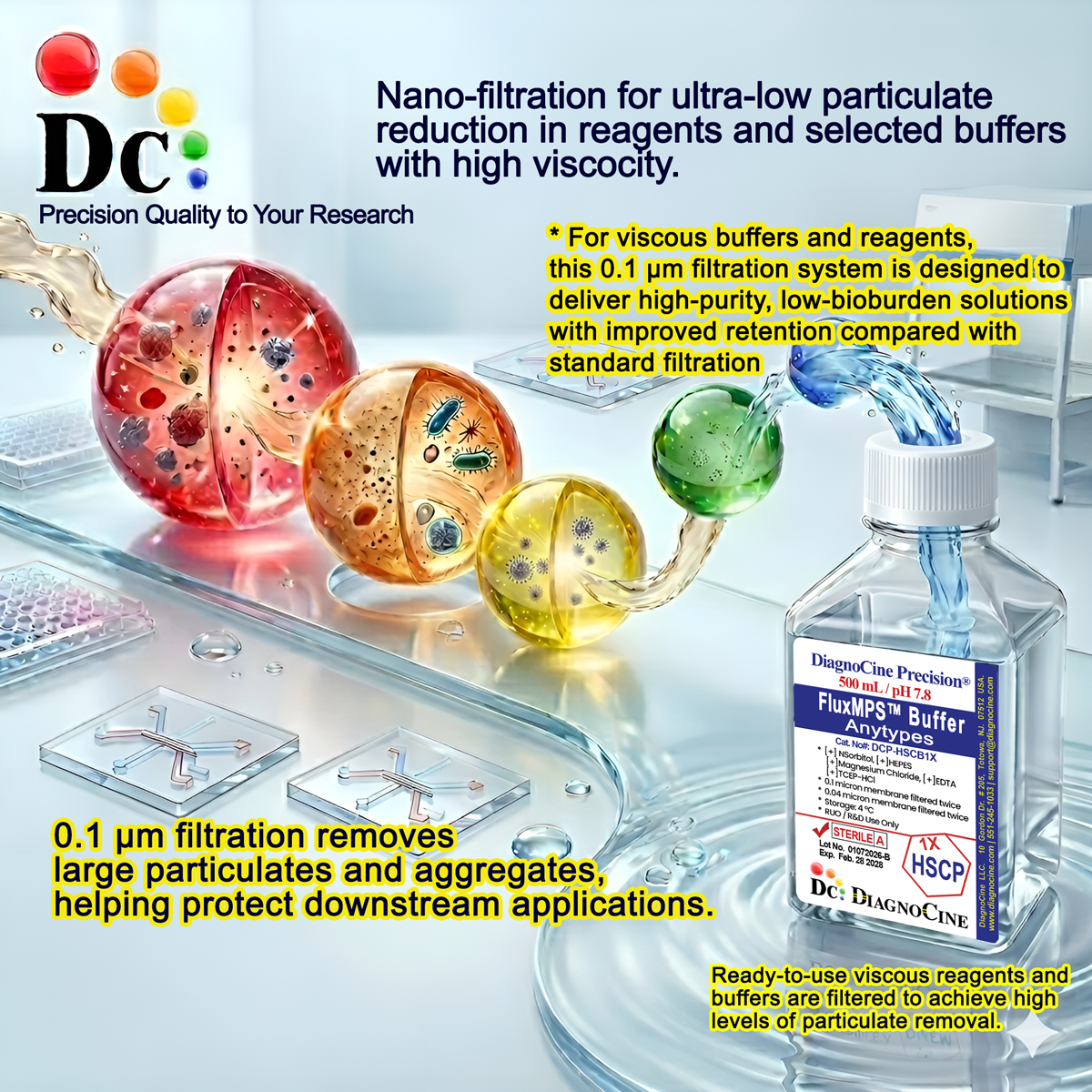
The 10X cocktail is passed once through a 0.1 µm membrane, removing particulates and aggregates to deliver a clean, Ultrapure, Non-Sterile concentrate suitable for sensitive protein work.
Performance vs. conventional preparation
Single-pass 0.1 µm membrane filtration removes particulates and aggregates that unfiltered or coarsely-filtered protease inhibitor stocks can retain, supporting cleaner lysates and more consistent downstream assay results.
© Diagnocine® — DCP-PIC10X
Where DCP-PIC10X fits your workflow
This 10X protease inhibitor cocktail minimizes proteolytic degradation across a wide range of protein-focused laboratory procedures, from lysis through downstream detection.
Automated Bioreactors & Robotics
For automated bioreactor and robotic liquid-handling workflows requiring the lowest possible particulate load, an optional 0.01 µm (10 nm) ultra-filtered variant of this protease inhibitor cocktail is available on request.
- Total Particulate Exclusion — finer membrane retention for automated fluidic paths
- Valve & Sensor Protection — reduces particulate load on precision components
- Extended Perfusion Stability — supports longer unattended run times
Inquiry Required: contact support@diagnocine.com to request the 0.01 µm ultra-filtered grade for your automated platform.
Protein Purification & Extraction
Included during purification and extraction to preserve target protein integrity by suppressing proteolytic activity.
Cell Lysis Procedures
Added to lysis buffers to minimize protein degradation immediately upon cell disruption.
Protein Expression & Characterization
Supports expression and characterization studies where intact, non-degraded protein is required for accurate results.
Western Blotting
Preserves target protein bands during sample preparation for Western blot analysis by limiting proteolytic breakdown.
Cell Culture Experiments
Used in cell culture workflows to protect secreted or intracellular proteins from degradation during handling.
Enzymatic Assays
Prevents proteolytic interference in enzymatic assay systems where sample protein stability is required over the assay timeline.
Full specification set
Every measured and declared parameter for DCP-PIC10X, organized for quick reference.
| Parameter | Specification |
|---|---|
| Formulation | 10X cocktail of AEBSF.HCl, Aprotinin, Bestatin, E-64, Leupeptin, and Pepstatin A |
| Appearance | Clear solution |
| Working Dilution | 100-fold to working concentration |
| Product Grade | Ultrapure |
| Parameter | Specification |
|---|---|
| Sterility USP <71>-referenced | Non-Sterile; filtered 0.1-micron membrane once |
| DNase Activity | None detected after 18-hour incubation with plasmid DNA at room temperature |
| RNase Activity | None detected after 18-hour incubation with ribosomal RNA at room temperature |
| Manufacturing Standard ISO 13485 | ISO 13485-certified, CE-approved facilities |
| Parameter | Specification |
|---|---|
| Storage Temperature (long term) | -80°C |
| Storage Temperature (short term) | 4°C, 1-4 weeks |
| Shelf Life | 1 year at 80°C |
| Parameter | Specification |
|---|---|
| Manufacturing QMS ISO 13485 | ISO 13485-certified facility (Supplier of DiagnoCine Precision) |
| Regulatory Alignment | CE-approved facility |
| Production Method | Final packaging, quality assurance, and testing performed at the DiagnoCine R&D and Quality Testing Center |
| Customization Assembly | DiagnoCine Precision, Totowa, New Jersey, USA |
| Intended Use | Research Use Only (RUO) |
Full composition
Six inhibitors, each present at a defined concentration, combine to block serine, cysteine, aspartic, and aminopeptidase proteolytic activity in a single 10X concentrate.
| Component | CAS Number | Concentration |
|---|---|---|
| AEBSF.HCl | 30827-99-7 | 1 mM |
| Aprotinin | 9087-70-1 | 8 µM |
| Bestatin | 58970-76-6 | 0.5 mM |
| E-64 | 66701-25-5 | 10 µM |
| Leupeptin | 103476-89-7 | 0.1 mM |
| Pepstatin A | 26305-03-3 | 0.01 mM |
Manufacturing & compliance
DCP-PIC10X is produced and quality-tested under a documented, ISO 13485-aligned quality system.
ISO 13485:2016 QMS
Manufactured under ISO 13485-certified and CE-approved supplier facilities (DiagnoCine Precision).
Ultrapure Single-Pass Filtration
Single 0.1 µm membrane filtration produces an Ultrapure, Non-Sterile, ultra-clean formulation.
Dedicated QA & Testing Center
Final packaging, quality assurance, and testing are completed at the DiagnoCine R&D and Quality Testing Center.
Custom Formulation Assembly
Specific customization requests and assembly are completed at DiagnoCine Precision in Totowa, New Jersey, USA.
DNase Activity Testing
None detected after 18-hour incubation with plasmid DNA at room temperature.
RNase Activity Testing
None detected after 18-hour incubation with ribosomal RNA at room temperature.
Appearance QC
Verified as a clear solution prior to release.
Documentation / CoA
Certificate of Analysis available on request.
How DCP-PIC10X compares
A side-by-side look at inhibitor coverage, filtration, and quality testing relative to conventional preparations.
| Parameter | DCP-PIC10X (FluxMPS™) | Conventional Single-Target Inhibitor | Standard Alternative Cocktail |
|---|---|---|---|
| Protease Classes Inhibited | Serine, cysteine, aspartic & aminopeptidase (6 inhibitors) | Serine only | Serine & cysteine |
| Final Filtration Pore Size | 0.1 µm | Not filtered | Not specified |
| DNase Activity Tested | check_circle | cancel | cancel |
| RNase Activity Tested | check_circle | cancel | cancel |
| ISO 13485-Certified Manufacturing | check_circle | cancel | Not specified |
| Custom Formulation Available | check_circle | cancel | cancel |
| Working Dilution | 100-fold from 10X concentrate | Varies | 100-fold |
| Certificate of Analysis | check_circle | Not specified | Not specified |
Frequently asked questions
Common questions about DCP-PIC10X formulation, filtration, and use.
Supporting literature
DCP-PIC10X has no product-specific published citations at this time. The literature below provides background on protease inhibition, protein sample preparation, and organ-on-a-chip workflows relevant to its use.
- Bond, J.S., Butler, P.E. Intracellular proteases. Annu Rev Biochem. 1987. doi:10.1146/annurev.bi.56.070187.002143
- Powers, J.C., et al. Irreversible inhibitors of serine, cysteine, and threonine proteases. Chem Rev. 2002. doi:10.1021/cr010182v
- Umezawa, H., et al. Bestatin, an inhibitor of aminopeptidase B, produced by actinomycetes. J Antibiot. 1976. doi:10.7164/antibiotics.29.97
- Barrett, A.J., Kembhavi, A.A., et al. L-trans-Epoxysuccinyl-leucylamido(4-guanidino)butane (E-64) and related compounds as inhibitors of cysteine proteinases. Biochem J. 1982. doi:10.1042/bj2010353
- Fritz, H., et al. Aprotinin: biochemistry and applications. Arzneimittelforschung. 1983.
- Marciniszyn, J., et al. Mode of inhibition of acid proteases by pepstatin. J Biol Chem. 1976.
- Bhatia, S.N., Ingber, D.E. Microfluidic organs-on-chips. Nat Biotechnol. 2014. doi:10.1038/nbt.2989
- Zhang, B., Radisic, M. Organ-on-a-chip devices advance to market. Lab Chip. 2017. doi:10.1039/C6LC01554A
- Mahmood, T., Yang, P.C. Western blot: technique, theory, and trouble shooting. N Am J Med Sci. 2012. doi:10.4103/1947-2714.100998
- Simpson, R.J. Stabilization of proteins for storage. Cold Spring Harb Protoc. 2010. doi:10.1101/pdb.top79