

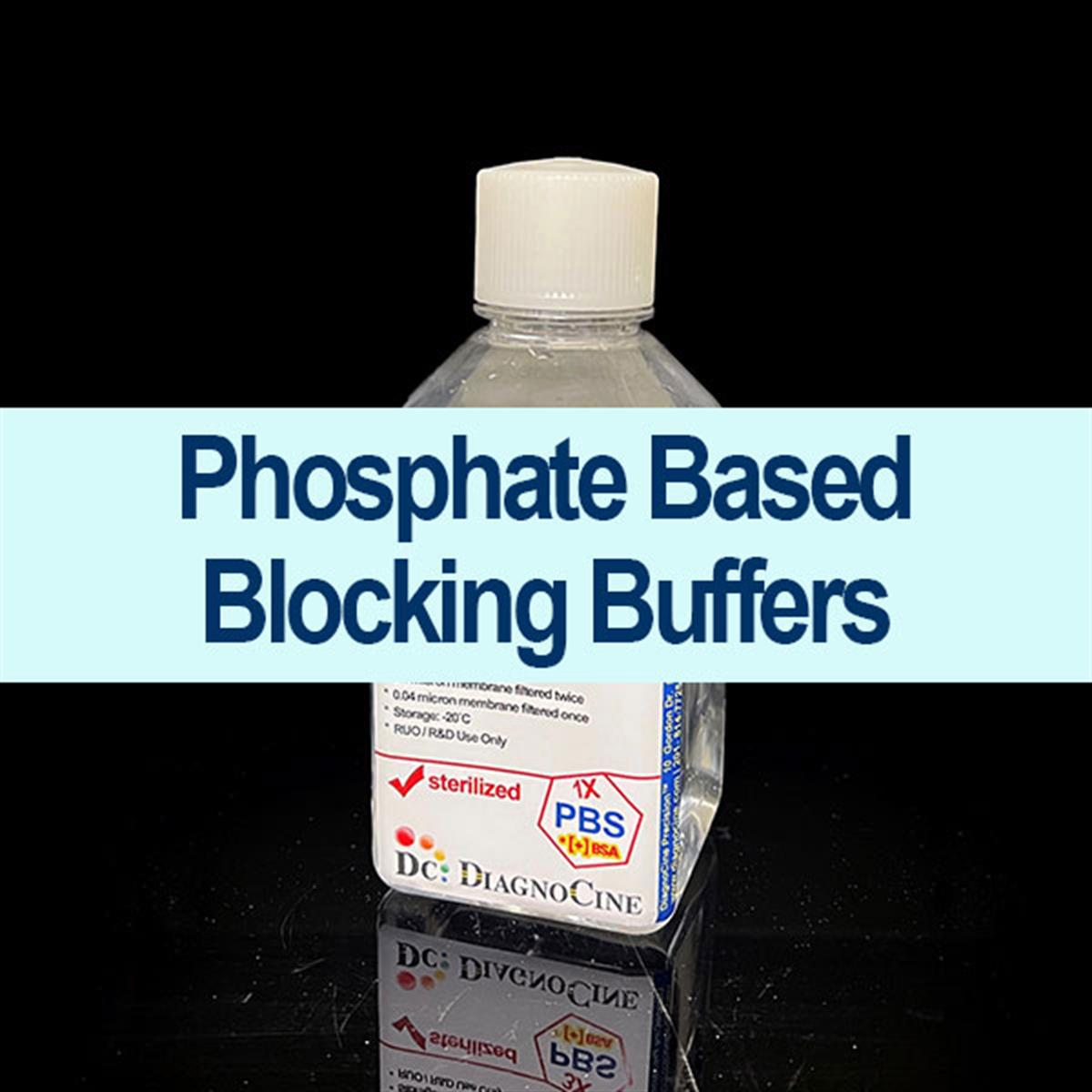
Phosphate Based Blocking Buffers - Category Selection Guide
Five blocking formulations on two phosphate-buffered bases, ten catalog numbers in 500 ml and 1000 ml. This page is a category reference — pick the formulation your detection chemistry needs and click View for its product page; specifications and selection guidance follow below.
| Cat. No. | Base | Size |
|---|---|---|
|
Bovine Serum Albumin (3%) with PBS Blocking Buffer PBS · 2 catalog numbers · 500 ml · 1000 ml
Viewarrow_forward |
||
| DCP-BSAPBS3X_500 ml | PBS | 500 ml |
| DCP-BSAPBS3X_1000 ml | PBS | 1000 ml |
|
Bovine Serum Albumin (3%) with PBST Blocking Buffer PBST · 2 catalog numbers · 500 ml · 1000 ml
Viewarrow_forward |
||
| DCP-BSAPBST3X_500 ml | PBST | 500 ml |
| DCP-BSAPBST3X_1000 ml | PBST | 1000 ml |
|
Casein (1%) with PBS Blocking Buffer PBS · 2 catalog numbers · 500 ml · 1000 ml
Viewarrow_forward |
||
| DCP-CPBS1X_500 ml | PBS | 500 ml |
| DCP-CPBS1X_1000 ml | PBS | 1000 ml |
|
Gelatin (1%) in PBS Blocking Buffer PBS · 2 catalog numbers · 500 ml · 1000 ml
Viewarrow_forward |
||
| DCP-GPBS1X_500 ml | PBS | 500 ml |
| DCP-GPBS1X_1000 ml | PBS | 1000 ml |
|
PVP in PBS Blocking Buffer PBS · 2 catalog numbers · 500 ml · 1000 ml
Viewarrow_forward |
||
| DCP-PVPPBS1X_500 ml | PBS | 500 ml |
| DCP-PVPPBS1X_1000 ml | PBS | 1000 ml |
Not sure which formulation? Compare the blocking agents · See applications by formulation · Read the FAQ
What the five formulations share, and where they differ
Phosphate-based blocking buffers provide an effective and versatile option for reducing non-specific binding in various protein detection techniques. Their ability to maintain physiological pH and compatibility with many detection systems make them a popular choice in molecular biology and biochemistry research. However, researchers should consider the specific requirements of their assay when choosing between phosphate-based and other blocking buffer options.
- Five formulations: Bovine Serum Albumin (3%) with PBS, Bovine Serum Albumin (3%) with PBST, Casein (1%) with PBS, Gelatin (1%) in PBS, and PVP in PBS.
- Two phosphate-buffered bases: PBS and PBST, as published in the product names.
- Why phosphate: the source credits the ability to maintain physiological pH and compatibility with many detection systems.
- Appearance: Clear, Colorless Liquid.
- Sterility: Nonsterile; 0.1 µm membrane filtration (single step).
- Fill sizes: every formulation is stocked in 500 ml and 1000 ml — ten catalog numbers in total.
- Selection basis: the source advises weighing the specific requirements of the assay when choosing between phosphate-based and other blocking buffer options.
- CategoryPhosphate Based Blocking Buffers
- Buffer bases stockedPBS, PBST
- Formulations5
- Catalog numbers10
- Fill sizes500 ml, 1000 ml
- AppearanceClear, Colorless Liquid
- Filtration0.1 µm membrane filtration (single step)
- Blocking agentsBSA 3%, Casein 1%, Gelatin 1%, PVP
- pHphysiological (value not stated)
Same base, different blocker, different blot
All five formulations sit on a phosphate base, so the variable a buyer is actually choosing is the blocking agent. The published immunoassay literature is consistent on one point: that choice is not cosmetic. Each literature statement below is cited to the reference list at the foot of the page.
Non-specific binding is the target
The source describes these buffers as an effective and versatile option for reducing non-specific binding in various protein detection techniques.
The phosphate base holds physiological pH
The source attributes the popularity of this family in molecular biology and biochemistry research to its ability to maintain physiological pH and its compatibility with many detection systems.
The blocker changes what you detect
A direct comparison of serum albumin, non-fat dry milk and Tween 20 on nitrocellulose found quantitative and qualitative differences in the antigens detected, and recommended comparing several blocking and washing methods rather than assuming one.[2]
Blocking efficiency differs by agent
On polystyrene plates, casein and instantized milk suppressed non-specific binding by over 90 % at far lower concentrations than most of eight other proteins; enzymatically hydrolyzed porcine-skin gelatin was the least effective protein tested.[3]
Casein is itself a phosphoprotein
Casein is the primary blocking protein of non-fat dry milk and is a phosphoprotein, which is why casein-based blocking is reported as unsuitable for phospho-specific antibodies.[7]
A protein-free route exists
Polyvinylpyrrolidone was described as a blocking agent for immunochemical work precisely because it is not a protein[4]; it is also a blocking component of Denhardt’s hybridization solution.[5]
The one decision this page exists to support
The source says to weigh the specific requirements of the assay when choosing between phosphate-based and other blocking buffers — and the literature says where that bites hardest: a casein blocker and a phospho-specific antibody are a documented mismatch[7], and a purified single protein such as BSA carries its own caveat that preparations differ and need a blocking control.[6]
0.1 µm membrane filtration
0.1 µm filtration removes large particulates and aggregates, helping protect downstream applications.
-
1
0.1 µm Membrane Filtration
Removes large particulates and aggregates, helping protect downstream applications.
The stocked agents, and what the literature records about each
The source does not publish a comparison table for this family, so the table below pairs each stocked formulation with the published characterization of its blocking agent. Every literature entry is cited; nothing in the “Formulation” column has been altered from the catalog.
| Formulation (as stocked) | Agent class | What the published literature records | Watch-out |
|---|---|---|---|
| Bovine Serum Albumin (3%) with PBS Blocking Buffer | Single purified protein | Serum albumin is one of the standard blockers benchmarked against milk, casein and gelatin on plates and on nitrocellulose.[2,3] | BSA preparations are not interchangeable: non-specific binding has been traced to the BSA preparation itself, so a blocking-agent control is advised.[6] |
| Bovine Serum Albumin (3%) with PBST Blocking Buffer | Single purified protein on a Tween-containing base | The non-ionic detergent Tween 20 was itself introduced as a means of blocking unoccupied protein-binding sites on nitrocellulose.[1] | Tween 20 used alone as the blocking agent has been reported to give artefactual results, so it is normally paired with a protein blocker.[9] |
| Casein (1%) with PBS Blocking Buffer | Milk phosphoprotein | Casein and instantized milk were the most effective proteins tested for suppressing non-specific binding, blocking by over 90 % at far lower concentrations than most alternatives.[3] | Casein is a phosphoprotein; casein-based blocking is reported as unsuitable for phospho-specific antibodies.[7] |
| Gelatin (1%) in PBS Blocking Buffer | Denatured collagen | Blocking performance depends strongly on the gelatin source: fish-skin gelatin blocked far better than enzymatically hydrolyzed porcine-skin gelatin, the weakest protein in the series.[3] | The source does not state the gelatin origin for this catalog item. Confirm it before applying a literature figure. |
| PVP in PBS Blocking Buffer | Synthetic polymer, protein-free | Polyvinylpyrrolidone was characterized as a blocking agent for immunochemical studies[4], and is a blocking component of Denhardt’s membrane-hybridization solution.[5] | The source does not state a PVP concentration for this catalog item, while the other four formulations carry one. |
Which formulation for which detection chemistry
The source assigns applications to the category as a whole, not to individual formulations. Each tab therefore states the source’s own category-level use first, then the published characterization of that blocking agent, cited.
- Reducing non-specific binding in various protein detection techniques (source).
- Anti-phosphoprotein antibodies: supplier guidance names BSA as the preferred blocker[10], and casein-based blocking is reported as unsuitable for phospho-specific antibodies.[7]
- Run a blocking-agent control: non-specific binding has been traced to the BSA preparation itself.[6]
- Reducing non-specific binding in various protein detection techniques (source).
- Protocols that keep a non-ionic detergent in the blocking step; Tween 20 was introduced as a way of blocking unoccupied protein-binding sites on nitrocellulose.[1]
- Tween 20 used alone as the blocking agent has been reported to produce artefactual results.[9]
- Reducing non-specific binding in various protein detection techniques (source).
- General protein detection where blocking strength is the priority: casein blocked non-specific binding by over 90 % at far lower concentrations than most of eight other proteins tested.[3]
- Not the formulation for phospho-specific antibodies — casein is itself a phosphoprotein.[7]
- Reducing non-specific binding in various protein detection techniques (source).
- An alternative when albumin- or milk-derived blockers cross-react with the probe; gelatin sits in the same benchmarked series as albumin, casein and milk.[3]
- Published performance is source-dependent: fish-skin gelatin blocked far better than enzymatically hydrolyzed porcine-skin gelatin.[3] The source does not state which gelatin this item uses.
- Reducing non-specific binding in various protein detection techniques (source).
- Workflows in which every protein blocker is a potential cross-reactant: polyvinylpyrrolidone was characterized as a blocking agent for immunochemical studies precisely because it is not a protein.[4]
- Membrane-hybridization lineage: PVP is a blocking component of Denhardt’s solution.[5]
The five formulations side by side
Every value in this table is reproduced from the catalog exactly as published.
| Product | Blocking agent | Base | Catalog numbers | Sizes |
|---|---|---|---|---|
| Bovine Serum Albumin (3%) with PBS Blocking Buffer | Bovine Serum Albumin (3%) | PBS | DCP-BSAPBS3X_500 ml DCP-BSAPBS3X_1000 ml |
500 ml, 1000 ml |
| Bovine Serum Albumin (3%) with PBST Blocking Buffer | Bovine Serum Albumin (3%) | PBST | DCP-BSAPBST3X_500 ml DCP-BSAPBST3X_1000 ml |
500 ml, 1000 ml |
| Casein (1%) with PBS Blocking Buffer | Casein (1%) | PBS | DCP-CPBS1X_500 ml DCP-CPBS1X_1000 ml |
500 ml, 1000 ml |
| Gelatin (1%) in PBS Blocking Buffer | Gelatin (1%) | PBS | DCP-GPBS1X_500 ml DCP-GPBS1X_1000 ml |
500 ml, 1000 ml |
| PVP in PBS Blocking Buffer | PVP (concentration not stated in source) | PBS | DCP-PVPPBS1X_500 ml DCP-PVPPBS1X_1000 ml |
500 ml, 1000 ml |
Frequently asked questions
The questions that come up when a purchasing decision meets a detection chemistry.
Supporting literature on blocking agents
The Diagnocine source description carries no citation list of its own. The sources below are the ones cited in the sections above; each was checked against its published record before it was listed.
- Batteiger B, Newhall WJ 5th, Jones RB (1982). The use of Tween 20 as a blocking agent in the immunological detection of proteins transferred to nitrocellulose membranes. J Immunol Methods 55(3):297–307. doi:10.1016/0022-1759(82)90089-8
- Spinola SM, Cannon JG (1985). Different blocking agents cause variation in the immunologic detection of proteins transferred to nitrocellulose membranes. J Immunol Methods 81(1):161–165. doi:10.1016/0022-1759(85)90132-2
- Vogt RF Jr, Phillips DL, Henderson LO, Whitfield W, Spierto FW (1987). Quantitative differences among various proteins as blocking agents for ELISA microtiter plates. J Immunol Methods 101(1):43–50. doi:10.1016/0022-1759(87)90214-6
- Haycock JW (1993). Polyvinylpyrrolidone as a blocking agent in immunochemical studies. Anal Biochem 208(2):397–399. doi:10.1006/abio.1993.1068
- Denhardt DT (1966). A membrane-filter technique for the detection of complementary DNA. Biochem Biophys Res Commun 23(5):641–646. doi:10.1016/0006-291X(66)90447-5
- Xiao Y, Isaacs SN (2012). Enzyme-linked immunosorbent assay (ELISA) and blocking with bovine serum albumin (BSA) — not all BSAs are alike. J Immunol Methods 384(1–2):148–151. doi:10.1016/j.jim.2012.06.009
- Galva C, Gatto C, Milanick M (2012). Soymilk: an effective and inexpensive blocking agent for immunoblotting. Anal Biochem 426(1):22–23. doi:10.1016/j.ab.2012.03.028
- Kim EE, Wyckoff HW (1991). Reaction mechanism of alkaline phosphatase based on crystal structures. Two-metal ion catalysis. J Mol Biol 218:449–464. doi:10.1016/0022-2836(91)90724-K
- Bird CR, Gearing AJH, Thorpe R (1988). The use of Tween 20 alone as a blocking agent for immunoblotting can cause artefactual results. J Immunol Methods 106(2):175–179.
- Bio-Rad Laboratories. Immunodetection (western blotting technical guide, Bio-Rad Antibodies). — Supplier guidance on TBS/TBST with AP-labeled antibodies and BSA for anti-phosphoprotein antibodies.