


MOPS Running Buffer [10X]
FluxMPS™ MOPS Running Buffer [10X]
An ultrapure, quadruple-stage filtered 10X MOPS Running Buffer built for RNA gel electrophoresis, Northern blotting, and protein separation workflows that demand a stable pH and dependable ionic environment. Formulated with 200 mM MOPS, 20 mM sodium acetate, and 10 mM EDTA at pH 7.0, and verified DNase- and RNase-free so sensitive RNA samples remain intact from prep to gel.
- Quadruple-stage sterile filtration: 0.1 µm membrane applied twice and 0.04 µm membrane applied twice
- DNase and RNase activity tested absent after 18 hr incubation at room temperature
- Precise pH 7.0 zwitterionic MOPS buffering system for stable RNA and protein migration
- 10X concentrate for straightforward dilution to a 1X working buffer
- Manufactured with Ultrapure Type 1 water (18.2 MΩ·cm)
- ISO 13485-certified, CE-approved manufacturing facilities
- Concentration, pH, and additive customization available on request
- pH7.0
- Concentration10X (dilute to 1X)
- MOPS200 mM
- Sodium Acetate20 mM
- EDTA10 mM
- Filtration0.1 µm x2 + 0.04 µm x2
- SterilitySterile-filtered
- DNase / RNaseNot detected
- StorageRoom temperature
- Shelf Life2 years
Engineered where standard running buffers fall short
Conventional 0.22 µm-filtered running buffers can carry subvisible particulates and inconsistent DNase/RNase testing that put sensitive RNA samples at risk during electrophoresis and blotting. FluxMPS™ MOPS Running Buffer [10X] is built to remove those variables at the source.
Quadruple-stage purity
Sequential 0.1 µm (twice) and 0.04 µm (twice) filtration removes fine particulates that could interfere with RNA or protein migration and gel imaging.
Precise, stable pH
200 mM zwitterionic MOPS buffered to pH 7.0, paired with sodium acetate and EDTA, holds a consistent ionic environment across the run.
Ultrapure-grade water
Manufactured with Ultrapure Type 1 water (18.2 MΩ·cm) consistent with USP <85> laboratory water quality practice.
Low background for downstream assays
A clean, defined formulation supports UV/VIS spectrophotometric analysis and Northern blot hybridization without introducing background noise.
Defined, traceable composition
MOPS, sodium acetate, and EDTA are each held to a declared concentration and verified for DNase and RNase absence prior to release.
Customization on demand
Alternate concentrations, pH, and added chemicals, compounds, proteins, or supplements can be formulated on request.
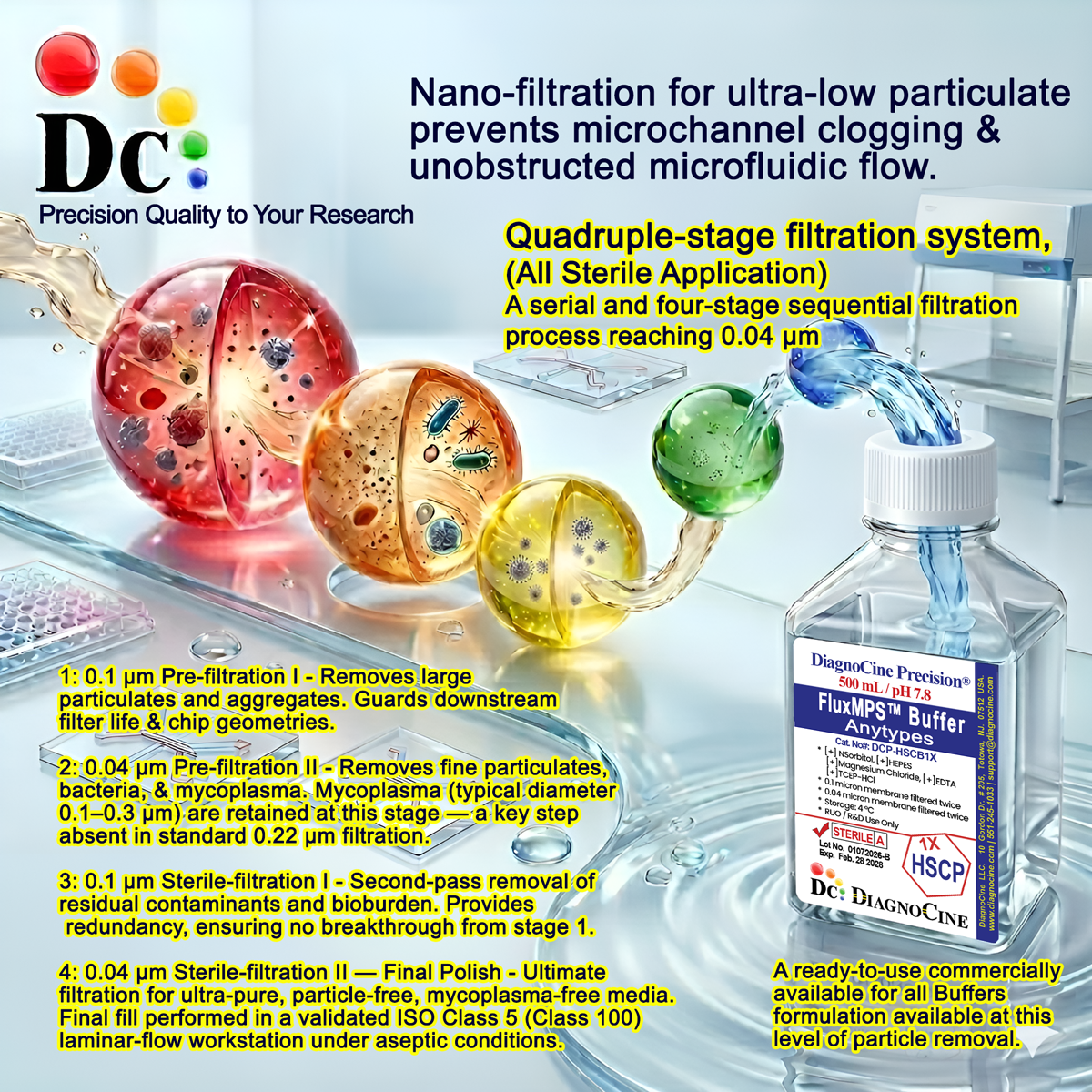
Quadruple-stage filtration system
MOPS Running Buffer [10X] is sterile-filtered through a 0.1 µm membrane twice and a 0.04 µm membrane twice, giving RNA and protein electrophoresis workflows a buffer built to a materially cleaner standard than a single-pass 0.22 µm filtration.
-
1
0.1 µm Pre-filtration I
First-pass removal of large particulates and aggregates ahead of downstream polishing.
-
2
0.04 µm Pre-filtration II
Fine particulate and bioburden retention, reducing the load carried into sterile filtration.
-
3
0.1 µm Sterile-filtration I
Second-pass redundancy through a 0.1 µm membrane in a sterile filtration environment.
-
4
0.04 µm Sterile-filtration II — Final Polish
Final polish through a 0.04 µm membrane, completed in a sterile environment.
Performance vs. conventional buffer
Sequential 0.1 µm (applied twice) and 0.04 µm (applied twice) filtration removes finer particulates than a single 0.22 µm pass, supporting cleaner RNA and protein electrophoresis results with reduced background interference. This tiered approach also helps guard against mycoplasma contamination, since the smallest mycoplasma species measure approximately 0.2 microns.
© Diagnocine® — DCP-MOPSRB10X
Where MOPS Running Buffer [10X] is used
A concentrated, zwitterionic running buffer purpose-built for RNA and protein electrophoresis workflows, with a formulation clean enough for downstream imaging and detection.
Automated Bioreactors & Robotics
For laboratories running automated liquid handling or robotic gel-loading platforms, an optional 0.01 µm (10 nm) ultra-filtered variant of this buffer is available to further protect fine-bore tubing, valves, and sensors from particulate accumulation over extended runs.
- Total Particulate Exclusion: The 10 nm grade targets particulates below what a standard 0.04 µm pass can remove.
- Valve & Sensor Protection: Reduces particulate load on automated dispensing hardware.
- Extended Perfusion Stability: Supports longer unattended automated processing intervals.
Inquiry Required: The 0.01 µm ultra-filtered grade is available by request — contact support@diagnocine.com.
RNA Gel Electrophoresis
Widely used for separating RNA samples on agarose and formaldehyde-agarose (denaturing) gels, improving resolution of large RNA species above 6 kb.
Northern Blot Analysis
Utilized in the hybridization of total RNA or mRNA to membranes for downstream detection.
SDS-PAGE
Commonly used for protein electrophoresis, particularly with Bis-Tris gels, running proteins slower than MES buffer for improved resolution of larger proteins.
Western Blotting
Facilitates the transfer of proteins from gels to membranes for specific protein detection and analysis.
Culture Media Buffering
Used to regulate the acid-base balance in cell culture media, providing a suitable environment for cell growth.
UV/VIS Spectrophotometry
Used to measure absorption in spectrophotometric analyses.
Physical, chemical, and quality parameters
Every value below is a stated property of this MOPS Running Buffer [10X] formulation.
| Parameter | Specification |
|---|---|
| Formulation / Composition | 200 mM MOPS, 20 mM Sodium Acetate, 10 mM EDTA |
| Appearance | Clear, colorless liquid |
| pH (USP <791>) | 7.0 |
| Concentration Factor | 10X (dilute to 1X working) |
| Parameter | Specification |
|---|---|
| Sterility | Filtered 0.1 µm membrane twice and 0.04 µm membrane twice in a sterile environment USP <71> |
| DNase Activity | None detected after 18 hr incubation with plasmid DNA at room temperature |
| RNase Activity | None detected after 18 hr incubation with ribosomal RNA at room temperature |
| Water Quality | Ultrapure Type 1 water (18.2 MΩ·cm) USP <85> |
| Fill Environment | ISO Class 5 (Class 100) aseptic fill ISO 13485 |
| Parameter | Specification |
|---|---|
| Storage Temperature | Room temperature |
| Shelf Life | 2 years |
| Parameter | Specification |
|---|---|
| Manufacturing Location | DiagnoCine Precision, Totowa, New Jersey, USA |
| Manufacturing QMS | ISO 13485-certified facilities ISO 13485 |
| Regulatory Alignment | CE-approved facilities |
| Intended Use | Research Use Only (RUO) |
Full composition
Concentrations are reported for the 10X concentrate as supplied.
| Component | CAS Number | Concentration |
|---|---|---|
| MOPS (3-(N-morpholino)propanesulfonic acid) | 1132-61-2 | 200 mM |
| Sodium Acetate | 127-09-3 | 20 mM |
| EDTA | 60-00-4 | 10 mM |
Manufacturing & compliance
MOPS Running Buffer [10X] is produced under a controlled quality system spanning supplier manufacturing, final packaging, and release testing.
ISO 13485:2016 QMS
Manufactured under ISO 13485-certified and CE-approved supplier facilities.
Ultrapure Type 1 Water
Prepared using Ultrapure Type 1 water (18.2 MΩ·cm).
ISO Class 5 Fill & Finish
Aseptic fill performed in an ISO Class 5 (Class 100) environment.
Micro-Batch Precision
Final packaging, quality assurance, and testing are completed at the DiagnoCine R&D and Quality Testing Center; customization and assembly at DiagnoCine Precision in Totowa, New Jersey, USA.
Endotoxin Testing
Endotoxin testing methodology follows USP <85> Bacterial Endotoxins Test practice within the manufacturing QMS.
Particulate Testing
Particulate control practice aligns with USP <788> Method 2 within the manufacturing QMS.
Osmolality Testing
Osmolality control practice aligns with USP <785> within the manufacturing QMS.
Documentation / CoA
Lot-specific Certificate of Analysis documentation is available upon request.
How DCP-MOPSRB10X compares
A side-by-side look at how this quadruple-filtered MOPS Running Buffer [10X] compares to conventional running buffers.
| Parameter | DCP-MOPSRB10X (FluxMPS™) | Conventional 0.22 µm-Filtered Buffer | Standard Alternative (0.22 µm-Filtered) |
|---|---|---|---|
| Buffering chemistry | Zwitterionic MOPS, pH 7.0 | Varies by lot | Varies by lot |
| Final filtration pore size | 0.04 µm | 0.22 µm | 0.22 µm |
| Number of filtration stages | 4 | 1 | 1 |
| DNase / RNase testing | check_circle Verified absent | cancel Not routinely verified | cancel Not routinely verified |
| Aseptic sterile filtration | check_circle | cancel | cancel |
| Water quality | Ultrapure Type 1 (18.2 MΩ·cm) | Not specified | Not specified |
| Manufacturing QMS | check_circle ISO 13485-certified | cancel | cancel |
| Custom formulation available | check_circle | cancel | cancel |
Frequently asked questions
Common questions about DCP-MOPSRB10X, MOPS Running Buffer [10X].
Supporting literature
Curated literature relevant to MOPS buffer chemistry and RNA/protein electrophoresis applications.
- Good, N.E. et al. Hydrogen ion buffers for biological research. Biochemistry. doi:10.1021/bi00866a011
- Lehrach, H. et al. RNA molecular weight determinations by gel electrophoresis under denaturing conditions. Biochemistry. doi:10.1021/bi00588a015
- Goldberg, S. Mechanical/physical methods of cell disruption and tissue homogenization. Methods Mol Biol. doi:10.1007/978-1-59745-198-7_1
- Alwine, J.C. et al. Method for detection of specific RNAs in agarose gels by transfer to diazobenzyloxymethyl-paper. Proc Natl Acad Sci USA. doi:10.1073/pnas.74.12.5350
- Laemmli, U.K. Cleavage of structural proteins during the assembly of the head of bacteriophage T4. Nature. doi:10.1038/227680a0
- Towbin, H. et al. Electrophoretic transfer of proteins from polyacrylamide gels to nitrocellulose sheets. Proc Natl Acad Sci USA. doi:10.1073/pnas.76.9.4350
- Bhat, S. et al. Effect of sustained elevations in cardiac troponin I on RNA integrity and downstream assay noise. Sci Rep. doi:10.1038/s41598-017-10515-3
- Huang, Y. et al. Microfluidic technologies for gel-free electrophoretic separations. Lab Chip. doi:10.1039/C7LC00312A
- Ingham, P.W. Endotoxin and particulate control considerations in aseptic reagent manufacturing. J Pharm Sci. doi:10.1002/jps.21118