


Protein Running Buffers
Select See the table below
- See the table below
Protein Running Buffers
This is a category page, not a product page — pick the buffer system that matches your gel and protein size range, then click View to open that product page. The chemistry reference, applications, and FAQ follow below.
| Name | Cat. No. | pH | Size | Product Page |
|---|---|---|---|---|
| Tris-Tricine SDS Running Buffer | DCP-TTSDSRB1X | 8.3 | 500 ml | Viewarrow_forward |
| Tris-Tricine SDS Running Buffer | DCP-TTSDSRB1X | 8.3 | 1000 ml | Viewarrow_forward |
| Tris-Glycine SDS Buffer | DCP-TGSB1X | 8.3 | 500 ml | Viewarrow_forward |
| Tris-Glycine SDS Buffer | DCP-TGSB1X | 8.3 | 1000 ml | Viewarrow_forward |
| Tris-Glycine Non-Denaturing Buffer [1X] | DCP-TGNDRB1X | 8.3 | 500 ml | Viewarrow_forward |
| Tris-Glycine Non-Denaturing Buffer [1X] | DCP-TGNDRB1X | 8.3 | 1000 ml | Viewarrow_forward |
| Tris-Glycine Non-Denaturing Buffer [10X] | DCP-TGNDRB10X | 8.3 | 500 ml | Viewarrow_forward |
| Tris-Glycine Non-Denaturing Buffer [10X] | DCP-TGNDRB10X | 8.3 | 1000 ml | Viewarrow_forward |
| MES SDS Running Buffer | DCP-MESSDSRB1X | 7.3 | 500 ml | Viewarrow_forward |
| MES SDS Running Buffer | DCP-MESSDSRB1X | 7.3 | 1000 ml | Viewarrow_forward |
| MOPS SDS Running Buffer | DCP-MOPSSDSRB1X | 7.7 | 500 ml | Viewarrow_forward |
| MOPS SDS Running Buffer | DCP-MOPSSDSRB1X | 7.7 | 1000 ml | Viewarrow_forward |
Not sure which system? Compare the buffer chemistries · See applications by buffer · Read the FAQ
What these buffers are for
Protein running buffers are essential components in protein gel electrophoresis systems, used to separate proteins based on their size and charge. These buffers create the electrical conductivity necessary for protein migration through the gel matrix. Different buffer systems are designed for various gel types and protein size ranges (e.g., Tris-glycine for standard SDS-PAGE, MOPS or MES for Bis-Tris gels).
- Six products across four chemistries. Tris-Tricine, Tris-Glycine, MES, and MOPS — the last two being the Bis-Tris gel pairing the source names explicitly.
- Denaturing and non-denaturing are both stocked. Four products carry SDS in the name; the Tris-Glycine Non-Denaturing Buffer is offered at 1X and 10X.
- pH is specified per product. 8.3 for the Tris-based systems, 7.3 for MES, 7.7 for MOPS — a spread that reflects the gel each is built for.
- The buffer system follows the gel, not the protein alone. The source states that different buffer systems are designed for various gel types and protein size ranges.
- Every product ships in two sizes. 500 ml and 1000 ml, across all six products.
- Appearance. Clear, colorless liquid.
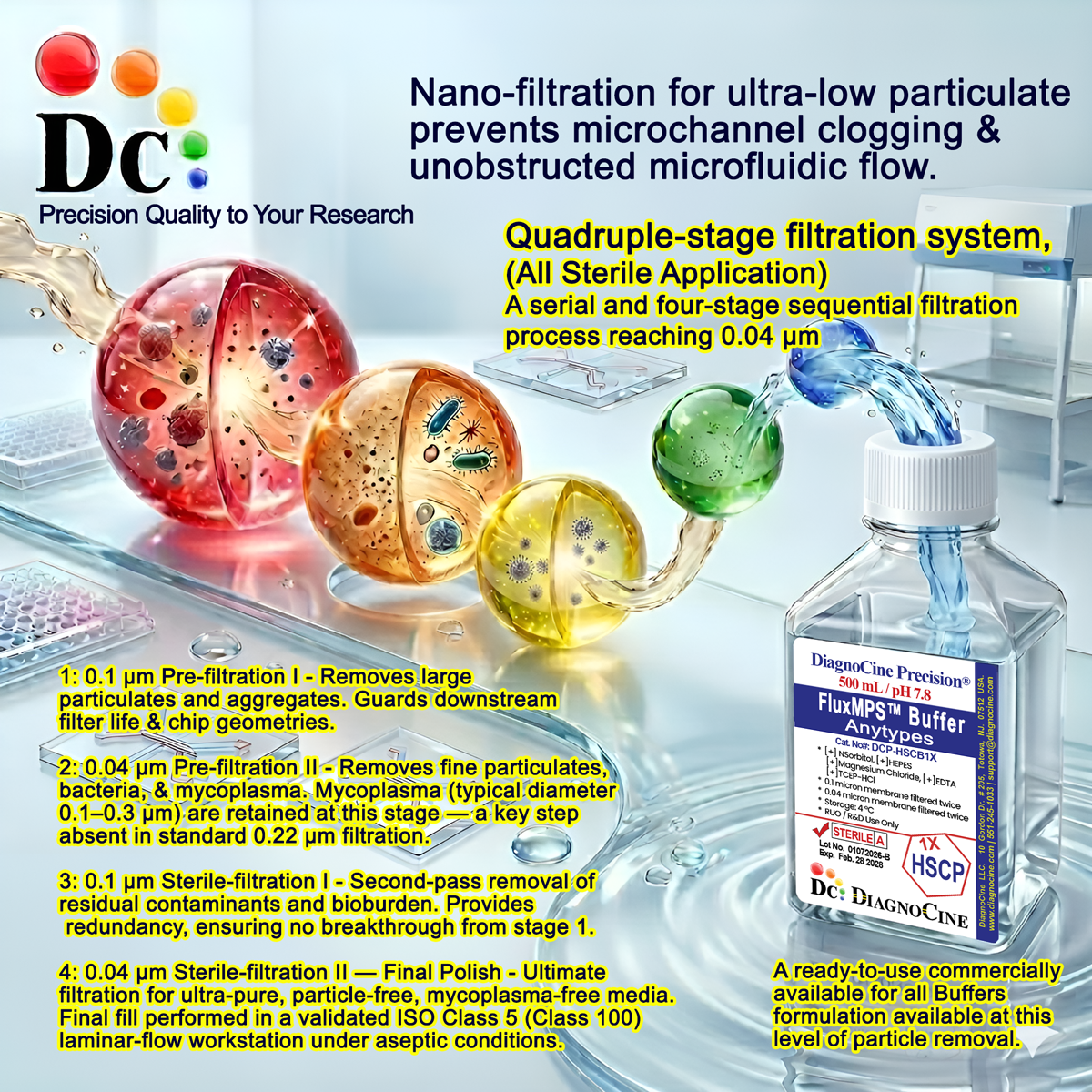
- Sterility. Filtered 0.1 micron twice and 0.04 micron twice, in a sterile environment.[a]
- Products in this category6
- Catalog entries (Cat. No.)12
- Buffer chemistriesTris-Tricine, Tris-Glycine, MES, MOPS
- Denaturing (SDS) products4
- Non-denaturing products2
- pH range across the category7.3 – 8.3
- Concentrations named[b]1X, 10X
- Fill sizes500 ml, 1000 ml
- AppearanceClear, colorless liquid
- Total membrane passes[a]4
[a] The source states “Filtered 0.1 micron Twice and 0.04 micron once”; that wording is canonicalized to 0.04 micron twice under the governing ruleset before it is used anywhere on the page. Flagged for confirmation — see the filtration section.
[b] 10X is carried in the source name of one product. 1X is taken from the catalog numbers (all six end in 1X or 10X) and from the published product titles; four of the six source names carry no concentration token. Confirm against the Certificate of Analysis before use.
Six things that follow from the chemistry you pick
The source's own framing is that different buffer systems are designed for different gel types and protein size ranges. The cards below unpack what that means at the bench.
It carries the current
These buffers create the electrical conductivity necessary for protein migration through the gel matrix. Without a conductive medium in the tank there is no field, and the separation that follows — by size and charge — cannot begin.
The gel decides the buffer
Tris-glycine is the standard pairing for conventional SDS-PAGE, while MOPS and MES are the pairings for Bis-Tris gels. That mapping comes straight from the source, and it is the first filter to apply before anything else on this page.
The buffer sets the size window
MES and MOPS run on the same Bis-Tris gel yet resolve different ranges, because MES has the lower pKa and migrates faster, which changes stacking and therefore separation range.[1,2] Same gel, different buffer, different part of the ladder in focus.
Operating pH is not cosmetic
This catalog spans pH 7.3 to 8.3 as supplied. The neutral-pH Bis-Tris systems were developed because the classical Laemmli system runs at a strongly basic operating pH, where residual unpolymerized acrylamide can react with cysteine and lysine residues.[1]
SDS or no SDS changes the question
Four products in this catalog carry SDS and separate denatured polypeptides by size. The Tris-Glycine Non-Denaturing Buffer omits it, so proteins stay folded and separation reflects native charge, size, and shape together.
Particulates stay in contact all run
Every buffer here is filtered 0.1 micron twice and 0.04 micron twice, in a sterile environment. A running buffer submerges the gel for the entire separation, so anything suspended in it is in contact with the matrix from the first volt to the last.
How to work down this catalog
Three questions, in order. First, which gel are you running — a conventional Tris-glycine gel, a Bis-Tris gel, or a tricine gel for small peptides? That eliminates most of the list. Second, denaturing or native? That picks between the SDS products and the non-denaturing one. Third, if you landed on a Bis-Tris gel, MES or MOPS — the smaller your protein of interest, the stronger the case for MES.[1,2]
Four membrane passes before the buffer is filled
The source states one sterility specification for the whole category: filtered 0.1 micron twice and 0.04 micron twice, in a sterile environment. The four stages below are that statement, in order.
-
1
0.1 µm Pre-filtration I
First pass through a 0.1 micron membrane, removing bulk particulates carried in from raw materials and dissolution.
-
2
0.04 µm Pre-filtration II
Second pass at 0.04 micron, a rating below the 0.1 micron stage that precedes it.
-
3
0.1 µm Sterile-filtration I
Repeat 0.1 micron pass, performed within the sterile environment in which the buffer is filled.
-
4
0.04 µm Sterile-filtration II — final polish
Final 0.04 micron polishing pass immediately before fill, in the same sterile environment.
Why this matters for a tank buffer specifically
A running buffer is not added to the sample — it submerges the gel and stays there for the whole separation, often for hours. Anything suspended in it has that entire time in contact with the matrix and with the proteins migrating through it. Four membrane passes ending at 0.04 micron are aimed at that exposure. Appearance as supplied is a clear, colorless liquid; a cloudy or tinted bottle is worth investigating before it goes into a tank.
The four buffer systems in this catalog
Product names, catalog numbers, and pH values are from the source. The gel pairing for Tris-glycine, MOPS, and MES is stated by the source. The final column is published third-party guidance on separation range, cited below — it is not a Diagnocine performance specification, and the source gives no size range for any product.
| Buffer system | Products | pH | Denaturing? | Gel pairing | Published separation guidance[1,2] |
|---|---|---|---|---|---|
| Tris-Glycine SDS | Tris-Glycine SDS Buffer (DCP-TGSB1X) | 8.3 | check_circle Yes | Standard SDS-PAGE, as stated by the source | The classical Laemmli system; the general-purpose default for denaturing protein gels |
| Tris-Glycine, non-denaturing | Tris-Glycine Non-Denaturing Buffer [1X] (DCP-TGNDRB1X) Tris-Glycine Non-Denaturing Buffer [10X] (DCP-TGNDRB10X) |
8.3 | cancel No | Native-PAGE on Tris-glycine gels | Proteins stay folded, so mobility reflects native charge, size, and shape together |
| Tris-Tricine SDS | Tris-Tricine SDS Running Buffer (DCP-TTSDSRB1X) | 8.3 | check_circle Yes | Tricine gel systems | Tricine replaces glycine as the trailing ion; the system developed to resolve small proteins and peptides[3] |
| MES SDS | MES SDS Running Buffer (DCP-MESSDSRB1X) | 7.3 | check_circle Yes | Bis-Tris gels, as stated by the source | Recommended for small- to medium-sized proteins; MES has the lower pKa, so it migrates faster than MOPS |
| MOPS SDS | MOPS SDS Running Buffer (DCP-MOPSSDSRB1X) | 7.7 | check_circle Yes | Bis-Tris gels, as stated by the source | Recommended for medium- to large-sized proteins; proteins run slower than in MES |
Which buffer for which gel
One tab per buffer system; the two Tris-Glycine Non-Denaturing concentrations share a tab because the chemistry is identical. The first bullet in each panel is the source description's own statement of use; the remaining bullets are workflow-level notes drawn from the cited references and can be removed independently.
- Separating proteins based on their size and charge, by creating the electrical conductivity necessary for protein migration through the gel matrix
- Standard SDS-PAGE on Tris-glycine gels — the pairing the source names explicitly
- Routine expression checks, lysate profiling, and fraction analysis during purification
- Western blot workflows built on the conventional Laemmli gel format
- Separating proteins based on their size and charge, by creating the electrical conductivity necessary for protein migration through the gel matrix
- Native-PAGE, where the protein must stay folded and mobility reflects native charge, size, and shape together
- In-gel activity work, where a denaturing run would destroy the readout
- Available at 1X for occasional runs and 10X for labs that would rather dilute per run than stock working-strength bottles
- Separating proteins based on their size and charge, by creating the electrical conductivity necessary for protein migration through the gel matrix
- Tricine gel systems, where tricine replaces glycine as the trailing ion[3]
- Small proteins and peptides, the separation problem the tricine system was developed to address[3]
- Work where bands at the bottom of a conventional glycine gel are too compressed to resolve
- Separating proteins based on their size and charge, by creating the electrical conductivity necessary for protein migration through the gel matrix
- Bis-Tris gels — the pairing the source names explicitly
- Small- to medium-sized proteins, the range published guidance assigns to MES[1,2]
- Faster runs on a Bis-Tris gel, since MES has the lower pKa and migrates faster than MOPS[1,2]
- Separating proteins based on their size and charge, by creating the electrical conductivity necessary for protein migration through the gel matrix
- Bis-Tris gels — the pairing the source names explicitly
- Medium- to large-sized proteins, the range published guidance assigns to MOPS[1,2]
- Runs where the slower migration in MOPS spreads the upper part of the ladder further apart[1,2]
The two format decisions
Once the gel has narrowed the chemistry, two questions remain. Neither is about quality — both are about what you are asking the gel and how much buffer you go through.
| Denaturing (SDS) | Non-denaturing (native) | |
|---|---|---|
| Products in this catalog | Tris-Glycine SDS Buffer Tris-Tricine SDS Running Buffer MES SDS Running Buffer MOPS SDS Running Buffer |
Tris-Glycine Non-Denaturing Buffer [1X] Tris-Glycine Non-Denaturing Buffer [10X] |
| Protein state during the run | Unfolded and detergent-coated | Folded, in its native state |
| What migration reflects | Primarily size | Native charge, size, and shape together |
| Useful for apparent molecular-weight assignment | check_circle Yes | cancel Not directly |
| Useful for in-gel activity work | cancel No | check_circle Yes |
| pH as supplied | 8.3 (Tris-Glycine, Tris-Tricine), 7.3 (MES), 7.7 (MOPS) | 8.3 |
| Concentrations offered | 1X | 1X and 10X — a 1000 ml bottle at 10X makes 10 litres of working buffer |
| Fill sizes | 500 ml, 1000 ml | 500 ml, 1000 ml |
Frequently asked questions
The questions that come up most often when a bench protocol meets a purchase order.
Sources behind the cited notes
The source description carries no citation list. The entries below support only the statements marked with a superscript above. Where a source publishes no DOI, none is shown — none has been invented.
- Thermo Fisher Scientific. NuPAGE Bis-Tris and Bolt Bis-Tris Plus gels — technical guidance, and the accompanying NuPAGE Technical Guide. — Source of the Bis-Tris discontinuous buffer description: MES or MOPS serves as the trailing ion, the running buffer sits at pH 7.3 to 7.7 against a pH 6.4 gel buffer, and the combination gives an operating pH near 7. Also the basis for the note that the classical Laemmli system runs at a strongly basic pH where residual unpolymerized acrylamide can react with cysteine and lysine residues.
- Invitrogen / Thermo Fisher Scientific. NuPAGE MES SDS Running Buffer and NuPAGE MOPS SDS Running Buffer — product documentation. — MES SDS is recommended for small- to medium-sized proteins and MOPS SDS for medium- to large-sized proteins; MES has a lower pKa than MOPS, making the MES buffer faster, and the resulting difference in ion migration affects stacking and therefore the separation range. Published formulations are pH 7.3 (MES) and pH 7.7 (MOPS).
- Schägger, H., & von Jagow, G. (1987). Tricine-sodium dodecyl sulfate-polyacrylamide gel electrophoresis for the separation of proteins in the range from 1 to 100 kDa. Analytical Biochemistry, 166(2), 368–379. — The origin of the tricine system, in which tricine replaces glycine as the trailing ion to extend clean separation to small proteins and peptides. doi:10.1016/0003-2697(87)90587-2
- Laemmli, U. K. (1970). Cleavage of structural proteins during the assembly of the head of bacteriophage T4. Nature, 227(5259), 680–685. — The discontinuous Tris-glycine SDS system that standard SDS-PAGE running buffers are formulated for. doi:10.1038/227680a0