


Blocking Buffer Test Set
FluxMPS™ Blocking Buffer Test Set
The FluxMPS™ Blocking Buffer Test Set (DCP-BBTS) is an MPS-grade screening panel of ready-to-use blocking chemistries — BSA, casein, gelatin, PVP, nonfat dry milk, and nonfat soy milk — formulated across PBS, TBS, PBST, and TBST bases so researchers can identify the lowest-background, highest-signal blocking buffer for their specific antigen-antibody pair.[1,2] Each 50 mL formulation is prepared with a controlled 0.1 µm membrane filtration step for a clean, consistent buffer base.
- Single-stage 0.1 µm membrane filtration for a clean, consistent buffer base across every formulation in the set
- Includes BSA, casein, gelatin, and PVP blocking chemistries in PBS, TBS, PBST, and TBST bases
- ProClin 300-preserved nonfat dry milk and nonfat soy milk formulations for extended bench stability
- 50 mL format per formulation — ideal for side-by-side strip blot and Western blot optimization
- Manufactured under ISO 13485:2016-aligned quality systems using Ultrapure Type 1 water
- Custom pH, concentration, and additive modifications available on request
- For Research Use Only (RUO)
- SKUDCP-BBTS
- FormatPre-formulated blocking buffer panel
- Size50 mL each
- Buffer BasesPBS, TBS, PBST, TBST
- Blocking AgentsBSA, casein, gelatin, PVP, nonfat dry milk, nonfat soy milk
- Milk PreservativeProClin 300
- Primary UseWestern blot & strip blot optimization
- CustomizationAvailable on request
- Manufacturing StandardISO 13485:2016
- Intended UseResearch Use Only (RUO)
Engineered where standard blocking protocols fail
Conventional single-formulation blocking buffers force researchers to guess, or to bench-prepare multiple recipes from scratch, before finding the agent that minimizes background without suppressing the specific signal. This test set removes that guesswork with pre-formulated, filtered, ready-to-use chemistries across the buffer bases and blocking agents most commonly used in strip blot and Western blot workflows.
Microchannel-safe purity
Each formulation is prepared with a 0.1 µm membrane filtration step, reducing particulate load in the buffer base and supporting cleaner blot and biosensor backgrounds.
Defined, ready-to-use formulations
Standard concentrations — 3% BSA, 1% casein, 1% gelatin, 5% nonfat dry milk, 5% nonfat soy milk — are pre-prepared in 1X PBS or TBS, eliminating in-house weighing and pH-adjustment error.
Ultrapure-grade water
Every buffer base is prepared using Ultrapure Type 1 water (18.2 MΩ·cm), reducing trace ionic and organic contaminants that can elevate blot background.
Low background for imaging & assays
Systematic screening across BSA, casein, gelatin, PVP, and milk-based agents helps identify the formulation with the best signal-to-noise ratio for a given antibody pair and detection method.[3]
Defined, traceable composition
Each formulation is its own catalog item with a dedicated product record, supporting lot traceability back to the individual blocking buffer used.
Customization on demand
Additional concentrations, chemicals, compounds, proteins, supplements, and pH modifications are available on request for any formulation in the set.
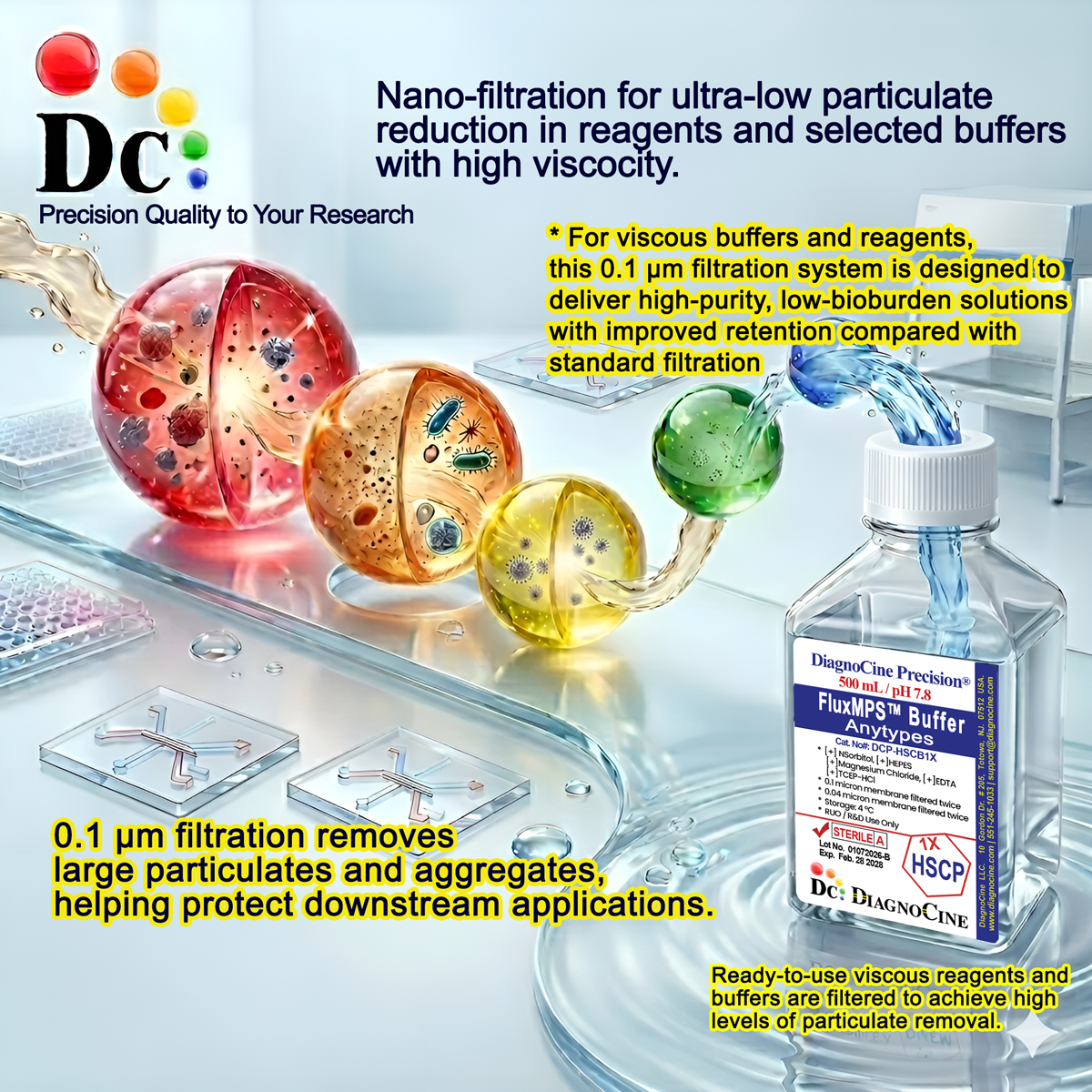
Single-stage 0.1 µm filtration
Each blocking buffer formulation in this test set is prepared with a controlled 0.1 µm membrane filtration step, reducing particulate load in the buffer base before fill so background-sensitive strip blot and Western blot workflows start with a clean, consistent buffer.
-
1
0.1 µm Pre-filtration
Large particulate and aggregate removal prior to fill, supporting a clean, low-background buffer base for every formulation in the set.
Performance vs. bench-prepared buffer
Membrane filtration of the buffer base removes coarse particulates that unfiltered, bench-mixed blocking buffers typically carry, supporting a cleaner background on strip blot and Western blot membranes.
© Diagnocine® — DCP-BBTS
Blocking buffer screening across research workflows
This test set is optimal for strip blot assays and Western blot optimization, and its individual chemistries extend to a range of immunodetection and surface-blocking applications.[1,2]
Automated Bioreactors & Robotics
Custom ultra-filtered (0.01 µm) blocking buffer variants can be prepared on request for automated bioreactor and robotic liquid-handling systems where minimizing particulate introduction into valves and sensors is critical.
- Total Particulate Exclusion — finer polish available for automated fluidic paths
- Valve & Sensor Protection — reduced particulate risk to precision liquid-handling hardware
- Extended Perfusion Stability — formulation consistency supports longer unattended run times
Inquiry Required: the 0.01 µm ultra-filtered grade is prepared to order; contact support@diagnocine.com to discuss requirements.
Micro Physiological System (MPS) & Chip
Blocking buffer screening for surface passivation in microfluidic channels, organ-on-a-chip biosensor surfaces, and lab-on-chip immunodetection assays.
Wash, Dilution & Reconstitution
Buffer bases support dilution of blocking agents and post-block wash steps between blocking and detection incubations.
iPSC-Derived Model Handling
Blocking optimization for reducing non-specific antibody binding when immunostaining iPSC-derived neurons, cardiomyocytes, and hepatocytes.
Endothelial & Primary Cell Perfusion
Screening across blocking chemistries supports immunostaining optimization for HUVECs, HAECs, and primary hepatocytes in perfusion-based assays.
ELISA, Blotting & Blocking
The primary use case for this set: side-by-side strip blot and Western blot blocking optimization, and ELISA plate blocking screening.
Microscopy & Optical Sensing
Low-background blocking formulations support confocal imaging and biosensor-based optical detection with reduced non-specific signal.
Formulation & quality parameters
Specification values shown reflect this product's stated formulation and manufacturing practices; parameters not specified for this test set are omitted rather than approximated.
| Parameter | Specification |
|---|---|
| Formulation / Composition | BSA, casein, gelatin, PVP, nonfat dry milk, and nonfat soy milk blocking buffers across PBS, TBS, PBST, and TBST bases |
| Buffer Bases Included | PBS, TBS, PBST (PBS with Tween-20), TBST (TBS with Tween-20) |
| Blocking Agent Concentrations | 3% BSA; 1% casein; 1% gelatin; 5% nonfat dry milk; 5% nonfat soy milk |
| Milk Formulation Preservative | ProClin 300 |
| Parameter | Specification |
|---|---|
| Water Quality USP | Ultrapure Type 1 water (18.2 MΩ·cm) |
| Filtration System | Single-stage 0.1 µm membrane filtration |
| Manufacturing Standard ISO | ISO 13485:2016-aligned quality system |
| Fill Environment | ISO Class 5 (Class 100) controlled fill environment |
| Parameter | Specification |
|---|---|
| Package Format | Individual 50 mL formulations, one bottle per blocking buffer chemistry |
| Parameter | Specification |
|---|---|
| Manufacturing QMS ISO | ISO 13485:2016 |
| Production Method | Each formulation individually manufactured under its own catalog SKU |
| Intended Use | Research Use Only (RUO); Western blot, strip blot, and immunoassay optimization |
| Customization | pH, concentration, and chemical/compound/protein/supplement additions available on request |
Full composition
Sixteen individually cataloged blocking buffer formulations, grouped below by blocking chemistry, make up this test set.
| Component | CAS Number | Concentration |
|---|---|---|
| Bovine Serum Albumin (BSA) Blocking Buffer in PBS | 9048-46-8 | 3% BSA in 1X PBS |
| Bovine Serum Albumin (BSA) Blocking Buffer in PBST | 9048-46-8 | 3% BSA in 1X PBST (PBS with Tween-20) |
| Bovine Serum Albumin (BSA) Blocking Buffer in TBS | 9048-46-8 | 3% BSA in 1X TBS |
| Bovine Serum Albumin (BSA) Blocking Buffer in TBST | 9048-46-8 | 3% BSA in 1X TBST (TBS with Tween-20) |
| Casein Blocking Buffer in PBS | 9000-71-9 | 1% casein in 1X PBS |
| Casein Blocking Buffer in TBS | 9000-71-9 | 1% casein in 1X TBS |
| Gelatin Blocking Buffer in TBS | 9000-70-8 | 1% gelatin in 1X TBS |
| Gelatin Blocking Buffer in PBS | 9000-70-8 | 1% gelatin in 1X PBS |
| Polyvinylpyrrolidone (PVP) Blocking Buffer in PBS | 9003-39-8 | Formulated in 1X PBS |
| Polyvinylpyrrolidone (PVP) Blocking Buffer in TBS | 9003-39-8 | Formulated in 1X TBS |
| Component | CAS Number | Concentration |
|---|---|---|
| Nonfat Dry Milk Blocking Buffer with ProClin 300 in TBS | 5% nonfat dry milk with ProClin 300 in 1X TBS | |
| Nonfat Dry Milk Blocking Buffer with ProClin 300 in PBS | 5% nonfat dry milk with ProClin 300 in 1X PBS | |
| Nonfat Dry Milk Blocking Buffer with ProClin 300 in PBST | 5% nonfat dry milk with ProClin 300 in 1X PBST | |
| Nonfat Dry Milk Blocking Buffer with ProClin 300 in TBST | 5% nonfat dry milk with ProClin 300 in 1X TBST | |
| Nonfat Soy Milk Blocking Buffer with ProClin 300 in TBS | 5% nonfat soy milk with ProClin 300 in 1X TBS | |
| Nonfat Soy Milk Blocking Buffer with ProClin 300 in PBS | 5% nonfat soy milk with ProClin 300 in 1X PBS |
Manufacturing & compliance
Every formulation in this test set is produced and documented as its own catalog item under a shared quality framework.
ISO 13485:2016 QMS
Manufactured under a documented ISO 13485:2016-aligned quality management system supporting consistent formulation and release across every formulation in this set.
Ultrapure Type 1 Water
Each buffer base is prepared using Ultrapure Type 1 water (18.2 MΩ·cm), reducing trace ionic and organic contaminants that can elevate blot background.
ISO Class 5 Fill & Finish
Filling is performed in an ISO Class 5 (Class 100) controlled environment to minimize airborne particulate introduction during bottling.
Micro-Batch Precision
Each formulation in this test set is manufactured and documented as its own catalog item, supporting precise, small-batch quality control and lot traceability.
Endotoxin — USP General Chapter 85
Endotoxin control practices reference USP Bacterial Endotoxins Test (General Chapter 85) guidance during raw material qualification.
Particulate — USP General Chapter 788
Particulate control practices reference USP General Chapter 788, Method 2, guidance during filtration and fill.
Osmolality — USP General Chapter 785
Osmolality testing guidance under USP General Chapter 785 is available upon request for individual formulations.
Documentation / CoA
Certificates of Analysis are available on request for each formulation in this set.
How DCP-BBTS compares
A comparison against purchasing a single blocking buffer chemistry or bench-preparing blocking buffers in-house.
| Parameter | DCP-BBTS (FluxMPS™) | Single-chemistry purchase | Bench-prepared in-house |
|---|---|---|---|
| Buffer bases included | check_circle PBS, TBS, PBST, TBST | cancel Single base only | cancel Depends on user |
| Blocking chemistries included | check_circle BSA, casein, gelatin, PVP, milk | cancel Single chemistry | cancel Depends on user |
| Final filtration pore size | check_circle 0.1 µm | cancel Varies by supplier | cancel Typically unfiltered |
| ProClin 300-preserved milk formulations | check_circle | cancel | cancel |
| Individual catalog access to each formulation | check_circle | check_circle | cancel |
| ISO 13485:2016 manufacturing | check_circle | cancel Varies by supplier | cancel |
| Custom formulation available | check_circle | cancel | check_circle User-dependent |
Frequently asked questions
Common questions about the FluxMPS™ Blocking Buffer Test Set.
Supporting literature
Curated literature relevant to blocking buffer chemistry, Western blot optimization, and microfluidic immunoassay applications.
- Mahmood T, Yang PC. Western blot: technique, theory, and trouble shooting. N Am J Med Sci. 2012. doi:10.4103/1947-2714.100998
- Kurien BT, Scofield RH. Western blotting. Methods. 2006. doi:10.1016/j.ymeth.2005.07.018
- Kurien BT, Scofield RH. Common artifacts and mistakes made in immunoblotting. Methods Mol Biol. 2015. doi:10.1007/978-1-4939-2694-7_23
- Bass JJ, et al. An overview of technical considerations for Western blotting applications to physiological research. Scand J Med Sci Sports. 2017. doi:10.1111/sms.12702
- Butler JE. Enzyme-linked immunosorbent assay. J Immunoassay. 2000. doi:10.1080/01971520009349533
- Bhatia SN, Ingber DE. Microfluidic organs-on-chips. Nat Biotechnol. 2014. doi:10.1038/nbt.2989
- Low LA, et al. Organs-on-chips: into the next decade. Nat Rev Drug Discov. 2021. doi:10.1038/s41573-020-0079-3
- Hnasko TS, Hnasko RM. The Western blot. Methods Mol Biol. 2015. doi:10.1007/978-1-4939-2742-5_9
- Alegria-Schaffer A, et al. Performing and optimizing Western blots with an emphasis on chemiluminescent detection. Methods Enzymol. 2009. doi:10.1016/S0076-6879(08)03626-2