

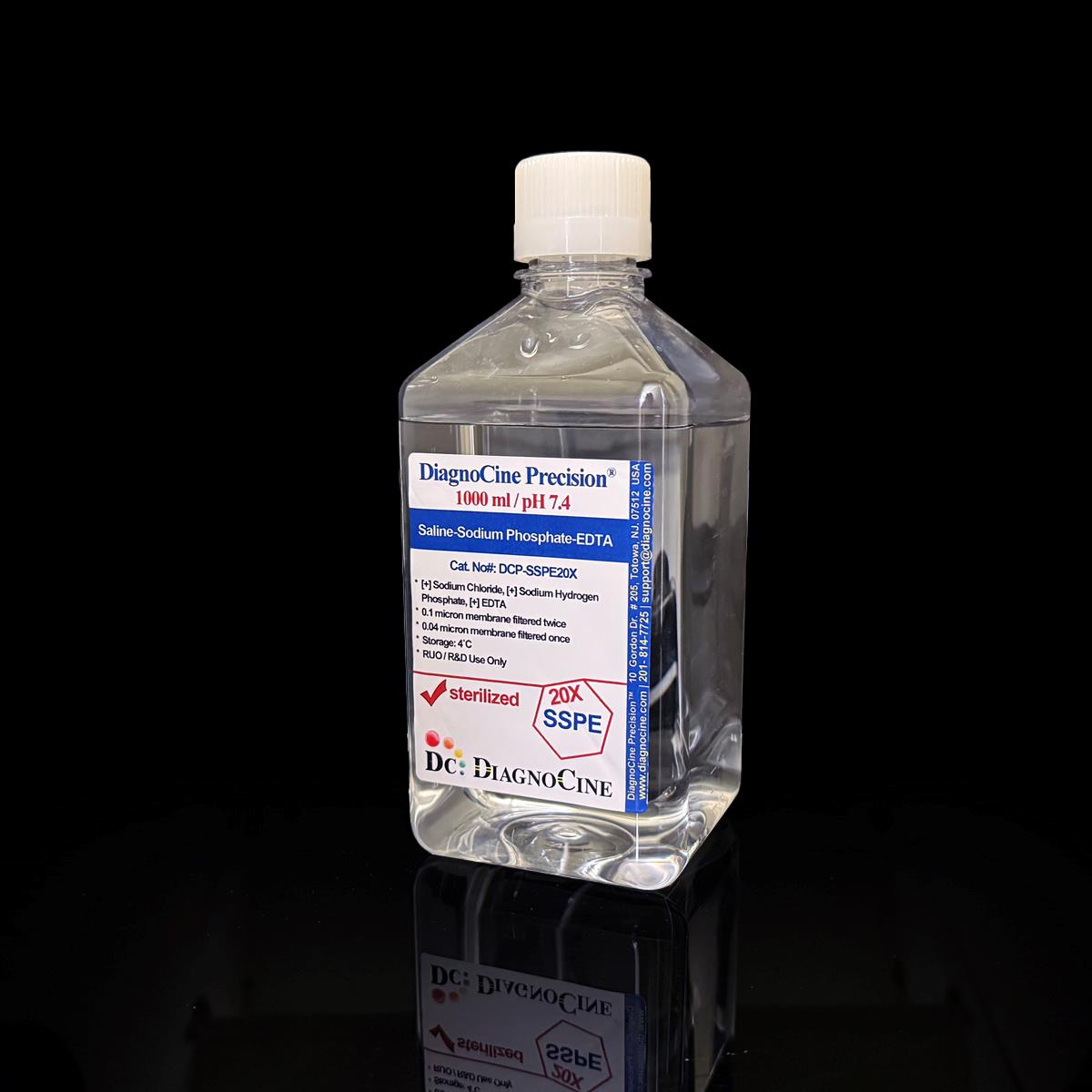
SSPE (20X)
FluxMPS™ SSPE (20X)
FluxMPS™ SSPE (20X) is an MPS-grade Saline-Sodium Phosphate-EDTA buffer concentrate engineered for Southern and Northern blotting, nucleic acid hybridization, blot transfer, and DNA microarray washing. Formulated to pH 7.4 with defined sodium chloride, sodium hydrogen phosphate, and EDTA concentrations, it is filtered 0.1 µm membrane twice and 0.04 µm membrane twice for an ultra-clean, nuclease-free buffer suitable for sensitive molecular biology and microfluidic-adjacent workflows.
- Filtered 0.1 µm membrane twice and 0.04 µm membrane twice for an ultra-clean, sterile buffer
- Formulated to pH 7.4 with 3.0 M sodium chloride, 0.2 M sodium hydrogen phosphate, and 0.02 M EDTA
- Manufactured with Ultrapure Type 1 water (18.2 MΩ·cm)
- No detectable DNase or RNase activity after 18-hour incubation at room temperature
- ISO 13485-certified, CE-approved manufacturing facilities
- Dilutable from 0.1X to 20X for Southern blotting, Northern blotting, microarray washing, and bacterial screening
- EDTA chelation of divalent metal ions helps preserve probe and target nucleic acid integrity
- Customization available: alternate concentrations, tracking dyes, pH, and modifications on request
- pH7.4
- Concentration20X (dilutable 0.1X to 20X)
- Sodium Chloride3.0 M
- Sodium Hydrogen Phosphate0.2 M
- EDTA0.02 M
- Filtration0.1 µm x2 + 0.04 µm x2
- SterilitySterile-filtered
- DNase / RNaseNone detected
- StorageRoom temperature
- Shelf Life1 year
Engineered where standard buffers fail
Conventional 0.22 µm-filtered hybridization and wash buffers can carry subvisible particulates, inconsistent pH, and undetected nuclease activity into sensitive blotting and hybridization workflows, elevating background and risking probe or target degradation. FluxMPS™ SSPE (20X) is manufactured to remove these failure modes at the source.
Microchannel-safe purity
A 0.04 µm final filtration pore size removes fine particulates that a single 0.22 µm pass allows through, supporting cleaner blotting membranes and hybridization surfaces.
Precise, stable pH
Formulated to pH 7.4 with defined 3.0 M sodium chloride and 0.2 M sodium hydrogen phosphate for reproducible hybridization stringency.
Ultrapure-grade water
Manufactured with Ultrapure Type 1 water (18.2 MΩ·cm), consistent with USP <85> water quality expectations.
Low background for blotting & hybridization
Nuclease-free, ultra-clean formulation supports low-background Southern and Northern blot signal and clean microarray wash steps.
Defined, traceable composition
Sodium chloride, sodium hydrogen phosphate, and EDTA are formulated to stated concentrations and verified nuclease-free prior to release.
Customization on demand
Alternate concentrations, tracking dyes, pH, and other modifications are available — contact support@diagnocine.com.
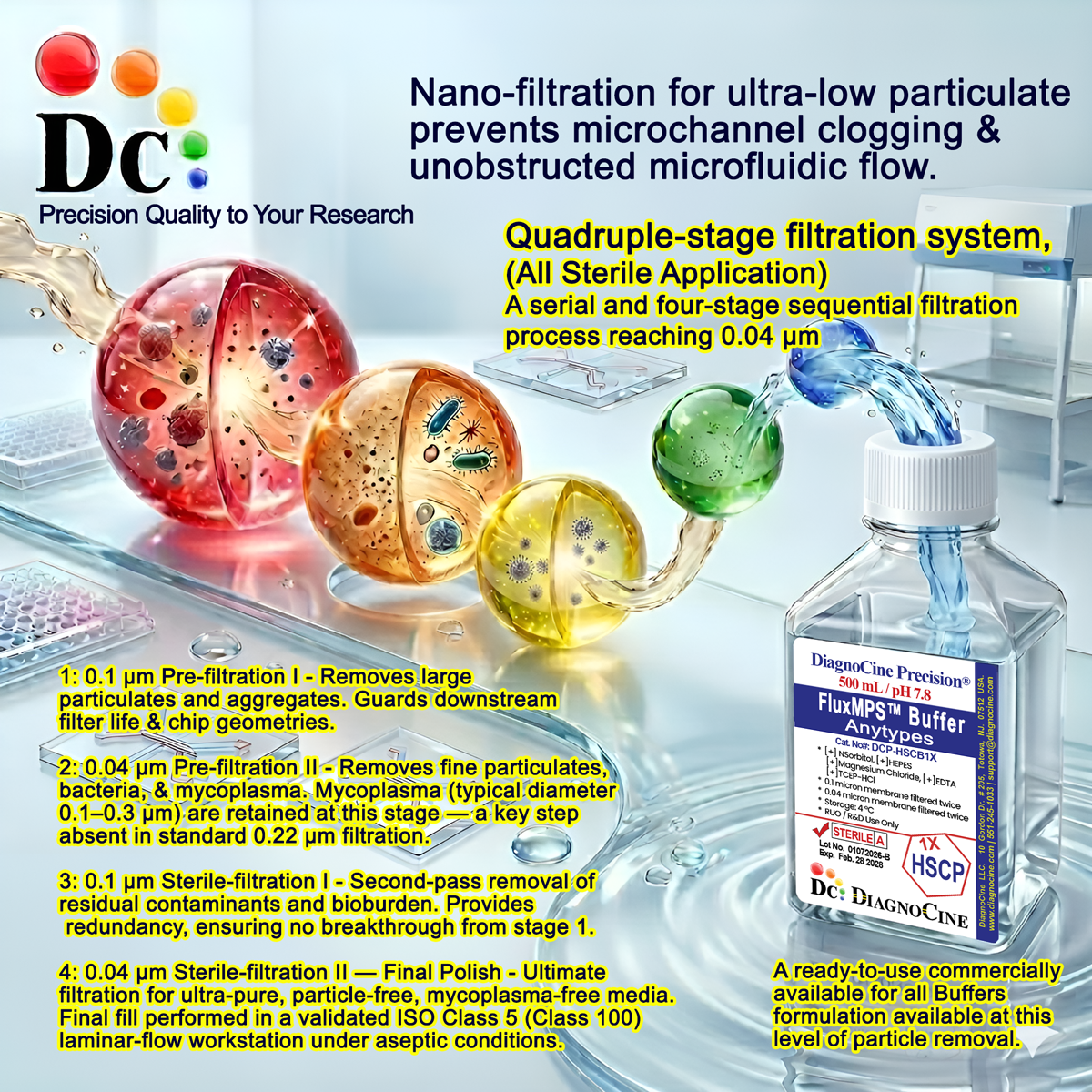
Quadruple-stage filtration system
FluxMPS™ SSPE (20X) is manufactured under a quadruple-stage filtration architecture — filtered 0.1 µm membrane twice and 0.04 µm membrane twice — in a sterile environment, supporting a nuclease-free, ultra-clean buffer for hybridization and blotting applications.
-
1
0.1 µm Pre-filtration I
Removes large particulates and aggregates from the raw formulation, extending the working life of downstream filters.
-
2
0.04 µm Pre-filtration II
Retains fine particulates and bioburden. Dual-membrane processing at this pore size is fine enough to exclude organisms at and below the smallest mycoplasma size, approximately 0.2 micron.
-
3
0.1 µm Sterile-filtration I
A second 0.1 µm pass provides redundant particulate and bioburden reduction ahead of final polish.
-
4
0.04 µm Sterile-filtration II — Final Polish
A second 0.04 µm pass delivers the final polish under ISO Class 5 (Class 100) aseptic fill conditions.
Performance vs. conventional buffer
Sequential 0.1 µm and 0.04 µm filtration passes remove finer particulates than a single 0.22 µm pass typical of standard SSPE buffer, helping protect probe and target nucleic acid integrity throughout hybridization and transfer procedures.
© Diagnocine® — DCP-SSPE20X
Where SSPE (20X) is used
20X SSPE is a concentrated buffer widely used in molecular biology for nucleic acid hybridization and blotting procedures, serving as both a hybridization and transfer buffer across Southern blotting, Northern blotting, microarray washing, and bacterial screening.
Automated Bioreactors & Robotics
For automated, closed-loop bioreactor and robotic liquid-handling platforms where any particulate can compromise valves, sensors, or long-duration perfusion, FluxMPS™ offers an optional 0.01 µm (10 nm) ultra-filtered variant of SSPE (20X) engineered for total particulate exclusion.
- Total Particulate Exclusion: sub-0.04 µm polishing minimizes residual particulate carryover
- Valve & Sensor Protection: reduces particulate exposure to automated fluidic hardware
- Extended Perfusion Stability: supports long-duration automated wash and dilution cycles
Inquiry Required: the 0.01 µm (10 nm) ultra-filtered grade is produced to specification — contact support@diagnocine.com to request this configuration.
Southern & Northern Blot Hybridization
Serves as the hybridization buffer for DNA and RNA blot procedures, with EDTA chelation protecting probe and target integrity.
Wash, Dilution & Transfer Buffer
Dilutable from 0.1X to 20X for blot transfer and general wash and dilution steps in nucleic acid workflows.
DNA Microarray Washing
Used as a washing buffer in DNA microarray experiments, supporting clean, low-background signal.
Bacterial Colony Screening
Utilized in bacterial screening procedures as part of colony and plasmid-based hybridization workflows.
Nuclease-Free Handling
Verified free of detectable DNase and RNase activity, preserving probe and target DNA/RNA integrity during hybridization.
Microfluidic & Chip-Based Nucleic Acid Workflows
Ultra-filtered, nuclease-free formulation suited to on-chip and microfluidic nucleic acid handling steps.
Detailed specifications
Physical, chemical, purity, storage, and traceability parameters for FluxMPS™ SSPE (20X), DCP-SSPE20X.
| Parameter | Specification |
|---|---|
| Formulation / Composition | Saline-Sodium Phosphate-EDTA (SSPE) buffer, 20X concentrate |
| Appearance | Clear solution |
| pH (USP <791>)USP | 7.4 |
| Molarity / Concentration | 20X concentrate; dilutable to working concentrations from 0.1X to 20X |
| Parameter | Specification |
|---|---|
| Sterility | Filtered 0.1 µm membrane twice and 0.04 µm membrane twice in a sterile environment |
| Water QualityUSP | Ultrapure Type 1 water (18.2 MΩ·cm) |
| DNase Activity | None detected after 18 hours incubation with plasmid DNA at room temperature |
| RNase Activity | None detected after 18 hours incubation with ribosomal RNA at room temperature |
| Manufacturing StandardISO | ISO 13485-certified, CE-approved facilities |
| Fill Environment | ISO Class 5 (Class 100) cleanroom |
| Parameter | Specification |
|---|---|
| Storage Temperature | Room temperature |
| Shelf Life | 1 year |
| Parameter | Specification |
|---|---|
| Raw Material Grade | Ultrapure buffer-grade reagents |
| Traceability | Packaged and quality-tested at the DiagnoCine R&D and Quality Testing Center; custom assembly at DiagnoCine Precision, Totowa, New Jersey, USA |
| Manufacturing QMSISO | ISO 13485:2016 |
| Regulatory Alignment | CE-approved |
| Intended Use | Research Use Only (RUO) |
Full composition
FluxMPS™ SSPE (20X) is a defined buffering system released per lot against the specifications below.
| Component | CAS Number | Concentration |
|---|---|---|
| Sodium Chloride | 7647-14-5 | 3.0 M |
| Sodium Hydrogen Phosphate (Na2HPO4) | 7558-79-4 | 0.2 M |
| EDTA | 60-00-4 | 0.02 M |
Manufacturing & compliance
FluxMPS™ SSPE (20X) is manufactured, packaged, and quality-tested under a controlled quality management system, with custom assembly completed at DiagnoCine Precision in Totowa, New Jersey, USA.
ISO 13485:2016 QMS
Manufactured under ISO 13485-certified and CE-approved facilities.
Ultrapure Type 1 Water
Formulated with Ultrapure Type 1 water (18.2 MΩ·cm).
ISO Class 5 Fill & Finish
Final sterile filtration and fill performed under ISO Class 5 (Class 100) conditions.
Micro-Batch Precision
Final packaging, quality assurance, and testing are completed at the DiagnoCine R&D and Quality Testing Center.
DNase / RNase Testing
No DNase activity detected after 18-hour incubation of plasmid DNA at room temperature; no RNase activity detected after 18-hour incubation of ribosomal RNA at room temperature.
Sterility Assurance
Filtered 0.1 µm membrane twice and 0.04 µm membrane twice in a sterile environment.
Appearance & pH Control
Released as a clear solution formulated to pH 7.4.
Documentation / CoA
A Certificate of Analysis documenting appearance, pH, sterility, and nuclease testing is available for this lot.
How DCP-SSPE20X compares
A summary comparison against conventional single-pass filtered SSPE buffer.
| Parameter | DCP-SSPE20X (FluxMPS™) | Conventional SSPE (0.22 µm filtered) | Standard Alternative (0.22 µm filtered) |
|---|---|---|---|
| Filtration architecture | 0.1 µm x2 + 0.04 µm x2 | Single 0.22 µm pass | Single 0.22 µm pass |
| Final filtration pore size | 0.04 µm | 0.22 µm | 0.22 µm |
| Number of filtration stages | 4 | 1 | 1 |
| Nuclease testing (DNase/RNase) | check_circle None detected | cancel Not routinely tested | cancel Not routinely tested |
| Water quality | Ultrapure Type 1 (18.2 MΩ·cm) | Standard purified water | Standard purified water |
| Manufacturing QMS | ISO 13485-certified | Not specified | Not specified |
| Microfluidic / chip compatibility | check_circle | cancel | cancel |
| pH reproducibility | Formulated to pH 7.4 | Variable | Variable |
| Custom formulation | check_circle Available | cancel Not available | cancel Not available |
Frequently asked questions
Common questions about FluxMPS™ SSPE (20X), DCP-SSPE20X.
Supporting literature
Curated literature relevant to SSPE buffer chemistry, hybridization, and blotting applications.
- Southern EM. Detection of specific sequences among DNA fragments separated by gel electrophoresis. J Mol Biol. 1975. doi:10.1016/S0022-2836(75)80083-0
- Alwine JC, Kemp DJ, Stark GR. Method for detection of specific RNAs in agarose gels by transfer to diazobenzyloxymethyl-paper and hybridization with DNA probes. PNAS. 1977. doi:10.1073/pnas.74.12.5350
- Thomas PS. Hybridization of denatured RNA and small DNA fragments transferred to nitrocellulose. PNAS. 1980. doi:10.1073/pnas.77.9.5201
- Schena M, Shalon D, Davis RW, Brown PO. Quantitative monitoring of gene expression patterns with a complementary DNA microarray. Science. 1995. doi:10.1126/science.270.5235.467
- Eisen MB, Brown PO. DNA arrays for analysis of gene expression. Methods Enzymol. 1999. doi:10.1016/S0076-6879(99)03014-1
- Auld DS. Removal and replacement of metal ions in metallopeptidases. Methods Enzymol. 1995. doi:10.1016/0076-6879(95)48027-6
- Huh D, Matthews BD, Mammoto A, et al. Reconstituting organ-level lung functions on a chip. Science. 2010. doi:10.1126/science.1188302
- Bhatia SN, Ingber DE. Microfluidic organs-on-chips. Nat Biotechnol. 2014. doi:10.1038/nbt.2989
- Sackmann EK, Fulton AL, Beebe DJ. The present and future role of microfluidics in biomedical research. Nature. 2014. doi:10.1038/nature13118