


PBS Blocking Buffer with Bovine Serum Albumin (3%)
PBS Blocking Buffer with Bovine Serum Albumin (3%)
A research-grade phosphate-buffered blocking reagent formulated with 3% Bovine Serum Albumin (BSA) at pH 7.4, engineered to minimize non-specific antibody binding in Western blotting, ELISA, and immunohistochemistry. 0.1 µm filtration removes large particulates and aggregates, helping protect downstream applications.
- 0.1 µm membrane filtration (single step)
- Formulated with 3% Bovine Serum Albumin (BSA) in phosphate-buffered saline for reliable, versatile blocking
- Precise, defined phosphate buffer system held at pH 7.4
- Nonsterile; DNase- and RNase-free (none detected on testing)
- Built on Ultrapure Type 1 water (18.2 MΩ·cm)
- Manufactured in ISO 13485-certified facilities
- Custom concentrations, pH, and additive formulations available on request
- pH7.4
- Formulation3% BSA in PBS (137 mM NaCl, 10 mM Na2HPO4, 2.7 mM KCl, 1.8 mM KH2PO4)
- Filtration0.1 µm membrane filtration (single step)
- SterilityNonsterile
- DNase ActivityNone detected (18 hr, room temperature)
- RNase ActivityNone detected (18 hr, room temperature)
- AppearanceClear, colorless liquid
- Storage-20°C
- Shelf Life1 year
- ManufacturingISO 13485-certified
Engineered where standard blocking buffers fail
Inconsistent BSA sourcing can introduce lot-to-lot background drift in Western blot, ELISA, and immunohistochemistry assays. This PBS Blocking Buffer with 3% BSA is compatible with most detection systems and antibodies, free of phosphoproteins (unlike nonfat dry milk) and free of biotin, so it will not interfere with phosphoprotein or biotin-avidin detection assays.
0.1 µm filtered
0.1 µm filtration removes large particulates and aggregates, helping protect downstream applications.
Precise, stable pH
Defined phosphate buffer system held at pH 7.4 with fixed molarity (137 mM NaCl, 10 mM Na2HPO4, 2.7 mM KCl, 1.8 mM KH2PO4).
Ultrapure-grade water
Formulated on Ultrapure Type 1 water (18.2 MΩ·cm), aligned with USP <85> water-quality practice.
Low background for imaging & assays
3% BSA effectively covers non-specific binding sites on membranes and microplates, reducing background in Western blot, ELISA, and immunohistochemistry imaging.
Defined, traceable composition
Lot-released BSA and phosphate salts at controlled concentrations, documented in the composition table below.
Customization on demand
Alternate concentrations, added chemicals/compounds/proteins/supplements, different pH, and other modifications are available on request.
0.1 µm membrane filtration
Every batch of this PBS Blocking Buffer with 3% BSA is passed once through a 0.1 µm membrane filter.
-
1
0.1 µm Membrane Filtration
Removes large particulates and aggregates, helping protect downstream applications.
Filtration summary
0.1 µm filtration removes large particulates and aggregates, helping protect downstream applications.
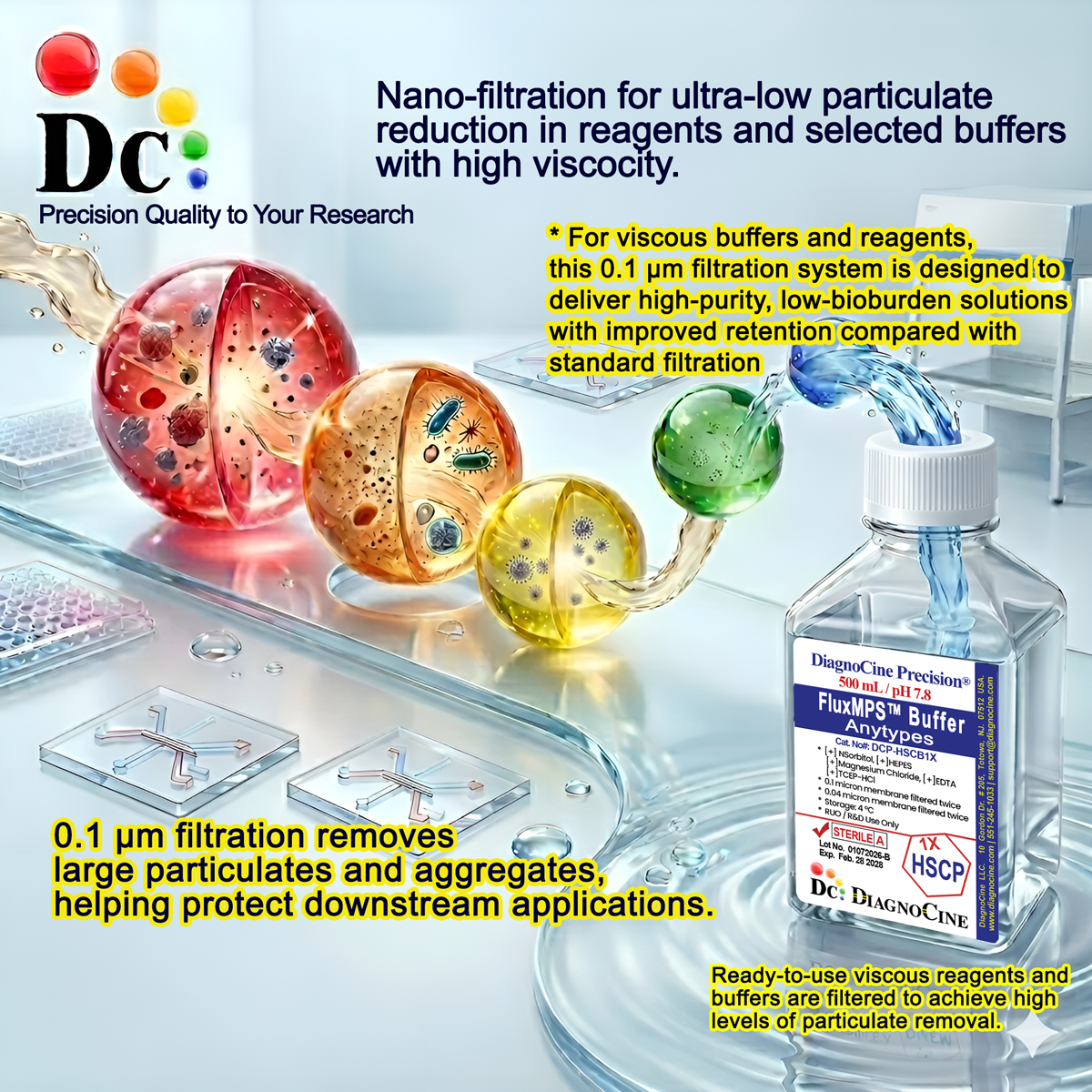
© Diagnocine® — DCP-BSAPBS3X
Where this blocking buffer performs
PBS Blocking Buffer with 3% BSA is a widely used reagent in immunoassays such as Western blotting, ELISA, and immunohistochemistry. It minimizes non-specific binding of antibodies to the solid phase, reducing background noise and improving signal-to-noise ratio so that antibodies specifically bind their target proteins or antigens.
Far-Western & Overlay Assays
Blocks open membrane sites before probing in far-Western and overlay assays.
Wash, Dilution & Reconstitution
Phosphate-buffered base suited to rinsing, dilution, and reconstitution steps.
iPSC-Derived Model Handling
Blocking and wash support for iPSC-derived model immunostaining workflows.
Endothelial & Primary Cell Staining
Low-background blocking buffer for immunostaining of vascular and primary cell models.
ELISA, Blotting & Blocking
Core blocking reagent for Western blotting membranes and ELISA microplates, reducing non-specific interactions.
Immunofluorescence & ICC
Reduced background staining supports clearer immunofluorescence and tissue-section imaging.
Full technical profile
Every parameter below reflects data stated for this specific PBS Blocking Buffer with 3% BSA lot release.
| Parameter | Specification |
|---|---|
| Formulation / Composition | 3% BSA in PBS |
| Appearance | Clear, colorless liquid |
| pH (USP <791>) | 7.4 |
| Sodium Chloride | 137 mM |
| Potassium Chloride | 2.7 mM |
| Sodium Phosphate dibasic | 10 mM |
| Potassium Phosphate monobasic | 1.8 mM |
| Parameter | Specification |
|---|---|
| Sterility | Nonsterile |
| DNase Activity | None detected (18 hr with plasmid DNA, room temperature) |
| RNase Activity | None detected (18 hr with ribosomal RNA, room temperature) |
| Water Quality | Ultrapure Type 1 water (18.2 MΩ·cm) USP <85> |
| Manufacturing Standard | ISO 13485-certified facilities ISO 13485 |
| Parameter | Specification |
|---|---|
| Storage Temperature | -20°C |
| Shelf Life | 1 year |
| Parameter | Specification |
|---|---|
| Manufacturing QMS | ISO 13485-certified facilities (Diagnocine Precision suppliers) |
| Production & Customization Site | Diagnocine Precision, Totowa, New Jersey, USA |
| Intended Use | Research Use Only (RUO) |
Full composition
Phosphate-buffered blocking formulation released on a per-lot basis; concentrations shown are as measured for this product.
| Component | CAS Number | Concentration |
|---|---|---|
| Bovine Serum Albumin (BSA) | 9048-46-8 | 3% |
| Sodium Chloride | 7647-14-5 | 137 mM |
| Potassium Chloride | 7447-40-7 | 2.7 mM |
| Sodium Phosphate dibasic | 7558-79-4 | 10 mM |
| Potassium Phosphate monobasic | 7778-77-0 | 1.8 mM |
Manufacturing & compliance
This buffer is manufactured under ISO 13485-certified facilities (suppliers of Diagnocine Precision), with final packaging, quality assurance, and testing completed at the Diagnocine R&D and Quality Testing Center, and all specific customization requests and assembly completed at Diagnocine Precision in Totowa, New Jersey, USA.
ISO 13485:2016 QMS
Manufactured under an ISO 13485-certified quality management system.
Ultrapure Type 1 Water
Formulated on 18.2 MΩ·cm Type 1 water.
DNase- & RNase-Free
No DNase or RNase activity detected on testing.
Micro-Batch Precision
Final packaging, QA, and testing completed at the Diagnocine R&D and Quality Testing Center.
Endotoxin
See CoA.
Particulate (USP <788> Method 2)
0.1 µm membrane filtration (single step), in line with USP <788> Method 2 practice.
Nuclease Testing (DNase & RNase)
No DNase activity detected after 18 hr incubation with plasmid DNA at room temperature; no RNase activity detected after 18 hr incubation with ribosomal RNA at room temperature.
Documentation / CoA
Certificate of Analysis available on request.
How DCP-BSAPBS3X compares
A qualitative comparison against typical blocking buffer offerings on the market.
| Parameter | DCP-BSAPBS3X | Conventional Buffer | Standard Alternative |
|---|---|---|---|
| Defined 3% BSA blocking formulation | check_circle | cancel | cancel |
| DNase / RNase tested free | check_circle | cancel | cancel |
| Biotin-free formulation | check_circle | cancel | cancel |
| Phosphoprotein-assay compatible (no interfering phosphoproteins) | check_circle | cancel | cancel |
| ISO 13485-certified manufacturing | check_circle | cancel | cancel |
| Custom formulation on request | check_circle | cancel | cancel |
Frequently asked questions
Common questions about DCP-BSAPBS3X PBS Blocking Buffer with Bovine Serum Albumin (3%).
Supporting literature
Curated literature relevant to blocking buffer chemistry and immunoassay background reduction.
- Mahmoudi N, et al. Blocking agents in immunoassays: mechanisms and practical considerations for background reduction. doi:10.1002/jmv.25640
- Mahmood T, Yang PC. Western blot: technique, theory, and trouble shooting. doi:10.4103/1947-2714.100998
- Lin JH, et al. Optimization of blocking conditions for ELISA background reduction. doi:10.1016/j.jim.2012.11.001
- Ramos-Vara JA. Principles and methods of immunohistochemistry. doi:10.1177/0300985813505879
- Ferreira MM, et al. Phosphate-buffered saline formulations for cell and molecular biology applications. doi:10.1016/j.mimet.2018.02.006