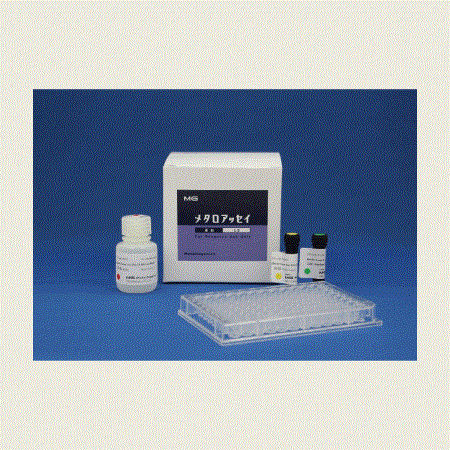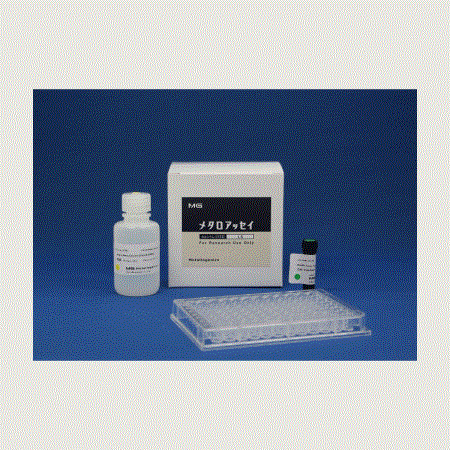


Iron Assay kit LS - Ferrozine method
Iron Assay kit LS - Ferrozine method
Cat. No. FNK-FE31ME
Size 200 tests / 1 kit
Store 4 oC
Measuring range 5 - 1000 ug/dl
Wavelength (maximume wavelength) 540 - 580 nm (560 nm)
Chromogen Ferrozine
Target Free Iron (Fe2+ , Fe3+)
Description
This product is a direct colorimetric assay kit without deproteinization of the sample. Dissociated iron from the transferrin-iron complex by weakly acid buffer and reduced by means of reductant (:Ferric→Ferrous).Ferrous ions give a complex with Ferrozine (as chromogen). The intensity of the colored complex is proportional to the iron concentration in the sample. The color intensity is proportional to the amount of iron present in the sample. Iron is an important element, which functions as an enzyme cofactor. All iron of in blood is bonded with transferrin, and they are transported to erythroblast or tissue for synthetic of globin protein which needs iron. Iron is an indispensable component to generate protein which transports oxygen. Its deficiency causes spanemia of hypoferrism, chronic hemorrhagic anemia and spanemia of infectivity. Increasing transferrin and high value of Iron can be observed in hepatitis or liver cirrhosis. Aplastic anemia and malignant anemia show increasing value of iron as well.
Features
- Using microplate reader for assay, no need to use Atomic Absorption Spectrometry or ICP-OES Optical Emission Spectrometry, which have been mainly used so far.
- Good correlation with the result of Atomic Absorption Spectrometry and ICP-OES.
- High throughput measurement by using microplate reader.
- All animal species sample can be measured.
- Assay time : just 10 minutes!
- 1 point calibration – do not need multiple point measurement to make standard curve (r^2=0.9999).
- Kit does not contain any hazardous components like cyanide or azide as preservative.
- Samples : Serum, Plasma, Urine, Saliva, Cell lysate, Tissue extract, Hair extract, Water, etc
- In combination with UIBC Assay kit LS Bathophenanthroline method (#UIB01E), TIBC (Total Iron Binding Capacity) can be measured.
Assay Principle
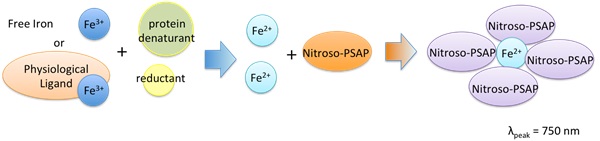
This kit measures iron concentration by color change caused by chelate complex formulation of Nitroso-PSAP and Iron. Iron combined to transportation protein such as transferrin is denatured by weak acid and denaturant then formulates Iron-Nitroso-PSAP chelate complex. Measuring this complex by 750 nm wavelength and obtain iron concentration.
Sample preparation
-
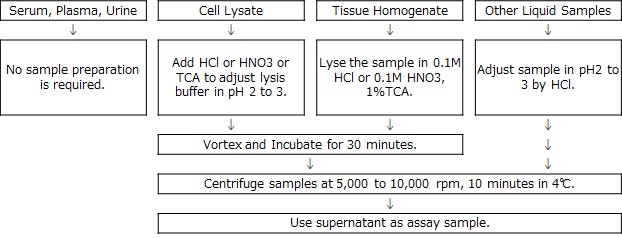
Samples which do not require preparation
e.g. Serum, Plasma and Urine
* EDTA treated sample is not suitable for this assay.
* Pooled urine should add HCl for storing. When assay, adujust sample pH 2 to 3. -
Samples which require acid extraction
e.g. cell lysate, tissue homogenate and other liquid samples.
* Measurable chemical species is limited as follows:
• Free iron
• Iron binds to protein (Protein-Fe2+, e.g. transferrin, ferritin, metallothionein)
* Lysis buffer contains EDTA is not suitable for this assay.
* Organoiron and Heme iron requires acidolysis. -
Microwave method and samples require acidolysis
e.g. samples contain strong chelate agents such as EDTA, Organoiron (in the case of single bond -C-Fe-C-),
iron in cyclic ligand (Fe-Porphyrin)
* After acidolysis, adjust sample pH in 2 to 3.
Handling procedure
|
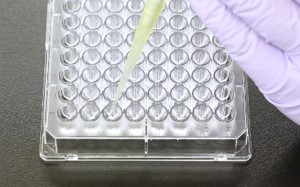
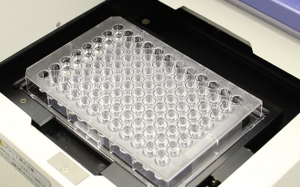
(1) Apply DW, Standard and Sample (40 uL) to 96 well plate. |
|
|
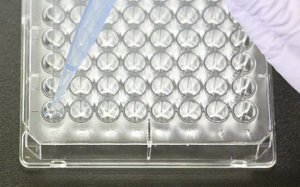
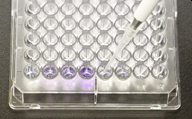
(2) Add R-A buffer (200 uL). |
|
|
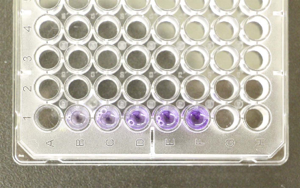
(3) Incubate at room temperature for 5 minutes. |
|
|
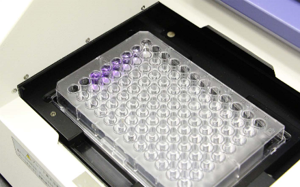
(4) Read the absorbance at 560 nm (main) as OD1. |
|
|
(5) Add R-R Chelate Color (8 uL). |
|
|
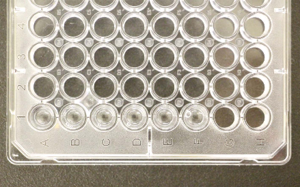
(6) Incubate at room temperature for 5 minutes. |
|
|
(7) Read the absorbance at 560 nm (main) as OD2. |
|
|
ΔODStd = (OD2Std - OD1Std) - (OD2Bl1 - ODBl)
|
*ODS : OD sample, ODBl : OD blank, |
Memo
- Unstableness of incubation temperature may result in unstable results.
- Use disposable test tube and glassware washed with 1MHNO3 or 1M HCl solution and distilled water.
- Accuracy in pipetting volume for samples and reagents may affect the quality of assay. Please note that samples, standards and Working Reagent must be poured accurately µL level.
- Temperature for chromogen reaction may affect optical density. Please try to extend or shorten chromogen reaction time depending on room temperature.
- In the cell lysate or the tissue extract use as specimen, high concentration of proteins or lipid, may affect observed value. Please remove its by ultrafiltration or centrifugation.
- Heme-containing iron species cannot be measured in this assay kit.
- Regulation of iron homeostasis by the p53-ISCU pathway; Sci Rep. 2015; 5: 16497.
- Characterization of Flavin-Containing Opine Dehydrogenase from Bacteria Plos One; September 18, 2015
- Association between renal iron accumulation and renal interstitial fibrosis in a rat model of chronic kidney disease Hypertension Research;38, 463-470 (July 2015)
- Temporary Dietary Iron Restriction Affects the Process of Thrombus Resolution in a Rat Model of Deep Vein Thrombosis Plos one; May 11, 2015
- JAK2V617F-positive myeloproliferative neoplasm clones evoke paracrine DNA damage to adjacent normal cells through secretion of lipocalin-2 Blood ; September 12, 2014
- Angiotensin II alters the expression of duodenal iron transporters, hepatic hepcidin, and body iron distribution in mice Eur J Nutr ; August 7, 2014
- Iron Chelation by Deferoxamine Prevents Renal Interstitial Fibrosis in Mice with Unilateral Ureteral Obstruction PLoS One ; February 19, 2014
- TEMPO-oxidized cellulose hydrogel as a high-capacity and reusable heavy metal ion adsorbent J Hazard Mater ;September 15, 2013
- Superparamagnetic nanoparticle clusters for cancer theranostics combining magnetic resonance imaging and hyperthermia treatment Theranostics ; April 23, 2013
- Dietary iron restriction inhibits progression of diabetic nephropathy in db/db mice Am J Physiol Renal Physiol ; April 1, 2013
- GRK6 deficiency in mice causes autoimmune disease due to impaired apoptotic cell clearance. Nat Commun ;February 26, 2013
- Estrogen Regulates Hepcidin Expression via GPR30-BMP6-Dependent Signaling in Hepatocytes PLoS One ; July 11, 2012
- FecA1, a bacterial iron transporter, determines the survival of Helicobacter pylori in the stomach Free Radic Biol Med ; March 15, 2012