.jpg "/Content/Upload/Product/Human_ELISA_kits_Diagnocine_1200_1200(7).jpg")
Human eosinophil chemotactic factor,ECF ELISA Kit
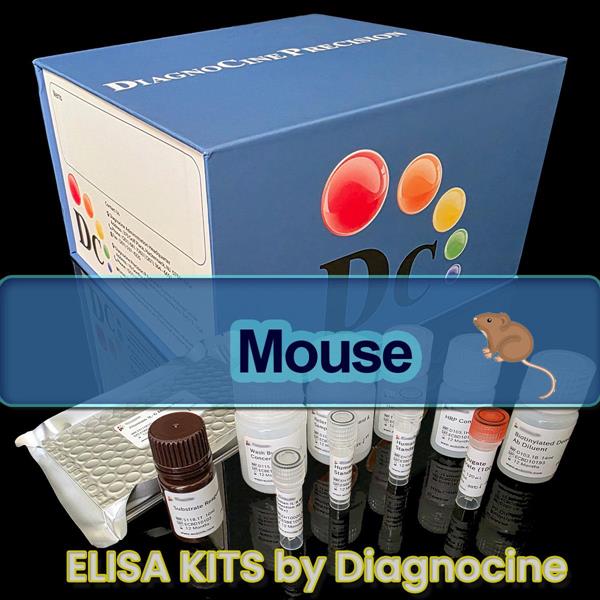
The Ultimate 1-Stop ELISA Marketplace:
60,000+ ELISA kits Available to Serve Scientists from All Fields of Life Science
Always Powered by Diagnocine for Precision Research.
Most comprehensive buffers, reagents and detection agents are provided with each kit to optimize data output.
All-inclusive format covers everything from sample preparation to signal detection. Every step can be customized and optimized for your precision research.
DiagnoCine Precision buffers and reagents are Made in USA ISO 13485 Certified
Why waste time searching for your ELISA kit when you can get everything in one place? Diagnocine can provide you with all the ELISA needs you have (customized ELISAs also available) on the planet through a single, streamlined ordering process.
* all types of species
* HRP and AP detection
* Low target signal enhancement
* Inquire about a trial version or a customized version
4 core reagents below are included with every order, plus 1 of the 2 detection-specific reagents (matched automatically to your kit type) — 5 components, every time.
+ the 5th component, matched to your kit's detection method:
If you have any questions or need additional information, please call us at 551-245-1033 or email us at support@diagnocine.com. Our team will be happy to assist you.
Universal Compatibility
All buffers and detection reagents work seamlessly across target proteins, bridging the gap in assay consistency.
1-Stop Convenience
Consolidate your lab's purchasing. Source all ELISA needs and experience optimal buffers and reagents in a single shipment.
Enhanced Precision
Designed by scientists for scientists, all components are engineered to deliver sharper results and an optical signal.
Human eosinophil chemotactic factor,ECF ELISA Kit
Sandwich quantitative immunoassay for chemokine (C-C motif) ligand 11 in human serum, plasma, cell culture supernates, tissue homogenates available in multiple catalog sizes:
Note: Please send inquiries regarding Trial 24T orders to support@diagnocine.com.
| Target name | chemokine (C-C motif) ligand 11 |
| Uniprot No. | P51671 |
| Species | Homo sapiens (Human) |
| Sample types | serum, plasma, cell culture supernates, tissue homogenates |
| Detection range | 31.25 pg/mL-2000 pg/mL |
| Sensitivity | 7.8 pg/mL |
| Assay time | 1-5h |
| Sample loading volume | 50-100μL |
| Detection wavelength | 450 nm |
| Assay principle | Sandwich (Quantitative) |
| Data analysis | Standard curve + Curve Expert software |
| Research area | Immunology |
| Storage condition | 2-8°C (see protocol for full details) |
| Shipping condition | 4 °C |
| Shelf life | 6 months |
10 business days
Processing + 3-5 days shipping
In Stock : USA
Worldwide shipping available
Antibody capture
450 nm detection
Standard curve
Quantification
In this sandwich ELISA, chemokine (C-C motif) ligand 11 in the sample is captured between a pre-coated capture antibody and a detection antibody. Signal intensity is proportional to analyte concentration. Quantification uses a standard curve fitted with Curve Expert software, covering 31.25 pg/mL-2000 pg/mL with a minimum detectable dose of 7.8 pg/mL.
This Human CCL11 ELISA Kit was designed for the quantitative measurement of Human CCL11 protein in serum, plasma, cell culture supernates, tissue homogenates . It is a Sandwich ELISA kit, its detection range is 31.25 pg/mL-2000 pg/mL and the sensitivity is 7.8 pg/mL.
- CCL11 contributes to eosinophil recruitment in UC and that intestinal myeloid cells are a source of CCL11. PMID: 23904440
- thi is a study of the interaction between vCCI and eotaxin-1 (CCL11), a CC chemokine that is an important factor in the asthma response. PMID: 24482230
- CCL11, CCL24, and CCL26 are increased in TB patients; hence, it seems that TB suppresses Th1 and the classic function of macrophages subsequently by inducing the chemokines' expression PMID: 24600981
- eotaxin-1 increases MMP-3 expression via the CCR3-ERK pathway, thereby promoting prostate cancer cell invasion and migration. PMID: 24604010
- Taken together, these findings indicate that inhibiting IL-4-induced eotaxin-1 expression by synephrine occurs primarily through the suppression of eosinophil recruitment, which is mediated by inhibiting STAT6 phosphorylation. PMID: 25111027
- the CCL11 GG genotype is a significant risk factor for ischemic as well as hemorrhagic stroke. Further, the frequency of the GG genotype was observed to be higher in hemorrhagic stroke patients in comparison with ischemic stroke. PMID: 25237944
- SF of BC OA displayed significantly higher concentrations for a number of proinflammatory cytokines [CXCL1, eotaxin, interferon (IFN)-gamma, interleukin (IL)-7, IL-8, IL-9, IL-12]. PMID: 25393692
- Results show the structure of CCL11 bound to the sulfated N-terminal region of its receptor CCR3 and show that intact CCR3 is sulfated and sulfation enhances receptor activity. PMID: 25450766
- Eotaxin measured on the day of birth is useful for identifying extremely low birth weight infants at risk of bronchopulmonary dysplasia/death. PMID: 26270578
- Serum and urinary CCL11 were decreased in patients with prostate cancer compared with controls. PMID: 26306920
- The results of this study suggested that eotaxin-1 as a novel modifier of Alzheimer's disease age at onset and open potential avenues for therapy. PMID: 26324103
- increased amounts released by neutrophils from fibromyalgia patients PMID: 26341115
- Findings demonstrate a link between CCL11 and primary Sjogren's syndrome disease activity and lymphoma. PMID: 26359802
- The A allele in eotaxin 67 G/A polymorphism is associated with worse survival in CAD patients. PMID: 26491210
- Review: eotaxins (CCL11, CCL24, and CCL26) play key role(s) during symptomatic inflammatory responses raised in response to allergic crisis of allergic asthma and atopic dermatitis PMID: 26861136
- These studies characterized serum and intestinal wall eotaxin-1 levels in various inflammatory bowel disease patients and to explore the effect of targeting eotaxin-1 by specific antibodies in dextran sodium sulfate-induced colitis model. PMID: 26874691
- ANDV caused long-term elevated levels of eotaxin-1, IL-6, IL-8, IP-10, and VEGF-A that peaked 20-25 days after infection PMID: 26907493
- Findings suggest that CCL11-CCR3 binding is involved in the progression of GBM. PMID: 27119233
- There were no significant differences in GE area of infertile and fertile women. C-C motif chemokine 11 (P=0.048), TGFalpha (P=0.049), IFNgamma (P=0.033) and interleukin-1 alpha (P=0.047) were significantly elevated in uterine lavage from infertile women <35years compared to fertile but not in women 35years PMID: 27525354
- this study shows that expression of CCL11 is increased in eosinophilic myocarditis patients compared to chronic lymphocytic myocarditis patients PMID: 27621211
- eotaxin promotes proliferation in vascular smooth muscle cells and triggers oxidative stress in a NADPH oxidase dependent manner. PMID: 27681294
- These results suggest CCL11 as a candidate biomarker for the prediction of acute and long-term functional outcomes in ischemic stroke patients PMID: 28634890
- analyzed the genotypes of 6 tag SNPs in the CCL11 gene (rs1129844, rs17809012, rs1860183, rs1860184, rs4795898, and rs4795895) in a case control study. We found the GG genotype of rs4795895 was significantly associated with increased risk of lacunar stroke and the GA genotype of rs17809012 was associated with a significant increase in risk of LAA stroke PMID: 28873081
- a receiver operating characteristic (ROC) curve analysis demonstrated CSF CCL11 accurately distinguished CTE subjects from non-athlete controls and AD subjects PMID: 28950005
- CCL11 promotor polymorphism is associated with increased risk for the development of schizophrenia in a Korean population. PMID: 29477870
Intra-assay Precision (Precision within an assay): CV%<8% | |||||||||||||||||||||||||||||||||||||||||||||||||
Three samples of known concentration were tested twenty times on one plate to assess. | |||||||||||||||||||||||||||||||||||||||||||||||||
Inter-assay Precision (Precision between assays): CV%<10% | |||||||||||||||||||||||||||||||||||||||||||||||||
Three samples of known concentration were tested in twenty assays to assess. | |||||||||||||||||||||||||||||||||||||||||||||||||
| |||||||||||||||||||||||||||||||||||||||||||||||||
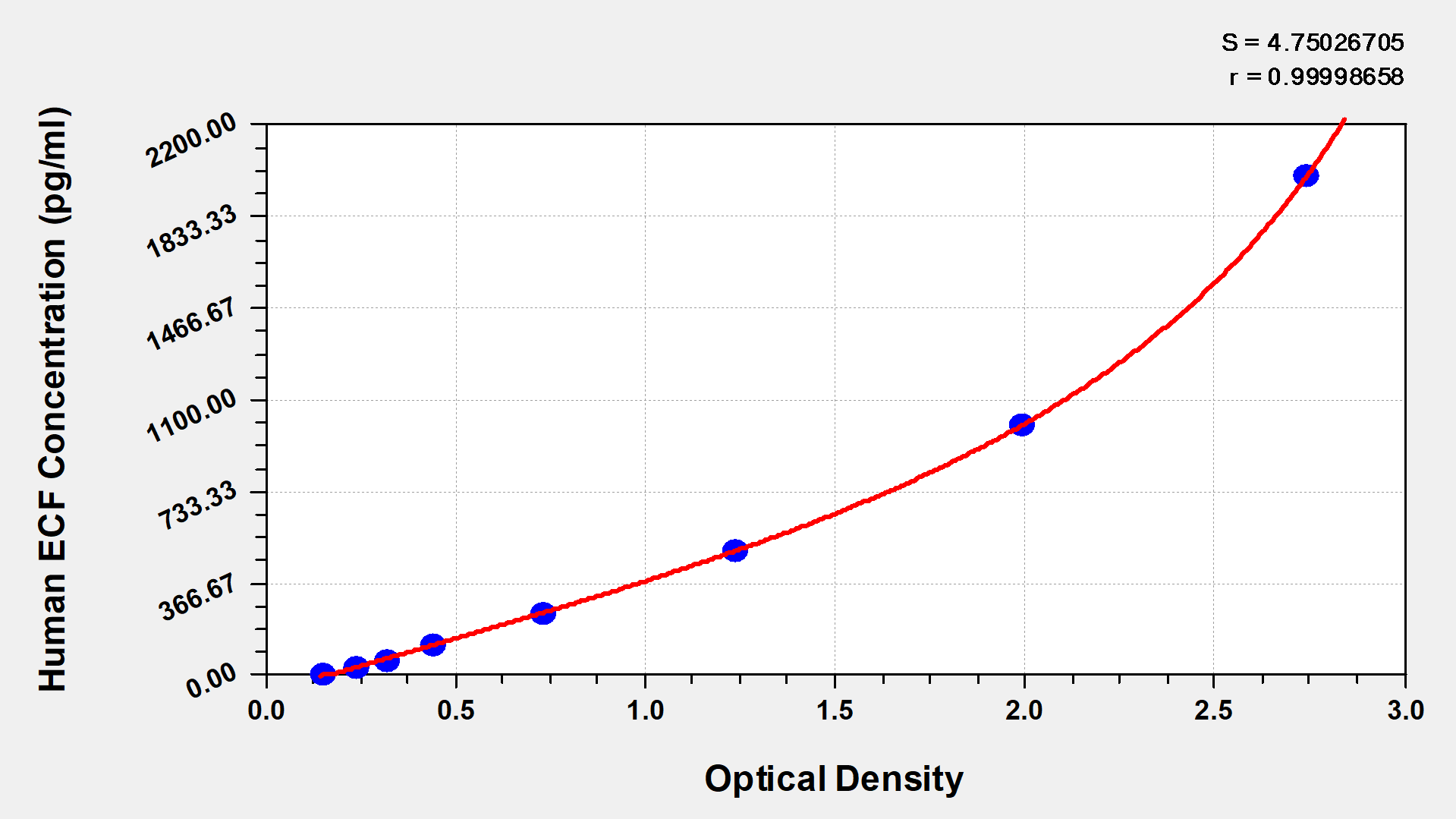
These standard curves are provided for demonstration only. A standard curve should be generated for each set of samples assayed. | ||||||||
| ||||||||
pg/ml | OD1 | OD2 | Average | Corrected | ||||
2000 | 2.706 | 2.743 | 2.725 | 2.558 | ||||
1000 | 1.981 | 1.987 | 1.984 | 1.817 | ||||
500 | 1.229 | 1.245 | 1.237 | 1.070 | ||||
250 | 0.745 | 0.732 | 0.739 | 0.572 | ||||
125 | 0.447 | 0.454 | 0.451 | 0.284 | ||||
62.5 | 0.323 | 0.341 | 0.332 | 0.165 | ||||
31.25 | 0.257 | 0.248 | 0.253 | 0.086 | ||||
0 | 0.168 | 0.166 | 0.167 |
| ||||
To assess the linearity of the assay, samples were spiked with high concentrations of human ECF in various matrices and diluted with the Sample Diluent to produce samples with values within the dynamic range of the assay. | |||||||
| Sample | Serum(n=4) | |||||
1:1 | Average % | 89 | |||||
Range % | 85-92 | ||||||
1:2 | Average % | 97 | |||||
Range % | 92-101 | ||||||
1:4 | Average % | 91 | |||||
Range % | 87-94 | ||||||
1:8 | Average % | 95 | |||||
Range % | 91-98 | ||||||
The recovery of human ECF spiked to levels throughout the range of the assay in various matrices was evaluated. Samples were diluted prior to assay as directed in the Sample Preparation section. | |||||||
Sample Type | Average % Recovery | Range | |||||
Serum (n=5) | 94 | 89-97 | |||||
EDTA plasma (n=4) | 89 | 84-92 | |||||