


FluxMPS™ Universal Blocking Buffer
FluxMPS™ Universal Blocking Buffer — Multi-Protein TBS Blocking Solution, 1X Ready-to-Use
FluxMPS™ Universal Blocking Buffer (DCP-UTBS1X) is a multi-component, ready-to-use blocking solution built on a Tris-buffered saline (TBS) platform for ELISA, Western blotting, immunohistochemistry, and other immunodetection workflows. A synergistic protein, polymer, and surfactant architecture blocks the full range of non-specific binding interactions — hydrophobic, electrostatic, and protein-surface — to maximize assay sensitivity while suppressing background. Manufactured with ultrapure Type 1 water and 0.1 µm membrane filtration for ultra-low particulate carry-over, it is engineered for microchannel-safe delivery in microphysiological system (MPS) and organ-on-a-chip (OoC) immunoassay formats.
- Multi-protein blocking architecture — sodium caseinate, BSA (Fraction V, biotin-free, IgG-free), and fish gelatin for comprehensive surface coverage with minimal cross-reactivity
- Polymer + dual-surfactant enhancement — PVP-40 and dextran sulfate address hydrophobic and electrostatic binding; Tween-20 and Triton X-100 ensure complete surface wetting and washing efficiency
- TBS buffering platform — superior compatibility with phosphoprotein detection versus phosphate-based alternatives; pH 7.4–7.6 at 1X concentration
- 0.1 µm membrane filtration for ultra-low particulate, microchannel-safe delivery into microfluidic and OoC devices
- Ultrapure Type 1 water (18.2 MΩ·cm) manufacturing basis with lot-released raw materials
- Ready-to-use 1X format — no dilution or preparation; compatible with automated platforms and high-throughput workflows
- Comprehensive stabilization — ProClin 300 antimicrobial protection, glycerol stabilization and viscosity control, EDTA chelation of interfering metal ions
- Customization on request — PBS-based formulation, pH, ionic strength, protein content, and additive levels available; contact support@diagnocine.com
- pH (at 1X concentration)7.4 – 7.6
- Buffering platformTris-buffered saline (TBS)
- Format1X ready-to-use liquid
- AppearanceColorless liquid solution
- SterilityNonsterile
- Filtration0.1 µm membrane
- Water qualityUltrapure Type 1, 18.2 MΩ·cm
- Storage — unopened−20 °C, 24 months
- Storage — opened4 °C, 6 months
- Shipping conditionSee CoA
Engineered where single-protein blocking buffers fail
Conventional blocking solutions rely on one protein — usually BSA or non-fat dry milk — to cover every class of non-specific interaction. That single mechanism leaves hydrophobic patches, charged-molecule interference, and incompletely wetted surfaces unaddressed, producing elevated background, lot-to-lot variability, and cross-reactivity with detection systems.[3,4,5] Conventional buffers are also typically clarified only to 0.22 µm, so subvisible particulates and protein aggregates carry through into microfluidic channels, valves, and optical paths.[6,7] FluxMPS™ Universal Blocking Buffer answers both problems: a three-protein, two-polymer, dual-surfactant architecture on a pH-stable TBS platform, delivered through 0.1 µm membrane filtration. Diagnocine positions it as the cleanest buffer available for cell and molecular biology experiments, and the TBS multi-protein blocking system represents the next generation of immunoassay blocking technology — delivering consistent, reliable performance across the full spectrum of research applications while maintaining the highest standards of sensitivity and specificity.
Microchannel-safe purity
0.1 µm membrane filtration removes large particulates and protein aggregates that accumulate in microfluidic channels and chip geometries, protecting downstream MPS and OoC devices. Particulate performance is characterized against USP <788> Method 2.
Multi-mechanism blocking
Small-protein (sodium caseinate), large-protein (BSA Fraction V), and gap-filling (fish gelatin) blockers work with PVP-40 and dextran sulfate to inhibit hydrophobic, protein-surface, and electrostatic non-specific binding simultaneously.
Ultrapure-grade water
Formulated in ultrapure Type 1 water (18.2 MΩ·cm) to hold ionic background and conductivity drift low, so blocking performance and wash behavior stay consistent lot to lot.
Low background for imaging & assays
Suppressed non-specific binding and low particulate load support clean signal-to-noise in colorimetric, chemiluminescent, and fluorescent detection, confocal imaging, and on-chip optical sensing.[4,5]
Defined, traceable composition
Every protein, polymer, surfactant, and stabilizer is a lot-released, documented component on a Tris-buffered saline platform that maintains pH stability and ionic strength for optimal antigen–antibody interaction.[9,10]
Customization on demand
PBS-based reformulation, adjusted pH, ionic strength, protein content, surfactant level, or preservative system are available on request — contact support@diagnocine.com.
Single-stage 0.1 µm filtration
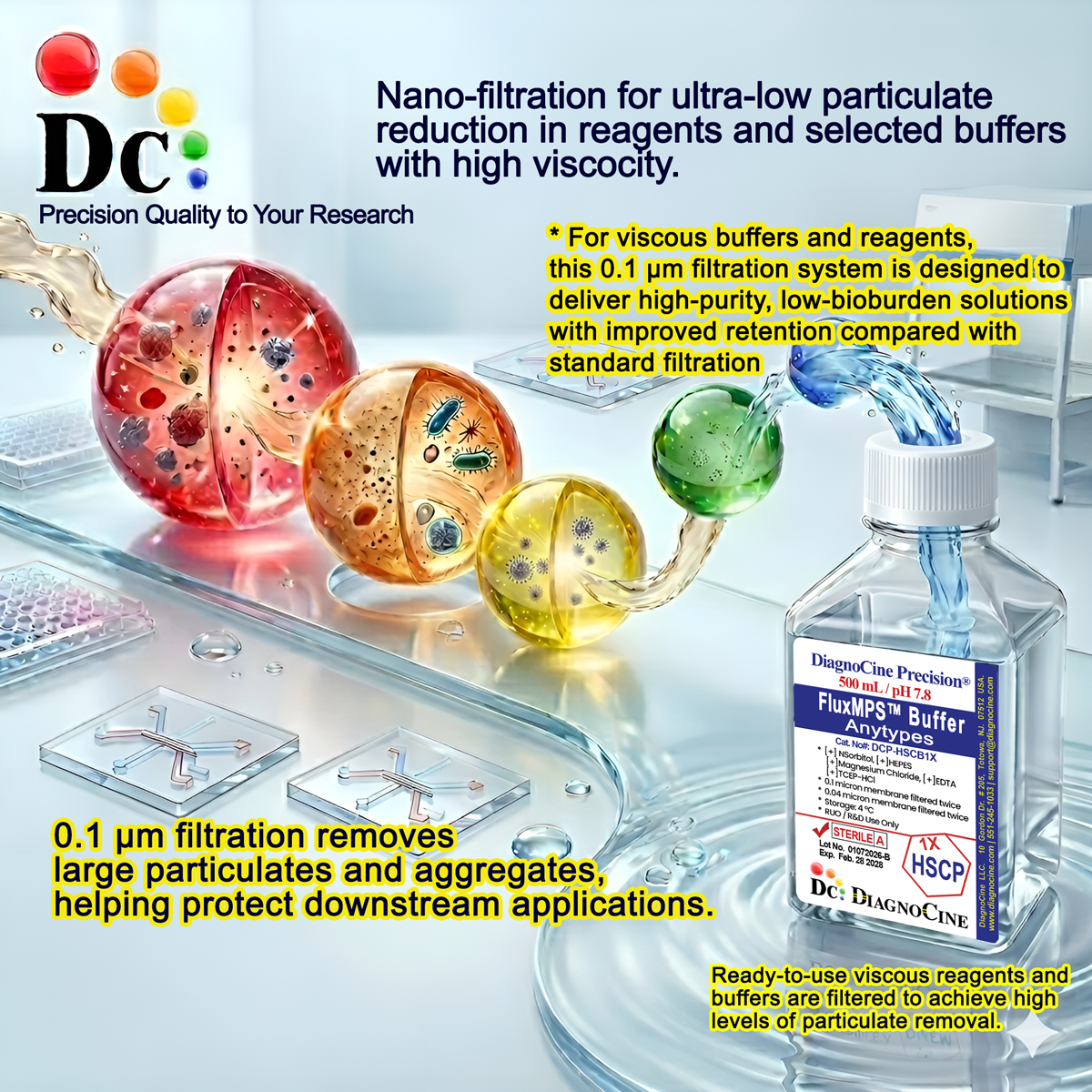
DCP-UTBS1X is processed through a 0.1 µm membrane filtration stage. This nominal rating is finer than the 0.22 µm clarification applied to conventional blocking buffers, removing large particulates and protein aggregates that would otherwise reach microchannels, valve seats, and optical windows. Because this is a protein-rich, viscosity-controlled blocking formulation, single-stage 0.1 µm processing is used to deliver high-purity, low-bioburden solution while preserving the integrity of the multi-protein blocking matrix.
-
01
0.1 µm Filtration — Particulate & Aggregate Removal
Large particulates, protein aggregates, and carry-over debris are retained on a 0.1 µm membrane. This guards downstream microfluidic applications and chip geometries and reduces bioburden load in the finished solution.
Performance vs. conventional blocking buffer
Standard immunoassay blocking solutions are clarified at 0.22 µm. The 0.1 µm membrane used for DCP-UTBS1X carries a nominal retention rating approximately 2.2× finer, which lowers the subvisible particulate burden delivered into microchannels, perfusion lines, and automated liquid-handling paths.
© Diagnocine® — DCP-UTBS1X
Universal blocking across immunoassay platforms
This blocking system delivers exceptional versatility across immunoassay platforms. In ELISA it provides rapid blocking with superior signal-to-noise ratios and supports both direct and sandwich formats. In Western blotting it is compatible with colorimetric, chemiluminescent, and fluorescent detection and with both nitrocellulose and PVDF membranes. For multiplexed immunoassays it maintains consistent performance across multiple analytes while minimizing cross-reactivity and assay variability. The TBS multi-protein blocking system supports both alkaline phosphatase and horseradish peroxidase detection systems.
Automated Bioreactors & Robotics
For automated bioreactors, robotic liquid handlers, and long-duration perfusion rigs, an optional 10 nm (0.01 µm) ultra-filtered grade of this formulation can be manufactured on request. Narrow-bore tubing, microvalves, and inline optical sensors are the components most sensitive to residual particulate, and the 0.01 µm grade is intended for those unattended, high-uptime configurations.
- Total Particulate Exclusion — residual subvisible particulate is driven to the practical detection floor for reagents entering automated fluid paths
- Valve & Sensor Protection — protects microvalve seats, pinch valves, and inline optical or electrochemical sensors from progressive fouling
- Extended Perfusion Stability — supports longer unattended runs between line flushes and filter changes in continuous-operation systems
Inquiry Required: the 0.01 µm (10 nm) ultra-filtered grade is a made-to-order configuration and is not the standard catalog format. To request it, contact support@diagnocine.com with your platform, volume, and required lead time.
Micro Physiological System (MPS) & Chip
Blocks non-specific protein adsorption on chip surfaces and channel walls in on-chip immunodetection and capture assays, with 0.1 µm filtration limiting particulate carry-over into channels.[1,2]
Wash, Dilution & Reconstitution
Doubles as an antibody diluent for primary and secondary antibodies in Western blotting, and as a plate-surface conditioning solution before antibody incubation.
iPSC-Derived Model Handling
Supports immunostaining and immunodetection readouts on iPSC-derived cultures where mammalian-protein cross-reactivity must be minimized — fish gelatin eliminates mammalian cross-reactivity concerns.
Endothelial & Primary Cell Perfusion
Used to passivate perfusion surfaces and immunoassay plates in endothelial and primary-cell workflows, with EDTA chelation preventing metal-ion interference in antibody–antigen binding.
ELISA, Blotting & Blocking
Primary use case: 300 µL per well for ELISA plate blocking; 10 mL for mini blots and 20 mL for midi blots in Western blotting; direct application to tissue sections for IHC.[3,5,8]
Microscopy & Optical Sensing
Low particulate load and suppressed background support confocal imaging, biosensor surfaces, and optical readouts where scattered light and non-specific adsorption degrade sensitivity.[6,7]
Key performance characteristics
- Universal compatibility with all immunoassay formats and detection systems
- Superior blocking efficiency through a multi-mechanism approach
- Enhanced sensitivity while maintaining low background signals
- Optimal pH and ionic strength for antigen–antibody interactions
- Extended stability with a comprehensive preservation system
- Ready-to-use formulation requiring no dilution or preparation
- Compatible with automated platforms and high-throughput applications
Recommended blocking protocols
- After coating and washing steps, add 300 µL blocking buffer per well
- Incubate 1–2 hours at room temperature (22–25 °C) or overnight
- Aspirate blocking buffer
- Proceed with antibody incubation, or dry plates for storage
- Transfer proteins to membrane as per standard protocol
- Block membrane with sufficient buffer to cover completely (10 mL for mini blots, 20 mL for midi blots)
- Incubate 5–60 minutes at room temperature with gentle agitation
- Use blocking buffer as antibody diluent for primary and secondary antibodies
- Apply blocking buffer directly to tissue sections
- Incubate 30–60 minutes at room temperature
- Remove excess buffer and proceed with primary antibody incubation
Specifications & quality control parameters
Released quality-control parameters, handling conditions, and regulatory traceability for DCP-UTBS1X. Values not specified below are reported on the lot-specific Certificate of Analysis (CoA).
| Parameter | Specification |
|---|---|
| Formulation / Composition | TBS-based multi-protein blocking solution: [+] Sodium caseinate, [+] BSA, [+] Fish gelatin, [+] PVP-40, [+] Dextran sulfate, [+] Tween-20, [+] Triton X-100, [+] ProClin 300, [+] Glycerol, [+] EDTA |
| Appearance | Colorless, liquid solution |
| pH at 1X concentration USP <791> | 7.4 – 7.6 |
| Osmolality USP <785> | See CoA |
| Concentration / Working format | 1X, ready-to-use (no dilution required) |
| Conductivity / Ionic strength | See CoA |
| Buffering system (pKa) | Tris-buffered saline (TBS); Tris pKa ≈ 8.06 at 25 °C |
| Viscosity control | Glycerol-stabilized for improved handling characteristics |
| Parameter | Specification |
|---|---|
| Sterility | Nonsterile |
| Antimicrobial preservation | ProClin 300, broad-spectrum |
| Bioburden | See CoA |
| Endotoxin | See CoA |
| Particulate ≥10 µm USP <788> | See CoA |
| Particulate ≥25 µm USP <788> | See CoA |
| Water purity | Ultrapure Type 1 water, 18.2 MΩ·cm |
| Filtration | 0.1 µm membrane |
| Parameter | Specification |
|---|---|
| Storage — unopened | −20 °C |
| Shelf life — unopened | 24 months from date of manufacture |
| Storage — opened | 4 °C |
| In-use stability — opened | 6 months |
| Light protection | Protect from direct sunlight |
| Available fill volumes | 500 mL, 1 L (a 50 mL volume is supplied within DiagnoCine Precision ELISA kits) |
| Shipping condition | See CoA |
| Equilibration note | Allow to reach room temperature and mix gently before use; re-verify pH if the buffer has been diluted or supplemented |
| Parameter | Specification |
|---|---|
| Raw material grade | Pharmaceutical-grade polymers; BSA Fraction V, biotin-free, IgG-free |
| Traceability | Lot-level traceability with CoA |
| Manufacturing QMS ISO 13485 | Manufactured under ISO 13485-certified and CE-approved facilities (suppliers of DiagnoCine Precision) |
| Regulatory alignment | ISO 13485:2016; 21 CFR Part 820 (cGMP) aligned |
| Final release | Final packaging, quality assurance, and testing performed at the DiagnoCine R&D and Quality Testing Center |
| Customization & assembly | All specific customization requests and assembly accomplished at DiagnoCine Precision, Totowa, New Jersey, USA |
| Intended use | For Research Use Only (RUO). Not intended for clinical, diagnostic, or therapeutic use in humans |
Full composition
DCP-UTBS1X is built on a Tris-buffered saline (TBS) platform, which provides pH stability and ionic-strength maintenance with superior compatibility for phosphoprotein detection systems compared with phosphate-based alternatives. Component concentrations are proprietary and are reported on the lot-specific Certificate of Analysis. Category headings below are reproduced from the product documentation.
| Component | CAS Number | Concentration |
|---|---|---|
| Tris-buffered saline (TBS) — buffering platform | — | See CoA |
| Multi-Protein Blocking Architecture | ||
| Sodium caseinate — primary small-protein blocker | 9005-46-3 | See CoA |
| BSA (Fraction V, biotin-free, IgG-free) — large-protein component | 9048-46-8 | See CoA |
| Fish gelatin — gap-filling agent | 9000-70-8 | See CoA |
| Component | CAS Number | Concentration |
|---|---|---|
| Advanced Polymer Enhancement System | ||
| PVP-40 (polyvinylpyrrolidone) — hydrophobic surface blocking | 9003-39-8 | See CoA |
| Dextran sulfate — ionic and electrostatic interference blocker | 9011-18-1 | See CoA |
| Component | CAS Number | Concentration |
|---|---|---|
| Optimized Surfactant Technology | ||
| Tween-20 (polysorbate 20) — non-specific binding reduction | 9005-64-5 | See CoA |
| Triton X-100 — surface wetting and washing efficiency | 9002-93-1 | See CoA |
| Comprehensive Stabilization and Preservation | ||
| ProClin 300 — broad-spectrum antimicrobial protection | — | See CoA |
| Glycerol — protein stabilization and viscosity control | 56-81-5 | See CoA |
| EDTA — chelation of interfering metal ions | 60-00-4 | See CoA |
Manufacturing & compliance
DCP-UTBS1X is manufactured under ISO 13485-certified and CE-approved facilities (suppliers of DiagnoCine Precision). All final packaging, quality assurance, and testing are performed at the DiagnoCine R&D and Quality Testing Center, and all specific customization requests and assembly are accomplished at DiagnoCine Precision in Totowa, New Jersey, USA.
ISO 13485:2016 QMS
Produced under an ISO 13485-certified, CE-approved quality management system aligned with 21 CFR Part 820 (cGMP) principles, with documented lot traceability.
Ultrapure Type 1 Water
Formulated in ultrapure Type 1 water (18.2 MΩ·cm) to minimize ionic and organic background that would otherwise affect wash behavior and assay signal.
Controlled Fill & Finish
Filled and finished in a controlled manufacturing environment following the 0.1 µm filtration stage. Supplied nonsterile with ProClin 300 preservation for extended in-use stability.
Micro-Batch Precision
Manufactured in controlled batch sizes so that protein, polymer, and surfactant ratios stay within tight release windows, supporting reproducible blocking performance lot to lot.
Particulate — USP <788> Method 2
Subvisible particulate characterized by microscopic particle count at the ≥10 µm and ≥25 µm thresholds; lot values are reported on the CoA.
pH — USP <791>
pH determined potentiometrically at 1X concentration against a released specification of 7.4–7.6.
Osmolality — USP <785>
Osmolality determined by freezing-point depression where required for the lot; the measured value is reported on the CoA.
Documentation / CoA
Each lot ships with a Certificate of Analysis covering appearance, pH, and the lot-specific parameters released for that batch.
How DCP-UTBS1X compares
Comparison against conventional single-protein blocking solutions used in ELISA, Western blotting, and IHC workflows. Parameters reflect the released specification and documented formulation of DCP-UTBS1X.
| Parameter | DCP-UTBS1X (FluxMPS™) | Conventional BSA blocking buffer (0.22 µm filtered) | Standard non-fat dry milk blocking solution (0.22 µm filtered) |
|---|---|---|---|
| Blocking mechanism | Multi-mechanism: 3 proteins + 2 polymers + 2 surfactants | Single protein | Single protein mixture |
| Electrostatic / charged-molecule blocking | check_circle Dextran sulfate | cancel | cancel |
| Hydrophobic surface blocking polymer | check_circle PVP-40 | cancel | cancel |
| Dual-surfactant wetting system | check_circle Tween-20 + Triton X-100 | Typically single surfactant | cancel |
| Phosphoprotein detection compatibility | check_circle TBS platform | Varies (phosphate-based common) | cancel Endogenous phosphoprotein interference |
| Final filtration membrane rating | 0.1 µm | 0.22 µm | 0.22 µm or unfiltered |
| Water quality | Ultrapure Type 1, 18.2 MΩ·cm | Varies by supplier | Varies by supplier |
| Manufacturing QMS | check_circle ISO 13485:2016 certified, CE-approved | Varies | Varies |
| Microfluidic / OoC channel compatibility | check_circle | Limited | cancel Particulate-rich |
| Ready-to-use, no preparation | check_circle 1X liquid | Varies | cancel Prepared fresh from powder |
| Antimicrobial preservation system | check_circle ProClin 300 | Varies | cancel |
| Custom formulation (PBS-based, pH, additives) | check_circle | cancel | cancel |
Frequently asked questions
Technical answers on formulation, filtration, handling, and documentation for DCP-UTBS1X.
Supporting literature
Peer-reviewed background on immunoassay blocking chemistry, surfactant and protein blocker performance, buffer behavior, and microfluidic reagent handling relevant to the use of DCP-UTBS1X.
- Bhatia SN, Ingber DE. Microfluidic organs-on-chips. Nature Biotechnology. 2014;32(8):760–772.doi:10.1038/nbt.2989
- Huh D, Matthews BD, Mammoto A, et al. Reconstituting organ-level lung functions on a chip. Science. 2010;328(5986):1662–1668.doi:10.1126/science.1188302
- Vogt RF Jr, Phillips DL, Henderson LO, Whitfield W, Spierto FW. Quantitative differences among various proteins as blocking agents for ELISA microtiter plates. Journal of Immunological Methods. 1987;101(1):43–50.doi:10.1016/0022-1759(87)90214-6
- Steinitz M. Quantitation of the blocking effect of Tween 20 and bovine serum albumin in ELISA microwells. Analytical Biochemistry. 2000;282(2):232–238.doi:10.1006/abio.2000.4602
- Xiao Y, Isaacs SN. Enzyme-linked immunosorbent assay (ELISA) and blocking with bovine serum albumin (BSA) — not all BSAs are alike. Journal of Immunological Methods. 2012;384(1–2):148–151.doi:10.1016/j.jim.2012.06.009
- Whitesides GM. The origins and the future of microfluidics. Nature. 2006;442(7101):368–373.doi:10.1038/nature05058
- Sackmann EK, Fulton AL, Beebe DJ. The present and future role of microfluidics in biomedical research. Nature. 2014;507(7491):181–189.doi:10.1038/nature13118
- Mahmood T, Yang PC. Western blot: technique, theory, and trouble shooting. North American Journal of Medical Sciences. 2012;4(9):429–434.doi:10.4103/1947-2714.100998
- Good NE, Winget GD, Winter W, Connolly TN, Izawa S, Singh RMM. Hydrogen ion buffers for biological research. Biochemistry. 1966;5(2):467–477.doi:10.1021/bi00866a011
- Ellis KJ, Morrison JF. Buffers of constant ionic strength for studying pH-dependent processes. Methods in Enzymology. 1982;87:405–426.doi:10.1016/S0076-6879(82)87025-0
- Esch EW, Bahinski A, Huh D. Organs-on-chips at the frontiers of drug discovery. Nature Reviews Drug Discovery. 2015;14(4):248–260.doi:10.1038/nrd4539