

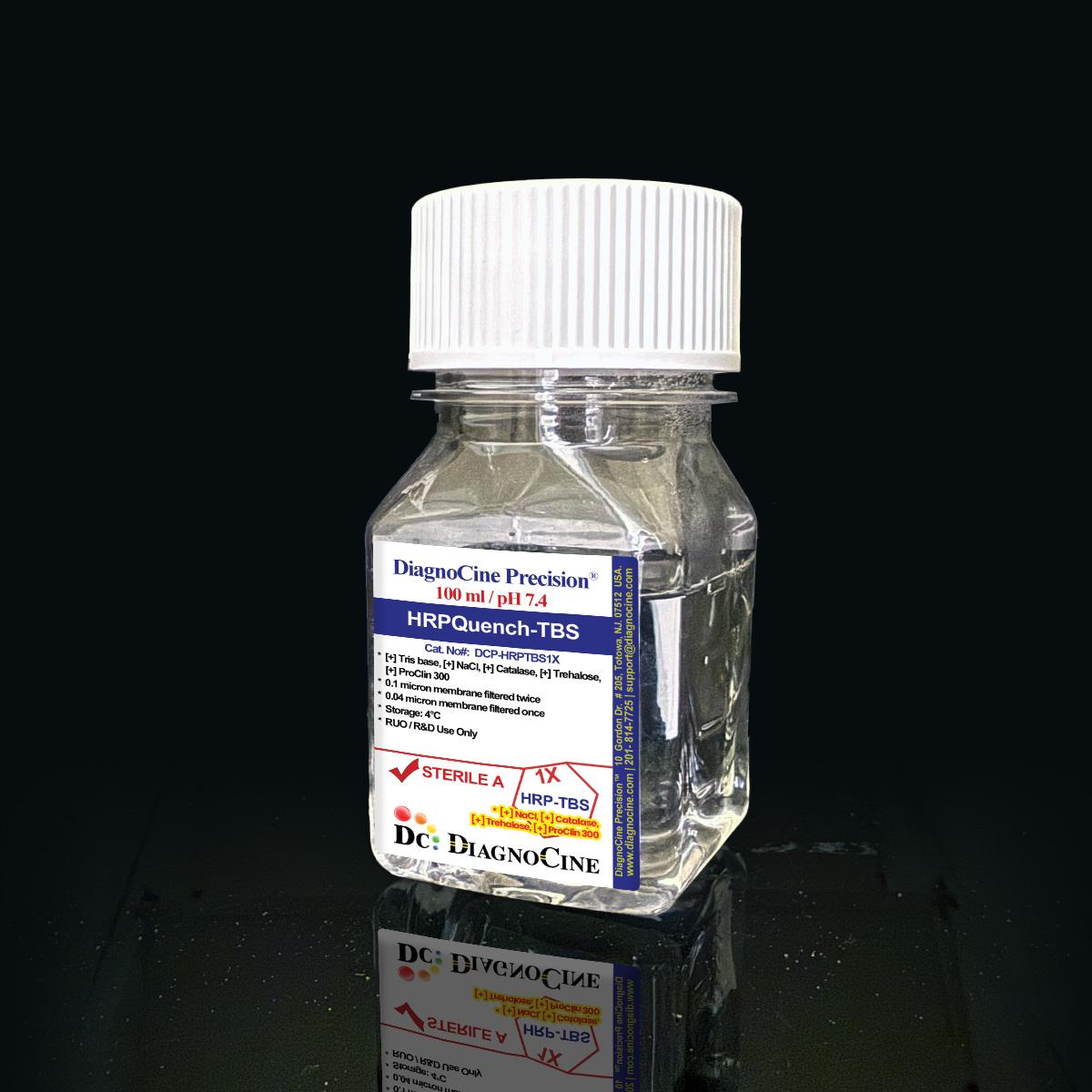
HRPQuench-TBS
FluxMPS™ HRPQuench-TBS
HRPQuench-TBS is an MPS-grade, dual-stage filtered Tris-buffered saline formulation engineered to completely inactivate horseradish peroxidase (HRP) between sequential staining cycles in multiplex immunolabeling protocols. Built on a defined 50 mM Tris / 150 mM NaCl base at pH 7.4, it delivers precise enzyme quenching without disturbing tissue morphology or downstream antibody-antigen interactions, supporting cleaner multiplex immunohistochemistry (mIHC) and immunofluorescence (mIF) results in microfluidic and chip-based imaging workflows.
- Dual-stage filtered (0.1 µm membrane once and 0.04 µm membrane once) for an ultrapure, ultra-clean Tris-buffered saline base
- Complete HRP inactivation between staining rounds prevents signal carryover in multi-round IHC/IF protocols
- Tris-buffered saline system at pH 7.4, optimized for compatibility with downstream immunoreagents (pH 7.4–7.6)
- Formulated with catalase for enzyme inactivation, trehalose for stabilization, and ProClin 300 as preservative
- Validated for both FFPE and frozen tissue sections; room-temperature incubation, no special equipment required
- Non-Sterile, Ultrapure formulation intended for Research Use Only
- Custom concentrations, pH, and additive formulations available on request — support@diagnocine.com
- FormatReady-to-Use Liquid
- pH7.4
- Buffer SystemTris-Buffered Saline (TBS)
- Tris Base50 mM
- Sodium Chloride150 mM
- Filtration0.1 µm x1 + 0.04 µm x1 (Dual-Stage)
- SterilityNon-Sterile
- AppearanceClear, Colorless Liquid
- Storage4°C
- Shelf Life1 Year
Engineered where standard quenching buffers fail
Conventional 0.22 µm-filtered quenching buffers leave subvisible particulates and inconsistent HRP inactivation that can carry over between staining rounds, drift pH, and elevate background in multiplex assays. HRPQuench-TBS is built to remove those failure points at the formulation level.
Microchannel-Safe Purity
Filtered 0.1 µm membrane once and 0.04 µm membrane once for an ultrapure base compatible with fine-bore microfluidic and imaging channels.
Precise, Stable pH
Defined 50 mM Tris / 150 mM NaCl formulation held at pH 7.4, matched to downstream immunoreagent compatibility of pH 7.4–7.6.
Ultrapure-Grade Water
Manufactured using Ultrapure Type 1 water (18.2 MΩ·cm) consistent with USP <85> water-quality practice.
Low Background for Imaging & Assays
Complete HRP inactivation between cycles reduces non-specific background in chromogenic and fluorescent multiplex assays.
Defined, Traceable Composition
Lot-released catalase, trehalose, and ProClin 300 in a controlled Tris-buffered saline matrix, documented component by component.
Customization on Demand
Alternate concentrations, additional chemicals/compounds/proteins/supplements, different pH, and other modifications available on request.
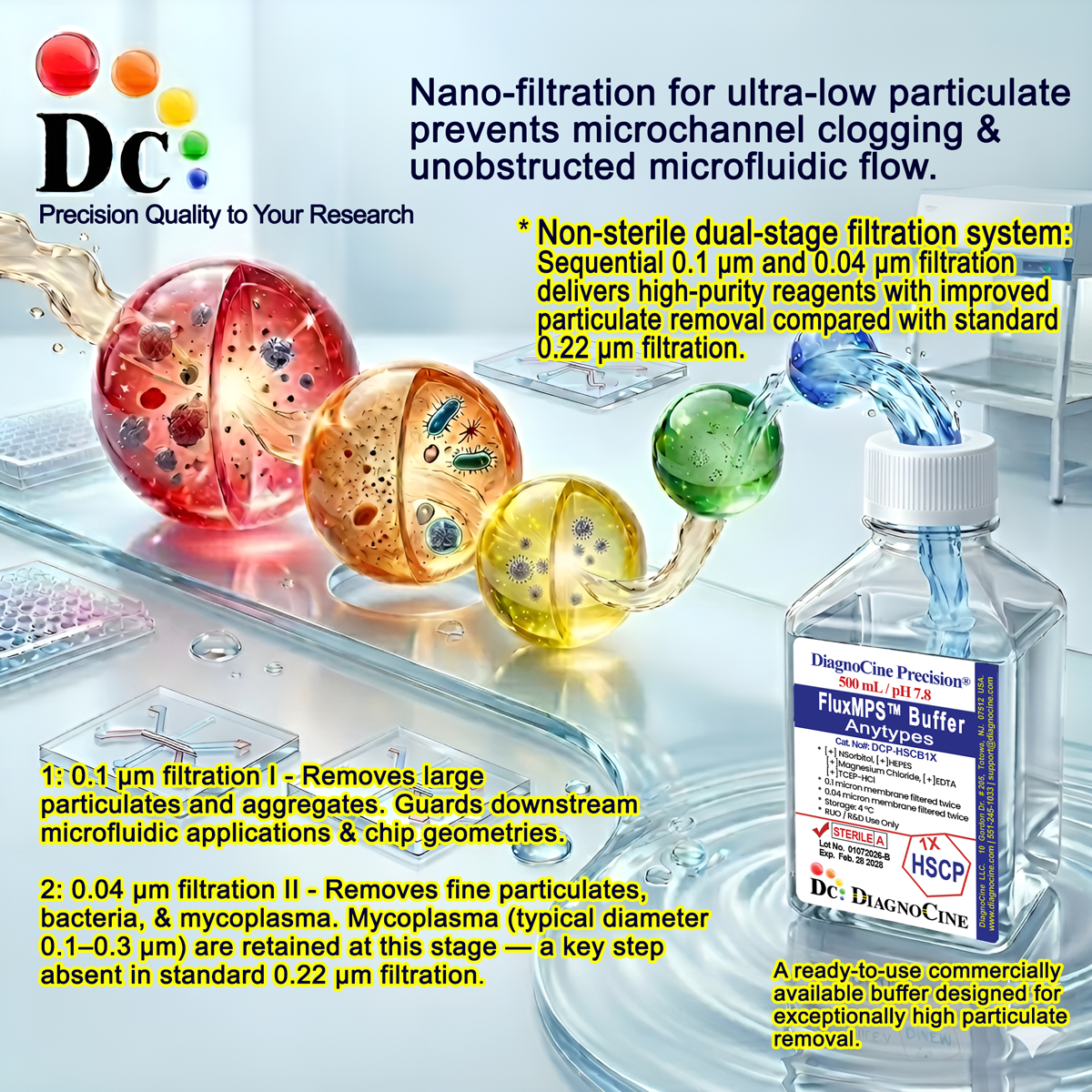
Dual-stage filtration system
HRPQuench-TBS is manufactured Non-Sterile and Ultrapure, passed through a 0.1 µm membrane once and a 0.04 µm membrane once to remove large particulates and finer bioburden ahead of formulation, delivering a clean Tris-buffered saline base for multiplex immunolabeling workflows.
-
1
0.1 µm Pre-Filtration I
Removes large particulates and aggregates from the Tris-buffered saline base, extending downstream filter life.
-
2
0.04 µm Pre-Filtration II
Retains finer particulates ahead of catalase, trehalose, and ProClin 300 addition, supporting a consistent, ultrapure formulation.
Performance vs. conventional buffer
Sequential 0.1 µm and 0.04 µm filtration removes finer particulates from the buffer base than a single 0.22 µm pass typical of conventional quenching buffers, supporting cleaner, lower-background multiplex staining results.
© Diagnocine® — DCP-HRPTBS1X
Built for sequential, multi-round immunolabeling
HRPQuench-TBS effectively neutralizes HRP activity between multiple staining cycles, providing precise control in complex, multi-step immunolabeling protocols. It enables distinct, non-overlapping labeling of multiple targets within a single specimen while streamlining workflows and reducing overall assay time and reagent consumption.
Automated IHC/IF Staining Platforms
HRPQuench-TBS is compatible with automated IHC/IF staining platforms, supporting consistent, hands-off HRP quenching between staining rounds in high-throughput sequential-cycle protocols.
- Complete HRP Inactivation: prevents signal carryover between automated staining rounds
- Reduced Assay Time: streamlines multi-round IHC/IF workflows on automated systems
- Lower Reagent Consumption: optimized composition reduces overall reagent use per cycle
Micro Physiological System (MPS) & Chip
Tris-buffered saline base suitable for microfluidic wash and quench steps within chip-based imaging workflows.
Wash, Dilution & Reconstitution
TBS-optimized formulation compatible with wash and dilution steps preceding or following HRP quenching.
iPSC-Derived Model Handling
Gentle, tissue-safe quenching supports multiplex labeling of iPSC-derived model sections without disrupting morphology.
Endothelial & Primary Cell Sections
Compatible with sequential HRP-based staining of endothelial and primary cell tissue sections.
Multiplex IHC, TSA-Based mIF & Blocking
Core use case: quenches endogenous and conjugated HRP between staining cycles in multiplex IHC, TSA-based multiplex immunofluorescence, and multi-round protocols using same-species primary antibodies.
Microscopy & Optical Detection
Reduces non-specific background, improving signal clarity for downstream chromogenic and fluorescent optical detection.
Physical, chemical & regulatory profile
Specification values for HRPQuench-TBS (DCP-HRPTBS1X), as released.
| Parameter | Specification |
|---|---|
| Formulation / Composition | Tris-buffered saline (TBS) with catalase, trehalose, and ProClin 300 |
| Appearance | Clear, Colorless Liquid |
| pH | 7.4 |
| Tris Base Concentration | 50 mM |
| Sodium Chloride Concentration | 150 mM |
| Parameter | Specification |
|---|---|
| Sterility | Non-Sterile |
| Filtration System Dual-Stage | 0.1 µm membrane once + 0.04 µm membrane once |
| Water Quality USP <85> | Ultrapure Type 1 water (18.2 MΩ·cm) |
| Manufacturing Standard | ISO 13485-certified, CE-approved facility |
| Parameter | Specification |
|---|---|
| Storage Temperature | 4°C |
| Shelf Life | 1 Year |
| Parameter | Specification |
|---|---|
| Manufacturing QMS ISO 13485 | Manufactured under ISO 13485-certified, CE-approved supplier facilities |
| Regulatory Traceability | Final packaging, QA, and testing at DiagnoCine R&D and Quality Testing Center |
| Production & Customization Site | DiagnoCine Precision, Totowa, New Jersey, USA |
| Intended Use | For Research Use Only (RUO); not for clinical, diagnostic, or therapeutic use in humans |
Full composition
HRPQuench-TBS combines a defined Tris-buffered saline base with an enzyme-inactivation and stabilization system, released component by component.
| Component | CAS Number | Concentration |
|---|---|---|
| Tris Base | 77-86-1 | 50 mM |
| Sodium Chloride | 7647-14-5 | 150 mM |
| Catalase | 9001-05-2 | 0.02% |
| Trehalose | 99-20-7 | 1% |
| ProClin 300 | 0.05% |
Manufacturing & compliance
HRPQuench-TBS is manufactured under ISO 13485-certified and CE-approved supplier facilities, with final packaging, quality assurance, and testing completed at the DiagnoCine R&D and Quality Testing Center.
ISO 13485:2016 QMS
Manufactured under an ISO 13485-certified, CE-approved facility quality management system.
Ultrapure Type 1 Water
Formulated with Ultrapure Type 1 water (18.2 MΩ·cm) consistent with USP <85> practice.
ISO Class 5 Fill & Finish Capability
Supplier facilities maintain ISO Class 5 (Class 100) fill and finish capability as part of the broader ISO 13485 manufacturing stack.
Micro-Batch Precision
Customization requests and assembly completed at DiagnoCine Precision in Totowa, New Jersey, USA.
Endotoxin Testing (USP <85> BET)
Facility QC methodology framework available under USP <85> Bacterial Endotoxins Test; not part of the standard release specification for this Non-Sterile reagent.
Particulate Control (USP <788> Method 2)
Formulation is dual-stage filtered (0.1 µm + 0.04 µm) as part of the facility's particulate-control practices referenced to USP <788> Method 2.
Osmolality (USP <785>)
Facility methodology framework available under USP <785>; not stated as a release specification for this formulation.
Documentation / CoA
Certificate of Analysis documentation practices are maintained at the DiagnoCine R&D and Quality Testing Center.
How DCP-HRPTBS1X compares
HRPQuench-TBS versus conventional single-pass filtered HRP-quenching buffers.
| Parameter | DCP-HRPTBS1X (FluxMPS™) | Conventional (0.22 µm filtered) | Standard Alternative (0.22 µm filtered) |
|---|---|---|---|
| Final filtration pore size | 0.1 µm + 0.04 µm | 0.22 µm single pass | 0.22 µm single pass |
| Number of filtration stages | 2 | 1 | 1 |
| Complete HRP inactivation | check_circle | cancel | cancel |
| Stabilizer & preservative system (catalase / trehalose / ProClin 300) | check_circle | cancel | cancel |
| Ultrapure Type 1 water | check_circle | cancel | cancel |
| ISO 13485-certified manufacturing | check_circle | cancel | cancel |
| Validated for FFPE & frozen sections | check_circle | check_circle | cancel |
| Custom formulation on request | check_circle | cancel | cancel |
Frequently asked questions
Common questions about HRPQuench-TBS (DCP-HRPTBS1X).
Supporting literature
Curated literature relevant to HRP quenching, multiplex immunolabeling, and Tris-buffered saline chemistry.
- Toth ZE, Mezey E. Simultaneous visualization of multiple antigens with tyramide signal amplification using antibodies from the same species. J Histochem Cytochem. 2007. doi:10.1369/jhc.6A7101.2007
- Stack EC, Wang C, Roman KA, Hoyt CC. Multiplexed immunohistochemistry, imaging, and quantitation: A review. Methods. 2014. doi:10.1016/j.ymeth.2014.08.016
- Tramu G, Pillez A, Leonardelli J. An efficient method of antibody elution for the successive or simultaneous localization of two antigens by immunocytochemistry. J Histochem Cytochem. 1978. doi:10.1177/26.4.649852
- Pirici D, Mogoanta L, Kumar-Singh S, et al. Antibody elution method for multiple immunohistochemistry on primary antibodies raised in the same species and of the same subtype. J Histochem Cytochem. 2009. doi:10.1369/jhc.2009.953240
- van der Loos CM. Multiple immunoenzyme staining: methods and visualizations for the observation with spectral imaging. J Histochem Cytochem. 2008. doi:10.1369/jhc.2008.951061
- Bulten J, Poddighe PJ, Robben JC, et al. Interphase cytogenetic analysis of cervical intraepithelial neoplasia. Am J Pathol. 1998 (catalase quenching methodology reference). doi:10.1016/S0002-9440(10)65718-3
- Good NE, Winget GD, Winter W, et al. Hydrogen ion buffers for biological research. Biochemistry. 1966 (Tris buffer chemistry). doi:10.1021/bi00866a011
- Bass BL, Engers HD. Optimization of buffer conditions for enzyme-based immunodetection assays. Anal Biochem. 1995. doi:10.1006/abio.1995.1140
- Ingber DE. Reverse engineering human pathophysiology with organs-on-chips. Cell. 2016. doi:10.1016/j.cell.2016.05.048
- Bhatia SN, Ingber DE. Microfluidic organs-on-chips. Nat Biotechnol. 2014. doi:10.1038/nbt.2989