.jpg "/Content/Upload/Product/Human_ELISA_kits_Diagnocine_1200_1200(141).jpg")
Human Prolactin/Luteotropic Hormone(PRL/LTH) ELISA Kit
The Ultimate 1-Stop ELISA Marketplace:
60,000+ ELISA kits Available to Serve Scientists from All Fields of Life Science
Always Powered by Diagnocine for Precision Research.
Most comprehensive buffers, reagents and detection agents are provided with each kit to optimize data output.
All-inclusive format covers everything from sample preparation to signal detection. Every step can be customized and optimized for your precision research.
DiagnoCine Precision buffers and reagents are Made in USA ISO 13485 Certified
Why waste time searching for your ELISA kit when you can get everything in one place? Diagnocine can provide you with all the ELISA needs you have (customized ELISAs also available) on the planet through a single, streamlined ordering process.
* all types of species
* HRP and AP detection
* Low target signal enhancement
* Inquire about a trial version or a customized version
4 core reagents below are included with every order, plus 1 of the 2 detection-specific reagents (matched automatically to your kit type) — 5 components, every time.
+ the 5th component, matched to your kit's detection method:
If you have any questions or need additional information, please call us at 551-245-1033 or email us at support@diagnocine.com. Our team will be happy to assist you.
Universal Compatibility
All buffers and detection reagents work seamlessly across target proteins, bridging the gap in assay consistency.
1-Stop Convenience
Consolidate your lab's purchasing. Source all ELISA needs and experience optimal buffers and reagents in a single shipment.
Enhanced Precision
Designed by scientists for scientists, all components are engineered to deliver sharper results and an optical signal.
Human Prolactin/Luteotropic Hormone(PRL/LTH) ELISA Kit
Sandwich quantitative immunoassay for Human Prolactin/Luteotropic Hormone(PRL/LTH) in human serum, plasma, cell culture supernates, tissue homogenates, cell lysates available in multiple catalog sizes:
Note: Please send inquiries regarding Trial 24T orders to support@diagnocine.com.
| Uniprot No. | P01236 |
| Species | Homo sapiens (Human) |
| Sample types | serum, plasma, cell culture supernates, tissue homogenates, cell lysates |
| Detection range | 40 μIU/mL-2000 μIU/mL |
| Sensitivity | 50 μIU/mL |
| Assay time | 1-5h |
| Sample loading volume | 50-100μL |
| Detection wavelength | 450 nm |
| Assay principle | Sandwich (Quantitative) |
| Data analysis | Standard curve + Curve Expert software |
| Research area | Signal Transduction |
| Storage condition | 2-8°C (see protocol for full details) |
| Shipping condition | 4 °C |
| Shelf life | 6 months |
10 business days
Processing + 3-5 days shipping
In Stock : USA
Worldwide shipping available
Antibody capture
450 nm detection
Standard curve
Quantification
In this sandwich ELISA, Human Prolactin/Luteotropic Hormone(PRL/LTH) in the sample is captured between a pre-coated capture antibody and a detection antibody. Signal intensity is proportional to analyte concentration. Quantification uses a standard curve fitted with Curve Expert software, covering 40 μIU/mL-2000 μIU/mL with a minimum detectable dose of 50 μIU/mL.
Prolactin is a peptide hormone primarily produced by the anterior pituitary gland that plays essential roles in lactation, reproduction, and immune regulation. Beyond its classical function in stimulating milk production in mammary glands, prolactin influences numerous physiological processes including osmoregulation, metabolism, and maternal behavior. The hormone acts through prolactin receptors distributed throughout various tissues, making it an important mediator in both reproductive and non-reproductive functions. Dysregulation of prolactin levels is associated with various clinical conditions, making its measurement important for endocrine research and diagnostic applications. The Human Prolactin/Luteotropic Hormone ELISA Kit (CSB-E06883h) provides quantitative measurement of prolactin in human samples using a sandwich assay principle. This kit works with multiple sample types including serum, plasma, cell culture supernates, tissue homogenates, and cell lysates. The detection range spans 40-2000 μIU/mL with sensitivity of 50 μIU/mL. The assay requires 50-100 μL sample volume and can be completed within 1-5 hours, with detection performed at 450 nm wavelength. Application Examples Note: The following application examples are drawn from a selection of publications citing this product. For additional applications, please refer to the full list of references in the "Citations" section. This ELISA kit has been used in research measuring prolactin levels across different biological contexts and experimental conditions. Studies have applied the kit to measure prolactin in serum samples and tissue homogenates, supporting research into hormonal regulation and cellular processes. • Endocrine research: Determination of circulating prolactin levels in serum samples to evaluate hormonal status and regulation • Reproductive biology: Analysis of decidual prolactin as a marker of decidualization in endometrial stromal cells during in vitro studies examining cellular differentiation processes • Breast tissue analysis: Quantification of prolactin levels in homogenized breast tissues alongside proliferation markers to study tissue-specific hormonal profiles
- PAK1 nuclear translocation is ligand-dependent: only PRL but not E2 stimulated PAK1 nuclear translocation PMID: 27003261
- This review addresses risk factors for rheumatoid arthritis (RA) linked to prolactin (PRL), the effects of PRL and vasoinhibins on joint tissues, blood vessels, and immune cells, and the clinical and experimental data associating PRL with RA. [review] PMID: 27026299
- GABA alpha2 and/or alpha3 receptor subtypes are involved in GABAergic modulation of prolactin secretion. PMID: 27128218
- In conclusion, the present study provides evidence supporting a significantly positive association between plasma prolactin levels and the risk of breast cancer. PMID: 27184120
- Study demonstrate that PRL is necessary for the survival of (retinal pigment epithelium) RPE under normal and advancing age conditions and, identified SIRT2 and TRPM2 as molecular targets for the antioxidant and antiapoptotic actions of PRL in the RPE. PMID: 27322457
- Data indicate 12 single nucleotide polymorphism (SNPs) associated with increased prolactin levels in both plasma and cerebrospinal fluid (CSF). PMID: 27357110
- These data provide insight into the mechanisms guiding PRL-mediated breast cancer cell motility and invasion and highlight a significant role for phosphoTyr-PAK1 in breast cancer metastasis. PMID: 27542844
- This study revealed a significant association between the prolactin polymorphic variant rs1341239 and the development of hyperprolactinemia in patients with schizophrenia. PMID: 27776952
- The review focuses on the role of prolactin in breast development, bone homeostasis and in breast cancer to bone metastases. (Review) PMID: 27782069
- High serum prolactin and vasoinhibin levels predict and may impact retinopathy of prematurity progression PMID: 27842054
- findings show that cysteine in the PRL catalytic site is endogenously phosphorylated as part of the catalytic cycle and that phosphocysteine levels change in response to Mg(2+) levels. PMID: 27856537
- changes in mRNA expression of selected toll-like receptors (TLR2, TLR4, TLR7), stress cytokine prolactin (PRL), and proand anti-inflammatory cytokines (TNF-alpha, IL-6, IL-12, IL-10) in peripheral blood monocytes of celiac disease patients, were investiagted. PMID: 28028951
- Prolactin rs1341239 T allele decreases the risk of brick tea fluorosis in the Inner Mongolia in China population. PMID: 28152004
- High normal circulating prolactin levels predict changes in haemodynamic indices and worsening endothelial function in healthy postmenopausal women. Particularly in young postmenopausal women, prolactin predicts accelerated arterial stiffening. PMID: 28332508
- Our studies have demonstrated the essential role of endogenous PRL and CDK7 in the upregulation of PRLR by E2 and provide insights for therapeutic approaches that will mitigate the transcription/expression of PRLR and its participation in breast cancer progression fueled by E2 and PRL via their cognate receptors. PMID: 28423697
- Depression and anxiety in subfertile males are associated with higher secretion of PRL. PMID: 28456148
- The production of PRL by Mvarphis was increased by unknown components of rheumatoid arthritis and rheumatoid arthritis synovial fluid, where it could contribute to disease progression. PMID: 28642278
- In newborns, serum PRL and hGH levels show a positive correlation that can be explained by common regulatory factors or a drift phenomenon. A higher gestational week is associated with a higher PRL/hGH ratio. PMID: 28700563
- PRL levels were lower in psychogenic non-epileptic seizure patients with a history of sexual abuse compared to healthy controls and healthy controls with a history of sexual abuse. PMID: 28927333
- Cin85-deficient mother mice had reduced pituitary hormone prolactin secretion as a result of excessive dopamine signaling in the brain. Their offspring matured normally and produced their own pups; however, nurturing behaviors such as pup retrieval and nursing were strongly inhibited. PMID: 29158391
- Circulating prolactin levels may not be higher in patients with Behcet's disease than in controls (meta-analysis). PMID: 29412808
| Intra-assay Precision (Precision within an assay): CV%<15% | ||||||
| Three samples of known concentration were tested twenty times on one plate to assess. | ||||||
| Inter-assay Precision (Precision between assays): CV%<15% | ||||||
| Three samples of known concentration were tested in twenty assays to assess. | ||||||
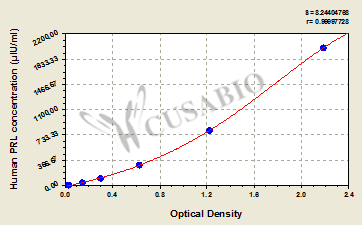
| These standard curves are provided for demonstration only. A standard curve should be generated for each set of samples assayed. | |||||||||||||||||||||||||||||||||||||||||||||||||
| |||||||||||||||||||||||||||||||||||||||||||||||||
| To assess the linearity of the assay, samples were spiked with high concentrations of human PRL in various matrices and diluted with the Sample Diluent to produce samples with values within the dynamic range of the assay. | ||||||
| Sample | Serum(n=4) | |||||
| 1:1 | Average % | 89 | ||||
| Range % | 86-97 | |||||
| 1:2 | Average % | 92 | ||||
| Range % | 87-100 | |||||
| 1:4 | Average % | 95 | ||||
| Range % | 92-99 | |||||
| 1:8 | Average % | 95 | ||||
| Range % | 90-98 | |||||
| The recovery of human PRL spiked to levels throughout the range of the assay in various matrices was evaluated. Samples were diluted prior to assay as directed in the Sample Preparation section. | ||||||
| Sample Type | Average % Recovery | Range | ||||
| Serum (n=5) | 94 | 90-102 | ||||
| EDTA plasma (n=4) | 97 | 92-99 | ||||