
FluxMPS™ Ham's F-12 Nutrient Mixture
Select See the table below
- See the table below
FluxMPS™ Ham's F-12 Nutrient Mixture
Ham's F-12 nutrient mixture is a widely utilized basal medium for culturing a variety of mammalian cells, including Chinese Hamster Ovary (CHO) cells, cancer cells, primary cells, and chicken embryonic cells. Developed by R.G. Ham in 1965 as an enhancement over the earlier F-10 nutrient mixture, it contains a more comprehensive array of components such as zinc, putrescine, hypoxanthine, and thymidine compared to other basal media like DMEM. Formulated for serum-free culture of single cells and clonal growth, Ham's F-12 can also be supplemented with serum for other cell types. While lacking proteins, lipids, and growth factors, it requires supplementation with serum or serum-free additives to facilitate optimal growth. The medium employs a sodium bicarbonate buffer system, necessitating a 5-10% CO2 environment to maintain physiological pH. Common modifications to Ham's F-12 include the addition or removal of L-glutamine, phenol red, and HEPES buffer. A popular variant, DMEM/F12, combines DMEM and F-12 in equal parts, creating a more nutrient-rich medium. Every FluxMPS™ variant is purified through quadruple-stage 0.04 micron filtration, engineered for organ-on-chip (OoC), tissue-on-chip (ToC), and lab-on-chip (LoC) microfluidic culture systems.
- 13 variants across L-Glutamine, Sodium Bicarbonate, and Phenol Red inclusion/exclusion, plus specialty formulations without Folic Acid and with L-Alanyl-L-Glutamine (Sodium Pyruvate included in every variant)
- One of the first defined media to incorporate copper and zinc as trace elements, plus putrescine, hypoxanthine, and thymidine, absent from DMEM
- Overall, a versatile basal medium suitable for serum-free and low-serum culture of various cell types, especially CHO cells
- The base formulation for the widely used DMEM/F-12 1:1 hybrid
- Sodium bicarbonate buffering system requiring a 5-10% CO2 environment
- FluxMPS™ quadruple-stage 0.04 micron filtration — finer than any ready-to-use cell culture media currently available
- Available in 500 mL and 1000 mL sizes; 2-8°C storage away from bright light; fully customizable on request
- Concentration1X
- Glucose1801.60 mg/L
- L-GlutamineConfigurable (+/-)
- Sodium PyruvateIncluded (all variants)
- Sodium Bicarbonate / Phenol RedConfigurable (+/-)
- Folic AcidConfigurable (+/-, specialty variants)
- Sizes500 mL / 1000 mL
- Storage2-8 C, away from light
Select Your Ham's F-12 Nutrient Mixture Configuration
Please select the supplement(s) of interest, then click Search. Check the supplement(s) you need below and press Search to instantly highlight every matching variant. Each row links straight through to its product page via the catalog number or the View button. Rows marked with an italic note carry a specialty modification (No Folic Acid, or L-Alanyl-L-Glutamine) beyond the four standard supplement flags.
| Name | Cat No. | L-Glutamine | Pyruvate | Bicarbonate | Phenol Red | Product Page |
|---|---|---|---|---|---|---|
| Ham's F-12 | DCP-H121X | check | check | check | check | Viewarrow_forward |
| Ham's F-12 w/o Glutamine | DCP-H12-Q1X | remove | check | check | check | Viewarrow_forward |
| Ham's F-12 w/o Bicarbonate | DCP-H12-B1X | check | check | remove | check | Viewarrow_forward |
| Ham's F-12 w/o Phenol Red | DCP-H12-R1X | check | check | check | remove | Viewarrow_forward |
| Ham's F-12 w/o Glutamine, Bicarbonate | DCP-H12-QB1X | remove | check | remove | check | Viewarrow_forward |
| Ham's F-12 w/o Glutamine, Phenol Red | DCP-H12-QR1X | remove | check | check | remove | Viewarrow_forward |
| Ham's F-12 w/o Bicarbonate, Phenol Red | DCP-H12-BR1X | check | check | remove | remove | Viewarrow_forward |
| Ham's F-12 w/o Glutamine, Bicarbonate, Phenol Red | DCP-H12-QBR1X | remove | check | remove | remove | Viewarrow_forward |
| Ham's F-12 w/o Folic Acid (No Folic Acid) | DCP-H12-F1X | check | check | check | check | Viewarrow_forward |
| Ham's F-12 w/o Bicarbonate, Folic Acid (No Folic Acid) | DCP-H12-BF1X | check | check | remove | check | Viewarrow_forward |
| Ham's F-12 w/o Phenol Red, Folic Acid (No Folic Acid) | DCP-H12-RF1X | check | check | check | remove | Viewarrow_forward |
| Ham's F-12 w/o Bicarbonate, Phenol Red, Folic Acid (No Folic Acid) | DCP-H12-BRF1X | check | check | remove | remove | Viewarrow_forward |
| Ham's F-12 + L-Alanyl-L-Glutamine (Has L-Alanyl-L-Glutamine) | DCP-H12YA1X | check | check | check | check | Viewarrow_forward |
About Ham's F-12 Nutrient Mixture
Ham's F-10 and Ham's F-12 are chemically defined, nutrient-rich cell culture media developed by Richard G. Ham at the University of Colorado to support the clonal growth of single Chinese hamster ovary (CHO) cells, an objective that required sustaining individual cells at very low densities under defined conditions, without reliance on serum or undefined biological extracts. They belong to a larger family of sequentially numbered formulations (the "F" series) developed by Ham in the late 1950s-1960s, each iteration tested against clonal growth efficiency as the quantitative readout.
Ham's F-12 (1965)
Ham, R.G. (1965). "Clonal growth of mammalian cells in a chemically defined, synthetic medium." Proceedings of the National Academy of Sciences USA, 53(2): 288-293. PMID: 14283412. F-12 was developed from F-10 (1963-1965) to achieve true protein-free clonal growth of CHO cells. In the 1965 PNAS paper, Ham demonstrated for the first time that single CHO cells could proliferate into clones in a fully chemically defined, protein-free medium.
F-12 is a direct development of F-10, retaining the same qualitative amino acid and vitamin profiles but with substantially altered concentrations of several components, most notably an approximately 30-fold higher zinc sulfate level, along with the addition of putrescine and linoleic acid, thereby rendering it effective for low-density, protein-free CHO culture. Both media share the same inorganic salt framework, the same 10-vitamin panel (including biotin and vitamin B12, which are absent from DMEM), the same nucleoside/nucleotide precursors (hypoxanthine and thymidine), and the same organic supplements (lipoic acid and sodium pyruvate).
F-12 became a medium of choice for myeloma and hybridoma cloning, primary rat hepatocytes, rat prostate epithelial cells, clonal toxicity assays, and the base of the widely used DMEM/F-12 hybrid. A tribute to Ham notes that F-12 became the starting medium for the systematic definition of individual growth-factor requirements across cell types, the platform from which the MCDB series grew.
Richard G. Ham and the Serum-Free Cloning Problem
By the late 1950s, growing a single mammalian cell into a clone essential for genetic analysis, mutagenesis, and selection of stable lines still depended on high serum concentrations or feeder cells. Ham recognized that the barrier was not a single missing factor but an incompletely defined nutrient environment whose inadequacies were masked by the serum's complex activity.
Working with near-diploid Chinese hamster (CHO) cells, the line initiated by Theodore T. Puck at the University of Colorado in 1957, Ham systematically developed a series of nutrient mixtures using single-cell plating efficiency (the fraction of individually plated cells that formed visible colonies) as his quantitative endpoint. Each formulation number marked an iteration in this optimization.
Ham's F-10 (1963) — The Direct Precursor
Ham, R.G. (1963). "An improved nutrient solution for diploid Chinese hamster and human cell lines." Experimental Cell Research, 29: 515-526. PMID: 13952250. F-10 enabled consistent single-cell cloning of Chinese hamster cells under low-serum conditions, and serum-free growth in the presence of defined proteins (serum albumin and fetuin). It was one of the first defined media to incorporate copper (CuSO4) and zinc (ZnSO4) as trace elements, and included hypoxanthine, thymidine, and lipoic acid. F-10 was also found to support human diploid cells, chromosome analysis of white blood cells, primary explants of rat, rabbit, and chicken tissues, and chick embryo cells.
Ham's F-12 Composition
Standard nutrient mixture F-12 (with L-glutamine; without sodium bicarbonate). All concentrations in mg/L. Per-lot Certificate of Analysis (CoA) requests can be directed to support@diagnocine.com.
Inorganic Salts
| Salt | mg/L |
|---|---|
| Calcium chloride dihydrate (CaCl2 * 2H2O) | 44.100 |
| Copper sulfate pentahydrate (CuSO4 * 5H2O) | 0.0025 |
| Ferrous sulfate heptahydrate (FeSO4 * 7H2O) | 0.834 |
| Magnesium chloride anhydrous (MgCl2) | 57.650 |
| Potassium chloride (KCl) | 223.600 |
| Sodium chloride (NaCl) | 7599.000 |
| Sodium phosphate dibasic anhydrous (Na2HPO4) | 142.040 |
| Zinc sulfate heptahydrate (ZnSO4 * 7H2O) | 0.863 |
Amino Acids
| Amino Acid | mg/L |
|---|---|
| Glycine | 7.500 |
| L-Alanine | 8.910 |
| L-Arginine hydrochloride | 210.700 |
| L-Asparagine monohydrate | 15.010 |
| L-Aspartic acid | 13.300 |
| L-Cysteine hydrochloride monohydrate | 35.120 |
| L-Glutamic acid | 14.700 |
| L-Glutamine | 146.000 |
| L-Histidine hydrochloride monohydrate | 20.960 |
| L-Isoleucine | 3.940 |
| L-Leucine | 13.100 |
| L-Lysine hydrochloride | 36.500 |
| L-Methionine | 4.480 |
| L-Phenylalanine | 4.960 |
| L-Proline | 34.500 |
| L-Serine | 10.500 |
| L-Threonine | 11.900 |
| L-Tryptophan | 2.040 |
| L-Tyrosine disodium salt dihydrate | 7.810 |
| L-Valine | 11.700 |
Vitamins
| Vitamin | mg/L |
|---|---|
| Biotin | 0.0073 |
| Choline chloride | 13.960 |
| D-Ca-Pantothenate | 0.480 |
| Folic acid | 1.320 |
| Nicotinamide | 0.037 |
| Pyridoxine hydrochloride | 0.062 |
| Riboflavin | 0.038 |
| Thiamine hydrochloride | 0.340 |
| Vitamin B12 | 1.360 |
| myo-Inositol | 18.000 |
Other Components
| Component | mg/L |
|---|---|
| D-Glucose | 1801.600 |
| Hypoxanthine sodium salt | 4.770 |
| Linoleic acid | 0.084 |
| Lipoic acid | 0.210 |
| Phenol red sodium salt | 1.240 |
| Putrescine dihydrochloride | 0.161 |
| Sodium pyruvate | 110.100 |
| Thymidine | 0.730 |
| Sodium bicarbonate (NaHCO3) | 1176.000 |
Key Structural Differences: F-10 to F-12
Context on the biochemical rationale behind the F-10-to-F-12 evolution that underlies the Coon's Modification base formulation.
The zinc difference is the defining feature. The approximately 30-fold increase in ZnSO4 * 7H2O from F-10 (0.029) to F-12 (0.863 mg/L) was the single most important change enabling protein-free CHO cloning. Zinc is required for numerous metalloenzymes, receptors, and transcription factors; at very low cell densities, the per-volume zinc requirement is not met by trace contamination, so it must be supplied at a defined, elevated concentration.
Putrescine supports polyamine-dependent proliferation. Putrescine (0.161 mg/L) is the diamine precursor to spermidine and spermine, essential for DNA synthesis, ribosome function, and cell division, partially bypassing the polyamine supply that serum normally provides.
Linoleic acid is an essential fatty acid. Linoleic acid (0.084 mg/L, free fatty acid) supplies the essential omega-6 fatty acid for membrane phospholipid synthesis that serum albumin-bound fatty acids would otherwise provide; cells cannot synthesize it de novo.
myo-Inositol is 33x higher in F-12 (18.0 vs 0.541 mg/L). Inositol is a component of phosphatidylinositol, a key membrane phospholipid and signaling intermediate whose requirement rises sharply in single-cell cultures.
Choline is 20x higher in F-12 (13.96 vs 0.698 mg/L), supporting phosphatidylcholine synthesis and the higher membrane biosynthetic demand of rapidly proliferating single-cell clones under protein-free conditions.
Comparison to Ham's F-10 (The Direct Precursor)
Ham's F-10 is provided here for reference and comparison; it is a distinct, separately formulated product from the F-12 family sold above.
Side-by-Side Composition Comparison
| Salt | F-10 (mg/L) | F-12 (mg/L) | Notes |
|---|---|---|---|
| CaCl2 * 2H2O | 44.100 | 44.100 | Identical |
| CuSO4 * 5H2O | 0.0025 | 0.0025 | Identical |
| FeSO4 * 7H2O (ferrous) | 0.834 | 0.834 | Identical |
| MgSO4 anhydrous | 74.640 | — | F-10 only |
| MgCl2 anhydrous | — | 57.650 | F-12 only; Mg source change |
| KCl | 285.000 | 223.600 | Lower in F-12 |
| KH2PO4 | 83.000 | — | F-10 only |
| NaCl | 7400.000 | 7599.000 | Slightly higher in F-12 |
| Na2HPO4 | 153.700 | 142.040 | Both are slightly lower in F-12 |
| ZnSO4 * 7H2O | 0.029 | 0.863 | Approximately 30x higher in F-12 — critical difference |
| Amino Acid | F-10 (mg/L) | F-12 (mg/L) | Change |
|---|---|---|---|
| Glycine | 7.510 | 7.500 | Approximately same |
| L-Alanine | 8.910 | 8.910 | Identical |
| L-Arginine HCl | 211.000 | 210.700 | Approximately same |
| L-Asparagine * H2O | 15.010 | 15.010 | Identical |
| L-Aspartic acid | 13.300 | 13.300 | Identical |
| L-Cysteine * HCl * H2O | 35.130 | 35.120 | Approximately same |
| L-Glutamic acid | 14.700 | 14.700 | Identical |
| L-Glutamine | (add separately) | 146.000 | Included in F-12 base |
| L-Histidine * HCl * H2O | 21.000 | 20.960 | Approximately same |
| L-Isoleucine | 2.600 | 3.940 | Higher in F-12 (+52%) |
| L-Leucine | 13.100 | 13.100 | Identical |
| L-Lysine * HCl | 29.300 | 36.500 | Higher in F-12 (+25%) |
| L-Methionine | 4.480 | 4.480 | Identical |
| L-Phenylalanine | 4.960 | 4.960 | Identical |
| L-Proline | 11.500 | 34.500 | 3x higher in F-12 |
| L-Serine | 10.500 | 10.500 | Identical |
| L-Threonine | 3.570 | 11.900 | 3.3x higher in F-12 |
| L-Tryptophan | 0.600 | 2.040 | 3.4x higher in F-12 |
| L-Tyrosine | 2.610 | 7.810 | 3x higher in F-12 |
| L-Valine | 3.500 | 11.700 | 3.3x higher in F-12 |
| Vitamin | F-10 (mg/L) | F-12 (mg/L) | Change |
|---|---|---|---|
| Biotin | 0.024 | 0.0073 | Lower in F-12 |
| Choline chloride | 0.698 | 13.960 | 20x higher in F-12 |
| D-Ca-Pantothenate | 0.715 | 0.480 | Lower in F-12 |
| Folic acid | 1.320 | 1.320 | Identical |
| Nicotinamide | 0.615 | 0.037 | Lower in F-12 |
| Pyridoxine * HCl | 0.206 | 0.062 | Lower in F-12 |
| Riboflavin | 0.376 | 0.038 | Lower in F-12 |
| Thiamine * HCl | 1.000 | 0.340 | Lower in F-12 |
| Vitamin B12 | 1.360 | 1.360 | Identical |
| myo-Inositol | 0.541 | 18.000 | 33x higher in F-12 |
| Component | F-10 (mg/L) | F-12 (mg/L) | Change |
|---|---|---|---|
| D-Glucose | 1100.000 | 1801.600 | Higher in F-12 (approximately 10 mM vs approximately 6 mM) |
| Hypoxanthine (Na salt) | 4.080 | 4.770 | Approximately same |
| Lipoic acid | 0.210 | 0.210 | Identical |
| Linoleic acid | — | 0.084 | F-12 only |
| Putrescine * 2HCl | — | 0.161 | F-12 only |
| Sodium pyruvate | 110.000 | 110.100 | Approximately same |
| Thymidine | 0.730 | 0.730 | Identical |
| NaHCO3 | 1200.000 | 1176.000 | Approximately same |
| Phenol red Na salt | 1.300 | 1.240 | Approximately same |
Media Lineage Comparison
| Feature | Ham's F-12 | Ham's F-10 | DMEM (High Glucose) |
|---|---|---|---|
| Developer & year | R.G. Ham, 1965 | R.G. Ham, 1963 | Dulbecco & Freeman, 1959 |
| Parent formulation | F-10 (direct) | Earlier "F" series | BME |
| Trace metals (Cu, Zn, Fe) | Cu + Zn + Fe | Cu + Zn + Fe | Fe only (ferric nitrate) |
| Hypoxanthine | Yes, 4.77 mg/L | Yes, 4.08 mg/L | No |
| Thymidine | Yes, 0.73 mg/L | Yes, 0.73 mg/L | No |
| Lipoic acid | Yes, 0.21 mg/L | Yes, 0.21 mg/L | No |
| Putrescine | Yes, 0.161 mg/L | No | No |
| Linoleic acid | Yes, 0.084 mg/L | No | No |
| Biotin | Yes, 0.0073 mg/L | Yes, 0.024 mg/L | No |
| Vitamin B12 | Yes, 1.36 mg/L | Yes, 1.36 mg/L | No |
| Vitamin B6 form | Pyridoxine HCl | Pyridoxine HCl | Pyridoxine HCl (Gibco) |
| myo-Inositol | 18.0 mg/L | 0.541 mg/L | Present (lower) |
| Glucose | 1801.6 mg/L (approximately 10 mM) | 1100 mg/L (approximately 6.1 mM) | 4500 mg/L (25 mM) |
| Sodium pyruvate | 110 mg/L | 110 mg/L | 110 mg/L (optional) |
| NaHCO3 | 1176 mg/L | 1200 mg/L | 3700 mg/L |
| Serum-free design | Full (protein-free CHO) | Partial (with proteins) | No |
| Osmolality (with NaHCO3) | 260-300 mOsm/kg | 300-340 mOsm/kg | approximately 320-355 mOsm/kg |
Validated Cell Types and Applications
Ham's F-12
CHO Cells
Primary application; protein-free clonal growth; serum-free bioproduction standard. Ham used CHO cells from the Puck line; the widely used proline-requiring subclone is CHO-K1.
Mouse L Cells
Serum-supplemented maintenance.
HeLa Cells
Serum-free culture with defined hormones (insulin, transferrin, hydrocortisone, EGF, FGF).
Myeloma & Hybridoma Cells
A medium of choice for cloning; widely used in monoclonal antibody work (Coon's modification of F-12 was developed for virally fused hybrid cells).
Primary Rat Hepatocytes
F-12 + supplements are a standard.
Rat Prostate Epithelial Cells
F-12-based defined systems.
Normal Rat Kidney (NRK) Cells
Supported with appropriate supplementation.
Clonal Toxicity Assays
CHO cells in F-12 at single-cell plating density.
Cancer Cells & Chicken Embryonic Cells
Ham's F-12 is also used for culturing cancer cells and chicken embryonic cells more broadly.
Shared Role: Base for Defined Media Development
F-12 is the base for the DMEM/F-12 1:1 hybrid (combining DMEM's high amino acid and glucose content with F-12's trace elements, lipids, and low osmolality), one of the most widely used media in serum-free and stem cell culture. It is also the starting formulation from which Ham and colleagues derived the MCDB series for specific primary cell types.
Ham's F-10 (Precursor, Reference)
F-10 is validated for CHO/Chinese hamster cells (founding application; clonal growth at low serum), human diploid cells, white blood cell chromosome analysis, primary rat/rabbit/chicken explants, chick embryo cells, mouse L cells, HeLa cells, and mammalian embryo culture (bovine, equine, porcine, human), often as F-10 + HEPES.
Why FluxMPS™ Ham's F-12 Nutrient Mixture
Quadruple-Stage 0.04 Micron Filtration
Purified to 0.04 microns — finer than any ready-to-use cell culture media currently available — removing the microscopic particulates and protein aggregates that silently block micro-channels.
Built for OoC / ToC / LoC Platforms
Engineered from the ground up for Organ-on-Chip, Tissue-on-Chip, and Lab-on-Chip platforms, where the medium itself is part of the instrument and cannot be an afterthought.
Particulate & Aggregate Removal
Eliminates particulates and protein aggregates that disrupt laminar flow and generate false biological signals before the media ever reaches the chip.
Optical Clarity
Supports real-time imaging and integrated biosensing on Organ-on-Chip platforms, where optical clarity of the medium is essential to data quality.
FDA-Recognized Physiological Modeling Standards
Formulated to support FDA-recognized physiological modeling standards, providing a validated, reproducible media foundation for regulatory-facing studies.
Drug Discovery, Toxicology & Translational Research
A validated foundation for drug discovery, toxicology screening, and translational research, where downstream data must stand up to regulatory scrutiny.
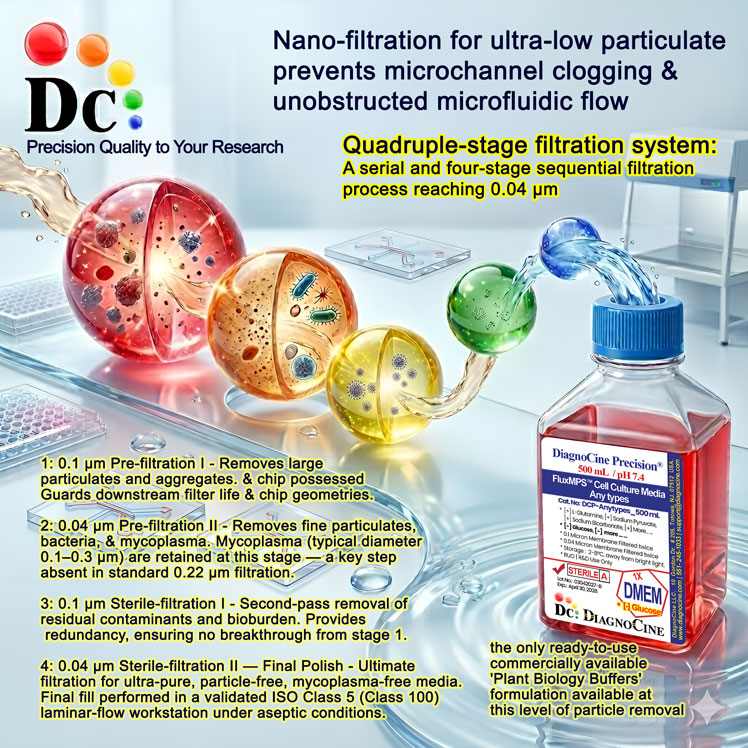
Quadruple-Stage Filtration System
Every FluxMPS™ Ham's F-12 Nutrient Mixture variant passes through the same four-stage architecture before reaching your chip.
-
01
Pre-Filtration Stage 1 0.1 µm
Initial coarse particulate removal.
-
02
Pre-Filtration Stage 2 0.1 µm
Secondary particulate and aggregate reduction.
-
03
Sterile Filtration Stage 1 0.04 µm
Fine sterile filtration below standard 0.22 micron practice.
-
04
Sterile Filtration Stage 2 0.04 µm
Final polish for microfluidic-grade clarity.
Engineered for Flow, Not Just Growth
Every component is optimized for consistent, laminar flow performance across complex micro-channel geometries, capillary-bed and vascular simulations, and long-term automated perfusion studies running continuously for weeks.
Frequently Asked Questions
Verified Bibliography
- Ham, R.G. (1963). An improved nutrient solution for diploid Chinese hamster and human cell lines. Experimental Cell Research, 29: 515-526. PMID: 13952250. DOI: 10.1016/S0014-4827(63)80014-2
- Ham, R.G. (1965). Clonal growth of mammalian cells in a chemically defined, synthetic medium. Proceedings of the National Academy of Sciences USA, 53(2): 288-293. PMID: 14283412. DOI: 10.1073/pnas.53.2.288
- Ham, R.G. & McKeehan, W.L. (1979). Media and growth requirements. Methods in Enzymology, 58: 44-93. DOI: 10.1016/S0076-6879(79)58127-2
- Barnes, D. & Sato, G. (1980). Serum-free cell culture: a unifying approach. Cell, 22(3): 649-655. DOI: 10.1016/0092-8674(80)90540-1
- McKeehan, W.L., Hamilton, W.G. & Ham, R.G. (1976). Selenium is an essential trace nutrient for the growth of WI-38 diploid human fibroblasts. Proc. Natl. Acad. Sci. USA, 73(6): 2023-2027. DOI: 10.1073/pnas.73.6.2023
- Yao, T. & Asayama, Y. (2017). Animal-cell culture media: History, characteristics, and current issues. Reproductive Medicine and Biology, 16(2): 99-117. PMC5661806
FluxMPS™ — Precision Cell Culture Media for Microphysiological Systems
Built for the architecture of the future. Not the flask of the past.
Traditional cell culture media were formulated for static well plates and flasks — environments that tolerate impurities, precipitates, and particle loads that would immediately compromise a microfluidic system. FluxMPS™ was designed from the ground up for Organ-on-Chip (OoC), Tissue-on-Chip (ToC), and Lab-on-Chip (LoC) platforms, where the medium itself is part of the instrument.
Purity That Protects Your Platform
FluxMPS™ is purified to 0.04 microns — finer than any ready-to-use cell culture media currently available. At this level, the microscopic particulates and protein aggregates that silently block micro-channels, disrupt laminar flow, and generate false biological signals are eliminated before the media ever reaches your chip.
The result: your platform stays operational, your data stays clean, and your biology drives the result — not your media.
Engineered for Flow, Not Just Growth
The name FluxMPS™ reflects its core design principle. Every component is optimized for consistent, laminar flow performance across:
- Complex micro-channel geometries
- Capillary-bed and vascular simulations
- Long-term automated perfusion studies running continuously for weeks
Zero-clogging performance is not a feature — it is the baseline specification.
Applications & Performance
| Application | What FluxMPS™ Delivers |
|---|---|
| Microfluidics | Stable shear stress; no channel blockage |
| Metabolic Tracing | Ultra-pure matrix with no contaminant interference |
| Long-term Perfusion | Consistent formulation stability over weeks of continuous flow |
| Organ-on-Chip | Optical clarity for real-time imaging and integrated biosensing |
Regulatory Foundation
FluxMPS™ is formulated to support FDA-recognized physiological modeling standards, providing a validated, reproducible media foundation for drug discovery, toxicology screening, and translational research. When your downstream data needs to stand up to regulatory scrutiny, your upstream media cannot be an afterthought.
The Bottom Line
Microfluidic platforms are precision instruments. They require precision inputs.
FluxMPS™ is the only ready-to-use cell culture medium engineered specifically to meet that standard — protecting your chip, your cells, and your science.