


Hank's Balanced Salt Solutions
Select See the table below
- See the table below
Hank’s Balanced Salt Solutions — Configuration Selector
This is a family page, not a product page. Check the supplements your protocol needs, press Search to highlight the matching configurations, then click View to open that product page.
| Cat No. | Name | Calcium | Magnesium | Sodium Bicarbonate | HEPES | Phenol Red | Product Page |
|---|---|---|---|---|---|---|---|
| DCP-HBSSH-R1XHBSS w/ HEPES, w/o Phenol red | HBSS w/ HEPES w/o Phenol red |
+ | + | + | + | − | Viewarrow_forward |
| DCP-HBSS-R1XHBSS w/o Phenol red | HBSS w/o Phenol red |
+ | + | + | − | − | Viewarrow_forward |
| DCP-HBSS-CMR1XHBSS w/o Ca, Mg and Phenol Red | HBSS w/o Calcium, Magnesium and Phenol Red |
− | − | + | − | − | Viewarrow_forward |
| DCP-HBSSRB-C1XHBSS w/ Phenol red, w/o Calcium | HBSS w/ Phenol red w/o Calcium |
− | + | + | − | + | Viewarrow_forward |
| DCP-HBSSRB1XHBSS w/ Phenol red | HBSS w/ Phenol red | + | + | + | − | + | Viewarrow_forward |
| DCP-HBSSR-B1XHBSS w/ Phenol red, w/o Sodium bicarbonate | HBSS w/ Phenol red w/o Sodium bicarbonate |
+ | + | − | − | + | Viewarrow_forward |
| DCP-HBSSR-CYMB1XHBSS w/ Phenol red, w/o Ca, Mg, Sodium bicarbonate | HBSS w/ Phenol red w/o Calcium, Magnesium, Sodium bicarbonate |
− | − | − | − | + | Viewarrow_forward |
Not sure which configuration? See what each supplement controls · Match a configuration to your workflow · Filtration architecture · Read the FAQ
One salt backbone, five supplement decisions
Hank’s Balanced Salt Solution (HBSS) is an isotonic buffer solution widely used in cell biology and tissue culture applications. It consists primarily of inorganic salts and a carbohydrate energy source, typically glucose or dextrose, designed to provide cells with essential nutrients while maintaining physiological pH and osmotic balance for optimal cell growth and function. The balanced formulation of HBSS preserves the structural and physiological integrity of cells, making it invaluable for various laboratory applications including cell washing, tissue transport, diluting cells for counting, and preparing reagents.
- Seven ready-to-use 1X configurations sharing the same Hank’s salt backbone and differing only in five supplement variables.
- Calcium and magnesium are present in some configurations and absent in others — the single most consequential choice in this family.
- Sodium bicarbonate is present in five of the seven configurations; two are supplied without it.
- HEPES is carried by one configuration, DCP-HBSSH-R1X, at 20 mM.[2]
- Phenol red is present in four configurations and omitted from three.
- Storage: 4 ℃.
- Sterility: filtered through a 0.1-micron membrane twice and a 0.04-micron membrane twice, in a sterile environment.
- Customization of concentrations, additives, and pH is available on request.
- Configurations in this family7
- Supplement variables5
- With calcium4 of 7
- With magnesium5 of 7
- With sodium bicarbonate5 of 7
- With HEPES1 of 7 (20 mM)
- With phenol red4 of 7
- Calcium- and magnesium-free2 of 7
- Storage4 ℃
- Filtration0.1 µm ×2 + 0.04 µm ×2
Each supplement changes what the solution can be used for
The seven configurations are not quality tiers. They are the same balanced salt solution with different supplement sets, and each supplement decides whether the solution fits a given bench step.
Calcium (Ca2+)
Calcium and magnesium promote cell adhesion, so calcium-free solutions are used to wash cells before trypsinization or other dissociation steps.[3] A solution containing calcium and magnesium should not be used for that pre-dissociation wash.[4]
Magnesium (Mg2+)
The second divalent cation in the Hank’s backbone. Omitting calcium and magnesium together prevents cell-to-cell adhesion and aggregation during enzymatic tissue dissociation, which is how single-cell suspensions are obtained.[5]
Sodium bicarbonate (NaHCO3)
The bicarbonate–CO2 system is the physiological buffer used in cell culture; the amount of bicarbonate in a formulation dictates the CO2 level needed to hold pH.[6] Bicarbonate-free configurations exist for workflows that do not run under a controlled CO2 atmosphere.
HEPES
A zwitterionic buffer that holds a stable physiological pH when cells are outside a CO2 incubator or handled in open air.[3] In this family it is carried only by DCP-HBSSH-R1X, at 20 mM.[2]
Phenol red
A colorimetric pH indicator — yellow when acidic, pink to purple when alkaline — that lets you read pH and spot contamination by eye.[6] It is also a weak estrogen mimic and absorbs in the visible range, which is why phenol red–free versions exist.[7,8]
The shared backbone
Every configuration keeps the inorganic salts and the carbohydrate energy source, typically glucose or dextrose, that provide essential nutrients while maintaining physiological pH and osmotic balance, preserving the structural and physiological integrity of cells.
Start with one question: does this step involve dissociation?
If cells are about to be detached, choose a calcium- and magnesium-free configuration — DCP-HBSS-CMR1X or DCP-HBSSR-CYMB1X. If the step is transport, dilution for counting, or reagent preparation with intact adherent cells, the calcium- and magnesium-containing configurations are the ones intended for it. Everything else — bicarbonate, HEPES, phenol red — follows from where the work happens and how you need to read pH.
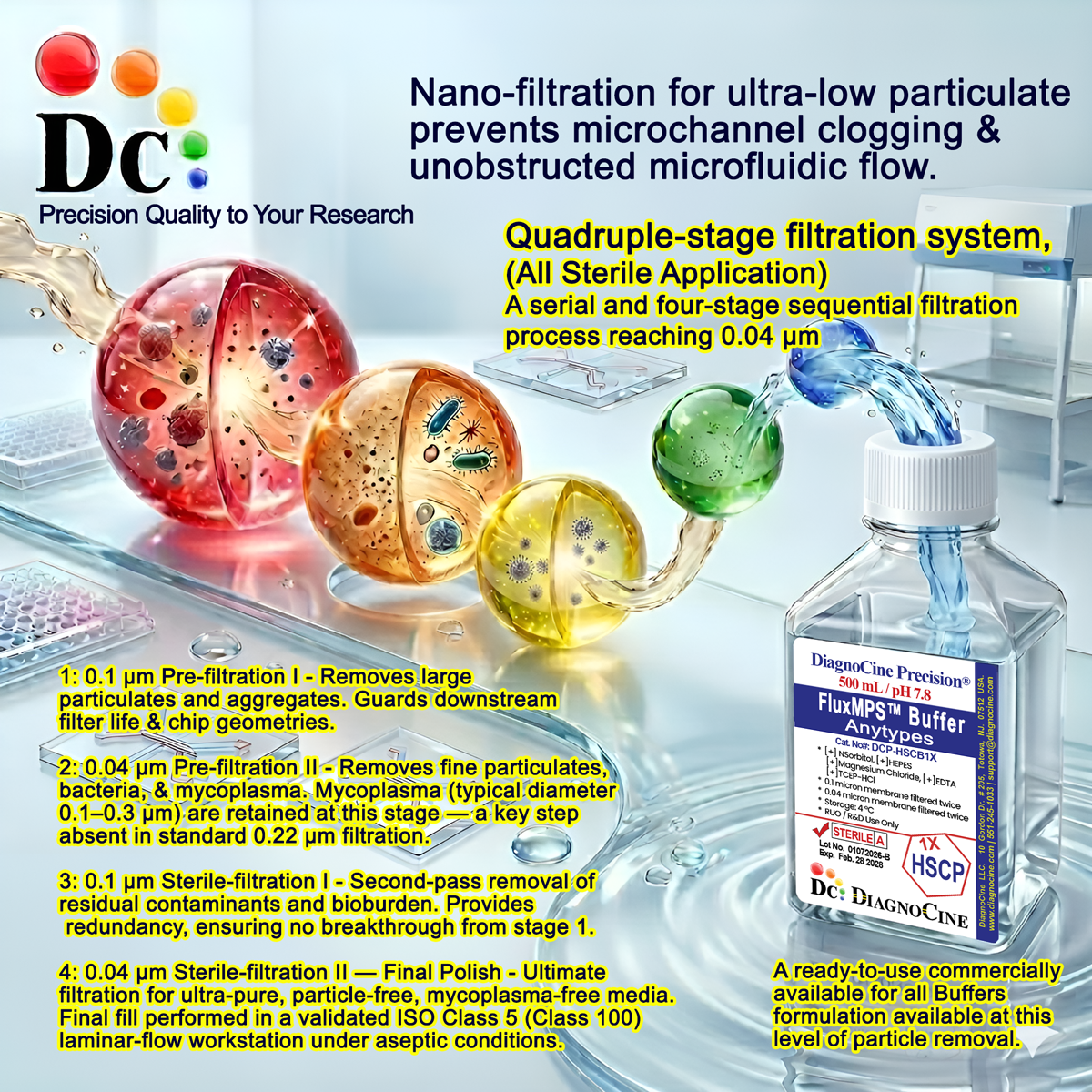
Quadruple-stage filtration to a 0.04-micron final polish
Every configuration in this family is filtered through a 0.1-micron membrane twice and a 0.04-micron membrane twice, in a sterile environment.
-
1
0.1 µm Pre-filtration I
First pass through a 0.1-micron membrane.
-
2
0.04 µm Pre-filtration II
First pass through a 0.04-micron membrane.
-
3
0.1 µm Sterile-filtration I
Second pass through a 0.1-micron membrane, in a sterile environment.
-
4
0.04 µm Sterile-filtration II — Final Polish
Second pass through a 0.04-micron membrane, in a sterile environment. This is the final stage the solution passes before fill.
What the 0.04-micron final stage means at the bench
The filtration architecture is stated by the source as part of the sterility specification for this family. It applies identically to all seven configurations; the supplement set is what varies between them, not the filtration.
What each variable controls, and which configurations carry it
The left three columns are published reference facts about each supplement; the right column is read directly off the catalog matrix above.
| Supplement | What it does | Leave it out when | Configurations carrying it |
|---|---|---|---|
| Calcium (CaCl2) | Divalent cation that promotes cell adhesion.[3] | Washing cells before trypsinization or dissociation — a calcium-containing saline should not be used for that step.[3,4] | 4 of 7 — DCP-HBSSH-R1X, DCP-HBSS-R1X, DCP-HBSSRB1X, DCP-HBSSR-B1X |
| Magnesium (MgSO4) | Second divalent cation of the Hank’s backbone; with calcium it supports cell-to-cell adhesion and aggregation.[5] | Enzymatic tissue dissociation, where removing both divalent cations helps yield single-cell suspensions.[5] | 5 of 7 — DCP-HBSSH-R1X, DCP-HBSS-R1X, DCP-HBSSRB-C1X, DCP-HBSSRB1X, DCP-HBSSR-B1X |
| Sodium bicarbonate (NaHCO3) | Provides the physiological bicarbonate–CO2 buffer; the bicarbonate level sets the CO2 concentration needed to hold pH.[6] | Work that is not performed under a controlled CO2 atmosphere.[6] | 5 of 7 — DCP-HBSSH-R1X, DCP-HBSS-R1X, DCP-HBSS-CMR1X, DCP-HBSSRB-C1X, DCP-HBSSRB1X |
| HEPES | Zwitterionic buffer that holds a stable physiological pH outside a CO2 incubator and during open-air procedures.[3] | Prolonged illuminated culture — HEPES has been reported to form cytotoxic products such as hydrogen peroxide on exposure to light.[9] | 1 of 7 — DCP-HBSSH-R1X (20 mM)[2] |
| Phenol red | Colorimetric pH indicator: yellow when acidic, pink to purple when alkaline; useful for spotting acidification or contamination by eye.[6] | Fluorescence, imaging and absorbance readouts, and hormone-sensitive work — phenol red absorbs in the visible range and has weak estrogenic activity.[7,8] | 4 of 7 — DCP-HBSSRB-C1X, DCP-HBSSRB1X, DCP-HBSSR-B1X, DCP-HBSSR-CYMB1X |
Match a configuration to your workflow
Select one of the four applications named for this family to see which configurations are relevant.
- Cell washing is one of the four applications named for HBSS.
- Where the wash precedes trypsinization or another dissociation step, a calcium- and magnesium-free solution is indicated.[3,4] The two calcium- and magnesium-free configurations in this family are DCP-HBSS-CMR1X and DCP-HBSSR-CYMB1X.
- Where the cells are to stay adherent and intact, the four calcium-containing configurations are the ones formulated with divalent cations.
- Tissue transport is one of the four applications named for HBSS.
- The balanced formulation preserves the structural and physiological integrity of cells.
- Transport happens outside a controlled CO2 atmosphere; HEPES holds a stable physiological pH under exactly those conditions.[3] DCP-HBSSH-R1X is the one configuration in this family carrying HEPES, at 20 mM.[2]
- Storage for all configurations is 4 ℃.
- Diluting cells for counting is one of the four applications named for HBSS.
- The isotonic salt composition maintains osmotic balance during dilution.
- Where a counting or imaging readout is affected by visible-range absorbance, the three phenol red–free configurations are DCP-HBSSH-R1X, DCP-HBSS-R1X and DCP-HBSS-CMR1X.[7,8]
- Preparing reagents is one of the four applications named for HBSS.
- Because the composition is defined, the configuration you start from determines which ions and indicators end up in the finished reagent — choose the supplement set deliberately rather than defaulting to the complete formulation.
- Other concentrations, additions of chemicals, compounds, proteins or supplements, a different pH, and further modifications are available on request.
What every configuration in the family has in common
These values apply identically across all seven catalog numbers. Only the five supplement variables differ.
| Solution type | Isotonic balanced salt solution |
| Base composition | Inorganic salts + carbohydrate energy source (typically glucose or dextrose) |
| Concentration | 1X |
| Storage | 4 ℃ |
| Sterility | Filtered 0.1 micron twice and 0.04 micron twice, in a sterile environment |
| Configurations in family | 7 |
| Intended use | Research Use Only (RUO) |
Frequently asked questions
The questions that come up most often when choosing between the seven configurations.
Origin of the formulation and supporting literature
The source description carried no citation list. The primary reference for Hank’s salts and the published sources behind the supplement guidance are given below.
- Hanks JH, Wallace RE (1949). Relation of oxygen and temperature in the preservation of tissues by refrigeration. Proc Soc Exp Biol Med 71(2):196–200. doi:10.3181/00379727-71-17131 — the primary reference for Hank’s balanced salt solution.
- Diagnocine product listing, Hank’s Balanced Salt Solution with Ca2+, Mg2+ and 20 mM HEPES, without Phenol Red (DCP-HBSSH-R1X, catalog ID 95702) — source of the 20 mM HEPES concentration.
- PurMa Biologics. Cell Culture Buffers: Types, Uses & How to Choose (technical guide) — roles of HEPES and of calcium / magnesium removal before dissociation.
- Thermo Fisher Scientific / Gibco. HBSS, calcium, magnesium, no phenol red — product FAQ stating that a saline containing calcium and magnesium should not be used to wash cells before dissociation.
- Freshney RI. Culture of Animal Cells: A Manual of Basic Technique and Specialized Applications, Wiley — balanced salt solutions, calcium- and magnesium-free variants, and their role in enzymatic dissociation.
- European Collection of Authenticated Cell Cultures (ECACC) / Culture Collections. CO2 concentration and pH control in the cell culture laboratory — bicarbonate buffering, the bicarbonate-to-CO2 relationship, and phenol red as a pH indicator.
- Thermo Fisher Scientific. The Essential Guide to Phenol Red in Cell Culture Media — phenol red as a weak estrogen mimic and its interference with fluorescence and absorbance readouts.
- PromoCell. Impact of Phenol Red in Cell Culture and Solutions — estrogenic activity and spectral interference of phenol red.
- Zigler JS Jr, Lepe-Zuniga JL, Vistica B, Gery I (1985). Analysis of the cytotoxic effects of light-exposed HEPES-containing culture medium. In Vitro Cell Dev Biol 21(5):282–287.
- Boston BioProducts. Balanced Salt Solutions Overview — selection between HBSS and EBSS by CO2 environment, divalent cation content, and phenol red content.