

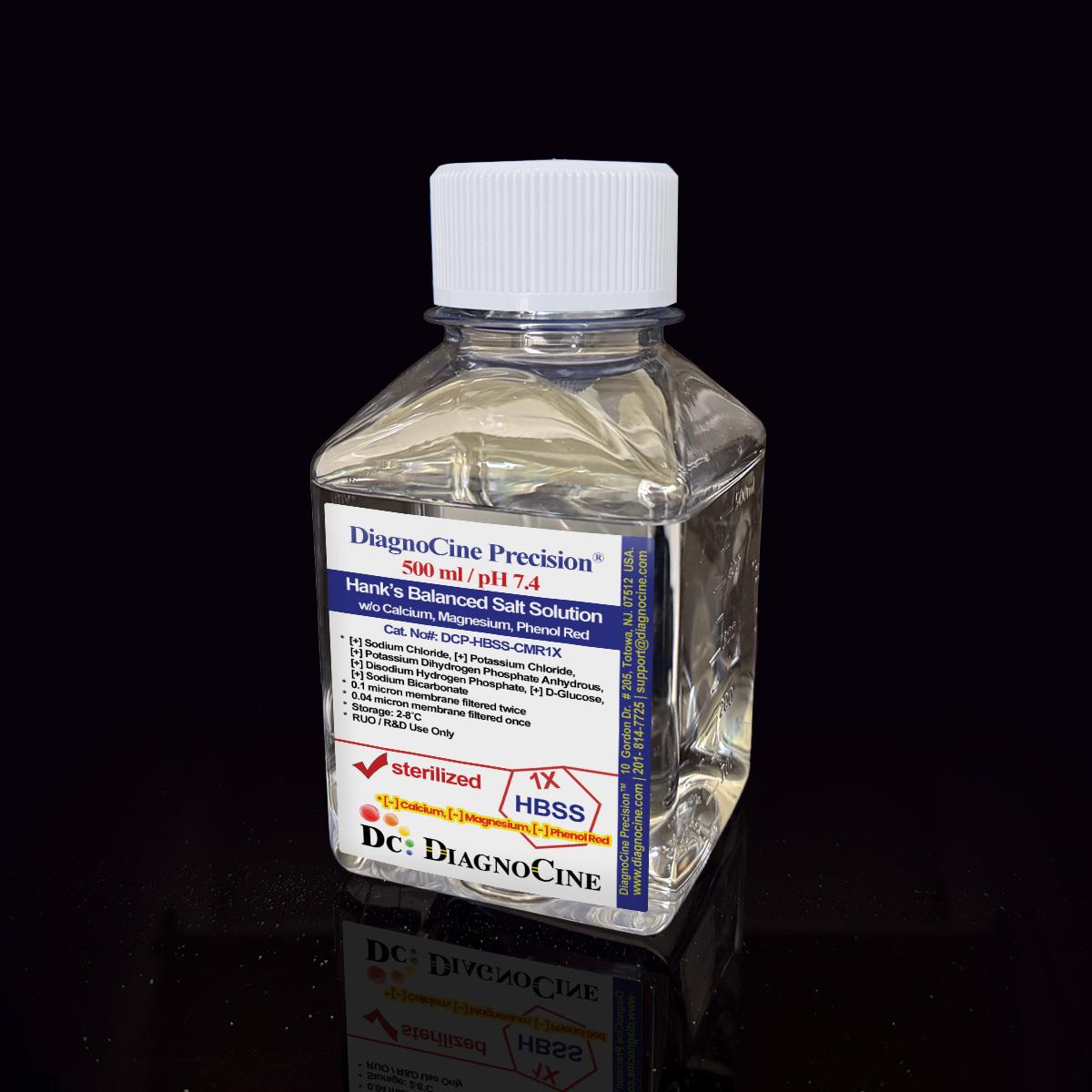
Hank's Balanced Salt Solution w/o Calcium, Magnesium and Phenol Red: 1X
FluxMPS™ Hank's Balanced Salt Solution w/o Calcium, Magnesium and Phenol Red: 1X
DCP-HBSS-CMR1X is an MPS-grade Hank's Balanced Salt Solution (HBSS) formulated without Calcium Chloride, Magnesium Sulfate, Magnesium Chloride, or Phenol Red, delivering precise pH 7.4 and a defined ionic profile for calcium/magnesium-sensitive protocols. Quadruple-stage 0.1 micron and 0.04 micron membrane filtration produces an ultra-clean, microchannel-safe buffer suited to organ-on-a-chip, tissue-on-a-chip, and microfluidic workflows. Every lot is manufactured under ISO 13485:2016-certified quality systems using ultrapure Type 1 water.
- Sterile, ultrapure HBSS filtered through sequential 0.1 micron (x2) and 0.04 micron (x2) membranes for microchannel-safe purity
- Formulated without Calcium Chloride, Magnesium Sulfate, Magnesium Chloride, and Phenol Red to reduce cell aggregation and eliminate optical interference
- Endotoxin content NMT 1 EU/mL
- Precise pH 7.4 and defined osmolality (260.00-300.00 mOsm/kg H2O) for stable ionic balance
- Manufactured with ultrapure Type 1 water (18.2 MΩ·cm)
- Compatible with microfluidic channels, organ-on-a-chip (OoC), and MPS platforms
- Customizable pH, concentrations, and additive content available on request
- FormulationHBSS, w/o Calcium, Magnesium & Phenol Red
- pH7.4
- Osmolality260.00-300.00 mOsm/kg H2O
- EndotoxinNMT 1 EU/mL
- SterilityNo growth after 14-day incubation (USP)
- Filtration0.1 µm x2 + 0.04 µm x2
- Water QualityUltrapure Type 1 (18.2 MΩ·cm)
- Storage2-8°C, protected from light
- Shelf Life24 months
- Size500 mL
Engineered where standard buffers fail
Conventional 0.22 micron-filtered balanced salt solutions can carry subvisible particulates, accumulate in microchannels, and drift in pH or ionic composition — all of which introduce noise into sensitive cell-based assays. FluxMPS™ DCP-HBSS-CMR1X is built to remove those failure modes at the source.
Microchannel-safe purity
Quadruple-stage 0.1 µm and 0.04 µm membrane filtration reduces particulate load beyond a single-pass 0.22 µm filter, protecting narrow microfluidic channels and valves.
Precise, stable pH
Formulated to pH 7.4 without Calcium Chloride, Magnesium Sulfate, or Magnesium Chloride, minimizing cell aggregation while preserving physiological ionic balance.
Ultrapure-grade water
Manufactured with ultrapure Type 1 water (18.2 MΩ·cm) per USP <85>, eliminating trace contaminants that can confound downstream assays.
Low background for imaging & assays
Phenol red-free formulation eliminates optical interference in fluorescence microscopy, flow cytometry, confocal imaging, and cloning efficiency assays.
Defined, traceable composition
Every inorganic salt and glucose component is lot-released against the composition table below, with calcium and magnesium omitted to prevent unwanted cell clumping.
Customization on demand
pH, concentrations, and the addition of chemicals, compounds, proteins, or supplements can be adjusted to your protocol — contact support@diagnocine.com.
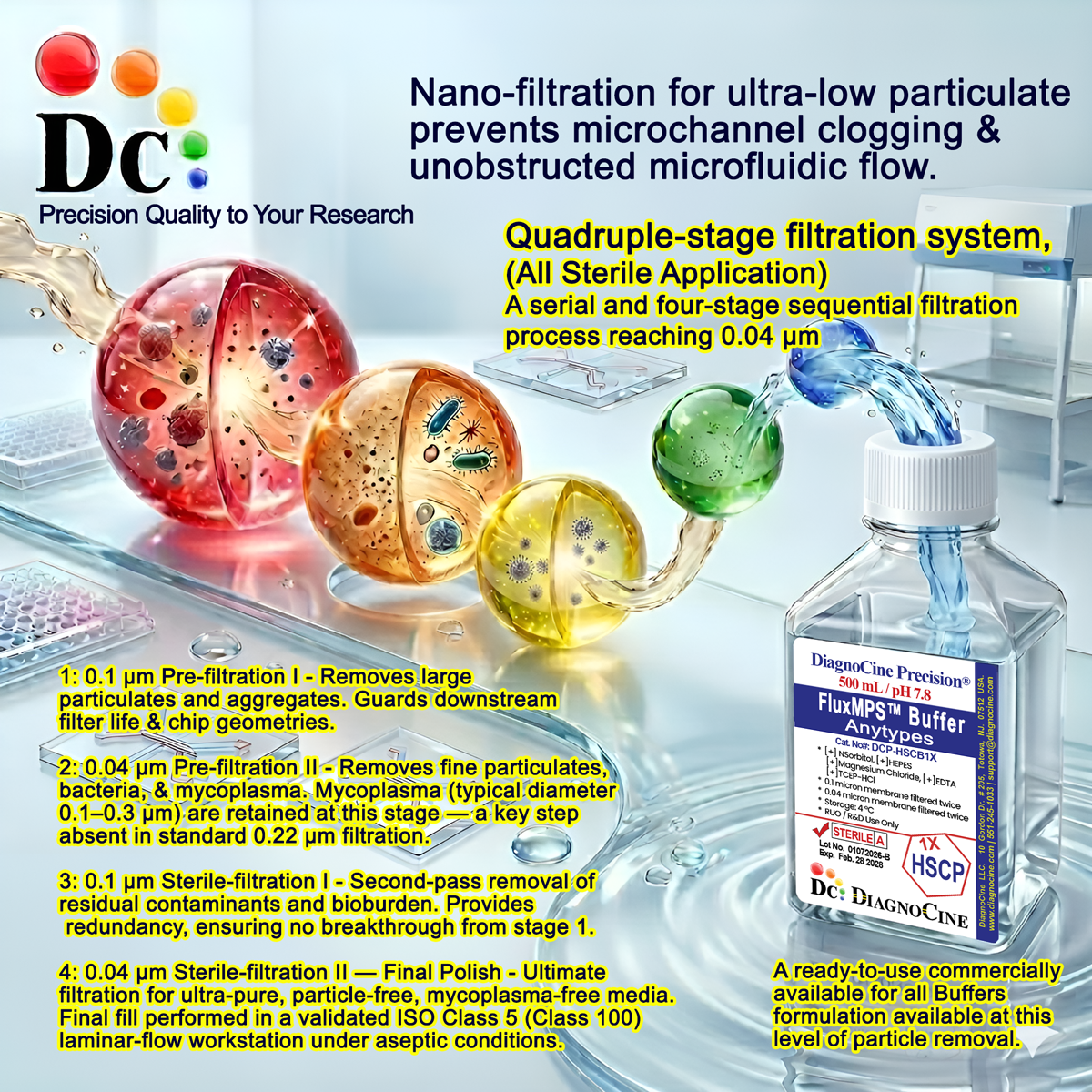
Quadruple-stage filtration system
DCP-HBSS-CMR1X is filtered through a 0.1 micron membrane twice and a 0.04 micron membrane twice, delivering the "world's cleanest buffer" purity claim for cell and molecular biology experiments.
-
1
0.1 µm Pre-Filtration I
Removes large particulates and aggregates from the raw HBSS formulation, extending the service life of the downstream 0.04 µm membranes.
-
2
0.04 µm Pre-Filtration II
Retains fine particulates and bioburden ahead of sterile fill, which is important since the smallest mycoplasma species measure approximately 0.2 microns.
-
3
0.1 µm Sterile-Filtration I
A second 0.1 micron pass provides redundant particulate and bioburden control ahead of final polishing.
-
4
0.04 µm Sterile-Filtration II — Final Polish
A second 0.04 micron pass delivers the final polish, produced under aseptic fill conditions to help prevent mycoplasma contamination.
Performance vs. conventional buffer
Sequential 0.1 micron and 0.04 micron filtration, each applied twice, removes finer particulates than the single 0.22 micron pass used in conventional balanced salt solutions, supporting cleaner microfluidic channels and reduced risk of mycoplasma carryover.
© Diagnocine® — DCP-HBSS-CMR1X
Where DCP-HBSS-CMR1X performs
Formulated without calcium, magnesium, or phenol red, this HBSS supports cell washing prior to dissociation, transport of cell and tissue samples, cell counting and dilution procedures, suspension cultures requiring reduced adhesion, and experiments sensitive to phenol red.
Automated Bioreactors & Robotics
For automated bioreactor and robotic liquid-handling systems, an optional 0.01 µm (10 nm) ultra-filtered variant of this buffer is available to further protect sensitive valves and sensors during continuous, unattended operation.
- Total Particulate Exclusion: sub-10 nm filtration removes particulates that a standard 0.1/0.04 µm stack can pass
- Valve & Sensor Protection: reduces fouling risk in automated dosing and perfusion hardware
- Extended Perfusion Stability: supports longer unattended run times without line clogging
Inquiry Required: the 0.01 µm ultra-filtered grade is produced to order — contact support@diagnocine.com to request this configuration.
Micro Physiological System (MPS) & Chip
Calcium/magnesium-free, phenol red-free HBSS for perfusion of organ-on-a-chip and tissue-on-a-chip devices.
Wash, Dilution & Reconstitution
Used for cell washing prior to dissociation and for cell counting and dilution procedures without calcium- or magnesium-driven clumping.
iPSC-Derived Model Handling
Low-aggregation buffer chemistry supports handling of iPSC-derived cell suspensions during passaging and dissociation.
Endothelial & Primary Cell Perfusion
Suited to suspension cultures requiring reduced adhesion in endothelial and primary cell perfusion protocols.
ELISA, Blotting & Blocking
Phenol red-free formulation avoids optical interference in colorimetric and chemiluminescent immunoassay workflows.
Microscopy & Optical Sensing
Eliminates phenol red background for fluorescence-sensitive imaging, cloning efficiency assays, and biosensor readouts.
Specifications at a glance
Measured and declared values for DCP-HBSS-CMR1X, as released on the Certificate of Analysis.
| Parameter | Specification |
|---|---|
| Formulation | HBSS, w/o Calcium Chloride, Magnesium Sulfate & Phenol Red |
| Appearance | Clear solution |
| pH USP <791> | 7.4 |
| Osmolality USP <785> | 260.00-300.00 mOsm/kg H2O |
| Parameter | Specification |
|---|---|
| Endotoxin USP <85> BET | NMT 1 EU/mL |
| Sterility USP <71> | No bacterial or fungal growth after 14 days incubation |
| Toxicity Test | Passes |
| Water Quality | Ultrapure Type 1 water (18.2 MΩ·cm) |
| Manufacturing Standard ISO 13485:2016 | ISO 13485-certified, CE-approved facility |
| Filtration System | 0.1 µm membrane x2, 0.04 µm membrane x2 |
| Parameter | Specification |
|---|---|
| Storage Temperature | 2-8°C, away from bright light |
| Shelf Life | 24 months |
| Expiry | Use before expiry date on product label |
| Parameter | Specification |
|---|---|
| Manufacturing Facility | ISO 13485-certified, CE-approved supplier facility (DiagnoCine Precision) |
| Final Packaging & QA | DiagnoCine R&D and Quality Testing Center |
| Custom Assembly Location | Totowa, New Jersey, USA |
| Intended Use | Research Use Only (RUO) |
Full composition
All components are listed in mg/L exactly as released on the Certificate of Analysis. This formulation omits Calcium Chloride, Magnesium Sulfate, Sodium Bicarbonate, Magnesium Chloride, and Phenol Red per the product label; the ingredients below reflect the components actually present in the shipped composition table.
| Component | CAS Number | Concentration |
|---|---|---|
| Disodium Hydrogen Phosphate | 7558-79-4 | 48.00 mg/L |
| Potassium Chloride | 7447-40-7 | 400.000 mg/L |
| Potassium Dihydrogen Phosphate Anhydrous | 7778-77-0 | 60.000 mg/L |
| Sodium Chloride | 7647-14-5 | 8000.000 mg/L |
| Sodium Bicarbonate | 144-55-8 | 350.000 mg/L |
| Component | CAS Number | Concentration |
|---|---|---|
| D-Glucose | 50-99-7 | 1000.000 mg/L |
Manufacturing & compliance
DCP-HBSS-CMR1X is manufactured under ISO 13485-certified and CE-approved facilities, with final packaging, quality assurance, and testing performed at the DiagnoCine R&D and Quality Testing Center. Custom assembly is completed at DiagnoCine Precision in Totowa, New Jersey, USA.
ISO 13485:2016 QMS
Manufactured under an ISO 13485-certified, CE-approved quality management system.
Ultrapure Type 1 Water
Formulated with ultrapure Type 1 water (18.2 MΩ·cm) per USP <85>.
Sterile Fill & Finish
Final packaging and quality testing occur at the DiagnoCine R&D and Quality Testing Center.
Custom Assembly Precision
Customization requests and assembly are completed at DiagnoCine Precision in Totowa, New Jersey, USA.
Endotoxin USP <85> BET
NMT 1 EU/mL.
Sterility USP <71>
No bacterial or fungal growth after 14 days of incubation.
Osmolality USP <785>
260.00-300.00 mOsm/kg H2O.
Documentation / CoA
A lot-specific Certificate of Analysis is available on request.
How DCP-HBSS-CMR1X compares
A side-by-side view of DCP-HBSS-CMR1X against conventional HBSS preparations.
| Parameter | DCP-HBSS-CMR1X (FluxMPS™) | Conventional 0.22 µm Filtered HBSS | Standard Alternative (0.22 µm Filtered) |
|---|---|---|---|
| Calcium/Magnesium/Phenol Red-Free Formulation | check_circle | cancel | cancel |
| Final Filtration Pore Size | 0.04 µm | 0.22 µm | 0.22 µm |
| Number of Filtration Stages | 4 | 1 | 1 |
| Endotoxin Specification | NMT 1 EU/mL | Not specified | Not specified |
| USP <788> Particulate Compliance | check_circle | cancel | cancel |
| Water Quality | Ultrapure Type 1 (18.2 MΩ·cm) | Purified water | Purified water |
| Manufacturing QMS | ISO 13485:2016 | Not certified | Not certified |
| Microfluidic Channel Compatibility | check_circle | cancel | cancel |
| Custom Formulation Available | check_circle | cancel | cancel |
Frequently asked questions
Common questions about DCP-HBSS-CMR1X for microfluidic and cell-based research.
Supporting literature
Curated literature relevant to balanced salt solutions, microfluidic cell culture, and buffer purity control.
- Bhatia SN, Ingber DE. Microfluidic organs-on-chips. Nat Biotechnol. 2014. doi:10.1038/nbt.2989
- Huh D, et al. Reconstituting organ-level lung functions on a chip. Science. 2010. doi:10.1126/science.1188302
- Hanks JH, Wallace RE. Relation of oxygen and temperature in the preservation of tissues by refrigeration. Proc Soc Exp Biol Med. 1949. doi:10.3181/00379727-71-17131
- Freshney RI. Culture of Animal Cells: A Manual of Basic Technique and Specialized Applications. 2015. doi:10.1002/9781118873651
- Low LA, et al. Organs-on-chips: into the next decade. Nat Rev Drug Discov. 2021. doi:10.1038/s41573-020-0079-3
- Ryan JA. Understanding and Managing Cell Culture Contamination. Corning Technical Bulletin. 1994. doi:10.1002/9780470112631
- Nikfarjam L, Farzaneh P. Prevention and detection of Mycoplasma contamination in cell culture. Cell J. 2012. doi:10.22074/cellj.2012.2946
- Gstraunthaler G. Alternatives to the use of fetal bovine serum: serum-free cell culture. ALTEX. 2003. doi:10.14573/altex.2003.4.275