- Home
- Hank's Balanced Salt Solution W/ Phenol red w/o Calcium chloride, Magnesium sulfate and Sodium bicarbonate: 1X
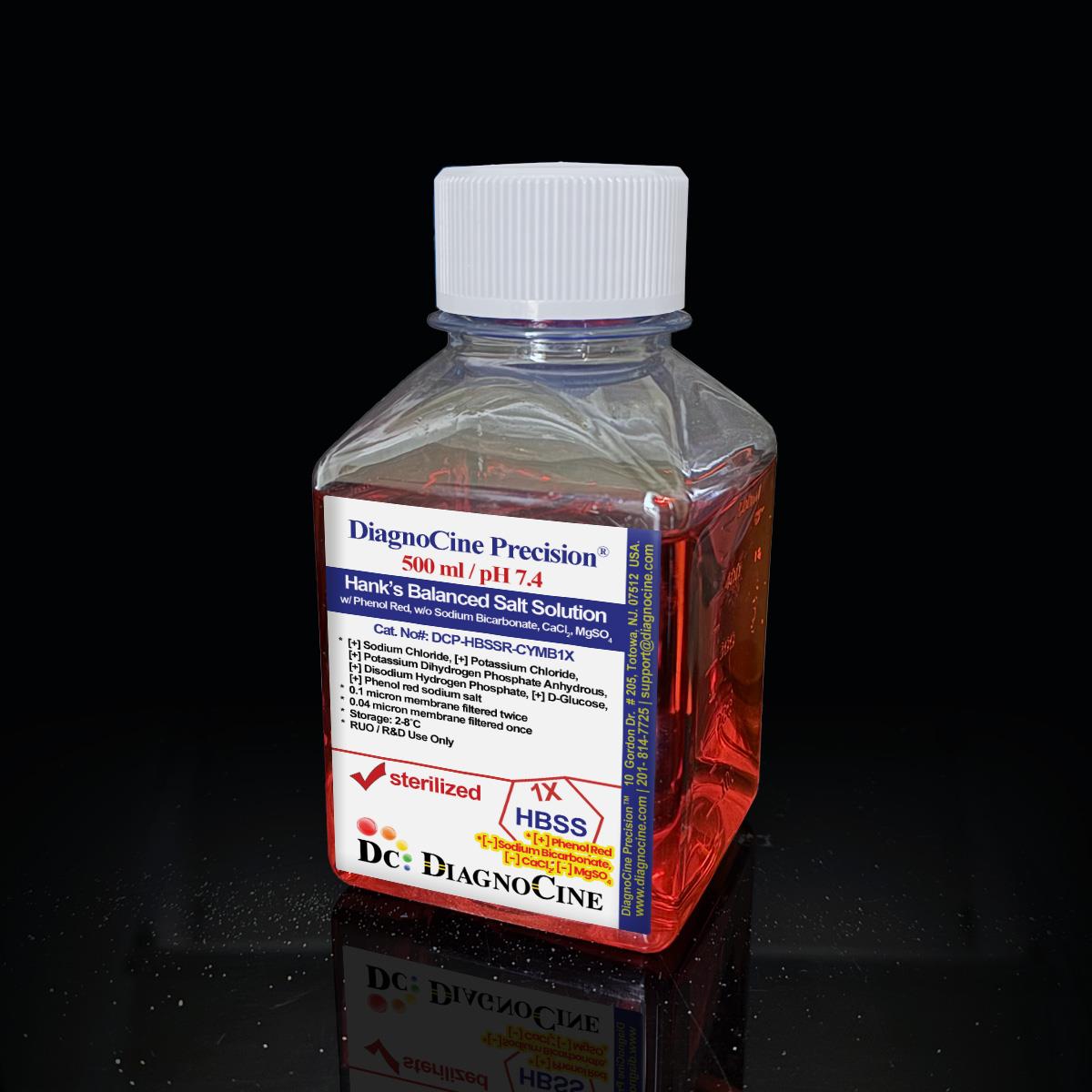
Hank's Balanced Salt Solution W/ Phenol red w/o Calcium chloride, Magnesium sulfate and Sodium bicarbonate: 1X
FluxMPS™ Hank’s Balanced Salt Solution w/ Phenol Red w/o Calcium Chloride, Magnesium Sulfate and Sodium Bicarbonate, 1X
An MPS-grade, calcium- and magnesium-free Hank’s Balanced Salt Solution formulated with phenol red for CO2-controlled and CO2-free cell culture workflows. Buffered to a defined pH of 7.4 with a phosphate-based inorganic salt system and processed through a quadruple-stage 0.1 µm and 0.04 µm filtration train, it delivers ultra-clean, microchannel-safe purity for downstream microfluidic and organ-on-a-chip protocols.
- Filtered 0.1-micron membrane twice and 0.04-micron membrane twice for ultra-clean, microchannel-safe purity
- Formulated without calcium chloride, magnesium sulfate, magnesium chloride, or sodium bicarbonate for CO2-controlled or CO2-free workflows
- Phenol red pH indicator included for visual monitoring of solution status
- Target pH of 7.4 in a defined phosphate-based inorganic salt solution
- Manufactured with ultrapure Type 1 water (18.2 MΩ·cm)
- Endotoxin controlled to NMT 1 EU/mL
- Manufactured under ISO 13485-certified and CE-approved facilities
- Custom pH, additions, and modifications available on request
- pH7.4
- FormulationCa/Mg/NaHCO3-free, phenol red indicator
- AppearanceRed colored, clear solution
- EndotoxinNMT 1 EU/mL
- SterilityNo growth at 14 days (USP)
- Filtration0.1 µm x2 + 0.04 µm x2
- Storage2-8°C, protect from light
- Shelf Life24 months
- Size500 mL
- Toxicity TestPasses
Engineered where standard buffers fail
Conventional 0.22 µm-filtered buffers can carry subvisible particulates that accumulate in narrow microchannels, exhibit pH and ionic drift, and introduce assay background. DCP-HBSSR-CYMB1X is engineered specifically to remove these failure modes for sensitive microfluidic and organ-on-a-chip protocols.
Microchannel-safe purity
A final 0.04 µm filtration pass targets particulate levels compliant with USP <788> for use in narrow microfluidic channels.
Precise, stable pH
Buffered to pH 7.4 using a defined phosphate-based inorganic salt system, without dependence on sodium bicarbonate.
Ultrapure-grade water
Manufactured with ultrapure Type 1 water (18.2 MΩ·cm) consistent with USP <85> expectations.
Low background for imaging & assays
A calcium- and magnesium-free formulation avoids unintended cell adhesion or enzymatic activation during downstream imaging and processing steps.
Defined, traceable composition
Every inorganic salt and additive is lot-released and disclosed in the full composition table below.
Customization on demand
Alternate pH, concentrations, and added chemicals, compounds, proteins, or supplements are available on inquiry.
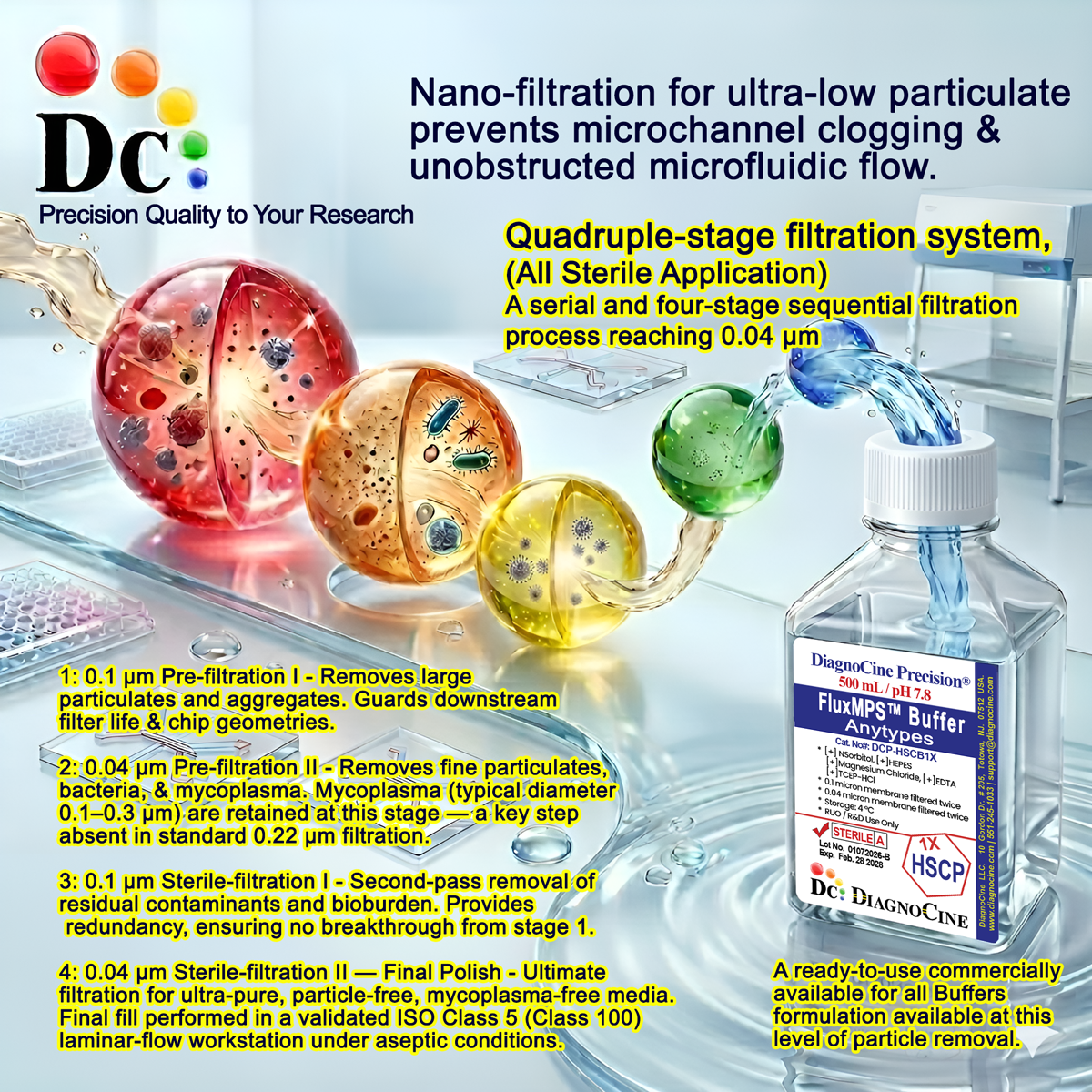
Quadruple-stage filtration system
Every lot of DCP-HBSSR-CYMB1X is filtered 0.1-micron membrane twice and 0.04-micron membrane twice, a four-stage sequence designed to reduce particulate and microbial bioburden beyond what a single 0.22 µm pass can achieve.
- 1
0.1 µm Pre-filtration I
Removes large particulates and aggregates, extending the working life of the downstream filters.
- 2
0.04 µm Pre-filtration II
Retains fine particulates and bioburden; sequential sub-0.1 µm filtration is designed to reduce mycoplasma contamination risk, as the smallest mycoplasma type is about 0.2 microns.
- 3
0.1 µm Sterile-filtration I
A second 0.1 µm pass provides redundant particulate and bioburden control.
- 4
0.04 µm Sterile-filtration II — Final Polish
A second 0.04 µm pass delivers the final polish under ISO Class 5 (Class 100) aseptic fill conditions.
Performance vs. conventional buffer
Sequential 0.1 µm and 0.04 µm filtration removes finer particulates than a single 0.22 µm pass and is designed to reduce the risk of mycoplasma carry-over during downstream cell culture and microfluidic work.
© Diagnocine® — DCP-HBSSR-CYMB1X
Where DCP-HBSSR-CYMB1X is used
Designed for cell and molecular biology workflows requiring controlled ionic balance without calcium, magnesium, or sodium bicarbonate, including CO2-controlled or CO2-free environments.
Automated Bioreactors & Robotics
An optional 0.01 µm (10 nm) ultra-filtered variant of this buffer can be produced for closed-loop automated bioreactor and robotics platforms where every subvisible particle matters.
- Total Particulate Exclusion — reduces particulate load beyond standard quadruple-stage filtration
- Valve & Sensor Protection — helps protect microvalves and inline sensors from particulate fouling
- Extended Perfusion Stability — supports longer unattended perfusion runs
Inquiry Required: the 0.01 µm ultra-filtered grade is produced to order — contact support@diagnocine.com to request it.
Micro Physiological System (MPS) & Chip
A calcium- and magnesium-free base solution suited to microfluidic channel networks and chip-based culture formats.
Cell Washing Prior to Dissociation
Used to wash cell monolayers or suspensions before enzymatic or mechanical dissociation.
Transport Medium for Cell Suspensions
Serves as a defined transport medium for cell suspensions between processing steps.
Diluent in CO2-Controlled Environments
Functions as a diluent for enzyme solutions in CO2-controlled or CO2-free environments.
Base for Calcium/Magnesium-Free Formulations
A base solution for custom media formulations requiring calcium- and magnesium-free conditions.
Microscopy & Optical Sensing
The phenol red indicator supports visual pH monitoring during live-cell imaging and optical assay workflows.
Full specification sheet
All values below are reported for DCP-HBSSR-CYMB1X as released; unstated parameters are omitted rather than estimated.
| Parameter | Specification |
|---|---|
| Formulation | Hank’s Balanced Salt Solution with phenol red, without calcium chloride, magnesium sulfate, magnesium chloride, or sodium bicarbonate |
| Appearance | Red colored, clear solution |
| pH (USP <791>) | 7.4 |
| Parameter | Specification |
|---|---|
| Endotoxin USP <85> | NMT 1 EU/mL |
| Sterility USP | No bacterial or fungal growth observed after 14 days of incubation |
| Toxicity Test | Passes |
| Water Quality | Ultrapure Type 1 water, 18.2 MΩ·cm |
| Manufacturing Standard ISO | ISO 13485-certified, CE-approved facilities |
| Fill Environment | ISO Class 5 (Class 100) |
| Parameter | Specification |
|---|---|
| Storage Temperature | 2-8°C, away from bright light |
| Shelf Life | 24 months from date of manufacture, use before label expiry |
| Parameter | Specification |
|---|---|
| Traceability | Final packaging, QA, and testing performed at the DiagnoCine R&D and Quality Testing Center; customization and assembly performed at DiagnoCine Precision, Totowa, New Jersey, USA |
| Manufacturing QMS | ISO 13485-certified |
| Regulatory Alignment | CE-approved facilities |
| Intended Use | For Research Use Only (RUO) |
Full composition (mg/L)
Every inorganic salt and additive in DCP-HBSSR-CYMB1X is disclosed below, grouped exactly as released on the certificate of analysis.
| Component | CAS Number | Concentration |
|---|---|---|
| Disodium Hydrogen Phosphate | 7558-79-4 | 48.00 mg/L |
| Potassium Chloride | 7447-40-7 | 400.000 mg/L |
| Potassium Dihydrogen Phosphate Anhydrous | 7778-77-0 | 60.000 mg/L |
| Sodium Chloride | 7647-14-5 | 8000.000 mg/L |
| Component | CAS Number | Concentration |
|---|---|---|
| D-Glucose | 50-99-7 | 1000.000 mg/L |
| Phenol Red Sodium Salt | 34487-61-1 | 11.000 mg/L |
Manufacturing & compliance
DCP-HBSSR-CYMB1X is manufactured under an ISO 13485-certified, CE-approved quality system with final packaging, QA, and testing performed at the DiagnoCine R&D and Quality Testing Center.
ISO 13485:2016 QMS
Manufactured under ISO 13485-certified, CE-approved supplier facilities.
Ultrapure Type 1 Water
Formulated with ultrapure Type 1 water, 18.2 MΩ·cm.
ISO Class 5 Fill & Finish
Final aseptic fill is performed under ISO Class 5 (Class 100) conditions.
Micro-Batch Precision
Customization and assembly for specific requests are completed at DiagnoCine Precision, Totowa, New Jersey, USA.
Endotoxin — USP <85> BET
Released at NMT 1 EU/mL.
Sterility — USP <71>
No bacterial or fungal growth observed after 14 days of incubation.
Osmolality — USP <785>
Tested as part of routine release per USP <785> methodology.
Documentation / CoA
A Certificate of Analysis reporting appearance, pH, sterility, toxicity, and endotoxin results is available for this lot.
How DCP-HBSSR-CYMB1X compares
A side-by-side look at DCP-HBSSR-CYMB1X versus conventionally filtered balanced salt solutions.
| Parameter | DCP-HBSSR-CYMB1X (FluxMPS™) | Conventional 0.22 µm-filtered buffer | Standard alternative 0.22 µm-filtered buffer |
|---|---|---|---|
| Ca/Mg/NaHCO3-free formulation | check_circle | cancel | cancel |
| Final filtration pore size | 0.04 µm | 0.22 µm | 0.22 µm |
| Number of filtration stages | 4 | 1 | 1 |
| Endotoxin specification | NMT 1 EU/mL | Not specified | Not specified |
| USP particulate compliance | check_circle | cancel | cancel |
| Water quality | Ultrapure Type 1, 18.2 MΩ·cm | Not specified | Not specified |
| Manufacturing QMS | ISO 13485-certified | cancel | cancel |
| Microfluidic channel compatibility | check_circle | cancel | cancel |
| Custom formulation available | check_circle | cancel | cancel |
Frequently asked questions
Common questions about DCP-HBSSR-CYMB1X.
Supporting literature
Curated references relevant to balanced salt solutions, buffer chemistry, and microfluidic/organ-on-a-chip applications.
- Hank, J.H. and Wallace, R.E. Relation of Oxygen and Temperature in the Preservation of Tissues by Refrigeration. Proc Soc Exp Biol Med. 1940.doi:10.3181/00379727-71-71032
- Bhatia, S.N. and Ingber, D.E. Microfluidic organs-on-chips. Nat Biotechnol. 2014;32(8):760-772.doi:10.1038/nbt.2989
- Huh, D. et al. Reconstituting Organ-Level Lung Functions on a Chip. Science. 2010;328(5986):1662-1668.doi:10.1126/science.1188302
- Good, N.E. et al. Hydrogen Ion Buffers for Biological Research. Biochemistry. 1966;5(2):467-477.doi:10.1021/bi00866a011
- Freshney, R.I. Culture of Animal Cells: A Manual of Basic Technique and Specialized Applications. Wiley-Blackwell.doi:10.1002/9780470649367
- Low, L.A. et al. Organs-on-chips: into the next decade. Nat Rev Drug Discov. 2021;20:345-361.doi:10.1038/s41573-020-0079-3
- Rasko, D.A. and Sperandio, V. Anti-virulence strategies to combat bacteria-mediated disease. Nat Rev Drug Discov. 2010.doi:10.1038/nrd3013
- United States Pharmacopeia. Bacterial Endotoxins Test <85> and Sterility Tests <71>. USP-NF.doi:10.31003/USPNF_M99035_02_01