

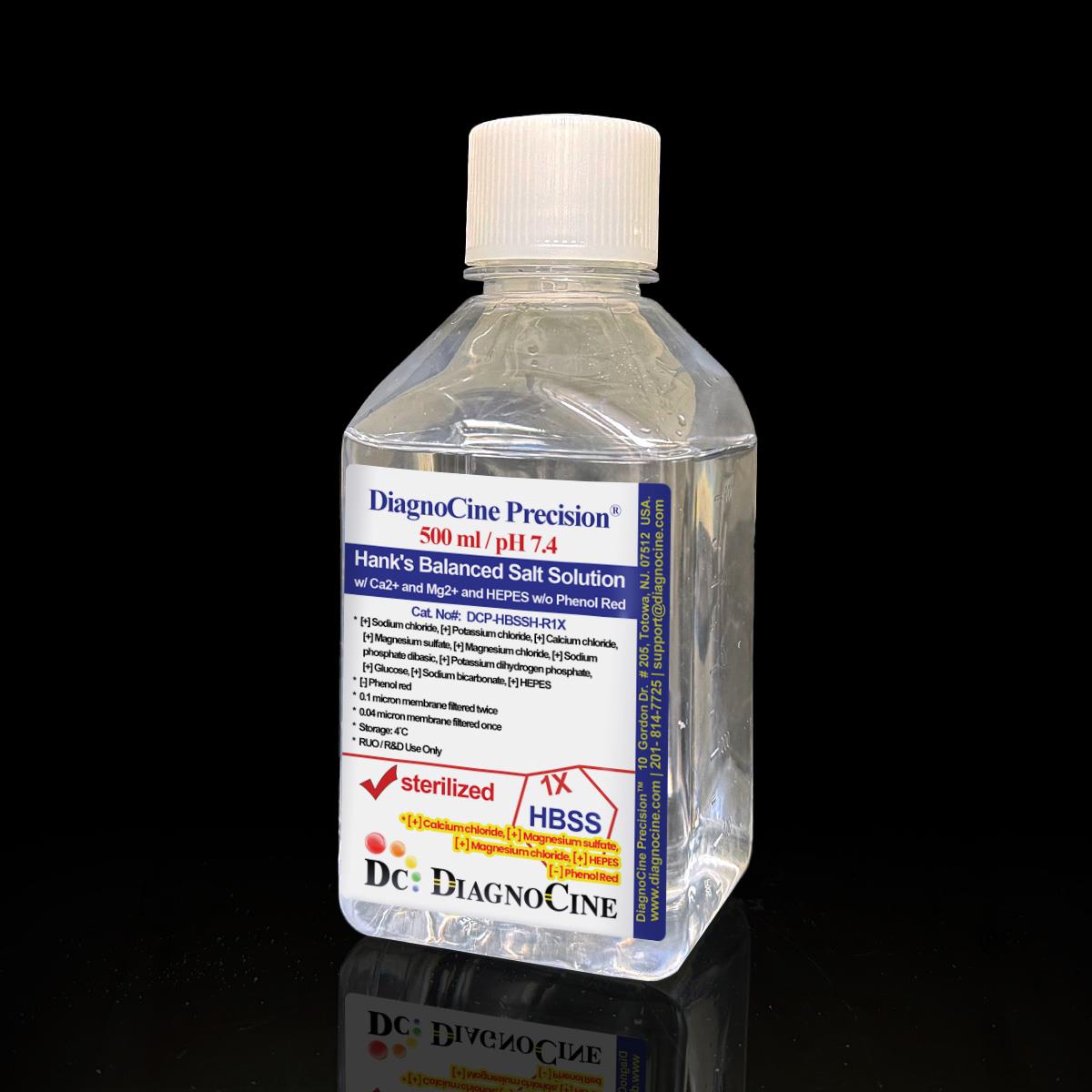
Hank's Balanced Salt Solution with Ca2+, Mg2+ and 20 mM HEPES without Phenol Red
FluxMPS™ Hank's Balanced Salt Solution with Ca2+, Mg2+ and 20 mM HEPES without Phenol Red
An MPS-grade physiological buffer formulated with calcium, magnesium, and a 20 mM HEPES buffering system to maintain a precise, stable pH of 7.4 across cell culture, microfluidic, and organ-on-a-chip (OoC) workflows. Quadruple-stage filtered for microchannel-safe purity, this phenol-red-free solution supports cell-to-cell adhesion, membrane integrity, and low-background imaging.
- Quadruple-stage filtration — 0.1 µm membrane twice and 0.04 µm membrane twice — for microchannel-safe, ultra-low-particulate purity
- Contains Ca2+ and Mg2+ to preserve cell-to-cell adhesion, signaling, and membrane integrity
- Buffered with 20 mM HEPES for stable pH 7.4 (25°C) throughout handling
- Osmolality isotonic with body fluids for proper osmotic equilibrium
- Phenol-red free — compatible with fluorescence, luminescence, and imaging-based assays
- DNase- and RNase-tested: none detected after 18 hr incubation at room temperature
- pH, molarity, tracking dyes, and other modifications available on request — contact support@diagnocine.com
- pH7.4 (25°C)
- FormulationHBSS + Ca2+/Mg2+ + 20 mM HEPES
- Buffering AgentHEPES, 20 mM
- OsmolalityIsotonic with body fluids
- Filtration0.1 µm ×2 + 0.04 µm ×2
- SterilityFiltered in a sterile environment
- DNase ActivityNone detected
- RNase ActivityNone detected
- Storage4°C
- Shelf Life2 years
Engineered where standard buffers fail
Conventional single-pass 0.22 µm-filtered buffers can carry subvisible particulates that accumulate in narrow microchannels, drift in pH and ionic balance during handling, and introduce background into sensitive imaging or biosensing assays. FluxMPS™ buffers are engineered specifically to remove these failure modes.
Microchannel-safe purity
Quadruple-stage filtration down to a 0.04 µm final pore size reduces particulate load relevant to USP <788> testing, protecting narrow microfluidic channels and valves.
Precise, stable pH
A defined 20 mM HEPES buffering system holds pH at 7.4 (25°C), supporting reproducible cellular behavior across wash, transport, and dilution steps.
Ultrapure-grade water
Formulated with ultrapure Type 1 water (18.2 MΩ·cm), consistent with USP <85> expectations for biological buffer preparation.
Low background for imaging & assays
Phenol-red free formulation minimizes optical interference in fluorescence, luminescence, and live-cell imaging applications.
Defined, traceable composition
Every inorganic salt, sugar, and buffering agent is formulated to a stated concentration and documented for lot traceability.
Customization on demand
pH, concentration, tracking dye additions, and other modifications are available — contact support@diagnocine.com.
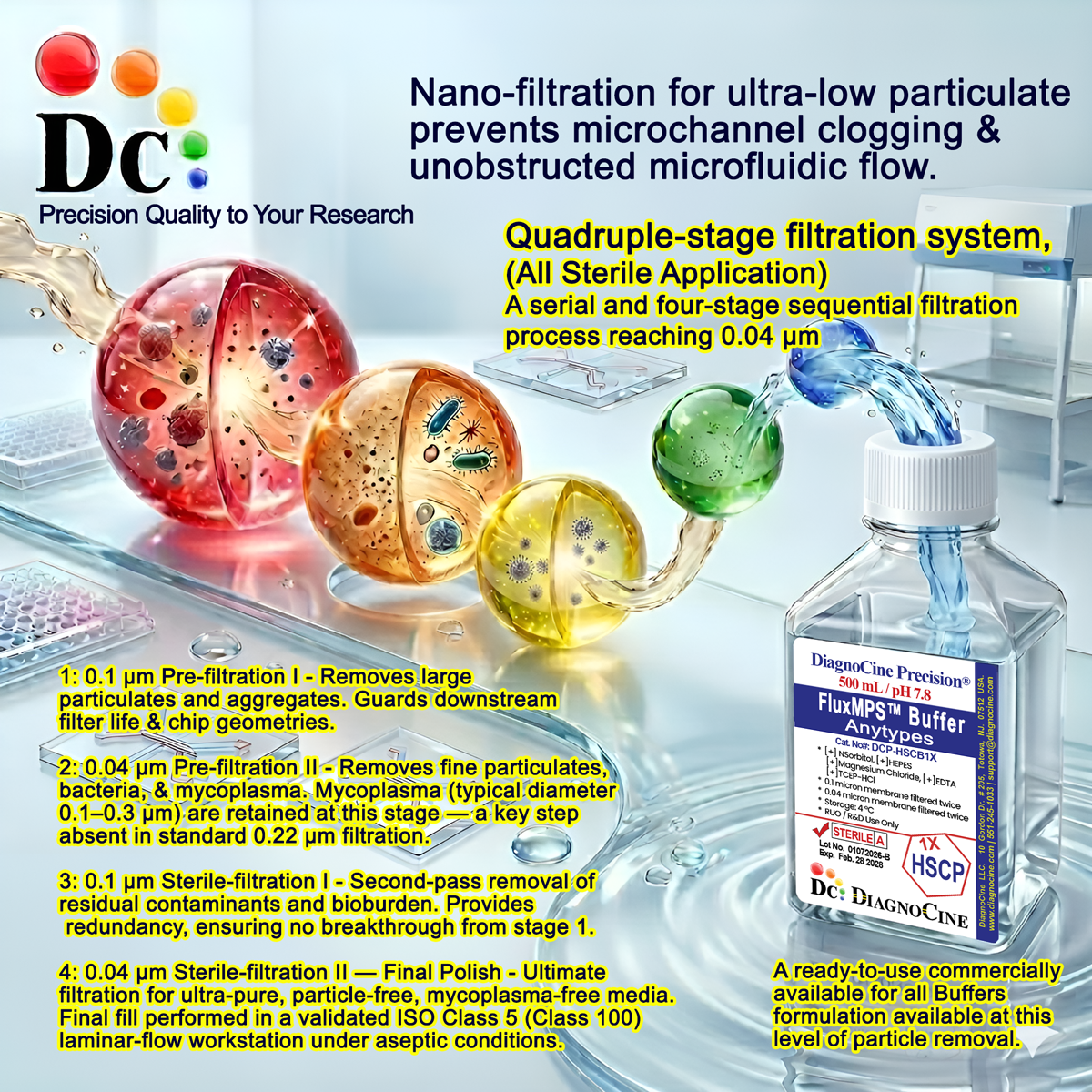
Quadruple-stage filtration system
This buffer is sterile-filtered through a 0.1-micron membrane twice and a 0.04-micron membrane twice, delivering the world's cleanest buffer purity level for cell and molecular biology experiments.
-
1
0.1 µm Pre-filtration I
Removes large particulates and aggregates, extending the life of downstream filters.
-
2
0.04 µm Pre-filtration II
Retains fine particulates and bioburden, including organisms well below the mycoplasma size range.
-
3
0.1 µm Sterile-filtration I
A second independent 0.1 µm pass adds redundancy to the sterilization process.
-
4
0.04 µm Sterile-filtration II — Final Polish
The final 0.04 µm polish is performed under aseptic fill conditions ahead of packaging.
Performance vs. conventional buffer
Sequential 0.1 µm and 0.04 µm filtration passes remove finer particulates than a single conventional 0.22 µm filtration used in standard buffers, supporting cleaner microchannels and reduced particulate interference in sensitive assays.
© Diagnocine® — DCP-HBSSH-R1X
Where this buffer is used
A versatile, physiological buffer suited to cell washing, short-term maintenance, transport, and reagent preparation across cell and molecular biology workflows, including microfluidic and organ-on-a-chip systems.
Automated Bioreactors & Robotics
For automated perfusion systems and robotic liquid handling, an optional 0.01 µm (10 nm) ultra-filtered variant of this buffer can be requested to further protect sensitive valves and sensors.
- Total Particulate Exclusion — minimizes subvisible particulate entering closed-loop perfusion systems
- Valve & Sensor Protection — reduces the risk of fouling in automated microvalves and inline sensors
- Extended Perfusion Stability — supports longer unattended run times in bioreactor and OoC platforms
Inquiry Required: the 0.01 µm ultra-filtered grade is available upon request — contact support@diagnocine.com.
Micro Physiological System (MPS) & Chip
Supports perfusion and wash steps in microfluidic tissue-chip platforms.
Wash, Dilution & Reconstitution
Used to rinse cells before dissociation and to dilute cell suspensions for accurate counting.
iPSC-Derived Model Handling
Calcium and magnesium content supports adhesion-dependent iPSC-derived cell models.
Endothelial & Primary Cell Perfusion
Isotonic, Ca2+/Mg2+-containing formulation suited to primary and endothelial cell perfusion.
ELISA, Blotting & Blocking
Serves as a base wash/dilution buffer supporting immunoassay workflows.
Microscopy & Optical Sensing
Phenol-red free formulation reduces optical background during live-cell imaging.
Detailed specifications
Physical, chemical, purity, and handling parameters for DCP-HBSSH-R1X.
| Parameter | Specification |
|---|---|
| Formulation | HBSS with Ca2+, Mg2+ and 20 mM HEPES, without phenol red |
| Appearance | Clear solution |
| pH (USP <791>) | USP <791> 7.4 (25°C) |
| Osmolality (USP <785>) | USP <785> Isotonic with body fluids |
| Buffering agent | HEPES, 20 mM |
| Parameter | Specification |
|---|---|
| Sterility | Filtered 0.1-micron membrane twice and 0.04-micron membrane twice in a sterile environment |
| DNase activity | None detected (plasmid DNA, 18 hr, room temperature) |
| RNase activity | None detected (ribosomal RNA, 18 hr, room temperature) |
| Water quality | Ultrapure Type 1 water, 18.2 MΩ·cm |
| Manufacturing standard | ISO 13485:2016 certified; CE-approved facility |
| Parameter | Specification |
|---|---|
| Storage temperature | 4°C |
| Shelf life | 2 years |
| Parameter | Specification |
|---|---|
| Manufacturing QMS | ISO 13485:2016 certified, CE-approved facility (Suppliers of DiagnoCine Precision) |
| Traceability | Final packaging, QA, and testing performed at the DiagnoCine R&D and Quality Testing Center |
| Production & customization site | DiagnoCine Precision, Totowa, New Jersey, USA |
| Intended use | Research Use Only (RUO) |
Full composition
Every inorganic salt, sugar, and buffering agent in DCP-HBSSH-R1X, formulated to the stated concentration.
| Component | CAS Number | Concentration |
|---|---|---|
| Sodium Chloride (NaCl) | 7647-14-5 | 137.93 mM |
| Potassium Chloride (KCl) | 7447-40-7 | 5.33 mM |
| Calcium Chloride (CaCl2) | 10043-52-4 | 1.26 mM |
| Magnesium Sulfate (MgSO4) | 7487-88-9 | 0.41 mM |
| Magnesium Chloride (MgCl2) | 7786-30-3 | 0.49 mM |
| Sodium Phosphate Dibasic (Na2HPO4) | 7558-79-4 | 0.338 mM |
| Potassium Phosphate Monobasic (KH2PO4) | 7778-77-0 | 0.44 mM |
| Sodium Bicarbonate (NaHCO3) | 144-55-8 | 4.17 mM |
| D-Glucose (Dextrose) | 50-99-7 | 5.56 mM |
| HEPES | 7365-45-9 | 20 mM |
Manufacturing & compliance
DCP-HBSSH-R1X is manufactured under ISO 13485-certified and CE-approved facilities, with final packaging, quality assurance, and testing performed at the DiagnoCine R&D and Quality Testing Center.
ISO 13485:2016 QMS
Manufactured under an ISO 13485-certified, CE-approved quality management system.
Ultrapure Type 1 Water
Formulated with ultrapure Type 1 water (18.2 MΩ·cm).
Sterile Fill & Finish
Quadruple-stage filtered and sterile-filled prior to packaging.
Micro-Batch Precision
Specific customization requests and assembly are completed at DiagnoCine Precision in Totowa, New Jersey, USA.
DNase & RNase Testing
None detected after incubation of plasmid DNA or ribosomal RNA with this product for 18 hr at room temperature.
Sterility
Filtered with a 0.1-micron membrane twice and a 0.04-micron membrane twice in a sterile environment.
Osmolality (USP <785>)
Isotonic with body fluids, maintaining osmotic equilibrium for cultured cells.
Documentation
A Certificate of Analysis is available on request.
How DCP-HBSSH-R1X compares
A side-by-side look at filtration architecture and quality practices versus conventional 0.22 µm-filtered buffers.
| Parameter | DCP-HBSSH-R1X (FluxMPS™) | Conventional Buffer | Standard Alternative |
|---|---|---|---|
| Buffering system (HEPES, pH 7.4) | check_circle | cancel | cancel |
| Final filtration pore size | 0.04 µm | 0.22 µm | 0.22 µm |
| Number of filtration stages | 4 | 1 | 1 |
| DNase/RNase tested | check_circle | cancel | cancel |
| Ultrapure Type 1 water | check_circle | cancel | cancel |
| ISO 13485:2016 manufacturing | check_circle | cancel | cancel |
| Microfluidic/OoC channel compatibility | check_circle | cancel | cancel |
| Custom formulation available | check_circle | cancel | cancel |
Frequently asked questions
Common questions about DCP-HBSSH-R1X.
Supporting literature
Curated references on HEPES buffering chemistry and organ-on-a-chip / microfluidic applications.
- Good NE, Winget GD, Winter W, Connolly TN, Izawa S, Singh RM. Hydrogen ion buffers for biological research. Biochemistry. 1966;5(2):467-477. doi:10.1021/bi00866a011
- Bhatia SN, Ingber DE. Microfluidic organs-on-chips. Nat Biotechnol. 2014;32(8):760-772. doi:10.1038/nbt.2989
- Huh D, Hamilton GA, Ingber DE. From 3D cell culture to organs-on-chips. Trends Cell Biol. 2011;21(12):745-754. doi:10.1016/j.tcb.2011.09.005
- Low LA, Mummery C, Berridge BR, Austin CP, Tagle DA. Organs-on-chips: into the next decade. Nat Rev Drug Discov. 2021;20(5):345-361. doi:10.1038/s41573-020-0079-3
- Ingber DE. Human organs-on-chips for disease modeling, drug development and personalized medicine. Nat Rev Genet. 2022;23(8):467-491. doi:10.1038/s41576-022-00466-9
- Zhang B, Radisic M. Organ-on-a-chip devices advance to market. Lab Chip. 2017;17(14):2395-2420. doi:10.1039/C6LC01554A
- Sung JH, Wang YI, Narasimhan Sriram N, et al. Recent advances in body-on-a-chip systems. Anal Chem. 2019;91(1):330-351. doi:10.1021/acs.analchem.9b02593
- Freshney RI. Physiological buffered salt solutions in animal cell culture. Culture of Animal Cells: A Manual of Basic Technique and Specialized Applications. doi:10.1002/9781118873686