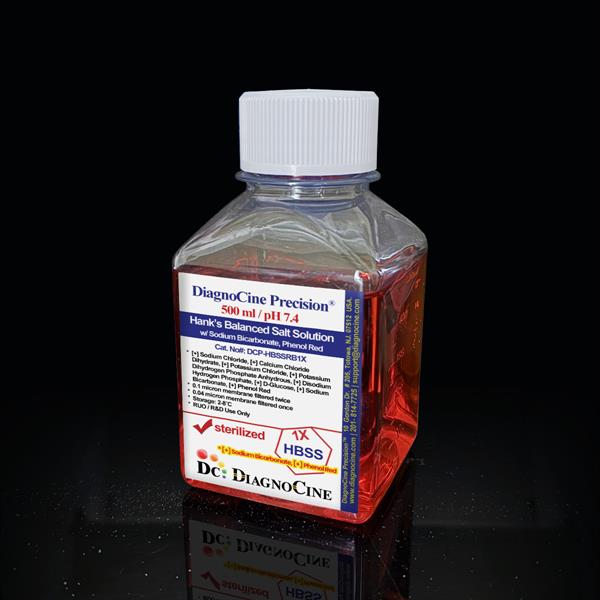
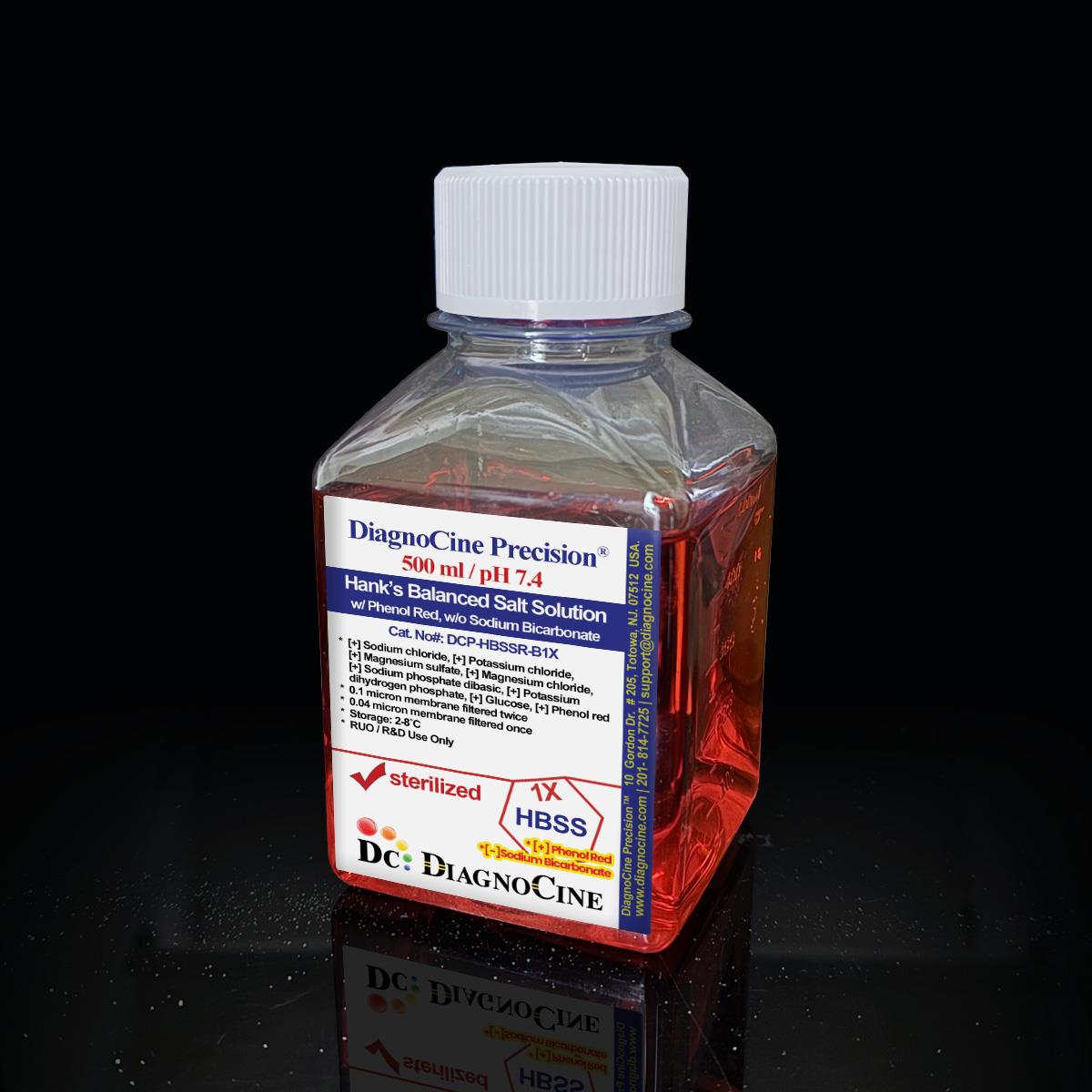
Hank’s Balanced Salt Solution w/ Phenol red w/o Sodium bicarbonate: 1X
FluxMPS™ Hank's Balanced Salt Solution w/ Phenol Red w/o Sodium Bicarbonate: 1X
An MPS-grade Hank's Balanced Salt Solution (HBSS) formulated with phenol red as a visual pH indicator and supplied without sodium bicarbonate, giving users full control over final buffering capacity. Ultra-filtered through a quadruple-stage 0.1 µm / 0.04 µm membrane train, this buffer is engineered for microfluidic channels, organ-on-a-chip (OoC) platforms, and precision cell and molecular biology workflows.
- Sterile, ultrapure buffer filtered 0.1 µm membrane twice and 0.04 µm membrane twice for microchannel-safe purity
- Formulated to pH 7.4 with an osmolality of 260.00-300.00 mOsm/kg H2O
- Endotoxin content NMT 1 EU/mL
- Contains phenol red pH indicator; sodium bicarbonate excluded so users can define their own buffering system
- Manufactured with Ultrapure Type 1 water (18.2 MΩ·cm)
- ISO Class 5 (Class 100) aseptic fill and finish
- Compatible with microfluidic channels, OoC, ToC, BoC, and LoC platforms
- Custom pH, additions, and modifications available on request — contact support@diagnocine.com
- pH7.4
- Osmolality260.00-300.00 mOsm/kg H2O
- EndotoxinNMT 1 EU/mL
- SterilityUSP <71> — No growth at 14 days
- Filtration0.1 µm x2 + 0.04 µm x2
- AppearanceRed colored, clear solution
- FormulationHBSS w/ Phenol Red, w/o NaHCO3
- Storage2-8°C, protect from light
- Shelf Life24 months
- Size500 mL
Engineered where standard buffers fail
Conventional 0.22 µm-filtered balanced salt solutions can carry subvisible particulates and residual bioburden that accumulate in narrow microfluidic channels, interfere with sensitive assays, and stress delicate cell models. FluxMPS™ buffers are built from the ground up for microphysiological system (MPS) and organ-on-a-chip (OoC) workflows.[3,4]
Microchannel-safe purity
Quadruple-stage 0.1 µm and 0.04 µm filtration removes finer particulates than a single-pass 0.22 µm filter, protecting narrow microfluidic geometries.
Precise, stable pH
Formulated to pH 7.4 with a controlled osmolality of 260.00-300.00 mOsm/kg H2O for reproducible physiological conditions.
Ultrapure-grade water
Manufactured with Ultrapure Type 1 water (18.2 MΩ·cm), meeting USP <85> expectations for reagent-grade water.
Low background for imaging & assays
Phenol red provides visual pH confirmation without a pre-loaded bicarbonate buffering system, letting users tailor conditions to their optical assay.
Defined, traceable composition
Nine characterized components with CAS-tracked inorganic salts, glucose, and phenol red sodium salt, released per lot.
Customization on demand
Inquire for different concentrations, added sodium bicarbonate, chemical/protein supplementation, or modified pH.
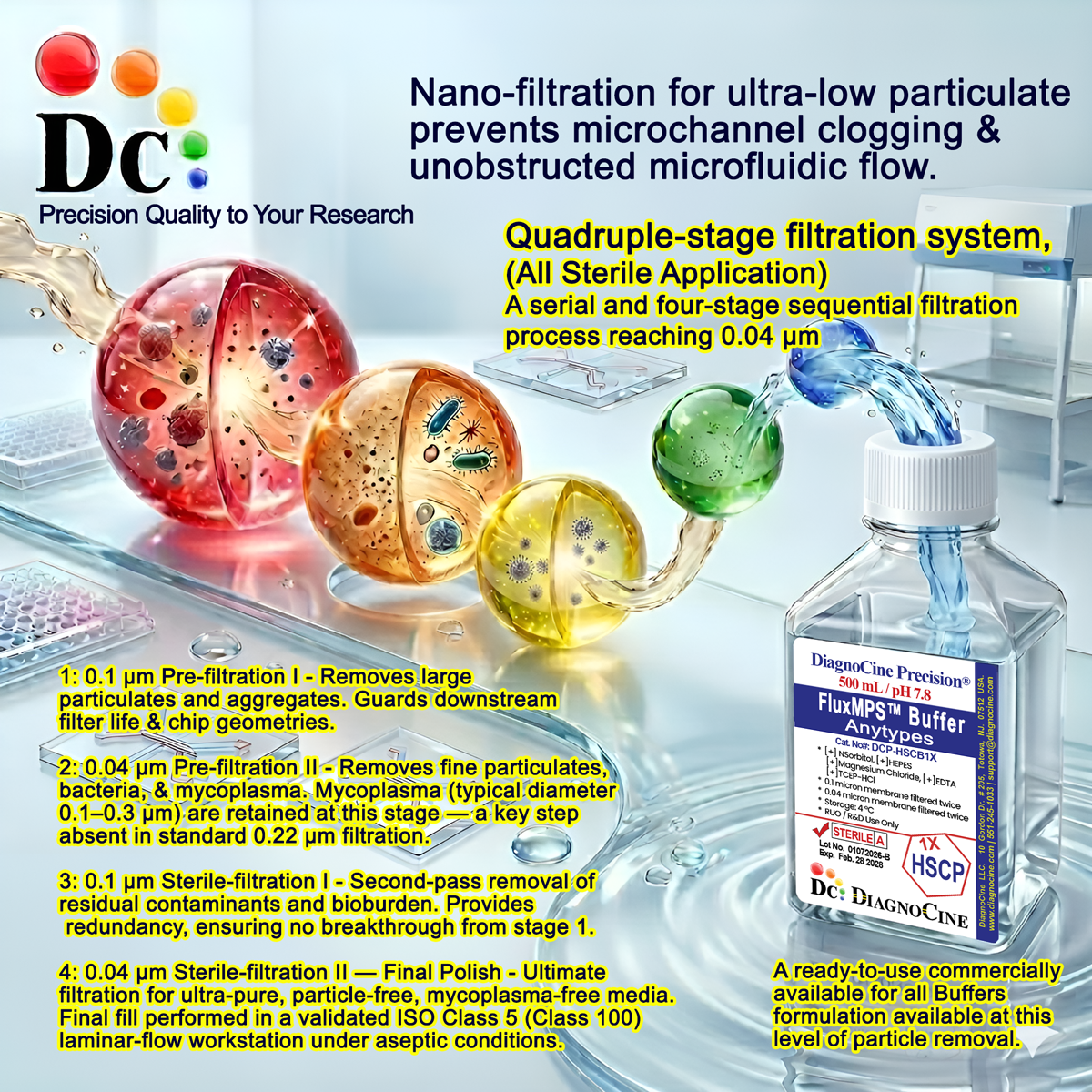
Quadruple-stage filtration system
This buffer is sterile-filtered through a quadruple-stage membrane train — 0.1 µm membrane filtration twice followed by 0.04 µm membrane filtration twice — delivering ultra-clean, microchannel-safe purity for sensitive cell and molecular biology applications.
- 1
0.1 µm Pre-filtration I
Removes large particulates and aggregates, extending the service life of downstream filters.
- 2
0.04 µm Pre-filtration II
Retains fine particulates and bioburden, including organisms in the mycoplasma size range (approximately 0.2 micron, as noted for DiagnoCine Precision buffers), before final sterile filtration.
- 3
0.1 µm Sterile-filtration I
Second-pass redundancy through a 0.1 µm sterilizing membrane.
- 4
0.04 µm Sterile-filtration II — Final Polish
Ultimate polish immediately prior to ISO Class 5 (Class 100) aseptic fill, preventing mycoplasma contamination.
Performance vs. conventional buffer
Sequential 0.1 µm and 0.04 µm filtration, applied across four total passes, removes finer particulates than a single 0.22 µm pass used in conventional balanced salt solutions.
© Diagnocine® — DCP-HBSSR-B1X
Where DCP-HBSSR-B1X performs
A physiological salt solution derived from the salt solution described by Sydney Ringer[1] and refined by Hanks and Wallace[2], this buffer supports mammalian cell metabolism outside of the living organism and is suited to workflows across microfluidics, sample handling, and immunoassays.
Automated Bioreactors & Robotics
For automated perfusion bioreactors and liquid-handling robotics, an optional 0.01 µm (10 nm) ultra-filtered variant of this buffer is available on request.
- Total Particulate Exclusion — sub-10 nm filtration for the most sensitive automated systems
- Valve & Sensor Protection — reduces particulate-driven wear in microvalves and inline sensors
- Extended Perfusion Stability — supports long-duration, unattended perfusion runs
Inquiry Required: the 0.01 µm ultra-filtered grade is produced to order — contact support@diagnocine.com to request this configuration.
Micro Physiological System (MPS) & Chip
Perfusion buffer for organ-on-a-chip and tissue-on-a-chip platforms.
Wash, Dilution & Reconstitution
Washes cells prior to dissociation and dilutes cells for counting.
iPSC-Derived Model Handling
Supports handling of iPSC-derived cell models during transport and dissociation.
Endothelial & Primary Cell Perfusion
Osmotic and pH-appropriate perfusion vehicle for primary and endothelial cells.
ELISA, Blotting & Blocking
Low-particulate buffer for washing steps in immunodetection workflows.
Microscopy & Optical Sensing
Phenol red pH indication supports visual monitoring during live-cell imaging.
Detailed specifications
All values below are specific to DCP-HBSSR-B1X as stated on the product's release documentation.
| Parameter | Specification |
|---|---|
| Formulation / Composition | Hank's Balanced Salt Solution w/ Phenol Red, w/o Sodium Bicarbonate |
| Appearance | Red colored, clear solution |
| pH USP <791> | 7.4 |
| Osmolality USP <785> | 260.00-300.00 mOsm/kg H2O |
| Parameter | Specification |
|---|---|
| Endotoxin USP <85> | NMT 1 EU/mL |
| Sterility USP <71> | No bacterial or fungal growth after 14 days incubation |
| Toxicity Test | Passes |
| Water purity | Ultrapure Type 1 water (18.2 MΩ·cm) |
| Manufacturing std. ISO 13485 | ISO 13485-certified, CE-approved facility |
| Fill environment | ISO Class 5 (Class 100) |
| Parameter | Specification |
|---|---|
| Storage temperature | 2-8°C, away from bright light |
| Shelf life | 24 months |
| Buffering capacity note | Requires addition of sodium bicarbonate prior to use for complete buffering capacity |
| Parameter | Specification |
|---|---|
| Raw material grade | Ultrapure, filtered 0.1 µm x2 and 0.04 µm x2 |
| Manufacturing QMS | ISO 13485:2016 |
| Regulatory alignment | CE-approved; final packaging, QA and testing at the DiagnoCine R&D and Quality Testing Center; customization at DiagnoCine Precision, Totowa, New Jersey, USA |
| Intended use | Research Use Only (RUO) |
Full composition (mg/L)
Nine components released per lot, presented in the original ingredient groupings used on this product's documentation.
| Component | CAS Number | Concentration |
|---|---|---|
| Calcium Chloride Anhydrous (CaCl2) | 10043-52-4 | 140.00 mg/L |
| Disodium Hydrogen Phosphate (Na2HPO4) | 7558-79-4 | 48.000 mg/L |
| Magnesium Sulfate Anhydrous (MgSO4) | 7487-88-9 | 49.000 mg/L |
| Magnesium Chloride (MgCl2) | 7786-30-3 | 46.650 mg/L |
| Potassium Chloride (KCl) | 7447-40-7 | 400.000 mg/L |
| Potassium Dihydrogen Phosphate Anhydrous (KH2PO4) | 7778-77-0 | 60.000 mg/L |
| Sodium Chloride (NaCl) | 7647-14-5 | 8000.000 mg/L |
| Component | CAS Number | Concentration |
|---|---|---|
| D-Glucose | 50-99-7 | 1000.000 mg/L |
| Phenol Red Sodium Salt | 34487-61-1 | 11.000 mg/L |
Manufacturing & compliance
Every lot of DCP-HBSSR-B1X moves through a controlled quality chain, from raw material sourcing to final release testing.
ISO 13485:2016 QMS
Manufactured under ISO 13485-certified and CE-approved facilities (Suppliers of DiagnoCine Precision).
Ultrapure Type 1 Water
Formulated with Ultrapure Type 1 water (18.2 MΩ·cm).
ISO Class 5 Fill & Finish
Final packaging, quality assurance, and testing are completed at the DiagnoCine R&D and Quality Testing Center.
Micro-Batch Precision
Specific customization requests and assembly are accomplished at DiagnoCine Precision in Totowa, New Jersey, USA.
Endotoxin — USP <85> BET
NMT 1 EU/mL.
Sterility — USP <71>
No bacterial or fungal growth after 14 days incubation.
Osmolality — USP <785>
260.00-300.00 mOsm/kg H2O.
Documentation / CoA
Certificate of Analysis available on request.
How DCP-HBSSR-B1X compares
A side-by-side look at how this buffer's filtration and quality architecture compares to conventional balanced salt solutions.
| Parameter | DCP-HBSSR-B1X (FluxMPS™) | Conventional 0.22 µm Buffer | Standard Alternative |
|---|---|---|---|
| Final filtration pore size | 0.04 µm | 0.22 µm | 0.22 µm |
| Number of filtration stages | 4 | 1 | 1 |
| Endotoxin specification | NMT 1 EU/mL | cancel | cancel |
| Sterility testing (USP <71>) | check_circle | cancel | cancel |
| Ultrapure Type 1 water | check_circle | cancel | cancel |
| Manufacturing QMS | ISO 13485:2016 | cancel | cancel |
| Microfluidic channel compatibility | check_circle | cancel | cancel |
| Formulation customization | check_circle | cancel | cancel |
Frequently asked questions
Common questions about DCP-HBSSR-B1X.
Supporting literature
Curated references relevant to balanced salt solutions, buffering chemistry, and microfluidic cell culture.
- Ringer S. Concerning the influence exerted by each of the constituents of the blood on the contraction of the ventricle. J Physiol. 1885. doi:10.1113/jphysiol.1885.sp000184
- Hanks JH, Wallace RE. Relation of oxygen and temperature in the preservation of tissues by refrigeration. Proc Soc Exp Biol Med. 1949. doi:10.3181/00379727-71-17131
- Ingber DE. Reverse engineering human pathophysiology with organs-on-chips. Cell. 2016. doi:10.1016/j.cell.2016.05.048
- Bhatia SN, Ingber DE. Microfluidic organs-on-chips. Nat Biotechnol. 2014. doi:10.1038/nbt.2989
- Halldorsson S, et al. Advantages and challenges of microfluidic cell culture in polydimethylsiloxane devices. Biosens Bioelectron. 2015. doi:10.1016/j.bios.2014.07.029
- Zhang B, Radisic M. Organ-on-a-chip devices advance to market. Lab Chip. 2017. doi:10.1039/C6LC01554A
- Freshney RI. Culture of Animal Cells: A Manual of Basic Technique and Specialized Applications. 2015. doi:10.1002/9781118873651
- Huh D, et al. Reconstituting organ-level lung functions on a chip. Science. 2010. doi:10.1126/science.1188302