

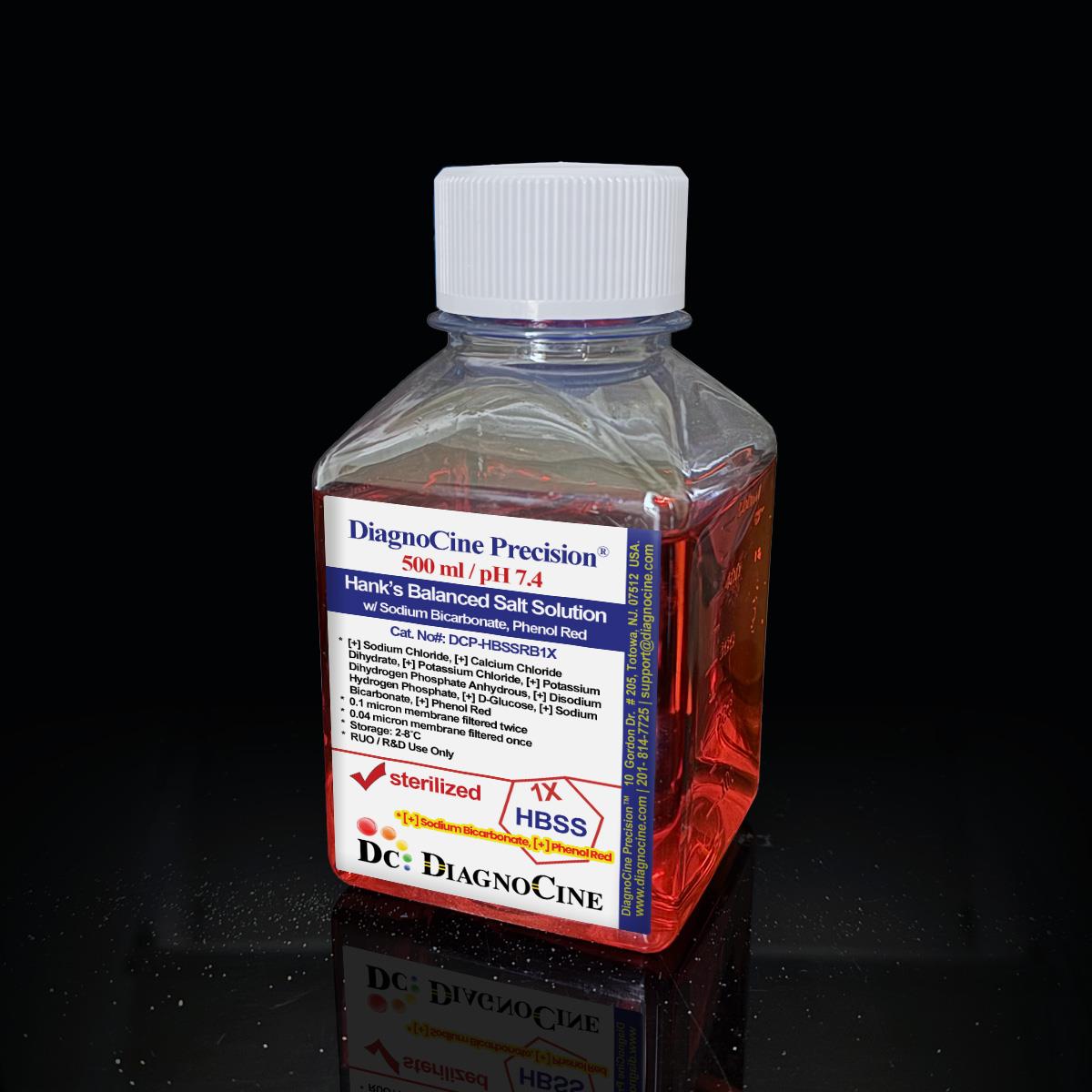
Hank’s Balanced Salt Solution w/ Phenol red and Sodium bicarbonate: 1X
FluxMPS™ Hank's Balanced Salt Solution w/ Phenol Red and Sodium Bicarbonate: 1X
FluxMPS™ HBSS 1X with Phenol Red and Sodium Bicarbonate is an MPS-grade balanced salt solution engineered for microphysiological system (MPS) and organ-on-a-chip (OoC) workflows that demand precise, stable pH and defined osmolality. Every lot is sequentially filtered through 0.1 µm membranes twice and 0.04 µm membranes twice, delivering ultra-clean, microchannel-safe buffer well beyond what standard single-pass filtration achieves. Ready to use as a wash, dissociation-reagent diluent, or short-term maintenance buffer for sensitive cell and tissue models.
- Quadruple-stage filtration: 0.1 µm membrane twice and 0.04 µm membrane twice for ultra-low particulate
- Endotoxin content NMT 1 EU/mL
- Manufactured to a defined pH of 7.4 with osmolality controlled to 265.00-305.00 mOsm/kg H2O
- Formulated with Phenol Red for visual pH monitoring and Sodium Bicarbonate for buffering capacity
- Sterility confirmed by USP-aligned 14-day incubation with no bacterial or fungal growth
- Manufactured under ISO 13485-certified, CE-approved facilities
- Microchannel-safe for organ-on-a-chip (OoC), tissue-on-a-chip (ToC), and lab-on-a-chip (LoC) systems
- Custom pH, concentration, and additive formulations available on request
- FormulationHBSS 1X w/ Phenol Red & Sodium Bicarbonate
- Size500 mL
- pH7.4
- Osmolality265.00-305.00 mOsm/kg H2O
- EndotoxinNMT 1 EU/mL
- SterilityNo growth at 14 days (USP)
- Filtration0.1 µm x2 + 0.04 µm x2
- AppearanceRed colored, clear solution
- Storage2-8°C, protect from light
- Shelf Life24 months
Engineered where standard balanced salt solutions fall short
Conventional 0.22 µm-filtered balanced salt solutions can carry subvisible particulates that accumulate in narrow microchannels, drift in pH and osmolality between lots, and introduce endotoxin or assay background that confounds sensitive organ-on-a-chip and imaging readouts. FluxMPS™ HBSS 1X is manufactured to close each of these gaps.
Microchannel-safe purity
Sequential 0.1 µm and 0.04 µm membrane filtration removes fine particulates before they can reach and obstruct microfluidic channels, valves, and sensors.
Precise, stable pH
Manufactured to a defined pH of 7.4 with Sodium Bicarbonate providing buffering capacity and Phenol Red enabling instant visual confirmation of pH drift.
Ultrapure-grade water
Formulated with Ultrapure Type 1 water (18.2 MΩ·cm), consistent with USP <85> water-quality expectations for sensitive cell culture reagents.
Low background for imaging & assays
Defined osmolality (265.00-305.00 mOsm/kg H2O) and controlled ionic composition help minimize variability in confocal, biosensor, and TEER measurements.
Defined, traceable composition
Every inorganic salt, D-Glucose, and Phenol Red Sodium Salt component is lot-released to its stated concentration for full formulation traceability.
Customization on demand
Alternate pH, concentration, added chemicals, compounds, proteins, or supplements can be formulated on request.
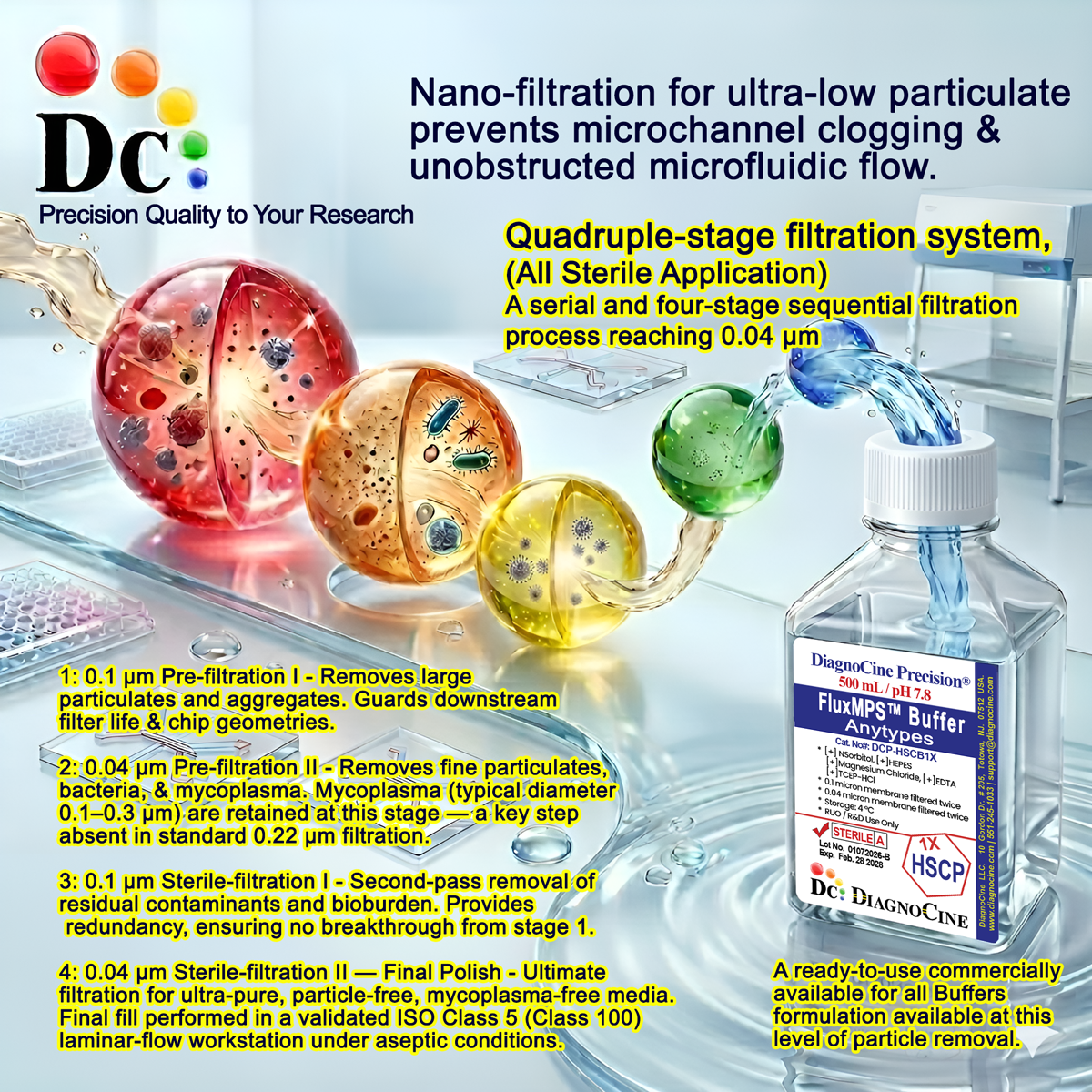
Quadruple-stage filtration system
Every lot of FluxMPS™ HBSS 1X is filtered through a 0.1 µm membrane twice and a 0.04 µm membrane twice, a four-stage sequence engineered to remove particulate and bioburden well beyond a single 0.22 µm pass.
- 1
0.1 µm Pre-filtration I
First-pass 0.1 µm membrane filtration removes large particulate and aggregates, extending the service life of downstream filters.
- 2
0.04 µm Pre-filtration II
First-pass 0.04 µm membrane filtration retains fine particulates and bioburden, including organisms in the size range of mycoplasma, which are typically about 0.2 microns.
- 3
0.1 µm Sterile-filtration I
A second 0.1 µm pass provides redundancy ahead of final polishing.
- 4
0.04 µm Sterile-filtration II — Final Polish
A second 0.04 µm pass delivers the ultimate polish for an ISO Class 5 (Class 100) aseptic fill, helping prevent mycoplasma contamination.
Performance vs. conventional buffer
Two sequential passes at both 0.1 µm and 0.04 µm remove finer particulate and bioburden than a single conventional 0.22 µm filtration pass, supporting the narrow flow paths of organ-on-a-chip and microfluidic systems.
© Diagnocine® — DCP-HBSSRB1X
Where FluxMPS™ HBSS 1X performs
As a physiological balanced salt solution, FluxMPS™ HBSS 1X with Phenol Red and Sodium Bicarbonate supports cell washing, tissue dissociation reagent preparation, and short-term maintenance of cell and tissue models across microfluidic and conventional culture formats.
Automated Bioreactors & Robotics
For fully automated bioreactor and liquid-handling robotics platforms where valve and sensor fouling is a leading cause of downtime, an optional 0.01 µm (10 nm) ultra-filtered variant of this buffer is available on request.
- Total Particulate Exclusion for closed-loop perfusion systems
- Valve & Sensor Protection against fine particulate fouling
- Extended Perfusion Stability for long-duration automated runs
Inquiry Required: Contact support@diagnocine.com to request the 0.01 µm ultra-filtered grade for automated bioreactor and robotics platforms.
Micro Physiological System (MPS) & Chip
Wash and buffer step for organ-on-a-chip and tissue-on-a-chip cell and tissue models.
Wash, Dilution & Reconstitution
Physiological rinse and dilution buffer during cell washing and enzymatic dissociation reagent preparation.
iPSC-Derived Model Handling
Osmotically balanced, pH-stable rinse buffer for sensitive iPSC-derived cell types.
Endothelial & Primary Cell Perfusion
Short-term maintenance buffer compatible with endothelial and primary cell perfusion workflows.
ELISA, Blotting & Blocking
pH-buffered wash and dilution solution for ELISA, blotting, and immunostaining workflows.
Microscopy & Optical Sensing
Phenol Red indicator enables rapid visual pH confirmation during live-cell microscopy and optical sensing setups.
Full technical specifications
Every value below is sourced from the product's own release specification.
| Parameter | Specification |
|---|---|
| Formulation / Composition | HBSS 1X with Phenol Red and Sodium Bicarbonate |
| Appearance | Red colored, clear solution |
| pH USP <791> | 7.4 |
| Osmolality USP <785> | 265.00-305.00 mOsm/kg H2O |
| Concentration | 1X |
| Parameter | Specification |
|---|---|
| Endotoxin USP <85> BET | NMT 1 EU/mL |
| Sterility | No bacterial or fungal growth after 14 days incubation, per USP specification |
| Toxicity Test | Passes |
| Water Quality | Ultrapure Type 1 water (18.2 MΩ·cm) |
| Manufacturing Standard ISO 13485 | ISO 13485-certified, CE-approved facilities |
| Fill Environment | ISO Class 5 (Class 100) |
| Parameter | Specification |
|---|---|
| Storage Temperature | 2-8°C, away from bright light |
| Shelf Life | 24 months |
| Use Before | Expiry date given on product label |
| Parameter | Specification |
|---|---|
| Manufacturing QMS ISO 13485:2016 | ISO 13485-certified, CE-approved supplier facilities |
| Traceability | Final packaging, QA, and testing at the DiagnoCine R&D and Quality Testing Center |
| Regulatory Alignment | CE-approved |
| Production Method | Customization and assembly at DiagnoCine Precision, Totowa, New Jersey, USA |
| Intended Use | Research Use Only (RUO) |
Full composition (mg/L)
Every component and its lot-release concentration is listed below, grouped exactly as declared in the product's formulation record.
| Component | CAS Number | Concentration |
|---|---|---|
| INORGANIC SALTS | ||
| Calcium Chloride Anhydrous (CaCl2) | 10043-52-4 | 140.00 mg/L |
| Disodium Hydrogen Phosphate (Na2HPO4) | 7558-79-4 | 48.000 mg/L |
| Magnesium Sulfate Anhydrous (MgSO4) | 7487-88-9 | 49.000 mg/L |
| Magnesium Chloride (MgCl2) | 7786-30-3 | 46.650 mg/L |
| Potassium Chloride (KCl) | 7447-40-7 | 400.000 mg/L |
| Potassium Dihydrogen Phosphate Anhydrous (KH2PO4) | 7778-77-0 | 60.000 mg/L |
| Sodium Chloride (NaCl) | 7647-14-5 | 8000.000 mg/L |
| Sodium Bicarbonate (NaHCO3) | 144-55-8 | 350.000 mg/L |
| Component | CAS Number | Concentration |
|---|---|---|
| OTHERS | ||
| D-Glucose (C6H12O6) | 50-99-7 | 1000.000 mg/L |
| Phenol Red Sodium Salt | 34487-61-1 | 11.000 mg/L |
Manufacturing & compliance
FluxMPS™ DCP-HBSSRB1X is manufactured, filled, and released under a documented quality system spanning raw material sourcing through final packaging.
ISO 13485:2016 QMS
Manufactured under ISO 13485-certified and CE-approved supplier facilities.
Ultrapure Type 1 Water
Formulated with Ultrapure Type 1 water (18.2 MΩ·cm).
ISO Class 5 Fill & Finish
Final fill performed in an ISO Class 5 (Class 100) aseptic environment.
Micro-Batch Precision
Final packaging, quality assurance, and testing performed at the DiagnoCine R&D and Quality Testing Center; customization and assembly performed at DiagnoCine Precision in Totowa, New Jersey, USA.
Endotoxin (USP <85> BET)
Each lot is tested to confirm endotoxin content NMT 1 EU/mL.
Sterility (USP-aligned)
No bacterial or fungal growth observed after 14 days of incubation, as per USP specification.
Osmolality (USP <785>)
Controlled to 265.00-305.00 mOsm/kg H2O.
Documentation
Certificate of Analysis available for every lot.
How DCP-HBSSRB1X compares
A side-by-side look at the purity architecture behind FluxMPS™ HBSS 1X versus conventionally filtered balanced salt solutions.
| Parameter | DCP-HBSSRB1X (FluxMPS™) | Conventional Balanced Salt Solution | Standard Alternative |
|---|---|---|---|
| Final filtration pore size | 0.04 µm | 0.22 µm | 0.22 µm |
| Number of filtration stages | 4 | 1 | 1 |
| Endotoxin specification | NMT 1 EU/mL | Not specified | Not specified |
| Defined pH | 7.4 | cancel | cancel |
| Osmolality control | check_circle | cancel | cancel |
| Water quality | Ultrapure Type 1 (18.2 MΩ·cm) | Not specified | Not specified |
| Manufacturing QMS | ISO 13485:2016 | Not specified | Not specified |
| Microfluidic channel compatibility | check_circle | cancel | cancel |
| Custom formulation | check_circle | cancel | cancel |
Frequently asked questions
Answers to common questions about FluxMPS™ DCP-HBSSRB1X.
Supporting literature
Curated peer-reviewed literature relevant to balanced salt solutions, buffer chemistry, and organ-on-a-chip applications.
- Bhatia SN, Ingber DE. Microfluidic organs-on-chips. Nat Biotechnol. 2014;32(8):760-772. doi:10.1038/nbt.2989
- Huh D, Matthews BD, Mammoto A, et al. Reconstituting organ-level lung functions on a chip. Science. 2010;328(5986):1662-1668. doi:10.1126/science.1188302
- Ingber DE. Reverse engineering human pathophysiology with organs-on-chips. Cell. 2016;164(6):1105-1109. doi:10.1016/j.cell.2016.02.049
- Zhang B, Korolj A, Lai BFL, Radisic M. Advances in organ-on-a-chip engineering. Nat Rev Mater. 2018;3:257-278. doi:10.1038/s41578-018-0034-7
- Good NE, Winget GD, Winter W, et al. Hydrogen ion buffers for biological research. Biochemistry. 1966;5(2):467-477. doi:10.1021/bi00866a011
- Freshney RI. Culture of Animal Cells: A Manual of Basic Technique and Specialized Applications. Wiley; 2010. doi:10.1002/9780470649367
- van Meer BJ, de Vries H, Firth KSA, et al. Small molecule absorption by PDMS in the context of drug response bioassays. Biochem Biophys Res Commun. 2017;482(2):323-328. doi:10.1016/j.bbrc.2016.11.062
- Malyala P, Singh M. Endotoxin limits in formulations for preclinical research. J Pharm Sci. 2008;97(6):2041-2044. doi:10.1002/jps.21152
- Kilic O, Pamies D, Lavell E, et al. Brain-on-a-chip model enables analysis of human neuronal differentiation and chemotaxis. Lab Chip. 2016;16(21):4152-4162. doi:10.1039/C6LC00284F