

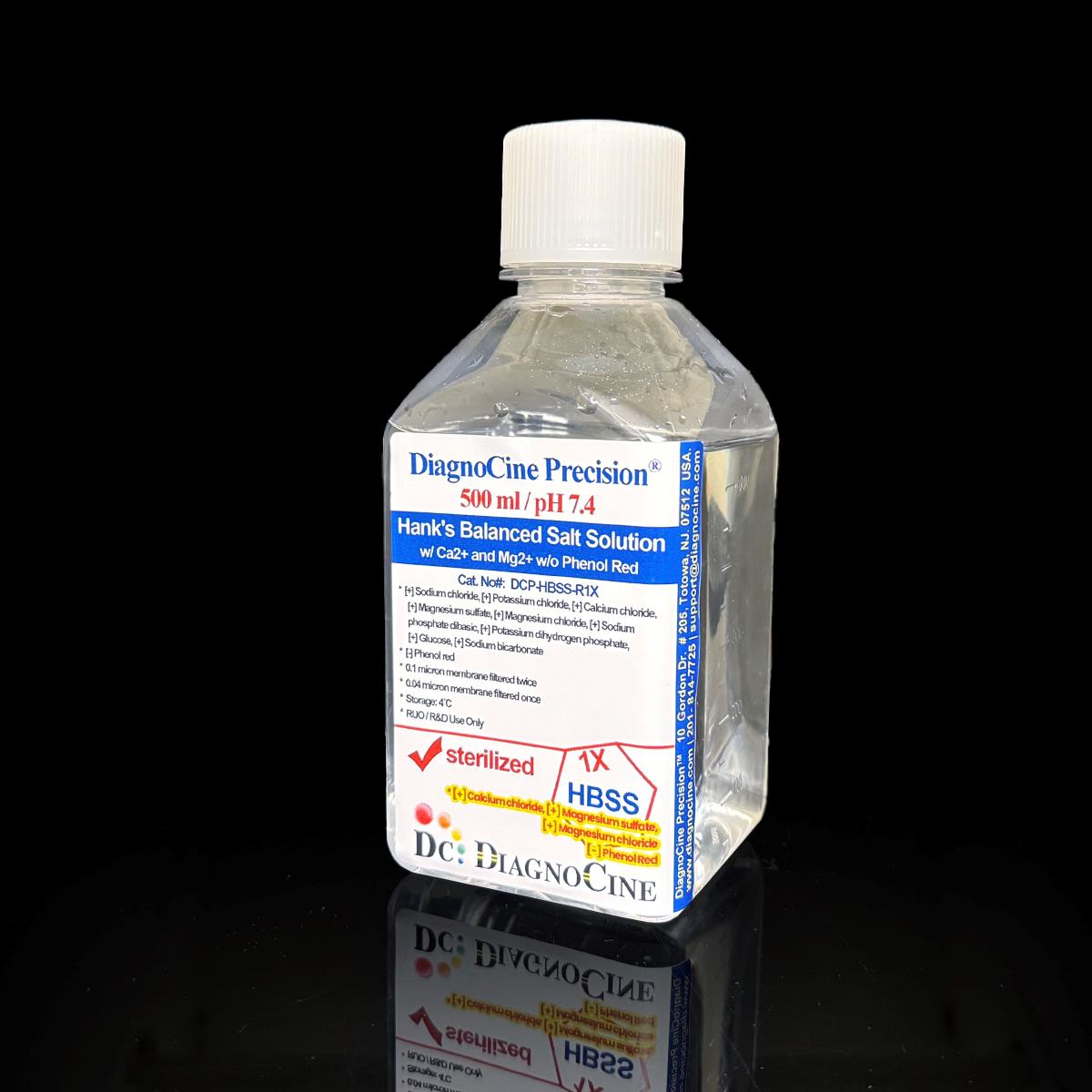
Hank's Balanced Salt Solution with Calcium and Magnesium without Phenol Red
FluxMPS™ Hank's Balanced Salt Solution with Calcium and Magnesium without Phenol Red
An MPS-grade physiological wash and transport buffer supplying defined Ca2+ and Mg2+ ion levels at pH 7.4, formulated without phenol red for low-background imaging and biosensor workflows. Quadruple-stage filtered through 0.1 µm membrane twice and 0.04 µm membrane twice, then sterile-filled for use in microfluidic channels, organ-on-a-chip systems, and general cell culture.
- Quadruple-stage filtration: 0.1 µm membrane twice and 0.04 µm membrane twice for an ultra-clean, sterile buffer
- Formulated with physiological Ca2+ and Mg2+ levels supporting cell-to-cell adhesion, signaling, and membrane integrity — without phenol red
- Precise pH 7.4 (measured at 25°C) and osmolality isotonic with body fluids
- DNase- and RNase-activity tested, with none detected after 18 hours at room temperature
- Manufactured in ISO 13485:2016-certified, CE-approved facilities
- Built on ultrapure Type 1 (18.2 MΩ·cm) water
- Suited for cell washing, transport, dilution/counting, and reagent-preparation workflows
- Custom concentrations, tracking dyes, pH, and other modifications available on request
- pH7.4 (25°C)
- FormulationHBSS with Ca2+/Mg2+, no phenol red
- OsmolalityIsotonic with body fluids
- Calcium Chloride1.26 mM
- Magnesium Chloride0.49 mM
- Sodium Bicarbonate4.17 mM
- D-Glucose5.56 mM
- Filtration0.1 µm x2 + 0.04 µm x2
- Storage4°C
- Shelf Life2 years
Engineered where standard buffers fail
Conventional 0.22 µm-filtered HBSS can carry subvisible particulates, drift in ionic composition, and background contaminants that accumulate inside microfluidic channels and confound sensitive assays. FluxMPS™ HBSS with Ca2+/Mg2+ is built to a different standard.
Microchannel-safe purity
Final 0.04 µm membrane pass, produced under USP <788> Method 2-aligned particulate control, keeps the buffer safe for narrow microfluidic geometries.
Precise, stable pH
Formulated with sodium bicarbonate and dibasic/monobasic phosphate salts to hold pH 7.4 (measured at 25°C) for reliable physiological conditions.
Ultrapure-grade water
Made with ultrapure Type 1 water (18.2 MΩ·cm), consistent with USP <85> water-quality expectations.
Low background for imaging & assays
Supplied without phenol red, reducing optical background for confocal microscopy, biosensor readouts, and fluorescence-based assays.
Defined, traceable composition
Nine named inorganic salts plus D-glucose, each present at a stated concentration and traceable to standard CAS identities.
Customization on demand
Alternate concentrations, tracking dyes, different pH targets, and other modifications are available — contact support@diagnocine.com.
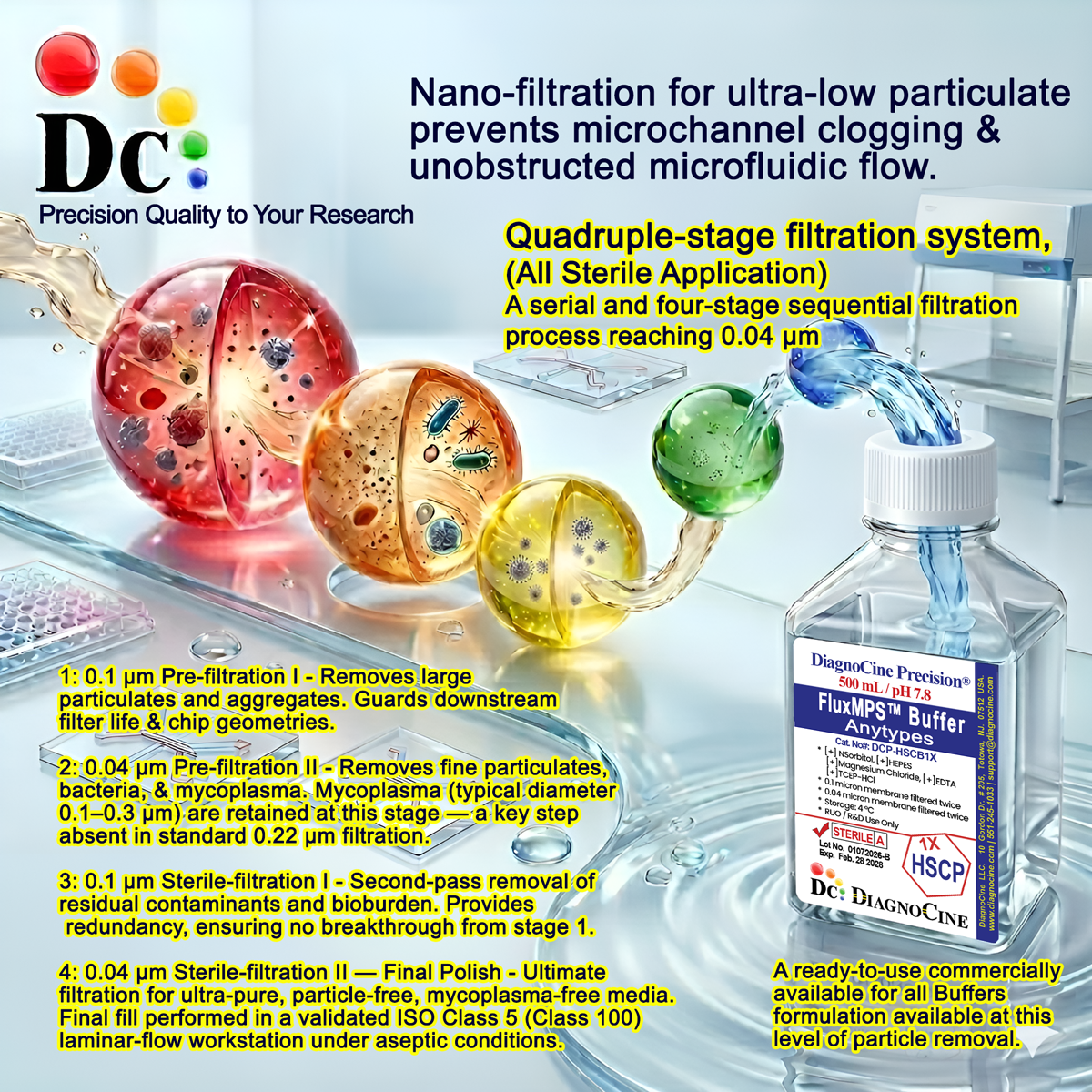
Quadruple-stage filtration system
Every lot of this HBSS is filtered through a 0.1 µm membrane twice and a 0.04 µm membrane twice before sterile fill, giving the solution a final polish well below the size of the smallest known mycoplasma organisms, which can be about 0.2 microns.
-
1
0.1 µmPre-filtration I
Removes large particulates and aggregates, extending the life of the downstream membranes.
-
2
0.04 µmPre-filtration II
Retains fine particulates and bioburden ahead of the second filtration pass, well below typical bacterial and mycoplasma dimensions.
-
3
0.1 µmSterile-filtration I
A second 0.1 µm pass provides redundant clarification before final polishing.
-
4
0.04 µmSterile-filtration II — Final Polish
A second 0.04 µm pass under ISO Class 5 (Class 100) conditions completes the filtration prior to aseptic fill.
Performance vs. conventional buffer
Sequential 0.1 µm and 0.04 µm filtration, each applied twice, removes finer particulates than a single 0.22 µm pass used in conventional HBSS.
© Diagnocine® — DCP-HBSS-R1X
Where this HBSS is used
This Ca2+/Mg2+-containing, phenol red-free HBSS supports cell washing, transport of cells or tissues, dilution for cell counting, and preparation of other reagents and solutions.
Automated Bioreactors & Robotics
For fully automated perfusion and robotic liquid-handling platforms, an optional 0.01 µm (10 nm) ultra-filtered variant of this buffer is available to further protect sensitive valves and sensors.
- Total Particulate Exclusion for automated flow paths
- Valve & Sensor Protection in closed-loop systems
- Extended Perfusion Stability for long-duration runs
Inquiry Required: contact support@diagnocine.com to request the 0.01 µm ultra-filtered grade of this buffer.
Micro Physiological System (MPS) & Chip
Physiological, phenol red-free buffer for perfusion and rinsing of chip-based culture systems.
Wash, Dilution & Reconstitution
Used to rinse cells before dissociation and to dilute cell suspensions for accurate counting.
iPSC-Derived Model Handling
Ca2+/Mg2+ content supports cell-to-cell adhesion during handling of iPSC-derived models.
Endothelial & Primary Cell Perfusion
Membrane-integrity-preserving formulation suited to perfusion of primary and endothelial cell types.
ELISA, Blotting & Blocking
Low-background, phenol red-free base suitable for immunoassay wash and dilution steps.
Microscopy & Optical Sensing
Phenol red-free formulation reduces optical interference in imaging and biosensor workflows.
Full specification set
All values below are drawn directly from this product's manufacturing and quality control records.
| Parameter | Specification |
|---|---|
| Formulation | HBSS with Ca2+ and Mg2+, without phenol red |
| Appearance | Clear solution |
| pH USP <791> | 7.4 (25°C) |
| Osmolality | Isotonic with body fluids |
| Detailed Composition | See full composition table below |
| Parameter | Specification |
|---|---|
| Sterility | Filtered 0.1 µm membrane twice and 0.04 µm membrane twice in a sterile environment |
| DNase Activity | None detected after 18 hours at room temperature |
| RNase Activity | None detected after 18 hours at room temperature |
| Water Quality USP <85> | Ultrapure Type 1 water (18.2 MΩ·cm) |
| Fill Environment | ISO Class 5 (Class 100) |
| Parameter | Specification |
|---|---|
| Storage temperature | 4°C |
| Shelf life | 2 years |
| Parameter | Specification |
|---|---|
| Raw material grade | Ultrapure inorganic salts and D-glucose |
| Manufacturing QMS ISO 13485 | ISO 13485-certified facilities |
| Regulatory alignment | CE-approved facilities |
| Production method | Final packaging, QA, and testing at the DiagnoCine R&D and Quality Testing Center; customization and assembly at DiagnoCine Precision, Totowa, New Jersey, USA |
| Intended use | Research Use Only (RUO) |
Full composition
Nine inorganic salts and D-glucose, each present at the concentration below, form this physiological buffer system.
| Component | CAS Number | Concentration |
|---|---|---|
| Sodium Chloride | 7647-14-5 | 137.93 mM |
| Potassium Chloride | 7447-40-7 | 5.33 mM |
| Calcium Chloride | 10043-52-4 | 1.26 mM |
| Magnesium Sulfate | 7487-88-9 | 0.41 mM |
| Magnesium Chloride | 7786-30-3 | 0.49 mM |
| Sodium Phosphate Dibasic | 7558-79-4 | 0.338 mM |
| Potassium Phosphate Monobasic | 7778-77-0 | 0.44 mM |
| Sodium Bicarbonate | 144-55-8 | 4.17 mM |
| D-Glucose (Dextrose) | 50-99-7 | 5.56 mM |
Manufacturing & compliance
Every lot is produced and released under a documented quality system spanning raw materials through final fill.
ISO 13485:2016 QMS
Manufactured under ISO 13485-certified and CE-approved facilities.
Ultrapure Type 1 Water
Formulated with ultrapure Type 1 water (18.2 MΩ·cm).
ISO Class 5 Fill & Finish
Sterile filtration and fill performed under ISO Class 5 (Class 100) conditions.
Micro-Batch Precision
Final packaging, QA, and testing performed at the DiagnoCine R&D and Quality Testing Center, with customization at DiagnoCine Precision, Totowa, New Jersey.
DNase / RNase Testing
No DNase or RNase activity detected after 18 hours of incubation at room temperature.
Sterility
Filtered 0.1 µm membrane twice and 0.04 µm membrane twice in a sterile environment.
pH Control USP <791>
Held at pH 7.4, measured at 25°C.
Documentation / CoA
Certificate of Analysis available upon request.
How DCP-HBSS-R1X compares
A side-by-side look at how this quadruple-stage filtered HBSS compares to conventional single-stage filtered alternatives.
| Parameter | DCP-HBSS-R1X (FluxMPS™) | Conventional HBSS (0.22 µm filtered) | Standard alternative (0.22 µm filtered) |
|---|---|---|---|
| Ca2+/Mg2+, phenol red-free formulation | check_circle | cancel | cancel |
| Final filtration pore size | 0.04 µm | 0.22 µm | 0.22 µm |
| Number of filtration stages | 4 | 1 | 1 |
| DNase / RNase activity tested | check_circle | cancel | cancel |
| Water quality | Ultrapure Type 1 (18.2 MΩ·cm) | Standard | Standard |
| Manufacturing QMS | ISO 13485:2016 | Unspecified | Unspecified |
| Microfluidic channel compatibility | check_circle | cancel | cancel |
| Custom formulation available | check_circle | cancel | cancel |
Frequently asked questions
Common questions about DCP-HBSS-R1X.
Supporting literature
Curated literature relevant to HBSS-based buffers, ionic composition, and their use in cell culture and microfluidic research.
- Ingber, D.E. Human organs-on-chips for disease modeling, drug development, and personalized medicine. Nature Reviews Genetics. doi:10.1038/s41576-022-00466-9
- Bhatia, S.N.; Ingber, D.E. Microfluidic organs-on-chips. Nature Biotechnology. doi:10.1038/nbt.2989
- Hanks, J.H.; Wallace, R.E. Relation of oxygen and temperature in the preservation of tissues by refrigeration. Proceedings of the Society for Experimental Biology and Medicine. doi:10.3181/00379727-71-17131
- Freshney, R.I. Culture of Animal Cells: A Manual of Basic Technique and Specialized Applications. doi:10.1002/9780470649367
- Halfter, K.; Mayer, B. Bioreactor technologies for tumor spheroid and organoid culture. Cell Biology International. doi:10.1002/cbin.11147
- Otto, G.P.; et al. Rethinking the concept of calcium and magnesium free wash buffers for cell dissociation. Cytotechnology. doi:10.1007/s10616-016-9985-7
- Marx, U.; et al. Biology-inspired microphysiological systems to advance patient benefit and animal welfare in drug development. ALTEX. doi:10.14573/altex.2001241
- Low, L.A.; et al. Organs-on-chips: into the next decade. Nature Reviews Drug Discovery. doi:10.1038/s41573-020-0079-3