
DNA/RNA Loading Buffer
Select See the table below
- See the table below
DNA/RNA Loading Buffer
This is a category page, not a product page — pick the tracking dye that suits your fragment size and click View to open that product page. The dye migration reference, applications, and FAQ follow below.
| Name | Cat. No. | Tracking dye | Size | Product Page |
|---|---|---|---|---|
| DNA Loading Buffer [6X] | DCP-DNALB6X | Bromophenol blue and Xylene cyanol | 5 x 1 mL | Viewarrow_forward |
| Gel Loading Buffer [10X] | DCP-GLB10X | Bromophenol blue and Xylene cyanol | 3 x 1 mL | Viewarrow_forward |
| Orange Loading Buffer [6X] | DCP-OLB6X | Orange-G | 5 x 1 mL | Viewarrow_forward |
| Orange-G/Xylene Cyanol Loading Buffer [6X] | DCP-OCLB6X | Orange-G and Xylene cyanol | 5 x 1 mL | Viewarrow_forward |
| Yellow Loading Buffer [6X] | DCP-YLB6X | Tartrazine | 5 x 1 mL | Viewarrow_forward |
| Yellow/Xylene Cyanol Loading Buffer [6X] | DCP-YCLB6X | Tartrazine and Xylene cyanol | 5 x 1 mL | Viewarrow_forward |
| Gel Loading Non-denaturing Buffer | DCP-GLNDB6X | Bromophenol Blue | 5 mL | Viewarrow_forward |
| Denaturing Gel-Loading Buffer with Dye, (4X) | DCP-DGLBWD4X | Bromophenol blue and Xylene cyanol | 5 X 1ml | Viewarrow_forward |
| Denaturing Gel-Loading Buffer without Dye [4X] | DCP-DGLBWOD4X | No dye | 5 X 1ml | Viewarrow_forward |
Not sure which dye? See where each dye runs on the gel · See applications by dye system · Read the FAQ
What this category covers
Loading buffers are specialized reagents used in molecular biology for preparing nucleic acid samples for gel electrophoresis. These buffers simplify the sample loading process and allow visual monitoring of the electrophoresis process. They are compatible with various gel types and nucleic acid samples.
- Nine products, one per catalog number. Every entry differs by tracking dye, concentration, or gel system — there are no size variants to choose between.
- Four tracking dyes across the family. Bromophenol blue, Xylene cyanol, Orange-G, and Tartrazine, alone or paired.
- One dye-free option. The Denaturing Gel-Loading Buffer without Dye [4X] (DCP-DGLBWOD4X) carries no dye at all.
- Denaturing and non-denaturing options are both stocked. Two products are named denaturing, one is named non-denaturing.
- Concentrations from 4X to 10X. A 10X buffer takes up the least volume in the reaction; a 4X leaves the most room for dilute sample.
- Sterility. Filtered 0.1 micron twice and 0.04 micron twice, in a sterile environment.
- Customization is offered. Other concentrations, added chemicals, compounds, proteins or supplements, different pH, and other modifications are available on inquiry.
- Products / catalog entries9
- Distinct tracking dyes4
- Products with two dyes5
- Products with one dye3
- Products with no dye1
- Concentrations offered[a]4X, 6X, 10X
- Denaturing / non-denaturing named2 / 1
- Pre-filtration0.1 µm × 2
- Final polish0.04 µm × 2
- Fill sizes across the category3 x 1 mL, 5 x 1 mL, 5 mL
[a] Concentration tokens are carried in the source product names for eight of the nine entries. The ninth, Gel Loading Non-denaturing Buffer, has no token in the source name; its 6X concentration is taken from its catalog number (DCP-GLNDB6X) and from the published product title Gel Loading Non-denaturing Buffer [6X]. Confirm against the Certificate of Analysis before use.
A loading buffer does three jobs, and the dye is the one you choose on
Every buffer in this category sinks the sample into the well, keeps it there, and marks the running front. What separates the nine products is which dye does that marking, and where that dye sits relative to your fragment.
Density gets the sample into the well
Loading buffers are denser than the running buffer, so the sample sinks rather than drifting out of the well. That is the mechanical job every entry in this category performs, and it is why the source calls them reagents that simplify the sample loading process.
The dye is your only view of the run
Nucleic acids are colorless. The tracking dye is the sole visual cue of how far the run has gone, which is exactly the visual monitoring the source describes. Stop too early and nothing has resolved; stop too late and the fragment has run off the end.
Each dye sits at a known fragment size
A dye front is a rough internal size ruler. In a typical 1% agarose gel, bromophenol blue runs near a 300 bp fragment and xylene cyanol FF near 4 kb.[1,2] Two dyes give you two reference marks, which is why five of the nine products carry a pair.
A fast dye stops obscuring small bands
Orange-G runs near 50 bp in agarose, ahead of essentially every fragment of interest.[2,3] That matters when you are looking at short PCR products or small restriction fragments that a slower dye would sit right on top of.
Sometimes the right dye is no dye
Where a dye band would co-migrate with the target or interfere with photometric or UV detection, a dye-free buffer removes the problem entirely.[6] This category stocks that option as the Denaturing Gel-Loading Buffer without Dye [4X].
Particulates cost you lanes
Every buffer in this category is filtered 0.1 micron twice and 0.04 micron twice, in a sterile environment. A loading buffer goes straight into the well, so anything it carries arrives at the top of the lane, where it can seed streaking and distort the front.
The one thing to check before you order
Where your fragment sits relative to the dye. If your PCR product is around 300 bp and you load a bromophenol-blue-only buffer, the dye front sits on your band throughout the run. If your fragment is 5 kb, xylene cyanol at roughly 4 kb is a useful stop signal; bromophenol blue alone will have left the gel long before. Pick the dye that stays out of the way of the size you actually care about — that is what the four dye systems in this catalog are for.
Four membrane passes before the buffer is filled
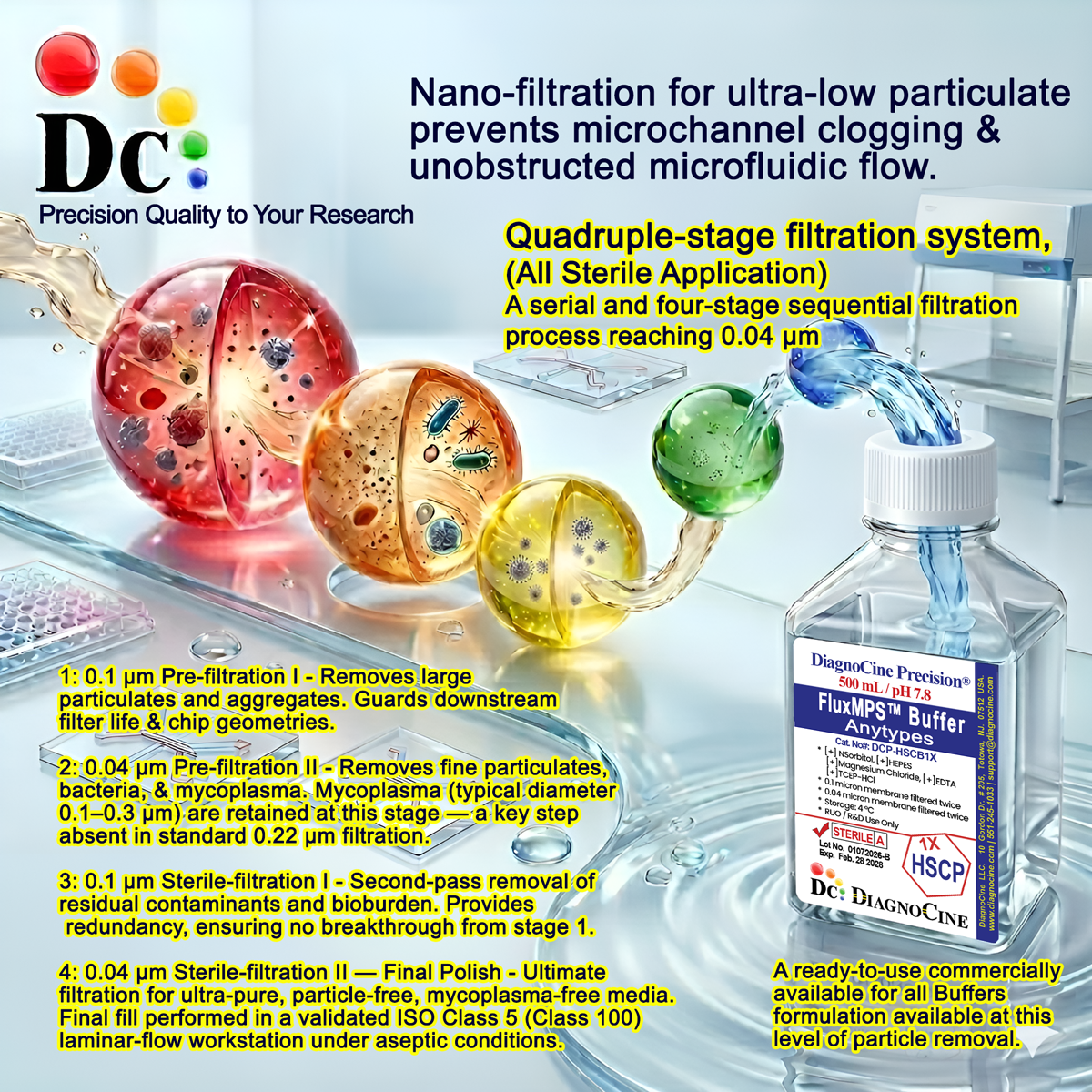
The source states one sterility specification for the whole category: filtered 0.1 micron twice and 0.04 micron twice, in a sterile environment. The four stages below are that statement, in order.
-
1
0.1 µm Pre-filtration I
First pass through a 0.1 micron membrane, removing bulk particulates carried in from raw materials and dissolution.
-
2
0.04 µm Pre-filtration II
Second pass at 0.04 micron, a rating below the 0.1 micron stage that precedes it.
-
3
0.1 µm Sterile-filtration I
Repeat 0.1 micron pass, performed within the sterile environment in which the buffer is filled.
-
4
0.04 µm Sterile-filtration II — final polish
Final 0.04 micron polishing pass immediately before fill, in the same sterile environment.
What the specification buys you at the well
Loading buffer is one of the few reagents that goes into the gel undiluted by anything except the sample itself. Whatever it carries lands at the top of the lane and stays there for the whole run. Four membrane passes ending at 0.04 micron are aimed squarely at that failure mode.
Where each dye runs, and which products carry it
The dye names and product assignments come from the source catalog. The migration figures are published values for the dyes themselves, not Diagnocine specifications — they are approximate, and they shift with agarose percentage and running buffer. Use them to choose a dye, not to size a band.
| Tracking dye | Color | Runs near (1% agarose)[1,2] | TAE / TBE apparent size[3] | What it is good for | Products in this catalog |
|---|---|---|---|---|---|
| Bromophenol blue | Blue | ~300 bp | TAE ~370 bp · TBE ~220 bp | General-purpose front marker; the default for mid-range fragments | DCP-DNALB6X, DCP-GLB10X, DCP-GLNDB6X, DCP-DGLBWD4X |
| Xylene cyanol FF | Blue-green | ~4 kb | TAE ~4,160 bp · TBE ~3,030 bp | Slow second marker; the useful stop signal for multi-kb fragments | DCP-DNALB6X, DCP-GLB10X, DCP-OCLB6X, DCP-YCLB6X, DCP-DGLBWD4X |
| Orange-G | Orange | ~50 bp | TAE and TBE both under 50 bp | Runs ahead of nearly every fragment, so it does not sit on small bands | DCP-OLB6X, DCP-OCLB6X |
| Tartrazine | Yellow | Not stated in source[7] | Not stated in source[7] | Yellow azo tracking dye; a visually distinct alternative to the blue dyes | DCP-YLB6X, DCP-YCLB6X |
| No dye | — | Not applicable | Not applicable | Removes any risk of a dye band co-migrating with the target or interfering with photometric or UV detection[6] | DCP-DGLBWOD4X |
[7] No migration figure for tartrazine is given in the source description, and none was confirmed in the technical references consulted. The cell is left as not stated rather than filled by inference. Request the value from support@diagnocine.com or check the Certificate of Analysis.
Which buffer for which gel
The nine products sort into four dye systems, each appearing once. The first bullet in every panel is the source description's own statement of use; the rest are workflow-level notes drawn from the cited technical references and can be removed independently.
- Preparing nucleic acid samples for gel electrophoresis, with visual monitoring of the run, across various gel types and nucleic acid samples
- Routine agarose electrophoresis where the fragment of interest sits between the two dye fronts — roughly 300 bp to 4 kb in 1 % agarose[1,2]
- Restriction digest checks, where a mixed fragment population benefits from two reference marks
- Plasmid and PCR product analysis with a clear run-progress signal at both ends of the range
- DCP-GLB10X at 10X takes the least volume in the reaction; DCP-DGLBWD4X at 4X is the denaturing member of this group
- Preparing nucleic acid samples for gel electrophoresis, with visual monitoring of the run, across various gel types and nucleic acid samples
- Short PCR products and small restriction fragments, where Orange-G at roughly 50 bp stays ahead of the band rather than on it[2,3]
- High-percentage agarose runs resolving fragments below a few hundred base pairs
- DCP-OCLB6X pairs Orange-G with xylene cyanol, giving a fast front and a slow front in one buffer
- Preparing nucleic acid samples for gel electrophoresis, with visual monitoring of the run, across various gel types and nucleic acid samples
- Runs where a yellow front is easier to distinguish against the gel and staining background than the blue dyes
- Labs standardizing on colour-coded loading buffers so that sample sets are visually distinguishable across a multi-lane gel
- DCP-YCLB6X pairs tartrazine with xylene cyanol for a second, slower reference mark
- Preparing nucleic acid samples for gel electrophoresis, with visual monitoring of the run, across various gel types and nucleic acid samples
- DCP-GLNDB6X is the non-denaturing member of the family, carrying bromophenol blue alone — a single, uncluttered front for native runs[4,5]
- DCP-DGLBWOD4X carries no dye, for detection chemistries where a dye band would co-migrate with the target or interfere with photometric or UV readout[6]
- A common pairing: load most lanes with a dyed buffer and the critical lane with the dye-free buffer, then judge run progress from the neighbouring lanes
The other decision in this catalog
Three of the nine products are explicitly named for their gel system. The columns below describe what those two classes of loading buffer do; they are not a statement of Diagnocine formulation, which is on the product page and Certificate of Analysis.
| Non-denaturing | Denaturing | |
|---|---|---|
| Products in this catalog | Gel Loading Non-denaturing Buffer (DCP-GLNDB6X) | Denaturing Gel-Loading Buffer with Dye, (4X) (DCP-DGLBWD4X) Denaturing Gel-Loading Buffer without Dye [4X] (DCP-DGLBWOD4X) |
| Nucleic acid secondary structure | Retained | Disrupted, so migration tracks length[4,5] |
| Typical gel system[4,5] | Native agarose or non-denaturing polyacrylamide | Urea polyacrylamide or denaturing agarose |
| Accurate sizing of single-stranded RNA | cancel Not reliable — structure distorts migration[5] | check_circle Yes |
| Overall RNA quality and integrity check | check_circle Commonly used for this[5] | check_circle Yes |
| Tracking dye supplied | Bromophenol Blue | Bromophenol blue and Xylene cyanol, or no dye |
| Concentration[a] | 6X | 4X |
Frequently asked questions
The questions that come up most often when a bench protocol meets a purchase order.
Technical sources behind the dye and gel-system notes
The source description carries no citation list. The entries below support the statements marked with a superscript above. No DOI is published for these technical documents, so none is shown — none has been invented.
- Sambrook J, Fritsch EF, Maniatis T. (1989). Molecular Cloning: A Laboratory Manual, 2nd edition. Cold Spring Harbor Laboratory Press. — The origin of the dye co-migration figures reproduced in most vendor tables.
- Promega Corporation. Agarose and Polyacrylamide Gels — Technical Reference. — Dye migration in 0.5–1.4 % agarose: xylene cyanol FF approximately 4 kb, bromophenol blue approximately 300 bp, Orange G approximately 50 bp; adapted from Sambrook et al. 1989.
- Thermo Fisher Scientific. Loading Dyes and Buffers for DNA Electrophoresis — dye selection guide. — Apparent size by running buffer: Orange G under 50 bp in TAE and TBE; bromophenol blue approximately 370 bp in TAE and 220 bp in TBE; xylene cyanol FF approximately 4,160 bp in TAE and 3,030 bp in TBE.
- Thermo Fisher Scientific. Agarose Gel Electrophoresis of RNA — protocol and gel loading solution compositions. — Denaturing versus non-denaturing loading solutions, and why a denaturing system is used for RNA.
- Sigma-Aldrich / Merck. Nucleic Acid Electrophoresis — technical protocol. — RNA secondary structure interferes with size-based migration; denaturing conditions are required for accurate sizing, non-denaturing runs for integrity assessment. Also gives a representative non-denaturing gel loading buffer composition.
- Elsevier. Bromophenol Blue — ScienceDirect Topics overview. — Where an oligonucleotide co-migrates with a tracking dye, the dye interferes with UV detection; loading buffer prepared without tracking dyes, or substituted with Orange G, avoids this.
- Diagnocine. Product pages for catalog numbers 94045, 95464, 95482, 95484, 95483, 95485, 94319, 93519, and 93471. — Source of the published product titles and concentration tokens cross-checked against the source catalog.