



Denaturing Gel-Loading Buffer without Dye [4X]
FluxMPS™ Denaturing Gel-Loading Buffer without Dye [4X]
An MPS-grade, formamide- and EDTA-based denaturing gel-loading buffer supplied as a 4X concentrate for ssDNA, DNA, and RNA electrophoresis. Prepared from DEPC-treated Ultrapure Type 1 water processed through DiagnoCine's quadruple-stage filtration architecture, then terminally sterile-filtered, this dye-free formulation is engineered for microchannel-safe, low-background molecular biology workflows.
- Ultrapure Type 1 water base processed through DiagnoCine's quadruple-stage filtration architecture (0.1 µm membrane twice and 0.04 µm membrane twice), helping prevent mycoplasma contamination
- Finished buffer terminally sterile-filtered through a 0.22 µm membrane once
- Formamide-based formulation denatures secondary structure in ssDNA, DNA, and RNA for denaturing agarose or PAGE electrophoresis
- Contains EDTA to chelate divalent metal ions (Ca2+, Mg2+) and inhibit metal-dependent nuclease activity
- Dye-free formulation — contains no SDS, bromophenol blue, or xylene cyanol
- No detectable DNase or RNase activity after 18 hr incubation at room temperature
- Supplied as 5 x 1 mL (4X), supporting 500 loadings (10 µl buffer + 30 µl sample = 40 µl/well)
- Custom concentrations, pH, and additive formulations available on request
- Concentration4X
- AppearanceClear, colorless liquid
- Dye ContentNone (dye-free)
- Key DenaturantFormamide
- Chelating AgentEDTA
- SterilityFiltered 0.22 µm membrane once
- DNase ActivityNone detected (18 hr, RT)
- RNase ActivityNone detected (18 hr, RT)
- Storage-20°C
- Shelf Life3 years
Engineered where standard loading buffers fall short
Conventional 0.22 µm-filtered loading buffers, unpurified water sources, and dye-laden formulations can introduce subvisible particulate, nuclease contamination, and optical background into sensitive nucleic acid workflows. FluxMPS™ addresses each failure mode directly.
Microchannel-safe purity
Ultrapure Type 1 water base processed through a quadruple-stage filtration architecture (0.1 µm x2, 0.04 µm x2) minimizes particulate carried into downstream gel or chip-based workflows.
Verified nuclease-free
No detectable DNase or RNase activity after 18 hr incubation with plasmid DNA and ribosomal RNA at room temperature, protecting sample integrity during denaturation and loading.
Ultrapure-grade water
DEPC-treated Ultrapure Type 1 water forms the buffer base, reducing background nuclease activity before it can affect ssDNA, DNA, or RNA samples.
Dye-free, low-background formulation
Free of SDS, bromophenol blue, and xylene cyanol, leaving downstream detection, blotting, or imaging steps unobstructed by tracking dye chemistry.
Defined denaturing chemistry
Formamide denatures secondary structure in ssDNA, DNA, and RNA, while EDTA chelates Ca2+ and Mg2+ to inhibit metal-dependent nucleases during handling.
Customization on demand
Alternate concentrations, additional chemicals, compounds, proteins, supplements, or pH adjustments are available on request.
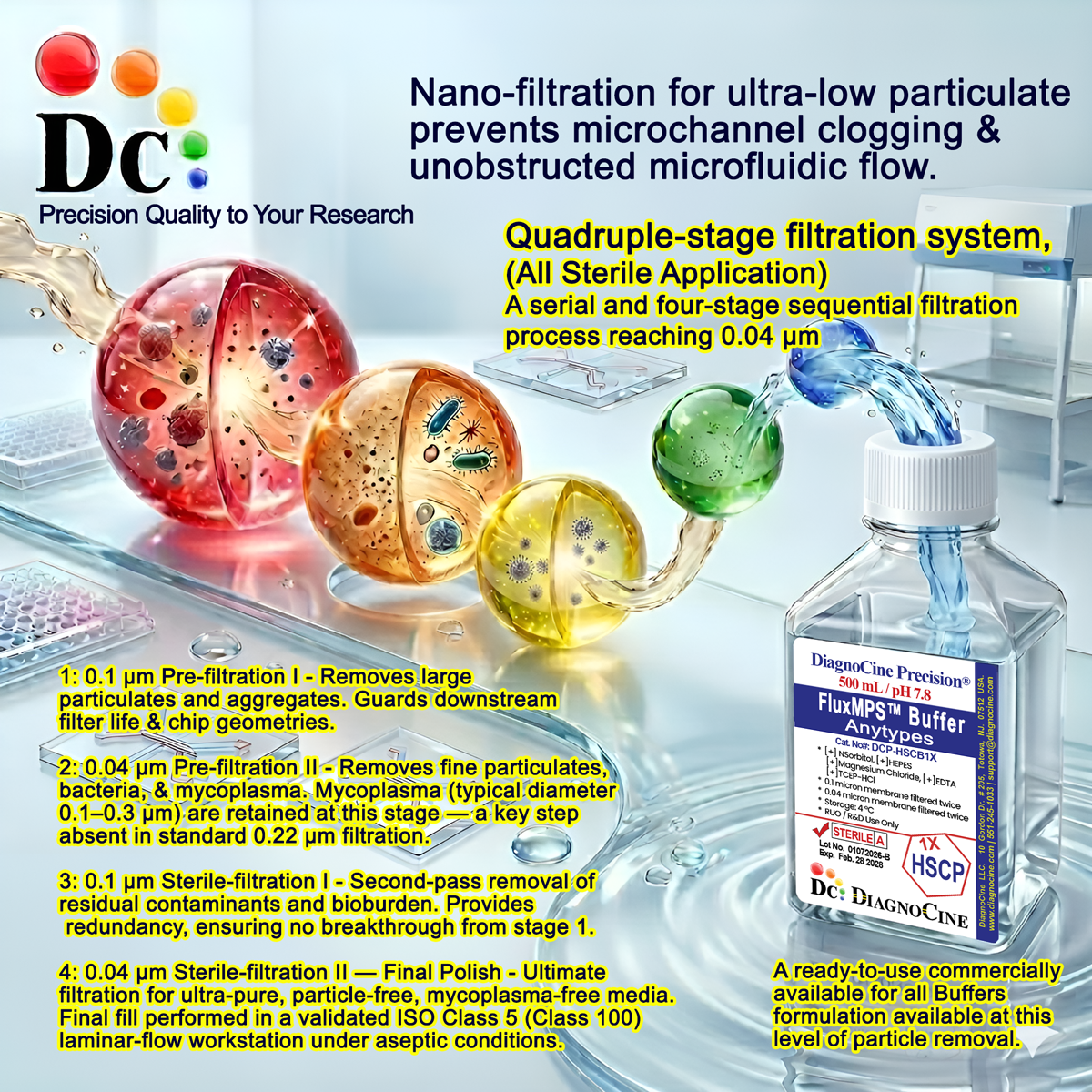
Quadruple-stage filtration system
The DEPC-treated Ultrapure Type 1 water used to prepare this buffer is processed through DiagnoCine's quadruple-stage filtration architecture — filtered through a 0.1 µm membrane twice and a 0.04 µm membrane twice — before compounding, helping prevent mycoplasma contamination during manufacturing.
-
1
0.1 µm Pre-filtration I
Removes large particulate and aggregates from the Ultrapure Type 1 water base, extending downstream filter life.
-
2
0.04 µm Pre-filtration II
Retains fine particulates and bioburden prior to buffer compounding.
-
3
0.1 µm Sterile-filtration I
Second-pass redundancy through a 0.1 µm membrane.
-
4
0.04 µm Sterile-filtration II — Final Polish
Ultimate polish of the water base prior to compounding, supporting a controlled aseptic fill.
Performance vs. conventional loading buffer
Sequential 0.1 µm and 0.04 µm filtration of the water base removes finer particulates than a single 0.22 µm pass, supporting cleaner denaturing electrophoresis workflows.
© Diagnocine® — DCP-DGLBWOD4X
Where FluxMPS™ DCP-DGLBWOD4X is used
Formulated for denaturing agarose or polyacrylamide gel electrophoresis (PAGE) of ssDNA, DNA, and RNA, this dye-free 4X loading buffer supports downstream nucleic acid analysis from a range of cell and tissue models, including MPS and organ-on-a-chip workflows.
Automated Bioreactors & Robotics
An optional 0.01 µm (10 nm) ultra-filtered variant of the water base is available for laboratories automating nucleic acid sample handling on robotic liquid handlers and integrated bioreactor platforms.
- Total Particulate Exclusion — supports valve and channel longevity in automated systems
- Valve & Sensor Protection — reduces particulate-driven fouling of microfluidic hardware
- Extended Perfusion Stability — supports consistent performance across long automated runs
Inquiry Required: contact support@diagnocine.com to request the 0.01 µm ultra-filtered water variant.
Micro Physiological System (MPS) & Chip
Denatures ssDNA, DNA, and RNA extracted from chip-based cultures for downstream size-based analysis by gel electrophoresis.
Nucleic Acid Denaturation & Loading
Increases sample density for well loading while maintaining denatured ssDNA, DNA, or RNA conformation prior to electrophoresis.
iPSC-Derived Model Transcript Analysis
Supports denaturing gel analysis of RNA derived from iPSC-derived neuron, cardiomyocyte, and hepatocyte cultures.
Endothelial & Primary Cell Nucleic Acid Work
Denatures nucleic acids from endothelial and primary hepatocyte perfusion samples for gel-based size resolution.
Blotting Workflows
Dye-free formulation resolves samples by size ahead of Southern or Northern blotting without interfering tracking-dye chemistry.
RNA Integrity Verification
Supports gel-based RNA integrity checks that validate samples prior to downstream imaging or biosensor-based assays.
Physical, chemical & quality parameters
Specifications reflect the documented properties of DCP-DGLBWOD4X as described in product records.
| Parameter | Specification |
|---|---|
| Formulation / Composition | Formamide-based denaturing buffer with EDTA, no dye |
| Concentration | 4X |
| Appearance | Clear, colorless liquid |
| Parameter | Specification |
|---|---|
| Sterility USP <71> | Filtered 0.22 µm membrane once |
| DNase Activity | None detected (18 hr incubation with plasmid DNA, room temperature) |
| RNase Activity | None detected (18 hr incubation with ribosomal RNA, room temperature) |
| Water Quality | DEPC-treated Ultrapure Type 1 water |
| Manufacturing Standard ISO 13485:2016 | ISO 13485:2016 aligned manufacturing |
| Parameter | Specification |
|---|---|
| Storage Temperature | -20°C (keep cold at all times) |
| Shelf Life | 3 years |
| Packaging | 5 x 1 mL (500 loadings: 10 µl buffer + 30 µl sample = 40 µl/well) |
| Parameter | Specification |
|---|---|
| Raw Material Grade | DEPC-treated Ultrapure Type 1 water; formamide; EDTA |
| Manufacturing QMS | ISO 13485:2016 |
| Dye Content | None (no SDS, bromophenol blue, or xylene cyanol) |
| Intended Use | Research Use Only (RUO) |
| Customization | Available on request (concentration, pH, additives) |
Full composition
Key formulation components as documented for DCP-DGLBWOD4X. This 4X concentrate contains no tracking dyes.
| Component | CAS Number | Concentration |
|---|---|---|
| Formamide | 75-12-7 | Not disclosed (proprietary formulation) |
| EDTA (Ethylenediaminetetraacetic acid) | 60-00-4 | Not disclosed (proprietary formulation) |
| DEPC-treated Ultrapure Water (Type 1) | 7732-18-5 | Carrier / solvent base |
Manufacturing & compliance
DCP-DGLBWOD4X is manufactured under a quality system aligned to ISO 13485:2016, with nuclease testing and multi-stage water purification built into the production process.
ISO 13485:2016 QMS
Manufactured under a quality management system aligned to ISO 13485:2016.
Ultrapure Type 1 Water
DEPC-treated Ultrapure Type 1 water forms the buffer base, processed through the quadruple-stage filtration architecture.
Nuclease-Verified Production
Each lot is tested for DNase and RNase activity after 18 hr incubation at room temperature.
Micro-Batch Precision
Supplied as 5 x 1 mL vials, supporting precise, low-waste denaturing electrophoresis workflows.
DNase Activity
None detected after 18 hr incubation with plasmid DNA at room temperature.
RNase Activity
None detected after 18 hr incubation with ribosomal RNA at room temperature, using DEPC-treated Ultrapure Water Type 1.
Sterility
Filtered through a 0.22 µm membrane once.
Documentation / CoA
Certificate of Analysis available on request.
How DCP-DGLBWOD4X compares
A comparison of the FluxMPS™ water purification architecture against conventional loading buffer manufacturing.
| Parameter | DCP-DGLBWOD4X (FluxMPS™) | Conventional Buffer (0.22 µm filtered) | Standard Alternative (0.22 µm filtered) |
|---|---|---|---|
| Dye-free formulation | check_circle | cancel | cancel |
| Water base filtration stages | 4 (0.1 µm x2, 0.04 µm x2) | 1 (0.22 µm) | 1 (0.22 µm) |
| Final buffer sterility filtration | 0.22 µm once | 0.22 µm once | 0.22 µm once |
| DNase/RNase verified nuclease-free | check_circle | cancel | cancel |
| Manufacturing QMS | ISO 13485:2016 | Not specified | Not specified |
| Microfluidic channel compatibility | check_circle | cancel | cancel |
| Custom formulation available | check_circle | cancel | cancel |
Frequently asked questions
Common questions about DCP-DGLBWOD4X.
Supporting literature
Selected literature relevant to formamide-based denaturation, EDTA chelation, and nucleic acid electrophoresis workflows.
- Sambrook J, Russell DW. Molecular Cloning: A Laboratory Manual, 3rd ed. Cold Spring Harbor Laboratory Press; 2001.
- Duyk GM, Kim S, Myers RM, Cox DR. Exon trapping: a genetic screen to identify candidate transcribed sequences in cloned mammalian genomic DNA. Proc Natl Acad Sci USA. 1990;87(22):8995-8999. doi:10.1073/pnas.87.22.8995
- Lehninger AL, Nelson DL, Cox MM. Lehninger Principles of Biochemistry. W.H. Freeman; various editions.
- Ausubel FM, et al. Current Protocols in Molecular Biology. John Wiley & Sons.
- Blake RD, Delcourt SG. Thermal stability of DNA. Nucleic Acids Res. 1998;26(14):3323-3332. doi:10.1093/nar/26.14.3323
- Masters JR. Interpretation of mycoplasma contamination and quality assurance in cell culture reagents. Nat Rev Cancer. 2002;2(4):315-319. doi:10.1038/nrc775
- Bhadra S, Ellington AD. Design and application of cotranscriptional non-enzymatic RNA circuits and signal transducers. Nucleic Acids Res. 2014;42(7):e58. doi:10.1093/nar/gku074
- Bhattacharya A, et al. Organ-on-a-chip platforms for molecular analysis of tissue-specific gene expression. Lab Chip. 2020;20(3):469-486. doi:10.1039/C9LC01185D
- Andries O, et al. Comparison of dendrimer nanoparticles and modified lipoplexes for the delivery of RNA. RNA. 2013;19:1-13.