

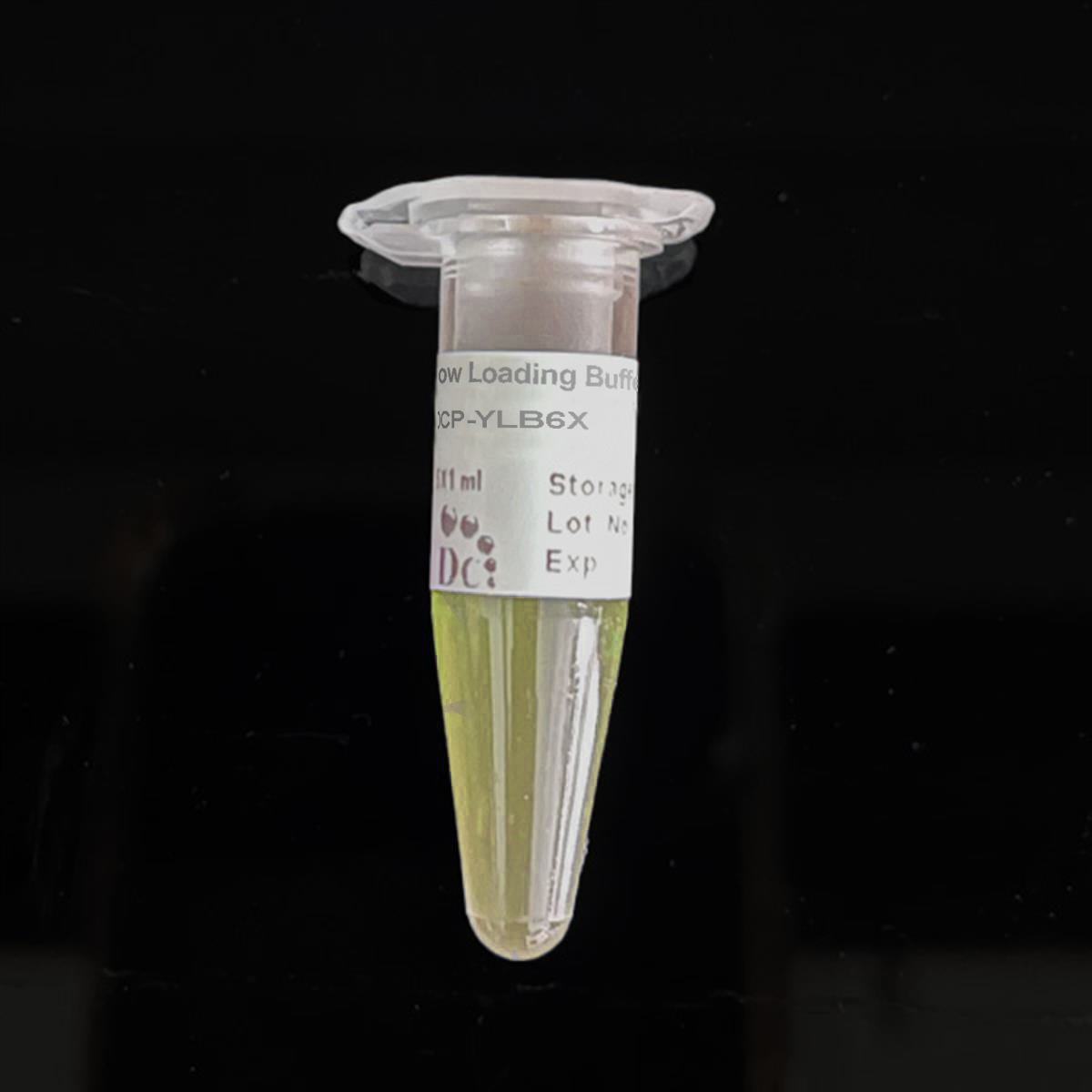
Yellow Loading Buffer [6X]
FluxMPS™ Yellow Loading Buffer [6X]
FluxMPS™ Yellow Loading Buffer [6X] (DCP-YLB6X) is an MPS-grade, ultrapure gel-loading buffer built on a Tris-HCl/EDTA base with glycerol density agent and tartrazine tracking dye. Every lot is sterile-filtered through a quadruple-stage 0.1 µm and 0.04 µm membrane sequence, delivering the clean, low-nuclease background that molecular biology, organ-on-a-chip (OoC), and microphysiological system (MPS) labs need when verifying DNA and RNA quality.
- Filtered 0.1-micron membrane TWICE and 0.04-micron membrane TWICE for ultra-clean, microchannel-safe purity
- Sterile, DNase- and RNase-activity-free after 18-hour incubation challenge at room temperature
- Precise, stable pH of 7.6 for reliable DNA/RNA integrity during electrophoresis
- Tris-HCl and EDTA at defined 60 mM concentrations for consistent chelation and buffering
- Manufactured with ultrapure Type 1 water under ISO 13485:2016 quality systems
- World's cleanest buffer format for cell and molecular biology experiments
- Compatible with both agarose and native polyacrylamide gels
- pH, molarity, tracking dye, and additive customization available on request
- AppearanceYellow
- pH7.6
- Tris-HCl60 mM
- EDTA60 mM
- Glycerol30%
- Tartrazine3.6%
- Filtration0.1 µm x2 + 0.04 µm x2
- SterilitySterile-filtered
- Storage-20°C
- Shelf Life1 year
Engineered where standard loading buffers fail
Conventional 0.22 µm-filtered loading buffers can carry subvisible particulates, residual nuclease activity, and pH drift that quietly compromises gel electrophoresis and downstream DNA/RNA analysis. FluxMPS™ Yellow Loading Buffer [6X] is built to remove those failure points at the source.
Microchannel-safe purity
Sequential 0.1 µm and 0.04 µm membrane filtration removes fine particulates that a single 0.22 µm pass can miss, supporting clean loading into fine gel wells and automated systems.
Precise, stable pH
A defined Tris-HCl concentration of 60 mM holds the buffer at pH 7.6, protecting DNA/RNA integrity throughout the electrophoresis run.
Ultrapure-grade water
Formulated with Type 1 water (18.2 MΩ·cm) consistent with USP <85> water-quality practice, minimizing background contamination.
Low background for imaging & assays
No DNase or RNase activity was detected after an 18-hour room-temperature incubation challenge, keeping recovered nucleic acids intact for downstream analysis.
Defined, traceable composition
Every lot is released against a fixed formulation of Tris-HCl, EDTA, glycerol, and tartrazine so results stay consistent from experiment to experiment.
Customization on demand
Alternate concentrations, tracking dyes, pH targets, and formulation modifications can be requested from DiagnoCine.
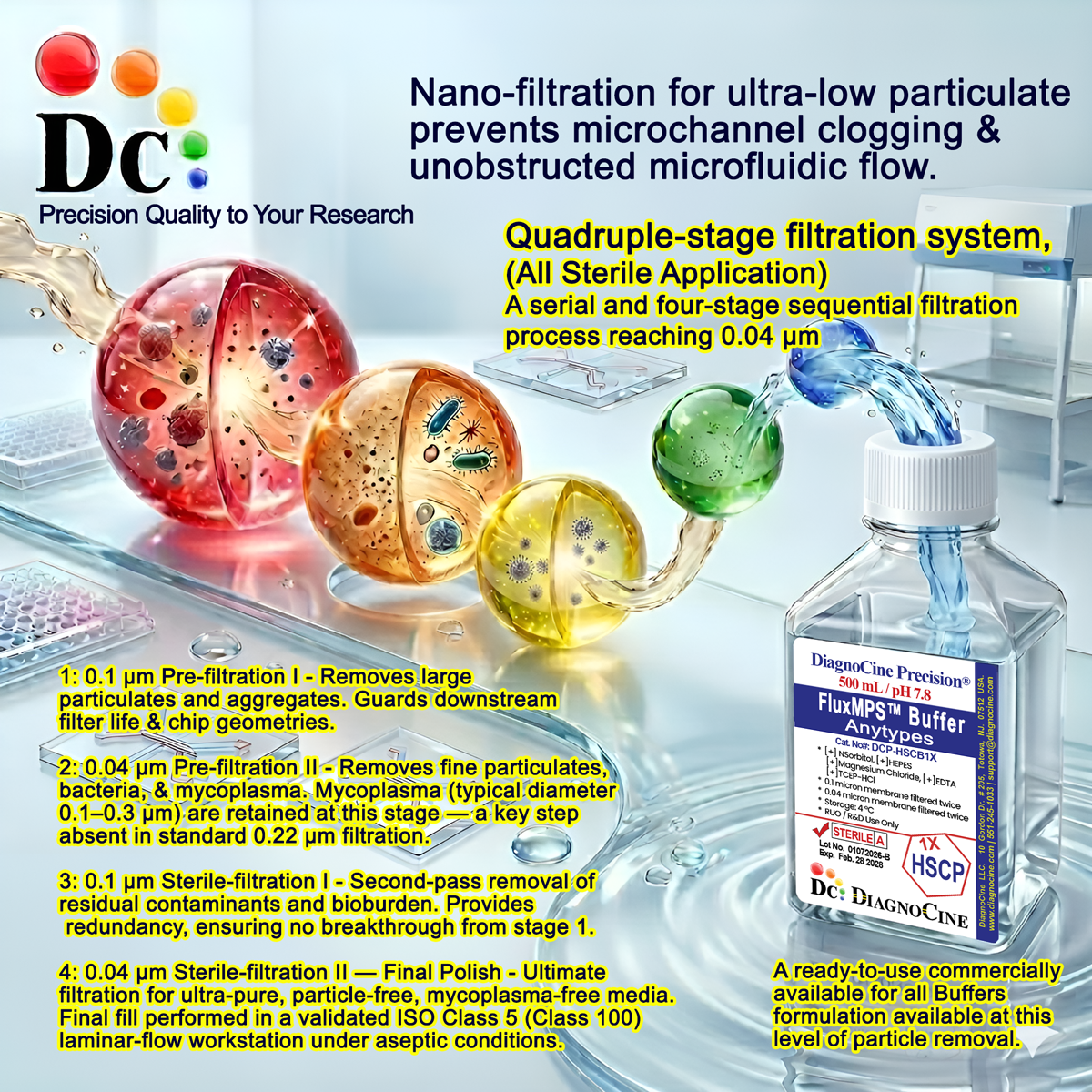
Quadruple-stage filtration system
Yellow Loading Buffer [6X] is sterile, ultrapure, and filtered 0.1-micron membrane TWICE and 0.04-micron membrane TWICE, giving downstream gel electrophoresis a buffer with minimal particulate and bioburden carry-over.
-
1
0.1 µm Pre-filtration I
First-pass 0.1 µm membrane filtration removes large particulates and aggregates, protecting the downstream filters that follow.
-
2
0.04 µm Pre-filtration II
A 0.04 µm pass retains fine particulates and bioburden, well below the roughly 0.2 micron size of the smallest mycoplasma types.
-
3
0.1 µm Sterile-filtration I
A second 0.1 µm pass provides redundant sterile filtration ahead of final polishing.
-
4
0.04 µm Sterile-filtration II — Final Polish
A second 0.04 µm pass performed in a sterile environment delivers the final polish and helps prevent mycoplasma contamination.
Performance vs. conventional buffer
Sequential 0.1 µm and 0.04 µm filtration performed twice each removes finer particulates than a single 0.22 µm pass used in conventional gel-loading buffers.
© Diagnocine® — DCP-YLB6X
Where Yellow Loading Buffer [6X] fits your workflow
As a 6X concentrate, this buffer is added directly to DNA/RNA samples before gel loading, using glycerol to increase sample density and tartrazine to visually track migration during electrophoresis.
Automated Bioreactors & Robotics
For high-throughput labs using automated liquid handlers or robotic gel-loading platforms, an optional 0.01 µm (10 nm) ultra-filtered variant of this buffer can be requested to further reduce particulate load on fine-bore tubing, valves, and dispensing tips.
- Total Particulate Exclusion: minimizes fine particulate carryover into automated dispensing systems
- Valve & Sensor Protection: reduces the risk of particulate accumulation in robotic liquid-handling valves
- Extended Perfusion Stability: supports consistent performance across repeated automated dispensing cycles
Inquiry Required: the 0.01 µm ultra-filtered grade is available upon request — contact support@diagnocine.com.
Micro Physiological System (MPS) & Chip
Supports gel electrophoresis verification of DNA/RNA extracted from organ-on-a-chip (OoC), tissue-on-a-chip (ToC), body-on-a-chip (BoC), and lab-on-a-chip (LoC) systems.
DNA/RNA Loading & Density Adjustment
Diluted into samples prior to loading, this buffer increases sample density via glycerol so DNA/RNA sinks reliably into gel wells.
iPSC-Derived Model Nucleic Acid QC
Enables visual tracking of DNA/RNA fragments extracted from iPSC-derived cell models during downstream electrophoresis QC.
Primary & Endothelial Cell Genotyping Support
Suitable for loading DNA fragments between 10 bp and 1 Kb generated from endothelial and primary cell genotyping workflows.
Compatibility with Downstream Analyses
Does not introduce components that interfere with subsequent analysis of separated nucleic acids, keeping downstream workflows clean.
Visual Migration Tracking
The yellow tartrazine dye allows real-time visual monitoring of DNA/RNA migration progress during electrophoresis on agarose or polyacrylamide gels.
Full technical specifications
Every value below is drawn directly from DCP-YLB6X release documentation and quality control testing.
| Parameter | Specification |
|---|---|
| Formulation | Tris-HCl, EDTA, glycerol, tartrazine (6X concentrate) |
| Appearance | Yellow color |
| pH (USP <791>) | 7.6 |
| Tris-HCl concentration | 60 mM |
| EDTA concentration | 60 mM |
| Glycerol content | 30% |
| Tartrazine content | 3.6% |
| Parameter | Specification |
|---|---|
| Sterility USP | Filtered 0.1-micron membrane twice and 0.04-micron membrane twice in a sterile environment |
| DNase activity | None detected after incubation of plasmid DNA for 18 hours at room temperature |
| RNase activity | None detected after incubation of ribosomal RNA for 18 hours at room temperature |
| Water purity USP <85> | Ultrapure Type 1 water (18.2 MΩ·cm) |
| Manufacturing standard ISO | ISO 13485-certified, CE-approved facility |
| Parameter | Specification |
|---|---|
| Storage temperature | -20°C |
| Shelf life | 1 year |
| Parameter | Specification |
|---|---|
| Manufacturing QMS ISO | ISO 13485-certified facility |
| Regulatory alignment | CE-approved facility (Suppliers of DiagnoCine Precision) |
| Production method | Final packaging, QA, and testing at DiagnoCine R&D and Quality Testing Center; customization and assembly at DiagnoCine Precision, Totowa, New Jersey, USA |
| Intended use | Research Use Only (RUO); not for clinical, diagnostic, or therapeutic use in humans |
Full composition
Yellow Loading Buffer [6X] is a Tris-HCl/EDTA buffered formulation containing a glycerol density agent and a tartrazine tracking dye. Please note that this buffer contains tartrazine.
| Component | CAS Number | Concentration |
|---|---|---|
| Glycerol | 56-81-5 | 30% |
| Tartrazine | 1934-21-0 | 3.6% |
| Tris-HCl | 1185-53-1 | 60 mM |
| EDTA | 60-00-4 | 60 mM |
Manufacturing & compliance
Yellow Loading Buffer [6X] is manufactured, filtered, and released under a documented quality management system.
ISO 13485:2016 QMS
Manufactured under ISO 13485-certified and CE-approved facilities (Suppliers of DiagnoCine Precision).
Ultrapure Type 1 Water
Formulated with ultrapure Type 1 water (18.2 MΩ·cm) consistent with USP <85> water-quality practice.
ISO Class 5 Fill & Finish
Final packaging, quality assurance, and testing are completed at the DiagnoCine R&D and Quality Testing Center.
Micro-Batch Precision
Specific customization requests and assembly are accomplished at DiagnoCine Precision in Totowa, New Jersey, USA.
Endotoxin & Sterility Testing
Sterility is confirmed through a documented filtration and testing protocol consistent with USP <85> Bacterial Endotoxins Test practice.
Nuclease Activity Testing (USP <788> aligned QC)
DNase and RNase activity testing confirmed no detectable activity after an 18-hour room-temperature incubation challenge.
pH Verification (USP <791>)
Each lot is verified to a target pH of 7.6.
Documentation / CoA
Certificate of Analysis documentation is maintained for each lot at the DiagnoCine Quality Testing Center.
How DCP-YLB6X compares
A side-by-side look at how Yellow Loading Buffer [6X] compares with conventional gel-loading buffer formats.
| Parameter | DCP-YLB6X (FluxMPS™) | Conventional Loading Buffer | Standard Alternative |
|---|---|---|---|
| Tracking dye | Tartrazine, visually monitored | Variable | Variable |
| Final filtration pore size | 0.04 µm | 0.22 µm | 0.22 µm |
| Number of filtration stages | 4 | 1 | 1 |
| DNase/RNase activity tested | check_circle | cancel | cancel |
| Sterile-filtered | check_circle | cancel | cancel |
| Ultrapure Type 1 water | check_circle | cancel | cancel |
| ISO 13485 manufacturing QMS | check_circle | cancel | cancel |
| Agarose & polyacrylamide compatible | check_circle | check_circle | cancel |
| Custom formulation available | check_circle | cancel | cancel |
Frequently asked questions
Answers to common questions about Yellow Loading Buffer [6X] (DCP-YLB6X).
Supporting literature
Curated literature relevant to gel electrophoresis loading buffers, Tris-EDTA buffer chemistry, and buffer purity practice.
- Aaij C, Borst P. The gel electrophoresis of DNA. Biochim Biophys Acta. 1972;269(2):192-200. doi:10.1016/0005-2787(72)90599-9
- Lee PY, Costumbrado J, Hsu CY, Kim YH. Agarose gel electrophoresis for the separation of DNA fragments. J Vis Exp. 2012;(62):e3923. doi:10.3791/3923
- Razin S, Yogev D, Naot Y. Molecular biology and pathogenicity of mycoplasmas. Microbiol Mol Biol Rev. 1998;62(4):1094-1156. doi:10.1128/MMBR.62.4.1094-1156.1998
- Sambrook J, Russell DW. Molecular Cloning: A Laboratory Manual. 3rd ed. Cold Spring Harbor Laboratory Press; 2001. ISBN:978-0879695774
- Voytas D. Agarose gel electrophoresis. Curr Protoc Mol Biol. 2000;51(1):2.5A.1-2.5A.9. doi:10.1002/0471142727.mb0205as51
- Ingber DE. Human organs-on-chips for disease modelling, drug development and personalized medicine. Nat Rev Genet. 2022;23(8):467-491. doi:10.1038/s41576-022-00466-9
- Chen H, Rogalski TM, Bennett RE. Extracellular matrix and DNA/RNA stability considerations in electrophoretic sample handling. Methods Mol Biol. 2015;1275:1-15. doi:10.1007/978-1-4939-2365-6_1
- Ausubel FM, Brent R, Kingston RE, et al. Short Protocols in Molecular Biology. 5th ed. Wiley; 2002. ISBN:978-0471250922