.jpg "/Content/Upload/Product/Human_ELISA_kits_Diagnocine_1200_1200(232).jpg")
Human macrophage stimulating protein,MSP ELISA Kit
The Ultimate 1-Stop ELISA Marketplace:
60,000+ ELISA kits Available to Serve Scientists from All Fields of Life Science
Always Powered by Diagnocine for Precision Research.
Most comprehensive buffers, reagents and detection agents are provided with each kit to optimize data output.
All-inclusive format covers everything from sample preparation to signal detection. Every step can be customized and optimized for your precision research.
DiagnoCine Precision buffers and reagents are Made in USA ISO 13485 Certified
Why waste time searching for your ELISA kit when you can get everything in one place? Diagnocine can provide you with all the ELISA needs you have (customized ELISAs also available) on the planet through a single, streamlined ordering process.
* all types of species
* HRP and AP detection
* Low target signal enhancement
* Inquire about a trial version or a customized version
4 core reagents below are included with every order, plus 1 of the 2 detection-specific reagents (matched automatically to your kit type) — 5 components, every time.
+ the 5th component, matched to your kit's detection method:
If you have any questions or need additional information, please call us at 551-245-1033 or email us at support@diagnocine.com. Our team will be happy to assist you.
Universal Compatibility
All buffers and detection reagents work seamlessly across target proteins, bridging the gap in assay consistency.
1-Stop Convenience
Consolidate your lab's purchasing. Source all ELISA needs and experience optimal buffers and reagents in a single shipment.
Enhanced Precision
Designed by scientists for scientists, all components are engineered to deliver sharper results and an optical signal.
Human macrophage stimulating protein,MSP ELISA Kit
Sandwich quantitative immunoassay for macrophage stimulating 1 (hepatocyte growth factor-like) in human serum, plasma, tissue homogenates available in multiple catalog sizes:
Note: Please send inquiries regarding Trial 24T orders to support@diagnocine.com.
| Target name | macrophage stimulating 1 (hepatocyte growth factor-like) |
| Uniprot No. | P26927 |
| Species | Homo sapiens (Human) |
| Sample types | serum, plasma, tissue homogenates |
| Detection range | 0.156 ng/mL-10 ng/mL |
| Sensitivity | 0.039 ng/mL |
| Assay time | 1-5h |
| Sample loading volume | 50-100μL |
| Detection wavelength | 450 nm |
| Assay principle | Sandwich (Quantitative) |
| Data analysis | Standard curve + Curve Expert software |
| Research area | Immunology |
| Storage condition | 2-8°C (see protocol for full details) |
| Shipping condition | 4 °C |
| Shelf life | 6 months |
10 business days
Processing + 3-5 days shipping
In Stock : USA
Worldwide shipping available
Antibody capture
450 nm detection
Standard curve
Quantification
In this sandwich ELISA, macrophage stimulating 1 (hepatocyte growth factor-like) in the sample is captured between a pre-coated capture antibody and a detection antibody. Signal intensity is proportional to analyte concentration. Quantification uses a standard curve fitted with Curve Expert software, covering 0.156 ng/mL-10 ng/mL with a minimum detectable dose of 0.039 ng/mL.
This Human MST1 ELISA Kit was designed for the quantitative measurement of Human MST1 protein in serum, plasma, tissue homogenates . It is a Sandwich ELISA kit, its detection range is 0.156 ng/mL-10 ng/mL and the sensitivity is 0.039 ng/mL.
- Cell migration and production of inflammatory cytokines by the brain are enhanced by MSP stimulation in primary microglia. PMID: 18480548
- The five gene transcripts (aldolase B, elafin, MST-1, simNIPhom and SLC6A14) were changed in patients with ulcerative colitis, and were related to the disease activity. PMID: 18700007
- Gene-centric association mapping of chromosome 3p implicates MST1 in IBD pathogenesis. PMID: 19079170
- Results suggest that hepatocyte growth factor activator is a major serum activator of pro-macrophage-stimulating protein. PMID: 19456860
- The effect of BSN-MST1 locus on Crohn's disease predisposition was replicated, but no influence on ulcerative colitis or multiple sclerosis predisposition could be detected PMID: 19657358
- Observational study and genome-wide association study of gene-disease association, gene-environment interaction, and pharmacogenomic / toxicogenomic. (HuGE Navigator) PMID: 20014019
- results suggest that MSP induces uPAR expression via MAPK, AP-1 and NF-kappaB signaling pathways PMID: 21081472
- the oncogenic effect of BRAF(V600E) is associated with the inhibition of MST1 tumor suppressor pathways, and that the activity of RASSF1A-MST1-FoxO3 pathways determines the phenotypes of BRAF(V600E) tumors. PMID: 21249150
- MSP-induced RSK2 activation is a critical determinant linking RON signaling to cellular EMT program. PMID: 21619683
- considerable number of Merkel cell carcinoma cases expressed both RON and MSP, while Merkel cells do not express these molecules PMID: 21723047
- These findings suggest that the MSP/RON signaling pathway may be regulated by hepsin in tissue homeostasis and in disease pathologies, such as in cancer and immune disorders. PMID: 21875933
- Studies indicate that the cylindromatosis/turban tumor syndrome gene (CYLD) ranked highest, followed by acylaminoacyl-peptidase (APEH), dystroglycan (DAG1), macrophage-stimulating protein (MST1) and ubiquitin-specific peptidase 4 (USP4). PMID: 21931648
- the missense SNP impairs MSP function by reducing its affinity to RON and perhaps through a secondary effect on in vivo concentration arising from reduced thermodynamic stability, resulting in down-regulation of the MSP/RON signaling pathway. PMID: 22087277
- HAT cleaves proMSP at the physiological activation site PMID: 22245154
- The present results refine the known genetic architecture in primary sclerosing cholangitis by confirming MST1 locus association. PMID: 22554193
- MSP may be one of the major determinants that affects the properties of tumor stroma and that produces a permissive microenvironment to promote cancer metastasis PMID: 23011677
- Results suggest that the [AA] genotype of the common MST1 variant rs3197999 enhances genetic risk of sporadic extrahepatic cholangiocarcinoma irrespective of primary sclerosing cholangitis status. PMID: 23422030
- Mst1 has an important role in inhibiting the growth of NSCLC in vitro and in vivo; its antiproliferative effect is associated with induction of apoptosis. PMID: 23928732
- functional consequences of the macrophage stimulating protein 689C inflammatory bowel disease risk allele PMID: 24409221
- These results support the hypothesis that the alpha-chain of MSPalphabeta mediates RON dimerization. PMID: 25193665
- MSP appears to promote the migration of fibroblasts, enhances collagen synthesis and remodeling, and effectively improves wound healing. PMID: 25315688
- Identify MST1/MSP as a mitogen for tracheal basal cells. PMID: 25551685
- Elevated serum levels of MST1 were found in subjects with excessive alcohol use. PMID: 25704570
- These data suggest that MSP is an effective inhibitor of inflammation and lipid accumulation in the stressed liver, thereby indicating that MSP has a key regulatory role in non-alcoholic steatohepatitis. PMID: 27609031
Intra-assay Precision (Precision within an assay): CV%<8% | ||||||||||||||||
Three samples of known concentration were tested twenty times on one plate to assess. | ||||||||||||||||
Inter-assay Precision (Precision between assays): CV%<10% | ||||||||||||||||
Three samples of known concentration were tested in twenty assays to assess. | ||||||||||||||||
| Intra-Assay Precision | Inter-Assay Precision | ||||||||||||||
Sample | 1 | 2 | 3 | 1 | 2 | 3 | ||||||||||
n | 20 | 20 | 20 | 20 | 20 | 20 | ||||||||||
Mean(ng/ml) | 1.255 | 1.265 | 1.297 | 1.287 | 1.286 | 1.317 | ||||||||||
SD | 0.038 | 0.043 | 0.035 | 0.044 | 0.044 | 0.053 | ||||||||||
CV(%) | 4.822 | 5.409 | 4.294 | 5.439 | 5.446 | 6.401 | ||||||||||
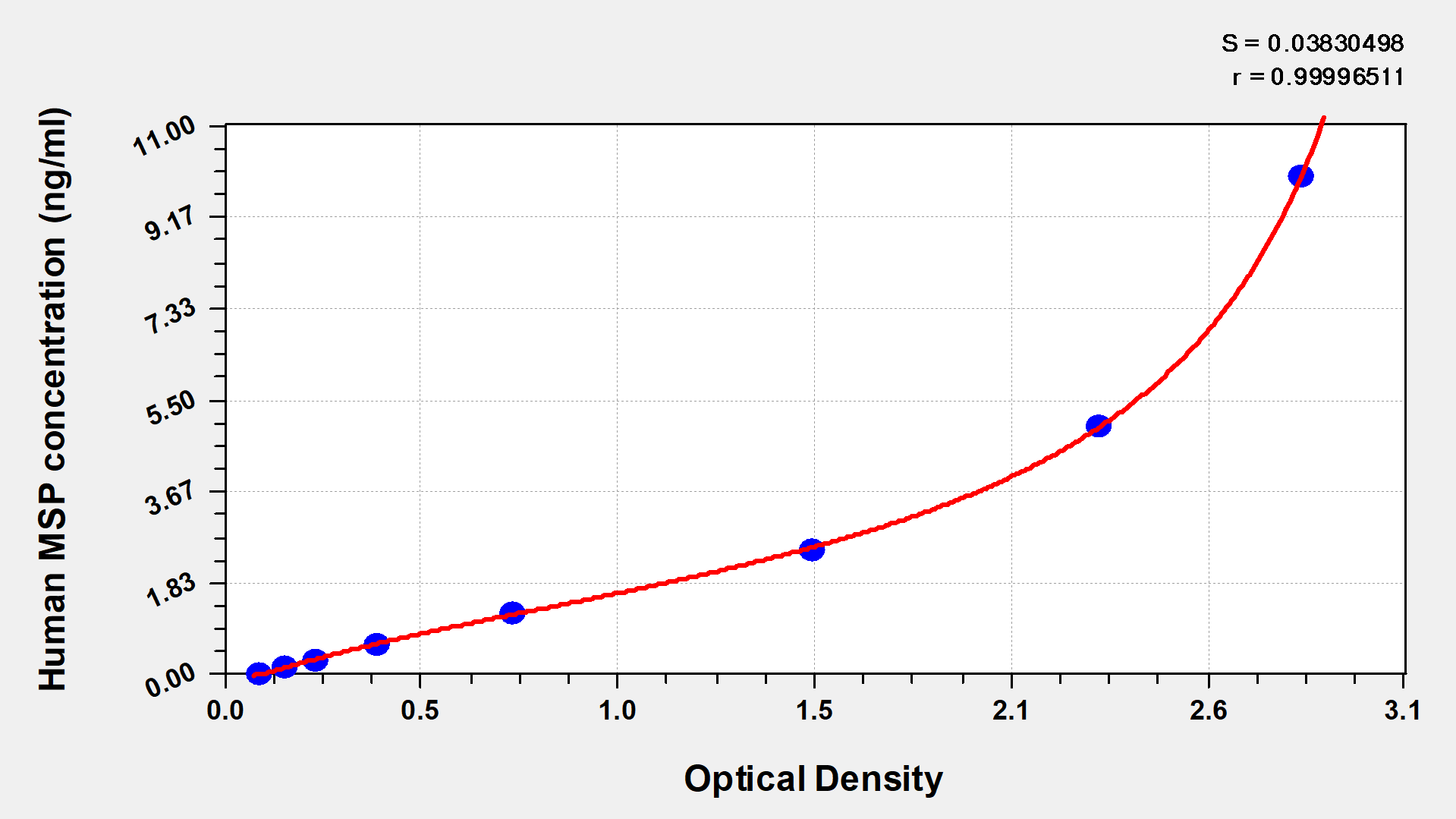
These standard curves are provided for demonstration only. A standard curve should be generated for each set of samples assayed.
| ||||||||||||||||||||
ng/ml | OD1 | OD2 | Average | Corrected | ||||||||||||||||
10 | 2.827 | 2.787 | 2.807 | 2.704 | ||||||||||||||||
5 | 2.314 | 2.254 | 2.284 | 2.181 | ||||||||||||||||
2.5 | 1.511 | 1.566 | 1.539 | 1.436 | ||||||||||||||||
1.25 | 0.745 | 0.773 | 0.759 | 0.656 | ||||||||||||||||
0.625 | 0.412 | 0.402 | 0.407 | 0.304 | ||||||||||||||||
0.312 | 0.250 | 0.242 | 0.246 | 0.143 | ||||||||||||||||
0.156 | 0.167 | 0.171 | 0.169 | 0.066 | ||||||||||||||||
0 | 0.101 | 0.105 | 0.103 |
| ||||||||||||||||
To assess the linearity of the assay, samples were spiked with high concentrations of human MSP in various matrices and diluted with the Sample Diluent to produce samples with values within the dynamic range of the assay. | ||||||||||||||||||
| Sample | Serum(n=4) | ||||||||||||||||
1:20 | Average % | 101 | ||||||||||||||||
Range % | 94-108 | |||||||||||||||||
1:40 | Average % | 105 | ||||||||||||||||
Range % | 99-109 | |||||||||||||||||
1:80 | Average % | 89 | ||||||||||||||||
Range % | 82-96 | |||||||||||||||||
1:160 | Average % | 93 | ||||||||||||||||
Range % | 87-99 | |||||||||||||||||
The recovery of human MSP spiked to levels throughout the range of the assay in various matrices was evaluated. Samples were diluted prior to assay as directed in the Sample Preparation section. | ||||||||||||||||||
Sample Type | Average % Recovery | Range% | ||||||||||||||||
Serum (n=5) | 104 | 97-113 | ||||||||||||||||
EDTA plasma (n=4) | 100 | 95-104 | ||||||||||||||||