

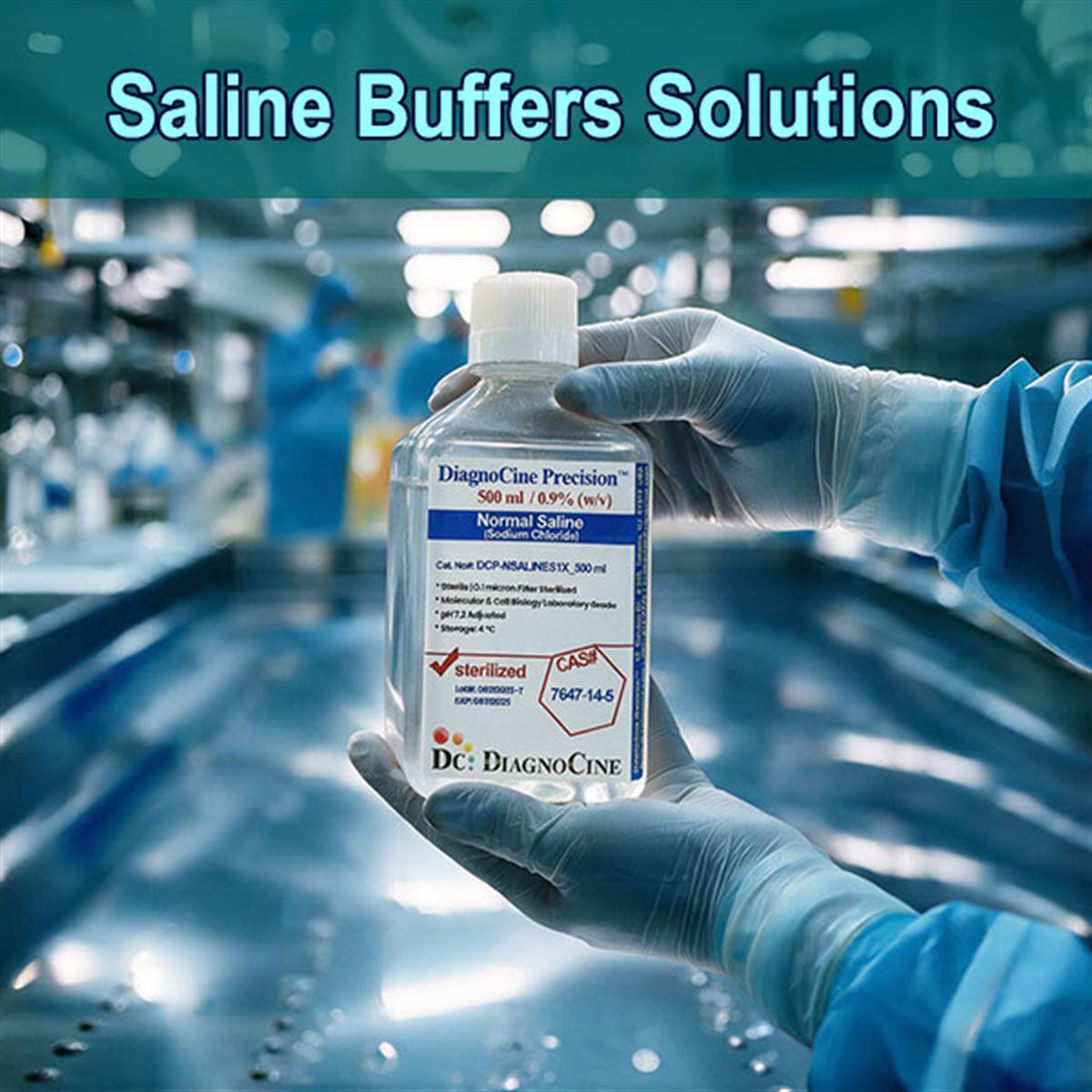
Saline Buffers & Solutions - Category Selection Guide
This is a category page, not a product page — click View on the group you need to reach its own product page. Seventeen catalog numbers across eight product pages; the chemistry and workflow guidance follow below.
| Cat. No. | Concentration | Size |
|---|---|---|
|
Normal Saline Normal Saline (Sodium Chloride), 0.9% (w/v), Sterile 0.9% (w/v) · Sterile · 3 catalog numbers · 500 ml · 1000 ml · 10L
Viewarrow_forward |
||
| DCP-NSALINES1X_500 ml | 0.9% | 500 ml |
| DCP-NSALINES1X_1000 ml | 0.9% | 1000 ml |
| DCP-NSALINES1X_10 L | 0.9% | 10L |
|
Tris-based TBS, 1X (Tris Buffered Saline), Non-Sterile 1X · Non-Sterile · 3 catalog numbers · 500 ml · 1000 ml · 10 L
Viewarrow_forward |
||
| DCP-TBS1X_500ml | 1X | 500 ml |
| DCP-TBS1X_1000ml | 1X | 1000 ml |
| DCP-TBS1X_10 Liter | 1X | 10 L |
|
Tris-based TBS, 10X (Tris Buffered Saline), Non-Sterile 10X · Non-Sterile · 2 catalog numbers · 500 ml · 1000 ml
Viewarrow_forward |
||
| DCP-TBS10X_500 ml | 10X | 500 ml |
| DCP-TBS10X_1000 ml | 10X | 1000 ml |
|
Tris-based TBS, 20X (Tris Buffered Saline), Non-Sterile 20X · Non-Sterile · 2 catalog numbers · 500 ml · 1000 ml
Viewarrow_forward |
||
| DCP-TBS20X_500 ml | 20X | 500 ml |
| DCP-TBS20X_1000 ml | 20X | 1000 ml |
|
Phosphate PBS, 1X (Phosphate Buffered Saline), Sterile 1X · Sterile · 2 catalog numbers · 500 ml · 1000 ml
Viewarrow_forward |
||
| DCP-PBS1X_500ml | 1X | 500 ml |
| DCP-PBS1X_1000ml | 1X | 1000 ml |
|
Phosphate PBS, 10X (Phosphate Buffered Saline), Sterile 10X · Sterile · 3 catalog numbers · 500 ml · 1000 ml · 10 Liter
Viewarrow_forward |
||
| DCP-PBS10X_500 ml | 10X | 500 ml |
| DCP-PBS10X_1000 ml | 10X | 1000 ml |
| DCP-PBS10X_10 Liter | 10X | 10 Liter |
|
Phosphate PBS, 20X (Phosphate Buffered Saline), Sterile 20X · Sterile · 1 catalog number · 500 ml
Viewarrow_forward |
||
| DCP-PBS20X | 20X | 500 ml |
|
HEPES HBS, 1X (HEPES-Buffered Saline), 20mM HEPES, Sterile 1X · 20mM HEPES · Sterile · 1 catalog number
Viewarrow_forward |
||
| DCP-HBS1X | 1X | — |
Not sure which one? Compare the four families · See applications by workflow · Read the FAQ
What this category does, in one paragraph
In biological and medical work, osmotic balance matters as much as pH. Saline buffers and solutions are simple, unbuffered or minimally buffered salt solutions designed to match the osmotic pressure (tonicity) of living cells, keeping them physically intact during handling, rinsing, and delivery.
The attributes that decide which of the eight product pages belongs in your protocol.
- Four chemistries stocked: plain sodium-chloride Normal Saline, Tris Buffered Saline (TBS), Phosphate Buffered Saline (PBS), and HEPES-Buffered Saline (HBS).
- Normal Saline is 0.9% (w/v) NaCl in water — roughly 154 mEq/L each of Na? and Cl?, approximately isotonic with blood plasma, and adjusted to physiological pH so it is non-toxic and does not damage healing tissues.
- TBS holds a narrow, slightly alkaline pH of 7–9. Tris acts as the buffering agent and NaCl regulates tonicity, so the solution can be isotonic or hypertonic depending on the concentration chosen.
- Tris shifts with temperature: the conjugate acid of Tris has a pKa of 8.07 at 25 °C, and the solution pH moves by 0.03 units per degree Celsius.
- PBS here is calcium- and magnesium-free — formulated for rinsing cells before treating them with proteases for dissociation.
- Concentrates and working strengths: TBS and PBS ship at 1X, 10X and 20X; Normal Saline and HBS ship at working strength.
- Sterility is not uniform: Normal Saline, PBS and HBS are Sterile; all three TBS concentrations are Non-Sterile.
- Customization is offered for both Normal Saline and PBS formulations, across a range of cell cultures and laboratory applications.
- Catalog numbers in this category17
- Product pages8
- Normal Saline concentration0.9% (w/v) NaCl
- Normal Saline ionic content~154 mEq/L each of Na? and Cl?
- TBS working pH range7–9 (slightly alkaline)
- Tris conjugate-acid pKa8.07 at 25 °C
- Tris pH shift with temperature0.03 units per °C
- HBS HEPES concentration20mM HEPES
- Concentrations offered (TBS & PBS)1X, 10X, 20X
- PBS water gradeASTM 0.05 µS/cm Type 1 Ultrapure H2O | Deionized
Cell membranes are semi-permeable and highly sensitive to osmotic water movement
Pure water is lethal to isolated cells — it drives hypotonic influx until they burst. What a saline solution supplies, and where a buffered saline becomes the better choice.
Pure water bursts cells
Cell membranes are semi-permeable and highly sensitive to osmotic water movement. Pure water drives hypotonic influx until isolated cells burst, which is why a salt background is the starting point for every rinse, transport, and suspension step.
Osmotic equilibrium
Monovalent ions — chiefly Na? and Cl? — at a concentration that approximates the cytoplasm keep cells morphologically stable. This is the whole job of a plain saline, and it is why 0.9% (w/v) is the reference concentration.
Chemical simplicity
No proteins, vitamins, or reactive amines. That gives a chemically inert background that will not interfere with sensitive assays — the reason saline is preferred over media as a carrier or blank.
Low toxicity
A safe handling environment without introducing complexes that stress cells or alter metabolism. The Normal Saline here is adjusted to physiological pH, making it a non-toxic, isotonic solution that does not damage healing tissues.
When plain saline is not enough
0.9% NaCl is close to isotonic but not a perfect match for intracellular or extracellular fluid. For demanding cell work, balanced salt solutions like PBS, HBSS, or Ringer’s are often preferable — which is why the buffered salines below sit in the same catalog.
pH control has a temperature catch
TBS maintains a narrow, slightly alkaline pH of 7–9. But the conjugate acid of Tris has a pKa of 8.07 at 25 °C and the solution pH shifts by 0.03 units per degree Celsius, so a buffer titrated on the bench is not the buffer you have in the cold room.
Tonicity and buffering are two separate decisions. A plain saline solves osmotic equilibrium and nothing else; a buffered saline adds pH control on top, and each buffering agent brings its own behaviour — Tris drifts with temperature, phosphate is supplied here without calcium and magnesium for protease dissociation work, and HEPES is supplied at a stated 20mM. Choose the tonicity first, then the buffering agent your assay can tolerate.
How 0.9% became the default — and why that is a historical accident
Three steps take saline from a cholera-ward improvisation to the most-used solution on the bench. The last one is the reason the name is misleading.
-
1
1831–1832 Intravenous fluid resuscitation is born
During the European cholera pandemic, William O’Shaughnessy analyzed the salt-depleted blood of cholera victims, and Scottish physician Thomas Latta acted on it, injecting salt-and-bicarbonate solutions intravenously to treat life-threatening dehydration. Important caveat: Latta’s fluids were dilute mixtures of sodium chloride and bicarbonate, bearing little resemblance to modern 0.9% saline.
-
2
1882–1883 The 0.9% figure enters the literature
Dutch physiologist Hartog Jacob Hamburger, using freezing-point and red-cell lysis experiments, concluded that 0.9% NaCl was isotonic with mammalian blood. This became the basis for “normal saline.” However, Hamburger’s conclusion was partly mistaken — he inferred that blood’s salt concentration was ~0.9%, when the true figure is closer to 0.6%.
-
3
Early 20th century Simplicity wins over accuracy
“Normal” or “physiological” saline (0.9% NaCl) became the default IV fluid and lab solution, even as Sydney Ringer’s more physiologically complete solutions (later lactated Ringer’s) existed. 0.9% saline endured for its simplicity, not its physiological accuracy — it is famously neither truly “normal” nor “physiological.”
The four chemistries side by side
Each family’s own specification, exactly as the source states it. Where the source supplies no value for a cell, that is said rather than inferred.
| Family | Buffering agent & tonicity | Purity / QC statements | Sterility & strengths |
|---|---|---|---|
| Normal Saline (Sodium Chloride) | Unbuffered 0.9% (w/v) NaCl; adjusted to physiological pH, so it is non-toxic and isotonic and does not damage healing tissues | The source states no QC panel for this family | Sterile · working strength only |
| Tris-based Buffers (TBS) | Tris acts as the buffering agent and NaCl regulates tonicity, allowing the solution to be isotonic or hypertonic based on the desired concentration; maintains a narrow, slightly alkaline pH of 7–9. Tris conjugate-acid pKa 8.07 at 25 °C, with a 0.03 unit shift per degree Celsius | Protease (−), DNAse (−), RNAse (−), Endonuclease (−). All Reagents Filtered TWICE (2X) through 0.1 micron membrane filters. No mycoplasma. | Non-Sterile · 1X, 10X, 20X |
| Phosphate Buffered Saline (PBS) | A balanced salt solution, supplied without calcium and magnesium for the purpose of rinsing cells before treating them with proteases for dissociation | CaCl2 (−), MgCl2 (−), Protease (−), DNAse (−), RNAse (−), Endonuclease (−). Used ASTM 0.05 µS/cm Type 1 Ultrapure H2O | Deionized. Tissue Culture & Molecular Biology grade. RUO* | R&D use only | Not for human therapeutic use or human consumption | Sterile · 1X, 10X, 20X |
| HEPES-Buffered Saline (HBS) | 20mM HEPES | The source supplies no description for this family beyond its product name | Sterile · 1X |
Which solution for which bench workflow
Select a workflow to see what the source states about it and which family it points to.
- Cell washing and pelleting — rinsing serum, enzymes, or media supplements from cell suspensions during centrifugation and passaging.
- Normal Saline is used for washing cells and for hydration of cells; it is sterile and approximately isotonic with blood plasma, which makes it suitable for gentle cell pelleting and suspension prep.
- PBS is supplied without calcium and magnesium specifically for rinsing cells before treating them with proteases for dissociation.
- Tissue rehydration and dissection — keeping biopsies and sections moist and viable during transport and gross processing.
- Normal Saline is used for pathological works and for treating or transporting tissues; being adjusted to physiological pH, it does not damage healing tissues.
- PBS is listed for transporting cells or tissue.
- Reagent dissolution — a neutral carrier for drugs, small molecules, or dyes in physiological testing.
- Chemical simplicity is the point here: no proteins, vitamins, or reactive amines, giving a background that will not interfere with sensitive assays.
- Normal Saline and PBS are both listed for preparing laboratory reagents; TBS is listed for diluting.
- Clinical and preclinical controls — negative-control matrix or delivery vehicle in animal-model injections.
- Sterile Normal Saline is described as ideal for use as a clean drug-delivery vehicle.
- Normal saline is also used for adjusting electrolyte disturbances.
- Wound and surface irrigation — general rinsing under uniform ionic conditions.
- A general purified NaCl base solution serves as a multi-purpose benchtop carrier for everyday dilutions, reagent blanks, and washing non-cellular hardware under uniform ionic conditions.
- TBS is commonly used as a laboratory reagent for washing, diluting, cell culture processing, Western blotting, ELISA and multiple assays, and immunohistochemistry steps.
- PBS is used for a wide range of applications including cell culture, washing cells, transporting cells or tissue, diluting cells for counting, and preparing other laboratory reagents.
- Where the assay cannot tolerate phosphate, the Tris-based line is the alternative; where it cannot tolerate Tris’s temperature-dependent pH shift, the phosphate line is.
The source’s sodium-chloride saline comparison
Reproduced row-for-row as published. Note that this table covers the sodium-chloride saline products only; the Tris, phosphate and HEPES families are described in the Family Reference above.
| Product | Core Basis | Best Use |
|---|---|---|
| Normal Saline (0.9% NaCl), Sterile | 0.9% (w/v) NaCl in water (~154 mEq/L each of Na? and Cl?) | Basic cell rinsing and preclinical injection — sterile, approximately isotonic with blood plasma; ideal for gentle cell pelleting, suspension prep, and as a clean drug-delivery vehicle |
| Saline (general) | Purified NaCl base solution | Multi-purpose benchtop carrier — everyday dilutions, reagent blanks, and washing non-cellular hardware under uniform ionic conditions |
Frequently asked questions
The questions that come up most often when a bench protocol meets a purchasing decision.
The primary literature behind 0.9% saline
The historical record behind the concentration, and the modern review that corrects the story.
- Latta, T. (1832). Saline venous injection in cases of malignant cholera, performed while in the vapor-bath. The Lancet, 18, 274–277 (and subsequent communications, vol. 19, 208–209). — The first recorded successful clinical use of intravenous saline to treat dehydration.
- Hamburger, H. J. (1882–1883). Studies on the osmotic resistance and lysis of red blood cells. — The in vitro red-cell experiments that led (partly in error) to 0.9% NaCl being adopted as “isotonic”/“normal” saline.
- Awad, S., Allison, S. P., & Lobo, D. N. (2008). The history of 0.9% saline. Clinical Nutrition, 27(2), 179–188. — The definitive modern review tracing the origins of 0.9% saline and debunking its “normal/physiological” label. doi:10.1016/j.clnu.2008.01.008