


TBS, 20X (Tris Buffered Saline), Non-Sterile
FluxMPS™ TBS, 20X (Tris Buffered Saline), Non-Sterile
An MPS-grade, non-sterile 20X Tris-NaCl buffer concentrate formulated at pH 7.4 with 20 mM Tris and 137 mM NaCl, purified through a quadruple-stage 0.1 µm and 0.04 µm membrane filtration architecture for ultra-low particulate performance in microfluidic and organ-on-a-chip (OoC) workflows. Built on ASTM Type 1 ultrapure water for defined, reproducible buffering across washing, blotting, and immunoassay applications.
- Quadruple-stage 0.1 µm (x2) and 0.04 µm (x2) membrane filtration for ultra-low particulate control
- Defined 20X Tris-NaCl formulation: 20 mM Tris, 137 mM NaCl at pH 7.4
- Manufactured with ASTM Type 1 ultrapure water (0.05 µS/cm), deionized
- Verified mycoplasma-free; protease-, DNase-, RNase-, and endonuclease-negative
- Manufactured under ISO 13485-certified, CE-approved facilities
- Customizable pH, concentration (1X, 2X, 4X, 5X, 10X), and additive content on request
- Tissue Culture & Molecular Biology grade, Non-Sterile
- pH
- 7.4
- Concentration
- 20X
- NaCl
- 137 mM
- Tris
- 20 mM
- Water Quality
- ASTM Type 1 Ultrapure, 0.05 µS/cm
- Filtration
- 0.1 µm x2 + 0.04 µm x2
- Mycoplasma
- Not detected
- Sterility
- Non-Sterile
- Storage
- Room Temp; 4°C recommended long-term
- Form
- Clear, colorless liquid
Engineered where standard TBS falls short
Tris-buffered saline is an isotonic, non-toxic buffer used across biochemical workflows to maintain a narrow, slightly alkaline pH range of approximately 7 to 9. Standard 0.22 µm-filtered TBS carries subvisible particulates and lot-to-lot ionic variability that accumulate in microchannels, drift pH under load, and elevate assay background. FluxMPS™ TBS, 20X addresses each failure mode directly.
Microchannel-safe purity
Quadruple-stage 0.1 µm and 0.04 µm membrane filtration reduces particulate load beyond a single 0.22 µm pass, protecting fine microfluidic channels and valves.
Precise, stable pH
Formulated with Tris (pKa 8.07 at 25°C) and NaCl at defined molarity for consistent pH 7.4 buffering; note that Tris-based buffer pH shifts approximately 0.03 units per degree Celsius of temperature change.
Ultrapure-grade water
Manufactured with ASTM Type 1 ultrapure, deionized water (0.05 µS/cm) as the sole aqueous base, minimizing trace ionic and organic contaminants.
Low background for imaging & assays
Nuclease- and protease-negative formulation supports clean Western blotting, ELISA, and immunohistochemistry signal without added background.
Defined, traceable composition
137 mM NaCl and 20 mM Tris at a controlled 20X concentration, with Tris acting as the buffering agent and NaCl regulating solution tonicity.
Customization on demand
pH, concentration (1X, 2X, 4X, 5X, 10X), and additional chemicals, detergents, inhibitors, or proteins available on request.
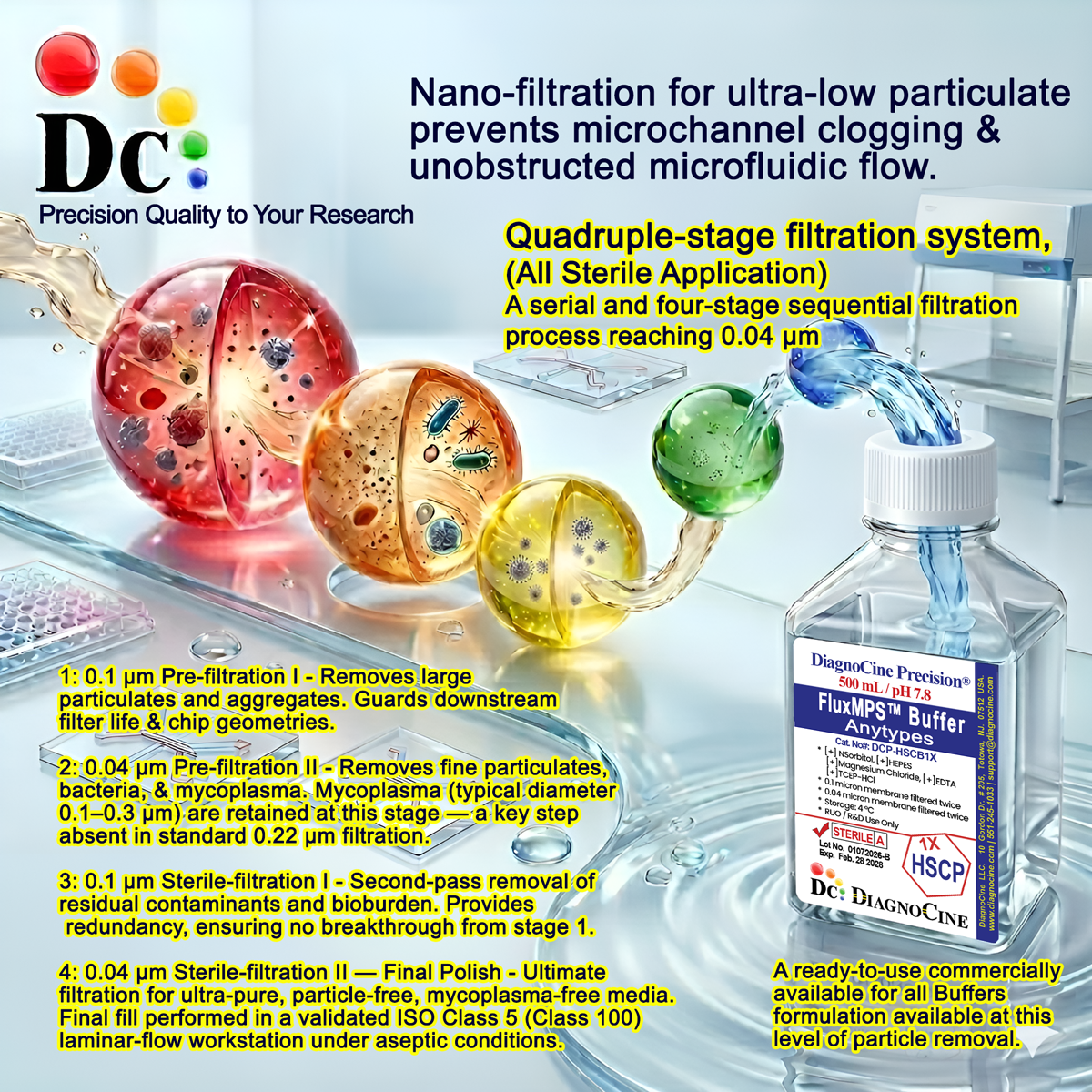
Quadruple-stage filtration system
Every lot of FluxMPS™ TBS, 20X passes through 0.1 µm membrane filters twice and 0.04 µm membrane filters twice, a sequential architecture designed to remove finer particulates than a single-pass 0.22 µm filtration step.
-
1
0.1 µm Pre-filtration I
Removes large particulates and aggregates, extending the working life of downstream filters.
-
2
0.04 µm Pre-filtration II
Retains fine particulates and bioburden not captured by the first pass.
-
3
0.1 µm Redundant Filtration I
A second 0.1 µm pass provides redundancy against membrane variability.
-
4
0.04 µm Redundant Filtration II — Final Polish
A second 0.04 µm pass delivers the final polish for ultra-low particulate content.
Performance vs. conventional buffer
Sequential 0.1 µm and 0.04 µm filtration, applied twice each, removes finer particulates than a single 0.22 µm filtration pass typical of conventional TBS preparations.
© Diagnocine® — DCP-TBS20X
Where FluxMPS™ TBS, 20X is used
TBS is commonly used as a laboratory reagent for washing, diluting, cell culture processing, Western blotting, ELISA, and immunohistochemistry steps, with Tris acting as the buffering agent and NaCl regulating solution tonicity for isotonic or hypertonic use.
Automated Bioreactors & Robotics
An optional 0.01 µm (10 nm) ultra-filtered variant of this buffer is available for automated bioreactor and robotic liquid-handling systems where sub-micron sensor and valve protection is required.
- Total Particulate Exclusion for sensitive fluidic pathways
- Valve & Sensor Protection in automated perfusion systems
- Extended Perfusion Stability for long-duration runs
Inquiry Required: Contact support@diagnocine.com to request the 0.01 µm ultra-filtered grade of DCP-TBS20X.
Micro Physiological System (MPS) & Chip
Wash and perfusion buffer for chip-based culture platforms requiring low-particulate, defined-ionic-strength fluids.
Wash, Dilution & Reconstitution
Isotonic Tris-NaCl base suitable for washing, diluting, and reconstituting samples and reagents.
iPSC-Derived Model Handling
Low-particulate, mycoplasma-free buffer for wash steps in iPSC-derived model workflows.
Endothelial & Primary Cell Perfusion
Defined ionic strength supports perfusion protocols with endothelial and primary cell models.
ELISA, Blotting & Blocking
Nuclease- and protease-negative TBS base for wash and dilution steps in blotting and plate-based assays.
Microscopy & Optical Sensing
Low-particulate buffer formulation reduces optical background in imaging and biosensor workflows.
Detailed product specifications
All values below are as stated for DCP-TBS20X; parameters not specified for this product are omitted rather than estimated.
| Parameter | Specification |
|---|---|
| Formulation / Composition | 137 mM NaCl, 20 mM Tris (20X concentrate) |
| Appearance | Clear, colorless liquid |
| pH | 7.4 |
| Molarity / Concentration | 20X (available in 1X, 2X, 4X, 5X, 10X on request) |
| Buffering Agent | Tris |
| Buffering Agent CAS Number | 77-86-1 |
| Parameter | Specification |
|---|---|
| Sterility | Non-Sterile |
| Mycoplasma | Not Detected |
| Nuclease / Protease Testing | Protease negative, DNase negative, RNase negative, Endonuclease negative |
| Water Purity | ASTM Type 1 Ultrapure Water, 0.05 µS/cm, deionized |
| Manufacturing Standard | ISO 13485-certified, CE-approved |
| Parameter | Specification |
|---|---|
| Storage Temperature | Room temperature; 4°C recommended for long-term storage |
| Parameter | Specification |
|---|---|
| Raw Material Grade | Tissue Culture & Molecular Biology grade |
| Manufacturing Facility | ISO 13485-certified, CE-approved (Supplier: DiagnoCine Precision) |
| Quality Assurance Location | DiagnoCine R&D and Quality Testing Center |
| Customization & Assembly Location | DiagnoCine Precision, Totowa, New Jersey, USA |
| Intended Use | RUO — Research Use Only; not for human therapeutic use or consumption |
Full composition
Defined Tris-NaCl formulation at 20X concentration; additional chemicals, detergents, inhibitors, or proteins can be added on request.
| Component | CAS Number | Concentration |
|---|---|---|
| Tris (2-amino-2-(hydroxymethyl)propane-1,3-diol) | 77-86-1 | 20 mM |
| Sodium Chloride (NaCl) | 7647-14-5 | 137 mM |
Manufacturing & compliance
FluxMPS™ TBS, 20X is manufactured under ISO 13485-certified, CE-approved facilities (Suppliers of DiagnoCine Precision), with final packaging, quality assurance, and testing completed at the DiagnoCine R&D and Quality Testing Center.
ISO 13485:2016 & CE-Approved Manufacturing
Produced under ISO 13485-certified, CE-approved facilities operated by Suppliers of DiagnoCine Precision.
Ultrapure ASTM Type 1 Water Base
Formulated with ASTM 0.05 µS/cm Type 1 ultrapure, deionized water.
Nuclease & Protease-Free Quality Control
Each lot is tested protease-, DNase-, RNase-, and endonuclease-negative, with no mycoplasma detected.
Micro-Batch Customization at Totowa, NJ
All specific customization requests and assembly are accomplished at DiagnoCine Precision in Totowa, New Jersey, USA.
Quadruple-Stage Filtration
0.1 µm membrane filtration applied twice and 0.04 µm membrane filtration applied twice per lot.
Mycoplasma-Free Testing
No mycoplasma detected in finished product testing.
pH Verification
Formulated and verified to pH 7.4.
Documentation / CoA
Certificate of Analysis available on request.
How DCP-TBS20X compares
A side-by-side look at how FluxMPS™ TBS, 20X compares against conventional 0.22 µm-filtered Tris-buffered saline.
| Parameter | DCP-TBS20X (FluxMPS™) | Conventional TBS (0.22 µm filtered) | Standard Alternative (0.22 µm filtered) |
|---|---|---|---|
| Defined Tris / NaCl concentration | check_circle | check_circle | check_circle |
| Final filtration pore size | 0.04 µm | 0.22 µm | 0.22 µm |
| Number of filtration stages | 4 | 1 | 1 |
| Nuclease / protease negative testing | check_circle | cancel | cancel |
| Mycoplasma testing | check_circle | cancel | cancel |
| ASTM Type 1 ultrapure water base | check_circle | cancel | cancel |
| ISO 13485-certified manufacturing | check_circle | cancel | cancel |
| Microfluidic channel compatibility | check_circle | cancel | cancel |
| Custom pH / concentration formulation | check_circle | cancel | cancel |
Frequently asked questions
Answers to common questions about FluxMPS™ TBS, 20X (DCP-TBS20X).
Supporting literature
Curated references relevant to Tris-buffered saline chemistry and its use in microfluidic and immunoassay workflows.
- Bhatia SN, Ingber DE. Microfluidic organs-on-chips. Nat Biotechnol. 2014. doi:10.1038/nbt.2989
- Zheng W, et al. Investigating opioid-induced adipocyte dysfunction using microfluidic devices. Lab Chip. 2016. doi:10.1039/C6LC00374E
- Good NE, et al. Hydrogen ion buffers for biological research. Biochemistry. 1966. doi:10.1021/bi00866a011
- Fukuda J, et al. Tris buffer modulates protein-protein interactions in immunoassays. J Immunol Methods. 2001. doi:10.1016/S0022-1759(01)00248-4
- Kilkenny C, et al. Reporting standards for buffer and reagent transparency in research. PLoS Biol. 2010. doi:10.1371/journal.pbio.1000412
- Towbin H, et al. Electrophoretic transfer of proteins and Western blotting buffer systems. Proc Natl Acad Sci. 1979. doi:10.1073/pnas.76.9.4350
- Whitesides GM. The origins and the future of microfluidics. Nature. 2006. doi:10.1038/nature05058
- Ingber DE. Reverse engineering human pathophysiology with organs-on-chips. Cell. 2016. doi:10.1016/j.cell.2016.05.048
- Engvall E, Perlmann P. Enzyme-linked immunosorbent assay (ELISA) buffer considerations. Immunochemistry. 1971. doi:10.1016/0019-2791(71)90454-X