

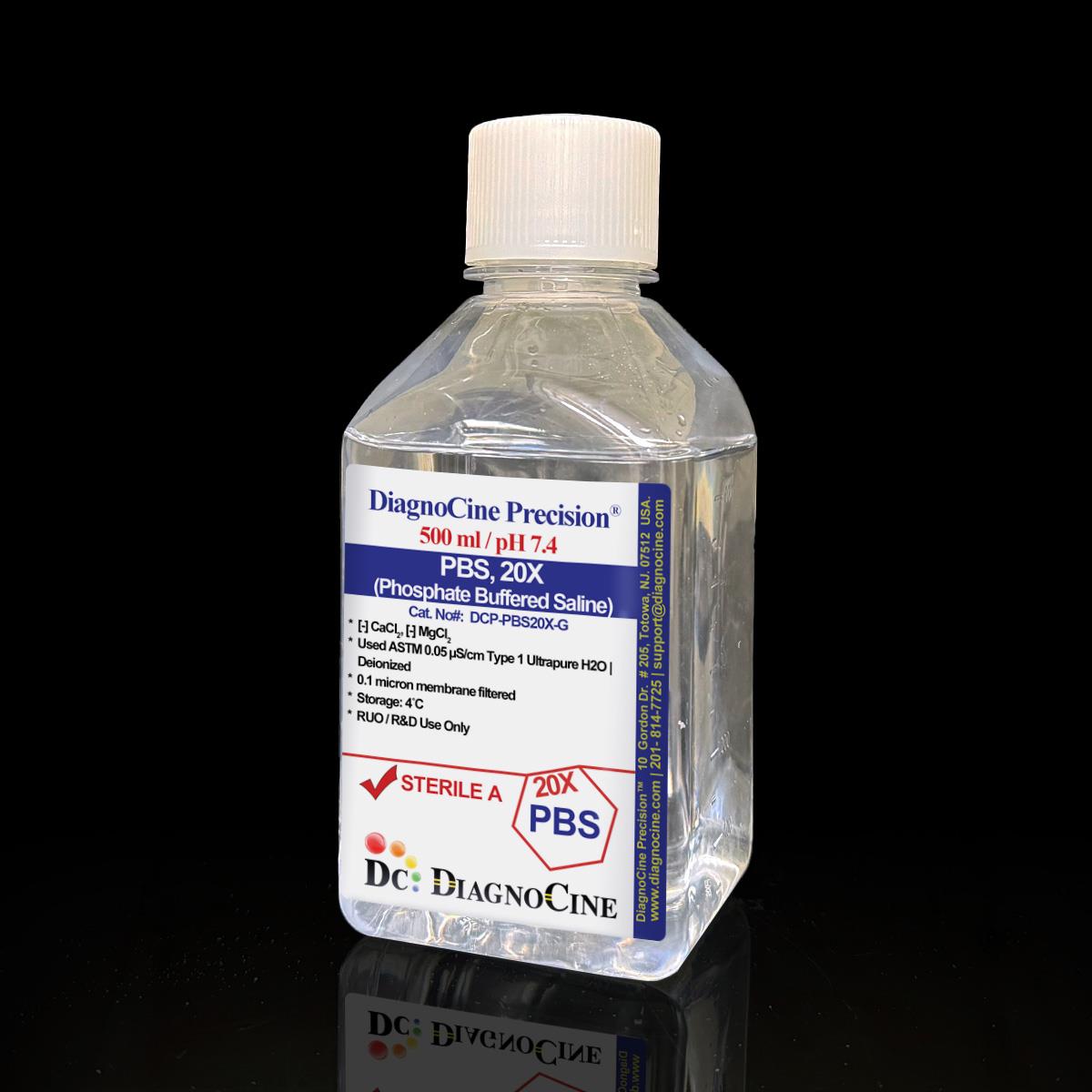
PBS, 20X (Phosphate Buffered Saline), Sterile
FluxMPS™ PBS, 20X (Phosphate Buffered Saline), Sterile
An MPS-grade, calcium- and magnesium-free 20X Phosphate Buffered Saline concentrate at pH 7.4, quadruple-stage filtered (0.1 µm twice, 0.04 µm twice) in a clean environment for ultra-low particulate and endotoxin control. Formulated with ASTM Type 1 ultrapure, deionized water for microchannel-safe performance in organ-on-a-chip (OoC), tissue culture, and molecular biology workflows.
- Quadruple-stage filtration: 0.1 µm membrane filtration performed twice and 0.04 µm membrane filtration performed twice, in a clean environment
- Endotoxin content NMT 1EU/mL; no bacterial or fungal growth after 14 days incubation per USP specification
- pH 7.4 at 20X concentration; pH 7.00-7.40 when diluted to 1X
- Calcium- and magnesium-free formulation (CaCl2 (-), MgCl2 (-)) — ideal where trypsin activity must not be hindered
- Manufactured with ASTM Type 1 ultrapure, deionized water (0.05 µS/cm)
- Sterilized liquid, clear and colorless; Tissue Culture & Molecular Biology grade
- Customizable pH and concentration (1X, 2X, 4X, 5X) available on request — contact support@diagnocine.com
- pH (20X)7.4
- pH (1X, diluted)7.00 - 7.40
- Concentration20X
- Calcium / MagnesiumCaCl2 (-), MgCl2 (-)
- EndotoxinNMT 1EU/mL
- SterilityNo growth after 14 days (USP)
- Filtration0.1 µm x2 + 0.04 µm x2
- StorageRoom temp; 4°C for long-term
- Shelf Life24 months
- ShippingRoom temperature
Engineered where standard buffers fail
Balanced salt solutions trace back to Sydney Ringer's original 1885 physiological salt solution and Tyrode's solution, developed to support mammalian cell metabolism, maintain physiological pH, and preserve intracellular and extracellular osmotic balance. Conventional 0.22 µm-filtered buffers can carry subvisible particulates, salt precipitation risk, and inconsistent pH/ionic conditions into sensitive microchannels. FluxMPS™ PBS, 20X is quadruple-stage filtered and manufactured under controlled, documented conditions to reduce these failure modes.
Microchannel-safe purity
Final 0.04 µm membrane pass in a clean environment reduces particulate load ahead of microfluidic and organ-on-a-chip channels.
Precise, stable pH
Formulated to pH 7.4 at 20X, resolving to pH 7.00-7.40 upon dilution to 1X, supported by a defined phosphate/chloride salt composition.
Ultrapure-grade water
Manufactured with ASTM Type 1 ultrapure, deionized water measured at 0.05 µS/cm conductivity.
Low background for imaging & assays
Colorless, clear, sterilized liquid suited to immunohistochemistry, hematology, and molecular biology procedures without interfering background.
Defined, traceable composition
Disodium hydrogen phosphate anhydrous, potassium dihydrogen phosphate, and sodium chloride at fixed mg/L levels, free of calcium, magnesium, protease, DNAse, RNAse, and endonuclease.
Customization on demand
Alternate pH targets and alternate concentrations (1X, 2X, 4X, 5X) can be produced on request. This product is also offered as a related 1X and 10X PBS series.
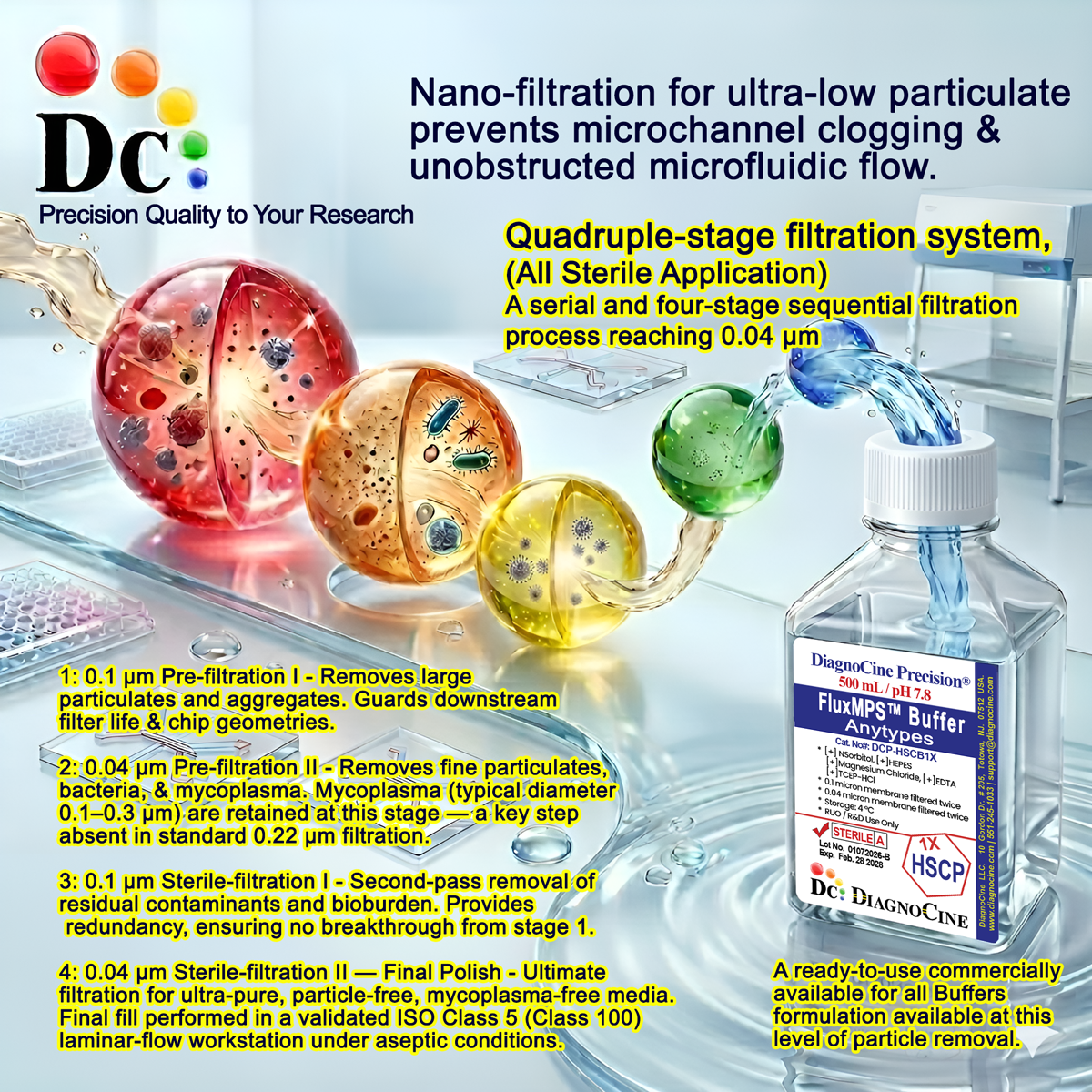
Quadruple-stage filtration system
All reagents in this product are sterilized by filtering through 0.1 micron membrane filters twice and through 0.04 micron membrane filters twice, in a clean environment, layering coarse and fine membrane passes for progressively lower particulate carryover.
-
1
0.1 µm Pre-filtration I
First 0.1 micron membrane pass removes larger particulates and aggregates ahead of subsequent stages.
-
2
0.04 µm Pre-filtration II
First 0.04 micron membrane pass retains finer particulates, reducing bioburden ahead of final sterile filtration.
-
3
0.1 µm Sterile-filtration I
Second 0.1 micron membrane pass provides redundant sterile-filtration coverage in the clean environment.
-
4
0.04 µm Sterile-filtration II — Final Polish
Second 0.04 micron membrane pass delivers the final polish, completing the clean-environment sterilization process.
Performance vs. conventional buffer
Sequential 0.1 µm and 0.04 µm filtration, applied twice each, removes finer particulates than a single 0.22 µm pass typical of conventional buffers.
© Diagnocine® — DCP-PBS20X
Where FluxMPS™ PBS, 20X performs
Free of calcium and magnesium, this 20X concentrate is used for tissue disaggregation and monolayer dispersal, since calcium and magnesium ions may hinder trypsin activity, as well as for routine immunohistochemical testing and general-purpose washing of cells in hematological and molecular biology procedures.
Automated Bioreactors & Robotics
An optional 10 nm (0.01 µm) ultra-filtered variant is available for automated bioreactor and robotic liquid-handling platforms where valve and sensor protection is critical.
- Total Particulate Exclusion for automated fluid paths
- Valve & Sensor Protection in closed-loop perfusion systems
- Extended Perfusion Stability across long-duration runs
Inquiry Required: the 0.01 µm ultra-filtered grade is produced to order; contact support@diagnocine.com to request this configuration.
Micro Physiological System (MPS) & Chip
Calcium- and magnesium-free wash and dilution buffer compatible with microfluidic circuitry.
Wash, Dilution & Reconstitution
Used as a general-purpose solution for washing cells in hematological and molecular biology procedures.
iPSC-Derived Model Handling
Calcium/magnesium-free buffer suited for cell dissociation steps that require unimpeded trypsin activity.
Endothelial & Primary Cell Perfusion
Supports tissue disaggregation and monolayer dispersal workflows for primary and endothelial cell isolation.
ELISA, Blotting & Blocking
Used for routine immunohistochemical testing as a stable, low-background wash and dilution buffer.
Microscopy & Optical Sensing
Clear, colorless formulation supports optical clarity for microscopy and sensor-based workflows.
Detailed specifications
All values below are as declared for this product.
| Parameter | Specification |
|---|---|
| Formulation | 20X Phosphate Buffered Saline (disodium hydrogen phosphate anhydrous, potassium dihydrogen phosphate, sodium chloride) |
| Appearance | Sterilized liquid, clear, colorless USP <790> |
| pH (20X) | 7.4 USP <791> |
| pH (1X, diluted) | 7.00 - 7.40 |
| Concentration | 20X |
| Calcium / Magnesium | CaCl2 (-), MgCl2 (-) |
| Parameter | Specification |
|---|---|
| Endotoxin (BET) | NMT 1EU/mL USP <85> |
| Sterility | No bacterial or fungal growth after 14 days incubation USP <71> |
| Toxicity Test | Passes |
| Enzyme / Nuclease Screening | Protease (-), DNAse (-), RNAse (-), Endonuclease (-) |
| Water Quality | ASTM Type 1 ultrapure, deionized water, 0.05 µS/cm |
| Manufacturing Standard | ISO 13485-certified, CE-approved facilities ISO 13485 |
| Parameter | Specification |
|---|---|
| Storage Temperature | Room temperature; 4°C recommended for long-term storage; store at 15-30°C away from bright light |
| Shipping Condition | Room temperature |
| Shelf Life | 24 months |
| Expiry | Use before expiry date given on product label |
| Parameter | Specification |
|---|---|
| Raw Material Grade | Tissue Culture & Molecular Biology grade |
| Manufacturing QMS | ISO 13485-certified, CE-approved facilities (Suppliers of DiagnoCine Precision) |
| Regulatory Traceability | Final packaging, QA, and testing at DiagnoCine R&D and Quality Testing Center; customization/assembly at DiagnoCine Precision, Totowa, NJ, USA |
| Production Method | Filtered 0.1 micron membrane twice and 0.04 micron membrane twice in a clean environment |
| Intended Use | RUO - Research Use Only, R&D use only; not for human therapeutic use or human consumption |
Full composition (mg/L)
Inorganic salt composition of the 20X concentrate, released per lot. Please note that salt might precipitate; gentle warming and mixing typically resolves this prior to use.
| Component | CAS Number | Concentration |
|---|---|---|
| INORGANIC SALTS | ||
| Disodium hydrogen phosphate anhydrous | 7558-79-4 | 14520.000 mg/L |
| Potassium dihydrogen phosphate | 7778-77-0 | 4200.000 mg/L |
| Sodium chloride | 7647-14-5 | 18000.000 mg/L |
Manufacturing & compliance
Produced under ISO 13485-certified and CE-approved facilities, with final packaging, quality assurance, and testing completed at the DiagnoCine R&D and Quality Testing Center.
ISO 13485:2016 QMS
Manufactured under ISO 13485-certified and CE-approved facilities (Suppliers of DiagnoCine Precision).
Ultrapure Type 1 Water
ASTM Type 1 ultrapure, deionized water, measured at 0.05 µS/cm.
Clean-Environment Fill & Finish
Quadruple-stage filtered and sterilized in a clean environment prior to fill.
Micro-Batch Precision
Customization requests and final assembly completed at DiagnoCine Precision, Totowa, New Jersey, USA.
Endotoxin (USP <85> BET)
NMT 1EU/mL.
Sterility (USP <71>)
No bacterial or fungal growth after 14 days of incubation.
Toxicity Test
Passes.
Documentation / CoA
A Certificate of Analysis is available for this lot.
How DCP-PBS20X compares
A qualitative comparison against a conventional single-pass filtered buffer and a standard laboratory alternative.
| Parameter | DCP-PBS20X (FluxMPS™) | Conventional Buffer (0.22 µm filtered) | Standard Alternative (0.22 µm filtered) |
|---|---|---|---|
| Calcium / Magnesium Free | check_circle | cancel | cancel |
| Final Filtration Pore Size | 0.04 µm | 0.22 µm | 0.22 µm |
| Number of Filtration Stages | 4 | 1 | 1 |
| Endotoxin Specification | NMT 1EU/mL | Not routinely specified | Not routinely specified |
| Sterility per USP <71> | check_circle | cancel | cancel |
| Water Quality | ASTM Type 1 Ultrapure | Standard purified water | Standard purified water |
| Manufacturing QMS | ISO 13485-certified | Not specified | Not specified |
| Microfluidic Channel Compatibility | check_circle | cancel | cancel |
| Custom Formulation Available | check_circle | cancel | cancel |
Frequently asked questions
Common questions about DCP-PBS20X.
Supporting literature
Curated references on balanced salt solutions, buffer chemistry, and microfluidic/organ-on-a-chip applications.
- Ringer S. Concerning the influence exerted by each of the constituents of the blood on the contraction of the ventricle. J Physiol. 1883. doi:10.1113/jphysiol.1883.sp000120
- Tyrode MV. The mode of action of some purgative salts. Arch Int Pharmacodyn Ther. 1910. doi:10.1002/cbf.1085
- Bhatia SN, Ingber DE. Microfluidic organs-on-chips. Nat Biotechnol. 2014;32:760-772. doi:10.1038/nbt.2989
- Huh D, et al. Reconstituting organ-level lung functions on a chip. Science. 2010;328:1662-1668. doi:10.1126/science.1188302
- Good NE, et al. Hydrogen ion buffers for biological research. Biochemistry. 1966;5:467-477. doi:10.1021/bi00866a011
- Freshney RI. Culture of Animal Cells: A Manual of Basic Technique and Specialized Applications. Wiley. doi:10.1002/9780470649367
- Low LA, Tagle DA. Organs-on-chips: progress, challenges, and future directions. Exp Biol Med. 2017;242:1573-1578. doi:10.1177/1535370217700523
- Williams DF. Endotoxin testing and its role in biocompatibility. Biomaterials. 2011. doi:10.1016/j.biomaterials.2011.01.019
- van Meer BJ, et al. Small molecule absorption by PDMS in the context of drug response bioassays. Biochem Biophys Res Commun. 2017. doi:10.1016/j.bbrc.2017.01.164