
Normal Saline (Sodium Chloride), 0.9% (w/v), Sterile
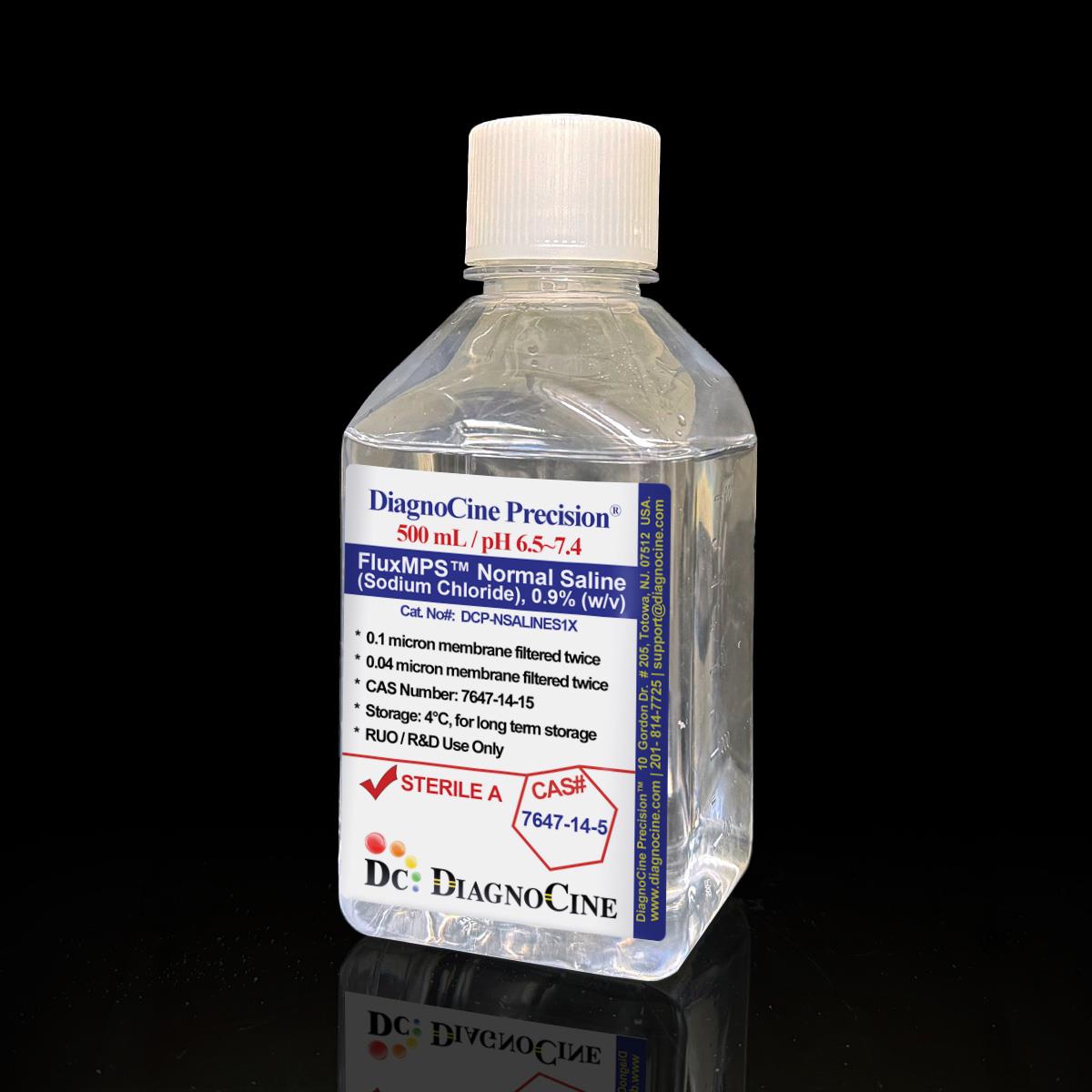
FluxMPS™ Normal Saline (Sodium Chloride), 0.9% (w/v), Sterile
An MPS-grade, physiological-pH normal saline formulated to 0.9% (w/v) Sodium Chloride in ASTM Type 1 Ultrapure Water. Quadruple-stage 0.1 µm / 0.04 µm membrane filtration delivers an isotonic, non-toxic solution suited to microchannel priming, cell washing, tissue hydration, and reagent preparation across microfluidic and organ-on-a-chip (OoC) workflows.
- Quadruple-stage filtration: 0.1 µm membrane twice and 0.04 µm membrane twice for microchannel-safe purity
- Formulated to physiological default pH 6.5-7.4 (unadjusted normal saline typically ranges pH 4 to 6)
- 0.9% (w/v) Sodium Chloride in ASTM Type 1 Ultrapure Water (0.05 µS/cm), deionized
- Isotonic, non-toxic solution that minimizes disturbance to healing tissue and cultured cells
- Tissue Culture & Molecular Biology grade, manufactured under ISO 13485-certified, CE-approved facilities
- Customizable pH (6.5-7.4 default or approximately 4 to 6), concentration, and additive content on request
- pH
- 6.5-7.4
- Concentration
- 0.9% (w/v) NaCl
- Appearance
- Colorless liquid solution
- Filtration
- 0.1 µm x2 + 0.04 µm x2
- Sterility
- Filtered in a sterile environment
- Water Quality
- ASTM 0.05 µS/cm Type 1 Ultrapure
- Storage
- 4°C, long term
- Shelf Life
- 24 months
- Grade
- Tissue Culture & Molecular Biology
- Intended Use
- RUO — Research Use Only
Engineered where standard saline falls short
Conventional 0.22 µm-filtered saline can carry finer particulates, unadjusted acidic pH, and undocumented water quality into sensitive microfluidic and cell-based work. FluxMPS™ Normal Saline addresses each failure mode with defined pH, quadruple-stage filtration, and ultrapure water.
Microchannel-safe purity
Sequential 0.1 µm and 0.04 µm membrane passes, applied twice each, reduce fine particulates that can accumulate in narrow microfluidic channels.
Precise, stable pH
Formulated to a physiological default of pH 6.5-7.4, rather than the pH 4 to 6 range typical of standard normal saline, to minimize disturbance to cells and tissues.
Ultrapure-grade water
Prepared with ASTM 0.05 µS/cm Type 1 Ultrapure, deionized water as the base solvent for the 0.9% (w/v) sodium chloride formulation.
Reduced irritation and toxicity
A pH close to physiological reduces the risk of irritation, inflammation, or chemical incompatibility when in contact with tissues, biomolecules, or cultured cells.
Defined, traceable composition
Simple, documented two-component formulation — sodium chloride (CAS 7647-14-5) in ultrapure water — manufactured under ISO 13485-certified, CE-approved facilities.
Customization on demand
Alternate pH (including the traditional 4 to 6 range), concentration, and additional chemicals, detergents, inhibitors, or proteins are available on inquiry.
Quadruple-stage filtration system
DCP-NSALINES1X is filtered through a 0.1 µm membrane twice and a 0.04 µm membrane twice, a four-pass architecture that supports mycoplasma-safe purity for microchannel and sensitive laboratory applications.
-
1
0.1 µm Pre-filtration I
First pass through a 0.1 µm membrane removes large particulate and aggregate material, protecting downstream filters from early loading.
-
2
0.04 µm Pre-filtration II
First pass through a 0.04 µm membrane retains finer particulates and bioburden ahead of the final sterile passes.
-
3
0.1 µm Sterile-filtration I
Second 0.1 µm pass provides redundant particulate control ahead of final polishing.
-
4
0.04 µm Sterile-filtration II — Final Polish
Second 0.04 µm pass, performed in a sterile environment, provides the final polish. The smallest mycoplasma species measure about 0.2 microns, so this stage helps guard against mycoplasma-scale contamination.
Performance vs. conventional saline
Sequential 0.1 µm and 0.04 µm membrane filtration, applied twice each, removes finer particulates than a single conventional 0.22 µm pass, supporting a cleaner base solution for microfluidic and cell-based work.
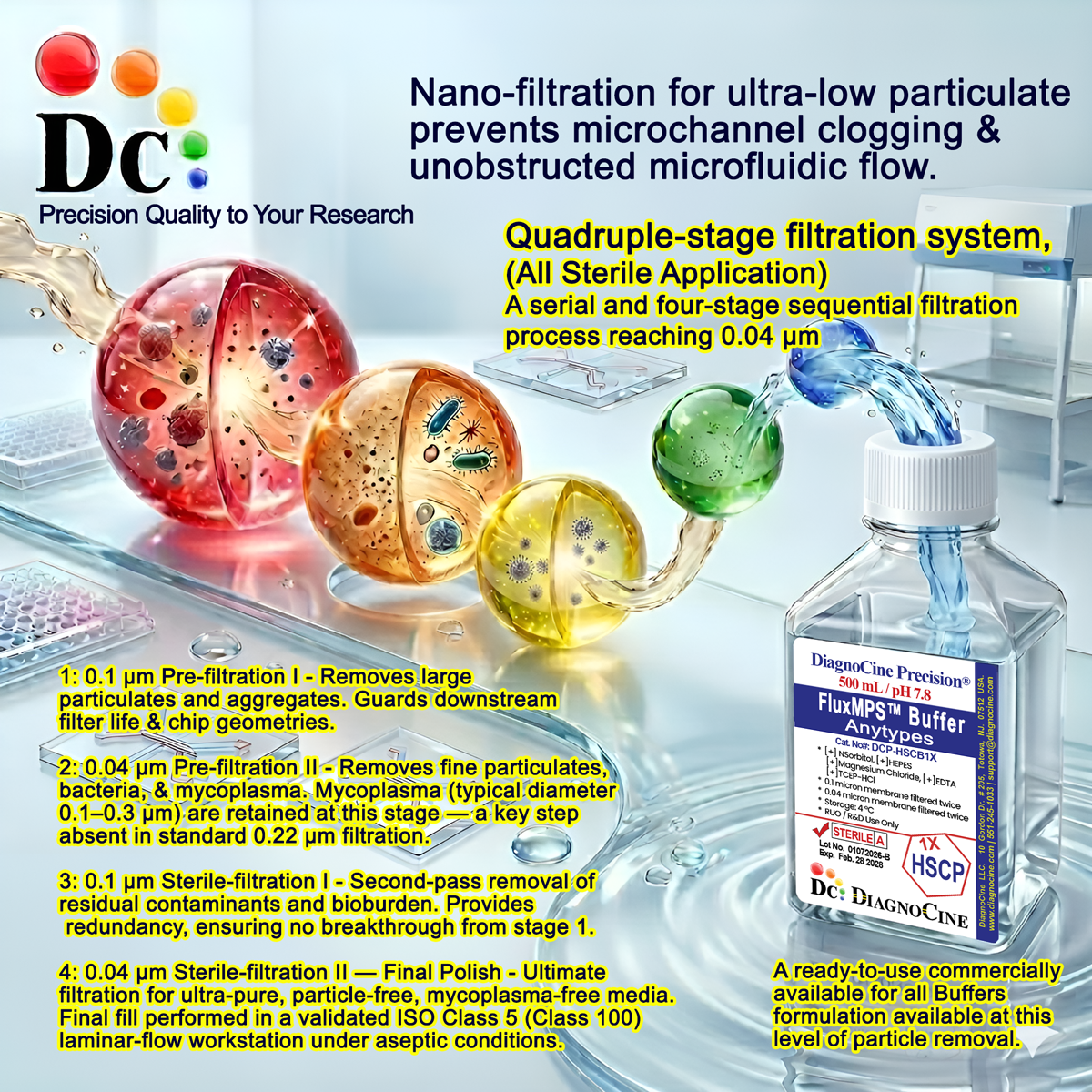
© Diagnocine® — DCP-NSALINES1X
Where FluxMPS™ Normal Saline is used
Normal Saline is used in the laboratory for multiple purposes, including washing cells, pathological work, treating or transporting tissues, hydration of cells, preparing reagents, and adjusting electrolyte disturbances.
Automated Bioreactors & Robotics
An optional 0.01 µm (10 nm) ultra-filtered variant is available on inquiry for automated bioreactor and robotic liquid-handling platforms where finer particulate exclusion is required.
- Total Particulate Exclusion for closed-loop automated systems
- Valve & Sensor Protection against fine particulate fouling
- Extended Perfusion Stability in long-duration automated runs
Inquiry Required: the 0.01 µm ultra-filtered grade is a customization option; contact support@diagnocine.com to request it.
Micro Physiological System (MPS) & Chip
Isotonic, physiological-pH saline for priming, washing, and hydrating microfluidic channels without disturbing on-chip cells or tissues.
Wash, Dilution & Reagent Prep
Used for washing cells, preparing reagents, and adjusting electrolyte disturbances in routine laboratory workflows.
iPSC-Derived Model Handling
Physiological pH supports gentle hydration and washing steps during handling of iPSC-derived cell models.
Endothelial & Primary Cell Perfusion
Isotonic composition supports hydration and transport of primary and vascular cell types without osmotic stress.
ELISA, Blotting & Rinse Steps
Physiological-pH saline for rinse and wash steps in immunoassay and blotting workflows.
Cell & Tissue Preservation for Imaging
A neutral, physiological pH prevents cellular stress during rinsing or storage of biological samples ahead of imaging.
Specifications
Measured and declared values for DCP-NSALINES1X.
| Parameter | Specification |
|---|---|
| Formulation / Composition | 0.9% (w/v) Sodium Chloride in Ultrapure Water |
| Appearance | Colorless, liquid solution |
| pH (at 1X concentration) USP <791> | 6.5-7.4 |
| Concentration | 0.9% (w/v) Sodium Chloride |
| Parameter | Specification |
|---|---|
| Sterility | Filtered in a sterile environment |
| Filtration System | 0.1 µm membrane twice, 0.04 µm membrane twice |
| Water Quality | ASTM 0.05 µS/cm Type 1 Ultrapure, deionized |
| Manufacturing Standard ISO 13485 | ISO 13485-certified, CE-approved facilities |
| Parameter | Specification |
|---|---|
| Storage | 4°C for long term storage |
| Shelf Life | 24 months |
| Expiration | Use before the expiry date on the product label |
| Parameter | Specification |
|---|---|
| Raw Material Grade | Tissue Culture & Molecular Biology grade |
| CAS Number (Sodium Chloride) | 7647-14-5 |
| Manufacturing QMS | ISO 13485-certified, CE-approved facilities |
| Regulatory Alignment / Intended Use | RUO — R&D use only; not for human therapeutic use or human consumption |
| Production & Assembly Location | DiagnoCine Precision, Totowa, New Jersey, USA |
Full composition
Two-component formulation released per lot at the DiagnoCine R&D and Quality Testing Center.
| Component | CAS Number | Concentration |
|---|---|---|
| Normal Saline (Sodium Chloride) | 7647-14-5 | 0.9% |
| Ultrapure Water | 7732-18-5 | 99.1% |
Manufacturing & compliance
Manufactured under ISO 13485-certified and CE-approved facilities, with final packaging, quality assurance, and testing performed at the DiagnoCine R&D and Quality Testing Center.
ISO 13485:2016 QMS
Manufactured under an ISO 13485-certified, CE-approved quality management system.
Ultrapure Type 1 Water
Formulated with ASTM 0.05 µS/cm Type 1 Ultrapure, deionized water.
ISO Class 5 Fill & Finish
Filtered and filled under controlled, sterile conditions to minimize particulate and bioburden ingress.
Micro-Batch Precision
Customization requests and assembly completed at DiagnoCine Precision in Totowa, New Jersey, USA.
Endotoxin USP <85> BET
Lot-specific endotoxin data is documented on the Certificate of Analysis; request via support@diagnocine.com.
Particulate USP <788> Method 2
Quadruple-stage 0.1 µm / 0.04 µm filtration is applied ahead of packaging to control particulate content.
Sterility Filtration
Filtered in a sterile environment as part of the final manufacturing step.
Documentation / CoA
Certificate of Analysis available per lot upon request.
How DCP-NSALINES1X compares
A comparison of FluxMPS™ Normal Saline against conventional 0.22 µm-filtered saline.
| Parameter | DCP-NSALINES1X (FluxMPS™) | Conventional 0.22 µm-filtered Saline | Standard Alternative Saline |
|---|---|---|---|
| Formulated pH | 6.5-7.4 (physiological default) | pH 4 to 6 (unadjusted) | pH 4 to 6 (unadjusted) |
| Final filtration pore size | 0.04 µm | 0.22 µm | 0.22 µm |
| Number of filtration stages | 4 | 1 | 1 |
| Sterile filtration | check_circle | check_circle | cancel |
| ASTM Type 1 Ultrapure Water | check_circle | cancel | cancel |
| ISO 13485-certified manufacturing | check_circle | cancel | cancel |
| Microfluidic channel compatibility | check_circle | cancel | cancel |
| Lot-to-lot pH reproducibility | check_circle | cancel | cancel |
| Custom formulation available | check_circle | cancel | cancel |
Frequently asked questions
Common questions about DCP-NSALINES1X, FluxMPS™ Normal Saline (Sodium Chloride), 0.9% (w/v), Sterile.
Supporting literature
Curated references relevant to isotonic saline solutions, microphysiological systems, and cell culture handling.
- Huh D, et al. Reconstituting Organ-Level Lung Functions on a Chip. Science, 2010. doi:10.1126/science.1188302
- Bhatia SN, Ingber DE. Microfluidic organs-on-chips. Nat Biotechnol, 2014. doi:10.1038/nbt.2989
- Wikswo JP. The relevance and potential roles of microphysiological systems in biology and medicine. Exp Biol Med, 2014. doi:10.1177/1535370214542068
- Low LA, et al. Organs-on-chips: into the next decade. Nat Rev Drug Discov, 2021. doi:10.1038/s41573-020-0079-3
- Freshney RI. Culture of Animal Cells: A Manual of Basic Technique and Specialized Applications. Wiley, 2015. doi:10.1002/9781118873686
- Lanigan RS, Yamarik TA. Final report on the safety assessment of sodium chloride. Int J Toxicol, 2001. doi:10.1080/109158101750300937
- Awad S, et al. The history of 0.9% saline. Clin Nutr, 2008. doi:10.1016/j.clnu.2008.01.008
- Rasmussen KM, et al. Isotonic fluids and cell viability in tissue culture applications. J Vis Exp, 2016. doi:10.3791/54317
- Uphoff CC, Drexler HG. Detection of mycoplasma contamination in cell cultures. Curr Protoc Mol Biol, 2014. doi:10.1002/0471142727.mb2404s106
- United States Pharmacopeia. General Chapter <1231> Water for Pharmaceutical Purposes. USP-NF, 2023. doi:10.31003/USP-NF_M99860