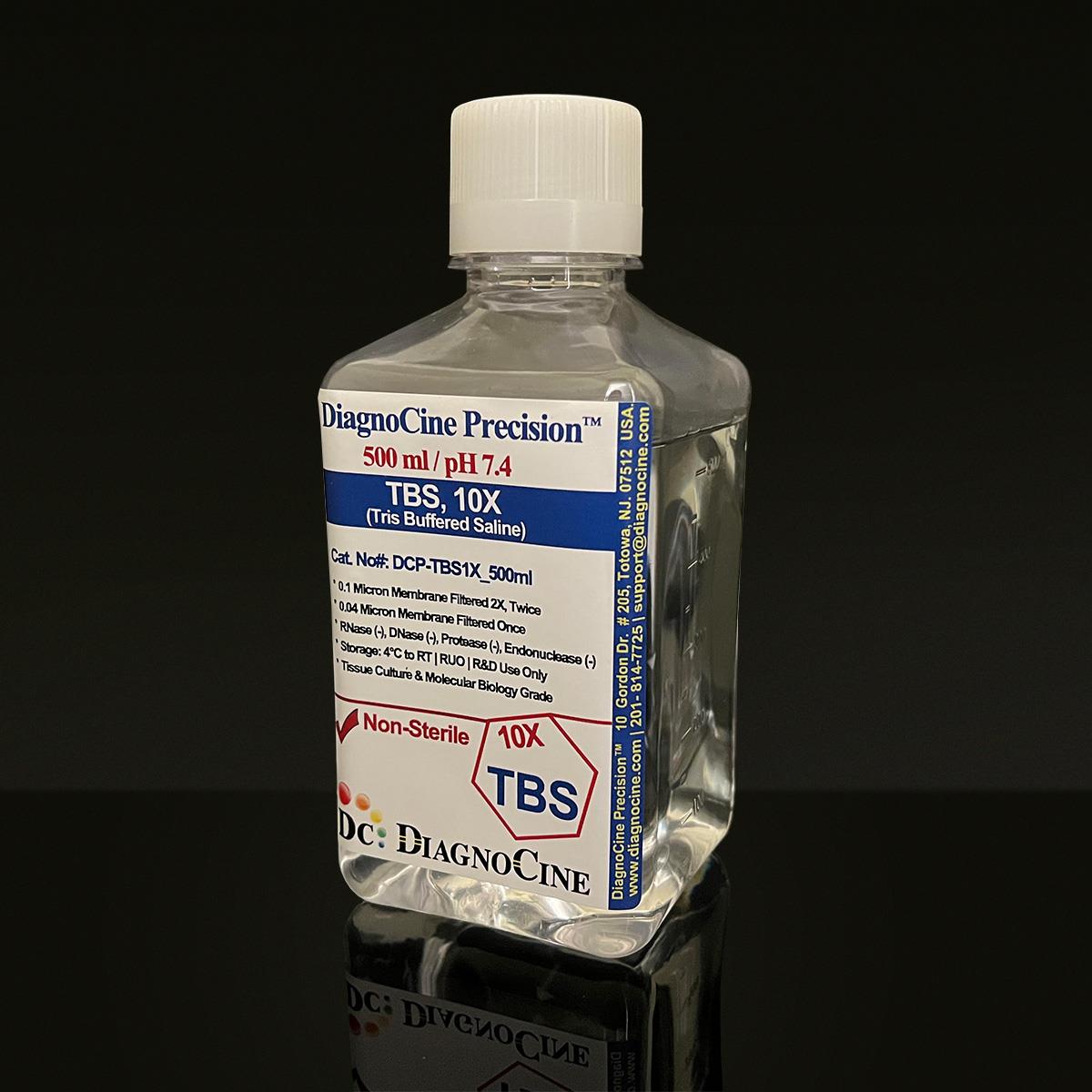
TBS, 10X (Tris Buffered Saline), Non-Sterile
FluxMPS™ TBS, 10X (Tris Buffered Saline), Non-Sterile
An MPS-grade, 10X concentrated Tris Buffered Saline formulated with 200 mM Tris and 1500 mM NaCl at pH 7.4, engineered for defined, reproducible buffering across washing, dilution, and immunoassay workflows. Quadruple-stage 0.1 µm / 0.04 µm membrane filtration and mycoplasma-free release testing support low-background performance in microfluidic, organ-on-a-chip, and molecular biology applications. Supplied non-sterile for research use, with pH, concentration, and additive customization available on request.
- Quadruple-stage filtration: 0.1 µm membrane filtration (twice) plus 0.04 µm membrane filtration (twice)
- Mycoplasma-free (no mycoplasma detected)
- Precise pH 7.4; 10X concentrate with 1X, 2X, 4X, and 5X customization available
- Defined formulation: 200 mM Tris and 1500 mM NaCl
- ASTM Type 1 Ultrapure Water (0.05 µS/cm), deionized
- Protease(-), DNase(-), RNase(-), Endonuclease(-)
- Non-sterile, RUO grade; Tissue Culture & Molecular Biology grade
- Custom pH, concentration, and additive/detergent/inhibitor/protein formulations available on request
- pH7.4
- Concentration10X
- Buffer SystemTris, 200 mM
- Salt ContentNaCl, 1500 mM
- Filtration0.1 µm x2 + 0.04 µm x2
- SterilityNon-sterile
- BioburdenMycoplasma-free
- Water QualityASTM Type 1 Ultrapure, 0.05 µS/cm
- StorageRT; 4°C for long-term
- GradeTissue Culture & Molecular Biology
Engineered where standard TBS falls short
Tris-buffered saline (TBS) is an isotonic, non-toxic buffer used to maintain a slightly alkaline pH range of 7–9 in a wide range of biochemical workflows. Tris acts as the buffering agent while NaCl regulates tonicity, and the conjugate acid of Tris carries a pKa of 8.07 at 25°C, with solution pH shifting approximately 0.03 units per degree Celsius as temperature changes. Conventional 0.22 µm-filtered buffer can carry subvisible particulates, inconsistent salt lots, and uncontrolled bioburden into sensitive workflows — FluxMPS™ TBS, 10X is built to remove those variables.
Microchannel-safe purity
Quadruple-stage 0.1 µm and 0.04 µm membrane filtration reduces particulate load beyond a single 0.22 µm pass, supporting use in fine microfluidic channels and valves.
Precise, stable pH
Formulated to pH 7.4 with 200 mM Tris, whose conjugate acid pKa of 8.07 at 25°C places the working range squarely within the Tris buffering window used across wash, dilution, and assay steps.
Ultrapure-grade water
Manufactured with ASTM 0.05 µS/cm Type 1 Ultrapure, deionized water as the base for consistent, low-background buffer performance.
Low background for assays
Protease(-), DNase(-), RNase(-), and Endonuclease(-) with a mycoplasma-free release status, reducing background interference in Western blotting, ELISA, and IHC.
Defined, traceable composition
Every lot is formulated with 200 mM Tris (CAS 77-86-1) and 1500 mM NaCl — a fully declared, traceable salt-and-buffer composition.
Customization on demand
pH, concentration (1X, 2X, 4X, 5X), and the addition of chemicals, detergents, inhibitors, or proteins are available on inquiry.
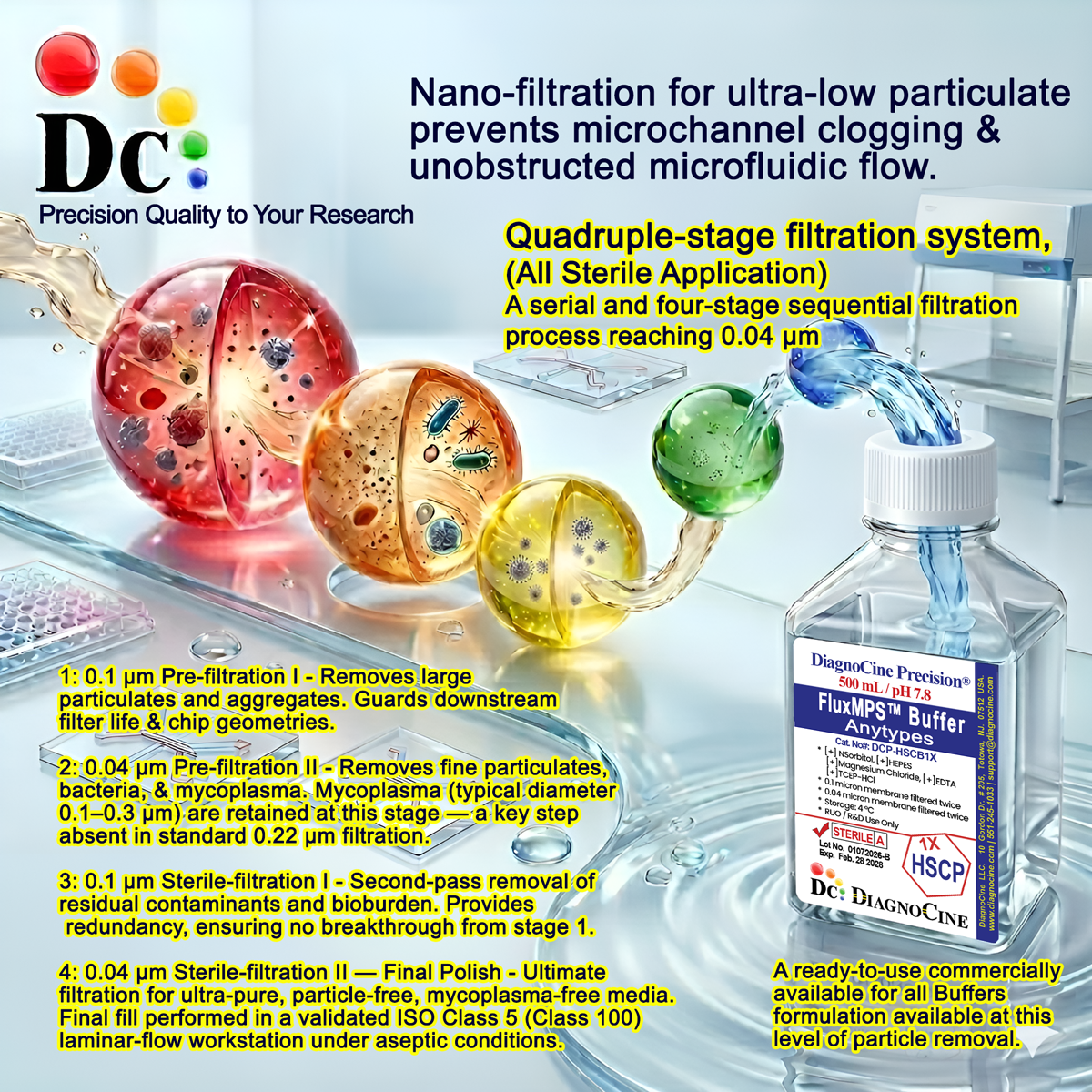
Quadruple-stage filtration system
Every batch of FluxMPS™ TBS, 10X is filtered 0.1-micron membrane twice and 0.04-micron membrane twice, sequentially removing particulate and bioburden ahead of final release testing that confirms no mycoplasma is present.
-
1
0.1 µm Pre-filtration I
First-pass removal of large particulates and aggregates, extending the working life of downstream filters.
-
2
0.04 µm Pre-filtration II
Retention of finer particulates and bioburden, including organisms in the size range relevant to mycoplasma screening.
-
3
0.1 µm Filtration II
Second 0.1 µm pass, providing redundancy ahead of the final polishing stage.
-
4
0.04 µm Filtration II — Final Polish
Second 0.04 µm pass for final polish prior to fill, supporting the product's mycoplasma-free release status.
Performance vs. conventional buffer
Sequential 0.1 µm and 0.04 µm filtration removes finer particulates and bioburden than a single 0.22 µm pass typical of conventional TBS.
© Diagnocine® — DCP-TBS10X
Where FluxMPS™ TBS, 10X is used
As a laboratory reagent, TBS is commonly used for washing, diluting, cell culture processing, Western blotting, ELISA, and multiple assays and immunohistochemistry steps, with tonicity governed by NaCl and pH governed by the Tris buffering system.
Automated Bioreactors & Robotics
An optional 0.01 µm (10 nm) ultra-filtered variant is available for automated bioreactor and robotic liquid-handling platforms where valve and sensor protection is critical.
- Total Particulate Exclusion for automated fluid paths
- Valve & Sensor Protection in closed perfusion systems
- Extended Perfusion Stability for long-duration runs
Inquiry Required: Contact support@diagnocine.com to request the 0.01 µm ultra-filtered grade of DCP-TBS10X.
Micro Physiological System (MPS) & Chip
Buffer exchange and perfusion in microfluidic and organ-on-a-chip platforms.
Wash, Dilution & Reconstitution
Isotonic washing and dilution steps where NaCl-controlled tonicity is required.
Western Blotting & Blocking
Tris-based wash and dilution buffer for blotting, blocking, and detection steps.
ELISA & Multi-Step Assays
Consistent pH and ionic background for ELISA and related multi-step assays.
Immunohistochemistry (IHC)
Rinse and dilution buffer for IHC staining and detection protocols.
Cell Culture Processing
General-purpose buffering for cell culture processing steps requiring stable, defined pH.
Full specification sheet
Measured and declared values for FluxMPS™ TBS, 10X (DCP-TBS10X), as supplied.
| Parameter | Specification |
|---|---|
| Formulation / Composition | 200 mM Tris, 1500 mM NaCl |
| Appearance | Liquid, Clear, Colorless |
| pH USP <791> | 7.4 |
| Concentration | 10X (1X, 2X, 4X, 5X available on request) |
| Parameter | Specification |
|---|---|
| Sterility | Non-sterile |
| Bioburden | Mycoplasma-free (no mycoplasma detected) |
| Nuclease / Protease Activity | Protease(-), DNase(-), RNase(-), Endonuclease(-) |
| Water Quality | ASTM Type 1 Ultrapure Water, 0.05 µS/cm, Deionized |
| Manufacturing Standard ISO 13485 | ISO 13485-certified, CE-approved facility |
| Parameter | Specification |
|---|---|
| Storage Temperature | Room Temperature; 4°C recommended for long-term storage |
| Parameter | Specification |
|---|---|
| Raw Material Grade | Tissue Culture & Molecular Biology grade |
| Traceability | Assembled and customized at DiagnoCine Precision, Totowa, New Jersey, USA |
| Manufacturing QMS | ISO 13485-certified, CE-approved facility (Suppliers of DiagnoCine Precision) |
| Production Method | Final packaging, quality assurance, and testing at the DiagnoCine R&D and Quality Testing Center |
| Intended Use | RUO — Research Use Only; not for human therapeutic use or consumption |
Full composition
Component concentrations for the 10X concentrate, as formulated per lot.
| Component | CAS Number | Concentration |
|---|---|---|
| Tris (2-amino-2-(hydroxymethyl)propane-1,3-diol) | 77-86-1 | 200 mM |
| Sodium Chloride (NaCl) | 7647-14-5 | 1500 mM |
Manufacturing & compliance
FluxMPS™ TBS, 10X is manufactured under ISO 13485-certified and CE-approved facilities (Suppliers of DiagnoCine Precision), with final packaging, quality assurance, and testing performed at the DiagnoCine R&D and Quality Testing Center.
ISO 13485:2016 QMS
Manufactured in an ISO 13485-certified, CE-approved facility.
Ultrapure Type 1 Water
ASTM 0.05 µS/cm Type 1 Ultrapure, deionized water base.
Mycoplasma-Free Release
Each lot is confirmed mycoplasma-free prior to release.
Traceable Assembly
Customization requests and assembly completed at DiagnoCine Precision, Totowa, New Jersey, USA.
Nuclease / Protease Testing
Protease(-), DNase(-), RNase(-), Endonuclease(-).
Filtration Validation
Filtered 0.1-micron membrane twice and 0.04-micron membrane twice.
pH Control
Formulated and confirmed at pH 7.4.
Documentation
Certificate of Analysis available on request.
How DCP-TBS10X compares
FluxMPS™ TBS, 10X against conventional TBS preparations.
| Parameter | DCP-TBS10X (FluxMPS™) | Conventional TBS (0.22 µm filtered) | Standard Alternative (0.22 µm filtered) |
|---|---|---|---|
| Defined pH | 7.4 | Not typically specified | Not typically specified |
| Final filtration pore size | 0.04 µm | 0.22 µm | 0.22 µm |
| Number of filtration stages | 4 | 1 | 1 |
| Mycoplasma testing | check_circle | cancel | cancel |
| Nuclease / Protease testing | check_circle | cancel | cancel |
| Ultrapure Type 1 water base | check_circle | Varies | Varies |
| ISO 13485 manufacturing | check_circle | Varies | Varies |
| Custom pH / concentration / additives | check_circle | cancel | cancel |
Frequently asked questions
Common questions about FluxMPS™ TBS, 10X (DCP-TBS10X).
Supporting literature
Curated references relevant to Tris-buffered saline chemistry and its laboratory applications.
- Good NE, et al. Hydrogen ion buffers for biological research. Biochemistry. 1966. doi:10.1021/bi00866a011
- Ferguson WJ, et al. Hydrogen ion buffers for biological research. Anal Biochem. 1980. doi:10.1016/0003-2697(80)90269-1
- Towbin H, et al. Electrophoretic transfer of proteins from polyacrylamide gels to nitrocellulose sheets. Proc Natl Acad Sci USA. 1979. doi:10.1073/pnas.76.9.4350
- Engvall E, Perlmann P. Enzyme-linked immunosorbent assay (ELISA). Immunochemistry. 1971. doi:10.1016/0019-2791(71)90454-X
- Bhatia SN, Ingber DE. Microfluidic organs-on-chips. Nat Biotechnol. 2014. doi:10.1038/nbt.2989
- Huh D, et al. Reconstituting organ-level lung functions on a chip. Science. 2010. doi:10.1126/science.1188302
- Rasooly A, Herold KE. Biosensors for the analysis of food- and waterborne pathogens and their toxins. J AOAC Int. 2006. doi:10.1093/jaoac/89.3.873
- Uphoff CC, Drexler HG. Detection of mycoplasma contamination in cell cultures. Curr Protoc Mol Biol. 2014. doi:10.1002/0471142727.mb2804s106
- Ramsden JJ. Ionic strength effects on protein and cellular interactions. Colloids Surf B Biointerfaces. 1999. doi:10.1016/S0927-7765(99)00104-1
- Malda J, et al. Of mice, men and elephants: the relation between endotoxin biosensing and biomaterials. Trends Biotechnol. 2013. doi:10.1016/j.tibtech.2013.06.002