
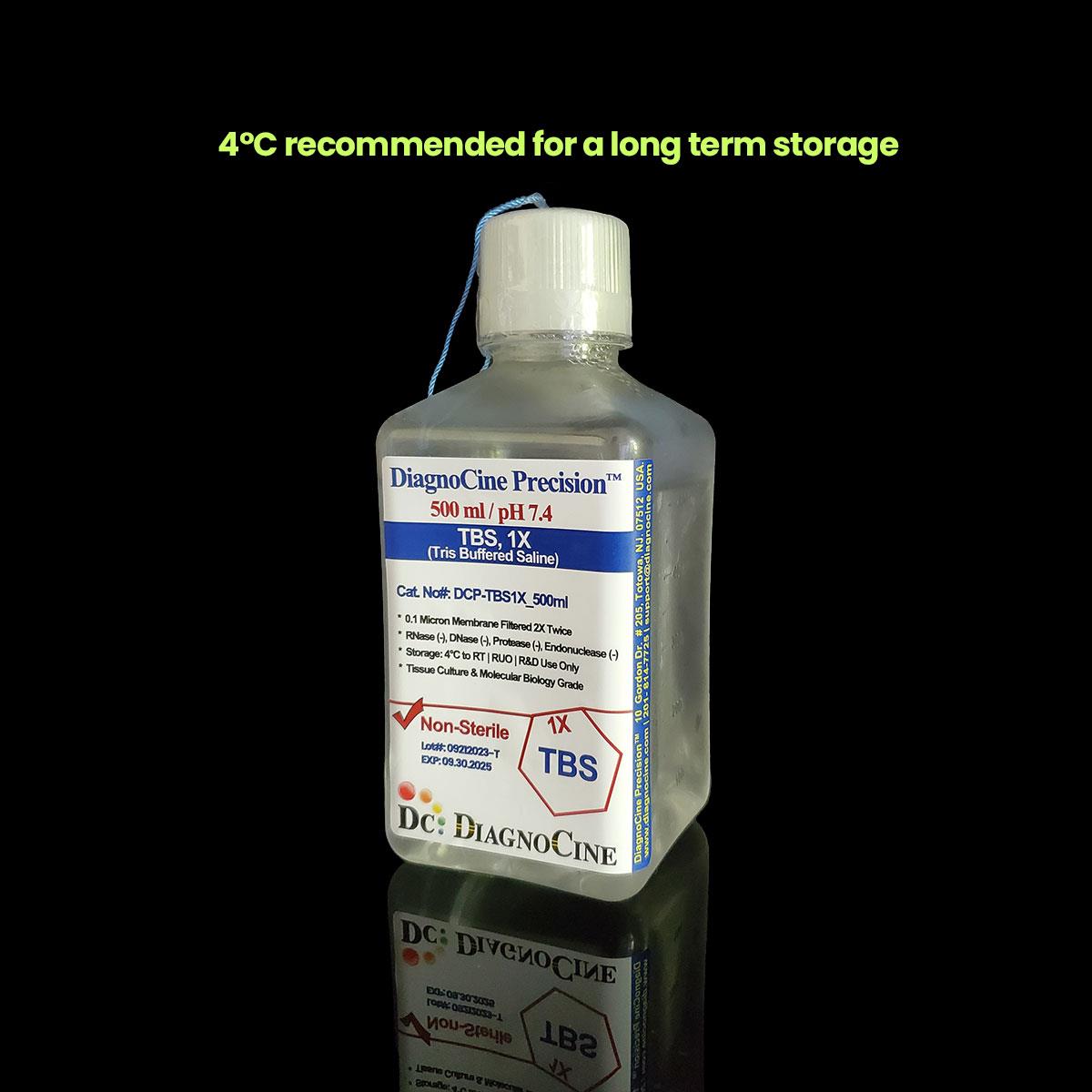
FluxMPS™ TBS, 1X (Tris Buffered Saline), Non-Sterile
FluxMPS™ TBS, 1X (Tris Buffered Saline), Non-Sterile
FluxMPS™ TBS, 1X is an MPS-grade Tris-buffered saline formulated at pH 7.4 with 150 mM NaCl and 20 mM Tris, purpose-built for washing, diluting, and processing steps across microfluidic, organ-on-a-chip (OoC), and traditional bench workflows. Reagents are passed twice (2X) through a 0.1 µm membrane filter and prepared with ASTM Type 1 ultrapure water for consistent, low-background performance in Western blotting, ELISA, and immunohistochemistry.
- Precise, stable Tris-based buffer at pH 7.4 — 150 mM NaCl / 20 mM Tris (1X formulation)
- Dual-pass 0.1 µm membrane filtration (2X) for reduced particulate carryover
- Verified free of mycoplasma, protease, DNase, RNase, and endonuclease activity
- Prepared with ASTM Type 1 ultrapure water (0.05 µS/cm), deionized
- Manufactured under ISO 13485-certified, CE-approved conditions at DiagnoCine Precision (Totowa, NJ, USA)
- Supplied as 1X, with 2X, 4X, 5X, and 10X concentration customization available on request
- Custom pH, additive, detergent, inhibitor, and protein supplementation available — contact support@diagnocine.com
- Tissue Culture & Molecular Biology grade, supplied non-sterile
- pH7.4
- Formulation150 mM NaCl, 20 mM Tris (1X)
- Concentration1X (2X, 4X, 5X, 10X on request)
- Form & AppearanceSterilized Liquid, Clear, Colorless
- Filtration0.1 µm membrane, dual-pass (2X)
- MycoplasmaNot detected
- SterilityNon-Sterile
- Water QualityASTM Type 1 Ultrapure, 0.05 µS/cm
- StorageRoom Temp; 4°C for long-term
- GradeTissue Culture & Molecular Biology
Engineered where standard buffers fail
Conventional single-pass filtered buffers can carry subvisible particulates, drift in pH and ionic strength, and introduce background into sensitive imaging and immunoassay workflows. FluxMPS™ TBS is built to eliminate those failure modes at the source.
Microchannel-safe purity
Dual-pass 0.1 µm membrane filtration removes large particulates and aggregates before final fill, supporting cleaner performance in narrow microfluidic channels.
Precise, stable pH
Formulated at pH 7.4 using Tris (pKa of approximately 8.07 at 25°C) buffered against 150 mM NaCl, giving predictable behavior across the slightly alkaline range TBS is designed for.
Ultrapure-grade water
Manufactured with ASTM Type 1 ultrapure, deionized water (0.05 µS/cm) as the base solvent for every batch.
Low background for imaging & assays
Clear, colorless formulation supports low-background use in Western blotting, ELISA, and immunohistochemistry.
Defined, traceable composition
150 mM NaCl and 20 mM Tris (CAS 77-86-1), with full chemical identity on record for every lot.
Customization on demand
pH, molarity/concentration (2X-10X), and additive, detergent, inhibitor, or protein supplementation available on request.
Single-stage 0.1 µm filtration
FluxMPS™ TBS is processed through a 0.1 µm membrane filtration architecture, with reagents passed twice (2X) through the membrane for consistent particulate reduction ahead of fill.
-
01
0.1 µm Dual-Pass Filtration
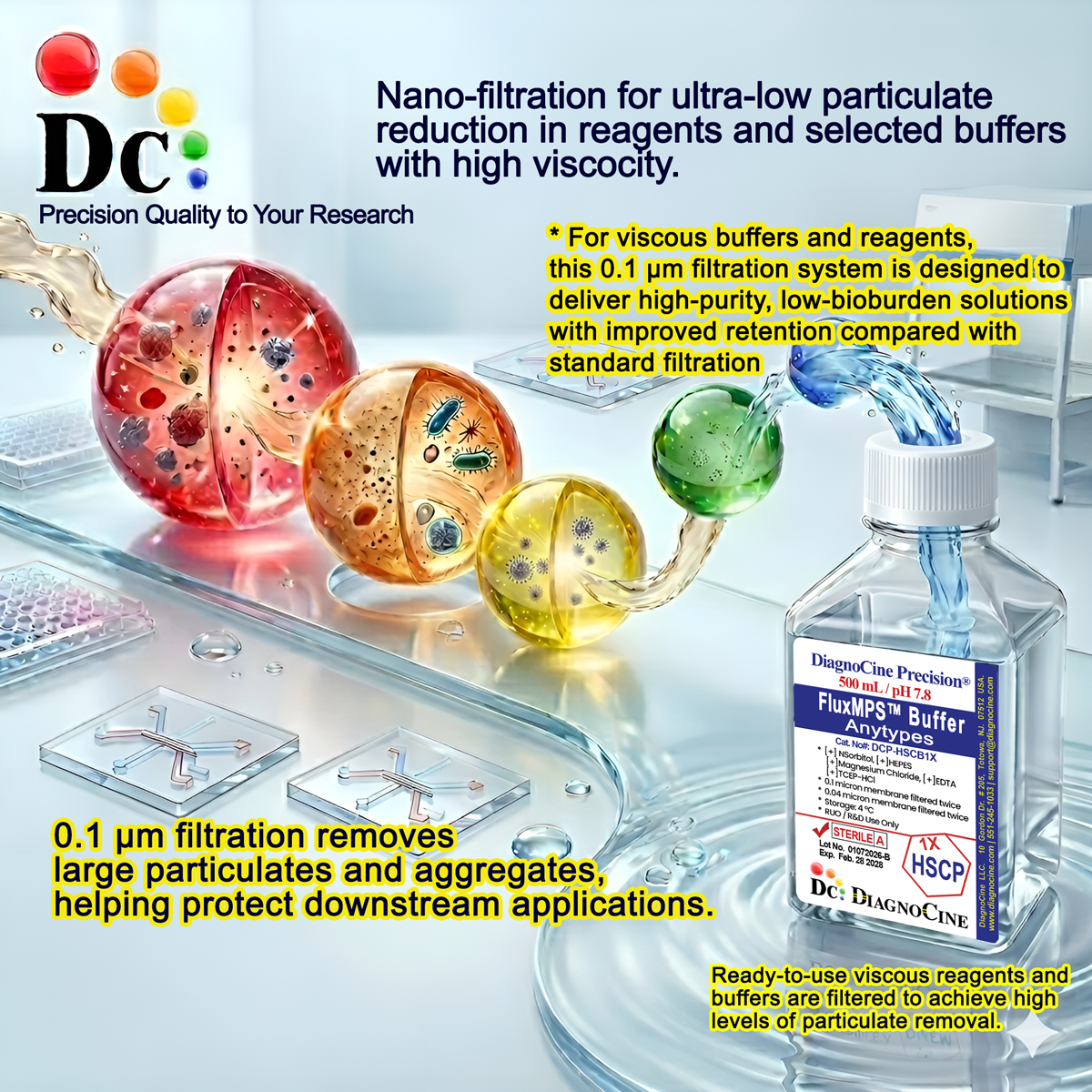
Reagents are passed twice (2X) through a 0.1 µm membrane filter, removing large particulates and aggregates and reducing bioburden. Each lot is verified free of mycoplasma contamination.
Performance vs. single unfiltered fill
Passing reagents twice through a 0.1 µm membrane filter provides an added layer of particulate and bioburden control compared to a single unfiltered fill, supporting cleaner performance in Western blotting, ELISA, and microfluidic workflows.
© Diagnocine® — DCP-TBS1X
Where FluxMPS™ TBS is used
A general-purpose Tris-buffered saline for washing, diluting, and processing steps spanning classical immunoassays to microphysiological system (MPS) and organ-on-a-chip (OoC) workflows.
Automated Bioreactors & Robotics
For automated perfusion and robotic liquid-handling platforms, an optional 0.01 µm (10 nm) ultra-filtered variant of this buffer can be requested to further protect valves, sensors, and microfluidic hardware from fine particulate accumulation over extended runs.
- Total Particulate Exclusion — finer filtration threshold for closed-loop systems
- Valve & Sensor Protection — reduced fouling risk in automated fluid paths
- Extended Perfusion Stability — supports long-duration unattended runs
Inquiry Required: the 0.01 µm ultra-filtered grade is available by request — contact support@diagnocine.com.
Micro Physiological System (MPS) & Chip
Wash and dilution buffer for chip-based culture and perfusion systems.
Wash, Dilution & Reconstitution
Standard 1X buffer for washing, diluting, and reconstituting samples and reagents.
iPSC-Derived Model Handling
Isotonic washing and processing buffer compatible with iPSC-derived model handling steps.
Endothelial & Primary Cell Perfusion
Isotonic buffer for washing and processing steps around endothelial and primary cell culture.
ELISA, Blotting & Blocking
Low-background Tris-buffered saline for Western blotting, ELISA, and immunohistochemistry protocols.
Microscopy & Optical Sensing
Clear, colorless buffer suited to low-background microscopy and optical sensing workflows.
Physical, chemical, and quality parameters
Specification values reflect this product as described by DiagnoCine Precision.
| Parameter | Specification |
|---|---|
| Formulation / Composition | 150 mM NaCl, 20 mM Tris (1X) |
| Appearance | Sterilized Liquid, Clear, Colorless |
| pH | 7.4 |
| Molarity / Concentration | 1X (2X, 4X, 5X, 10X available on request) |
| Parameter | Specification |
|---|---|
| Mycoplasma | Not detected |
| Protease | Not detected |
| DNase | Not detected |
| RNase | Not detected |
| Endonuclease | Not detected |
| Sterility | Non-Sterile |
| Manufacturing Standard ISO | ISO 13485-certified, CE-approved facility |
| Parameter | Specification |
|---|---|
| Storage Temperature | Room Temperature; 4°C recommended for long-term storage |
| Parameter | Specification |
|---|---|
| Raw Material Grade | Tissue Culture & Molecular Biology grade |
| Traceability | Customization and assembly performed at DiagnoCine Precision, Totowa, New Jersey, USA |
| Manufacturing QMS ISO | ISO 13485-certified, CE-approved |
| Production Method | Dual-pass 0.1 µm membrane filtration |
| Intended Use | RUO — Research Use Only; not for human therapeutic use or human consumption |
Full composition
Two-component Tris-buffered saline formulation, released per lot.
| Component | CAS Number | Concentration |
|---|---|---|
| Tris (Tromethamine) | 77-86-1 | 20 mM |
| Sodium Chloride (NaCl) | 7647-14-5 | 150 mM |
Manufacturing & compliance
Manufactured under ISO 13485-certified, CE-approved conditions, with final packaging, quality assurance, and testing performed at the DiagnoCine R&D and Quality Testing Center.
ISO 13485:2016 QMS
Manufactured under an ISO 13485-certified, CE-approved quality management system.
Ultrapure Type 1 Water
Prepared with ASTM Type 1 ultrapure, deionized water (0.05 µS/cm).
ISO Class 5 Fill & Finish
Fill and finish practices aligned with ISO Class 5 (Class 100) cleanroom standards.
Micro-Batch Precision
Customization requests and assembly completed at DiagnoCine Precision, Totowa, New Jersey, USA.
Endotoxin & Bioburden Testing
Testing protocols follow USP <85> Bacterial Endotoxins Test methodology as part of the ISO 13485 quality system; contact support@diagnocine.com for lot-specific data.
Particulate Testing
Particulate matter is assessed under USP <788> Method 2 guidelines as part of routine quality testing; contact support@diagnocine.com for lot-specific data.
Osmolality Testing
Osmolality testing follows USP <785> methodology; contact support@diagnocine.com for lot-specific results.
Documentation / CoA
A Certificate of Analysis is available upon request, covering pH, filtration confirmation, and sterility status for each lot.
How DCP-TBS1X compares
A structural comparison against conventionally filtered TBS and standard alternatives.
| Parameter | DCP-TBS1X (FluxMPS™) | Conventional (0.22 µm filtered) | Standard Alternative (0.22 µm filtered) |
|---|---|---|---|
| Defined molarity / tight pH control | check_circle | check_circle | cancel |
| Final filtration pore size | 0.1 µm (dual-pass) | 0.22 µm | 0.22 µm |
| Number of filtration stages | 1 (2X pass) | 1 (single pass) | 1 (single pass) |
| Verified mycoplasma-free | check_circle | cancel | cancel |
| ASTM Type 1 ultrapure water | check_circle | cancel | cancel |
| Manufacturing QMS (ISO 13485) | check_circle | check_circle | cancel |
| Microfluidic channel compatibility | check_circle | cancel | cancel |
| Custom pH / concentration formulation | check_circle | cancel | cancel |
Frequently asked questions
Common questions about FluxMPS™ TBS, 1X (DCP-TBS1X).
Supporting literature
Curated references on Tris buffer chemistry and its use in immunoassays, sample preparation, and microfluidic/organ-on-a-chip systems.
- Good NE, Winget GD, Winter W, Connolly TN, Izawa S, Singh RM. Hydrogen ion buffers for biological research. Biochemistry. 1966. doi:10.1021/bi00866a011
- Ferguson WJ, Braunschweiger KI, Braunschweiger WR, et al. Hydrogen ion buffers for biological research. Anal Biochem. 1980. doi:10.1016/0003-2697(80)90269-1
- Stoll VS, Blanchard JS. Buffers: principles and practice. Methods Enzymol. 1990. doi:10.1016/0076-6879(90)82008-p
- Towbin H, Staehelin T, Gordon J. Electrophoretic transfer of proteins from polyacrylamide gels to nitrocellulose sheets: procedure and some applications. Proc Natl Acad Sci USA. 1979. doi:10.1073/pnas.76.9.4350
- Engvall E, Perlmann P. Enzyme-linked immunosorbent assay (ELISA). Quantitative assay of immunoglobulin G. Immunochemistry. 1971. doi:10.1016/0019-2791(71)90454-x
- Huh D, Matthews BD, Mammoto A, Montoya-Zavala M, Hsin HY, Ingber DE. Reconstituting organ-level lung functions on a chip. Science. 2010. doi:10.1126/science.1188302
- Bhatia SN, Ingber DE. Microfluidic organs-on-chips. Nat Biotechnol. 2014. doi:10.1038/nbt.2989
- Zhang B, Korolj A, Lai BFL, Radisic M. Advances in organ-on-a-chip engineering. Nat Rev Mater. 2018. doi:10.1038/s41578-018-0034-7
- Low LA, Mummery C, Berridge BR, Austin CP, Tagle DA. Organs-on-chips: into the next decade. Nat Rev Drug Discov. 2021. doi:10.1038/s41573-020-0079-3