


HBS, 1X (HEPES-Buffered Saline), 20mM HEPES, Sterile
FluxMPS™ HBS, 1X (HEPES-Buffered Saline), 20mM HEPES, Sterile
DCP-HBS1X is a quadruple-stage, ultra-filtered HEPES-buffered saline formulated to hold a stable pH of 7.4 across a buffering range of pH 6.0 to 8.0. Built with a defined 20 mM HEPES concentration and a balanced saline backbone, it is engineered for microchannel-safe use in organ-on-a-chip (OoC), microfluidic, and molecular biology workflows where CO2-dependent bicarbonate buffering is impractical.
- Quadruple-stage sterile filtration: 0.1 µm membrane (twice) and 0.04 µm membrane (twice)
- Defined 20 mM HEPES concentration at pH 7.4
- Effective buffering capacity across pH 6.0 to 8.0
- Balanced saline formulation with sodium chloride, potassium chloride, magnesium sulfate, and calcium chloride
- Sterility confirmed: no bacterial or fungal growth after 14 days of incubation, per USP specification
- Manufactured under ISO 13485-certified, CE-approved facilities
- Stored at 2-8°C; 24-month shelf life from date of manufacture
- Custom pH, molarity, and salt composition available on request
- pH7.4
- Buffering Range6.0 to 8.0
- HEPES Concentration20 mM
- Sodium Chloride107 mM
- Potassium Chloride6 mM
- Filtration0.1 µm x2 + 0.04 µm x2
- AppearanceClear solution
- Storage2-8°C
- Shipping ConditionRoom Temperature
- Shelf Life24 months
Engineered where standard saline buffers fail
Conventional 0.22 µm-filtered saline can carry subvisible particulates that accumulate in narrow microchannels, drift in pH under CO2-variable conditions, and introduce assay background. DCP-HBS1X addresses each failure mode directly.
Microchannel-safe purity
Final 0.04 µm membrane pass reduces particulate load beyond a single 0.22 µm filtration step.
Precise, stable pH
20 mM HEPES holds pH 7.4 with effective buffering capacity across pH 6.0 to 8.0, independent of atmospheric CO2.
Ultrapure-grade water
Formulated with Ultrapure Type 1 water (18.2 MΩ·cm) per USP <85>.
Low background for imaging & assays
Chemically and enzymatically stable with low absorbance in the visible and ultraviolet range, suitable for flow cytometry.
Defined, traceable composition
Every salt component is formulated at a stated mM and mg/L concentration and released against fixed specifications.
Customization on demand
pH, molarity, and salt composition can be adjusted to protocol on request.
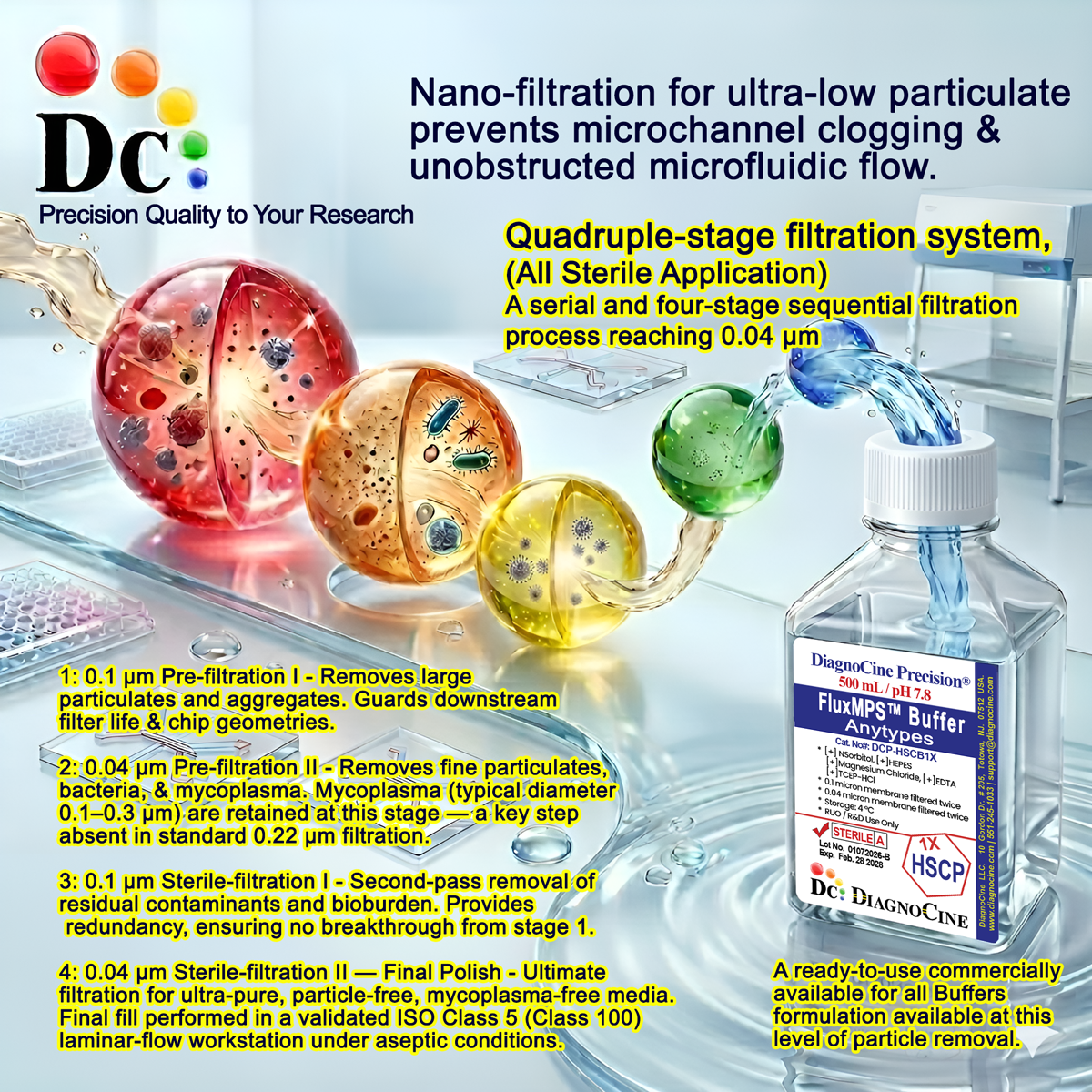
Quadruple-stage filtration system
DCP-HBS1X is sterile-filtered through a 0.1 µm membrane twice and a 0.04 µm membrane twice in a controlled sterile environment, preventing mycoplasma-scale contamination and supporting microchannel-safe purity.
-
1
0.1 µm Pre-filtration I
Removes large particulates and aggregates, protecting downstream membranes.
-
2
0.04 µm Pre-filtration II
Retains fine particulates and bioburden, including mycoplasma-scale organisms as small as approximately 0.2 microns.
-
3
0.1 µm Sterile-filtration I
Second-pass redundancy through a 0.1 µm membrane in a sterile fill environment.
-
4
0.04 µm Sterile-filtration II — Final Polish
Ultimate polish pass confirming sterility: no bacterial or fungal growth after 14 days of incubation, per USP specification.
Performance vs. conventional buffer
Sequential 0.1 µm and 0.04 µm filtration passes remove finer particulates than a single 0.22 µm pass typical of conventional saline buffers.
© Diagnocine® — DCP-HBS1X
Where DCP-HBS1X performs
HEPES-buffered saline maintains a stable pH environment more effectively than bicarbonate buffers in settings where CO2 levels cannot be controlled, making it a core reagent across cell culture, molecular biology, and microfluidic workflows. DCP-HBS1X is also available bundled with FAO Blue (Fatty Acid Oxidation Detection Reagent) for fatty acid oxidation assays; contact support@diagnocine.com for bundle details.
Automated Bioreactors & Robotics
An optional 0.01 µm (10 nm) ultra-filtered variant is available for automated bioreactors and robotic liquid-handling platforms where valve and sensor protection is critical.
- Total Particulate Exclusion for closed-loop perfusion systems
- Valve & Sensor Protection in automated dispensing hardware
- Extended Perfusion Stability for long-duration runs
Inquiry Required: the 0.01 µm ultra-filtered grade is available upon request; contact support@diagnocine.com.
Micro Physiological System (MPS) & Chip
Stable, CO2-independent pH buffering for closed microfluidic circuits.
Wash, Dilution & Reconstitution
Used to neutralize complex proteins that may inactivate trypsin during trypsinization.
iPSC-Derived Model Handling
Physiological pH support during handling of sensitive iPSC-derived cell types.
Endothelial & Primary Cell Perfusion
Balanced saline composition supports perfusion of primary and endothelial cell types.
ELISA, Blotting & Blocking
Stable pH background for antibody-based detection workflows.
Microscopy & Optical Sensing
Low absorbance in the visible and ultraviolet range supports flow cytometry and imaging.
Full specification sheet
Every figure below reflects DCP-HBS1X as manufactured and released.
| Parameter | Specification |
|---|---|
| Formulation / Composition | HEPES-buffered saline: HEPES, NaCl, KCl, MgSO4, CaCl2 |
| Appearance | Clear solution |
| pH USP <791> | 7.4 (at 1X concentration) |
| Molarity / Concentration | 20 mM HEPES |
| Buffering Range | pH 6.0 to 8.0 |
| Parameter | Specification |
|---|---|
| Sterility USP <71> | No bacterial or fungal growth after 14 days of incubation |
| Filtration | 0.1 µm membrane (twice) and 0.04 µm membrane (twice), sterile environment |
| Water Quality | Ultrapure Type 1 water (18.2 MΩ·cm) USP <85> |
| Manufacturing Standard | ISO 13485-certified, CE-approved ISO 13485 |
| Parameter | Specification |
|---|---|
| Storage Temperature | 2-8°C, away from bright light |
| Shipping Condition | Room Temperature |
| Shelf Life | 24 months |
| Expiry | Use before the expiry date on the product label |
| Parameter | Specification |
|---|---|
| Manufacturing QMS | ISO 13485-certified |
| Regulatory Alignment | CE-approved facilities |
| Final Packaging & QA | DiagnoCine R&D and Quality Testing Center |
| Production & Customization | DiagnoCine Precision, Totowa, New Jersey, USA |
| Intended Use | For Research Use Only (RUO) |
Full composition
All salt components below are released against the stated mM and mg/L concentrations, per lot.
| Component | CAS Number | Concentration |
|---|---|---|
| HEPES (at pH 7.4) | 7365-45-9 | 20 mM (4766.024 mg/L) |
| Sodium chloride (NaCl) | 7647-14-5 | 107 mM (6253.08 mg/L) |
| Potassium chloride (KCl) | 7447-40-7 | 6 mM (447.309 mg/L) |
| Magnesium sulfate (MgSO4) | 7487-88-9 | 1.2 mM (144.439 mg/L) |
| Calcium chloride (CaCl2) | 10043-52-2 | 2 mM (221.960 mg/L) |
Manufacturing & compliance
DCP-HBS1X is manufactured, filled, and released under a controlled quality system.
ISO 13485:2016 QMS
Manufactured under ISO 13485-certified and CE-approved facilities (Suppliers of DiagnoCine Precision).
Ultrapure Type 1 Water
Formulated with Ultrapure Type 1 water (18.2 MΩ·cm).
Sterile Fill & Finish
Filtered through a 0.1 µm membrane twice and a 0.04 µm membrane twice in a sterile environment.
Final Packaging & QA
All final packaging, quality assurance, and testing are done at the DiagnoCine R&D and Quality Testing Center.
Sterility Testing USP <71>
No bacterial or fungal growth is observed after 14 days of incubation, as per USP specification.
Cultural Response
Growth promotion capacity is assessed qualitatively by cell morphology and quantitatively by cell counts compared to a control medium.
Customization & Assembly
All specific customization requests and assembly were accomplished at DiagnoCine Precision in Totowa, New Jersey, USA.
Documentation / CoA
A Certificate of Analysis is available for this lot upon request.
How DCP-HBS1X compares
A side-by-side view of DCP-HBS1X against conventional buffered saline preparations.
| Parameter | DCP-HBS1X (FluxMPS™) | Conventional (0.22 µm filtered) | Standard alternative (0.22 µm filtered) |
|---|---|---|---|
| Defined 20 mM HEPES buffering | check_circle | cancel | cancel |
| Final filtration pore size | 0.04 µm | 0.22 µm | 0.22 µm |
| Number of filtration stages | 4 | 1 | 1 |
| 14-day USP sterility incubation testing | check_circle | cancel | cancel |
| Manufactured under ISO 13485 QMS | check_circle | cancel | cancel |
| Custom formulation available | check_circle | cancel | cancel |
Frequently asked questions
Common questions about DCP-HBS1X.
Supporting literature
Curated literature relevant to HEPES buffering and its use in cell culture and microfluidic workflows.
- Good, N.E. et al. Hydrogen ion buffers for biological research. Biochemistry. doi:10.1021/bi00866a011
- Ferrell, W.J. HEPES buffer. Chem. Phys. Lipids. doi:10.1016/0009-3084(76)90042-1
- Zheng, F. et al. Organ-on-a-chip systems: microengineering to biomimic living systems. Small. doi:10.1002/smll.201501026
- Bhatia, S.N., Ingber, D.E. Microfluidic organs-on-chips. Nat. Biotechnol. doi:10.1038/nbt.2989
- Freshney, R.I. Culture of Animal Cells: A Manual of Basic Technique and Specialized Applications. doi:10.1002/9780470649367
- Ng, K.W. et al. pH regulation in microfluidic cell culture. Lab Chip. doi:10.1039/C7LC00568G
- Drewes, J.E. et al. Detection of mycoplasma contamination and filtration approaches. In Vitro Cell. Dev. Biol. Anim. doi:10.1007/s11626-014-9822-x
- Yew, T.W. et al. Buffer selection for flow cytometry applications. Cytometry A. doi:10.1002/cyto.a.23604