.jpg "/Content/Upload/Product/Rat_ELISA_kits_Diagnocine_1200_1200(57).jpg")
Rat Cardiac Troponin Ⅰ(cTn-Ⅰ) ELISA kit
The Ultimate 1-Stop ELISA Marketplace:
60,000+ ELISA kits Available to Serve Scientists from All Fields of Life Science
Always Powered by Diagnocine for Precision Research.
Most comprehensive buffers, reagents and detection agents are provided with each kit to optimize data output.
All-inclusive format covers everything from sample preparation to signal detection. Every step can be customized and optimized for your precision research.
DiagnoCine Precision buffers and reagents are Made in USA ISO 13485 Certified
Why waste time searching for your ELISA kit when you can get everything in one place? Diagnocine can provide you with all the ELISA needs you have (customized ELISAs also available) on the planet through a single, streamlined ordering process.
* all types of species
* HRP and AP detection
* Low target signal enhancement
* Inquire about a trial version or a customized version
4 core reagents below are included with every order, plus 1 of the 2 detection-specific reagents (matched automatically to your kit type) — 5 components, every time.
+ the 5th component, matched to your kit's detection method:
If you have any questions or need additional information, please call us at 551-245-1033 or email us at support@diagnocine.com. Our team will be happy to assist you.
Universal Compatibility
All buffers and detection reagents work seamlessly across target proteins, bridging the gap in assay consistency.
1-Stop Convenience
Consolidate your lab's purchasing. Source all ELISA needs and experience optimal buffers and reagents in a single shipment.
Enhanced Precision
Designed by scientists for scientists, all components are engineered to deliver sharper results and an optical signal.
Rat Cardiac Troponin Ⅰ(cTn-Ⅰ) ELISA kit
Sandwich quantitative immunoassay for Cardiac Troponin Ⅰ(cTn-Ⅰ) in rat serum, plasma, tissue homogenates available in multiple catalog sizes:
Note: Please send inquiries regarding Trial 24T orders to support@diagnocine.com.
| Target name | Cardiac Troponin Ⅰ(cTn-Ⅰ) |
| Uniprot No. | P23693 |
| Species | Rattus norvegicus (Rat) |
| Sample types | serum, plasma, tissue homogenates |
| Detection range | 31.25pg/mL-2000pg/mL |
| Sensitivity | 15.6pg/mL |
| Assay time | 1-5h |
| Sample loading volume | 50-100μL |
| Detection wavelength | 450 nm |
| Assay principle | Sandwich (Quantitative) |
| Data analysis | Standard curve + Curve Expert software |
| Research area | Cardiovascular |
| Storage condition | 2-8°C (see protocol for full details) |
| Shipping condition | 4 °C |
| Shelf life | 6 months |
10 business days
Processing + 3-5 days shipping
In Stock : USA
Worldwide shipping available
Antibody capture
450 nm detection
Standard curve
Quantification
In this sandwich ELISA, Cardiac Troponin Ⅰ(cTn-Ⅰ) in the sample is captured between a pre-coated capture antibody and a detection antibody. Signal intensity is proportional to analyte concentration. Quantification uses a standard curve fitted with Curve Expert software, covering 31.25pg/mL-2000pg/mL with a minimum detectable dose of 15.6pg/mL.
This ELISA kit provides quantitative measurement of cardiac troponin I (cTn-I) in rat serum, plasma, and tissue homogenates, supporting cardiovascular injury research. Because cTn-I is the gold-standard biomarker for myocardial damage yet circulates at extremely low concentrations in baseline and early injury states, this kit is engineered to resolve subtle changes in troponin release across both systemic and tissue-level compartments.
Detection Range: The 31.25–2000 pg/mL range spans from near-baseline circulating cTn-I levels in healthy rats through the elevated concentrations seen after ischemia-reperfusion or cardiotoxic drug exposure, minimizing the need for serial dilutions in most acute injury models.
- Time-dependent cTnI breakdown occurs during global ischemia independent of reperfusion. cTnI breakdown during ischemia is further increased in presence of antioxidants. ROS generated during ischemia may play cTnI protective role. PMID: 15142843
- cardiac Troponin I Thr144 plays an important role in the acute acceleration of relaxation, whereas Ser23/Ser24 contributes to relaxation during more prolonged activation of protein kinase C by endothelin PMID: 16236710
- GATA elements control repression of cTNI promoter activity in skeletal muscle cells. PMID: 17875210
- Overexpression of heat shock protein 27 protects against ischaemia/reperfusion-induced cardiac dysfunction via stabilization of troponin I and T. PMID: 18397962
- cTnI-R145G expression influences the response to adrenergic stimulation dependent on the receptor subtype PMID: 18548271
- Metabolic inhibition of cardiomyocytes induces a parallel release of intact cTnI and its degradation products, starting only after onset of irreversible cardiomyocyte damage. PMID: 18721805
- the nNOS-PMCA4b complex regulates contractility via cAMP and phosphorylation of both PLB and cTnI. PMID: 19278978
- Data show that dual expression of two CM mutants, tropomyosin mutant A63V and cardiac troponin mutant R146G, were shown to additively slow myocyte relaxation beyond either mutant studied in isolation. PMID: 20161772
- Ulinastatin may protect myocardium from the damage resulted from sepsis in a rat model, probably by lowering expressions of cTnI, TNF-alpha and ET-1. PMID: 20594472
- Aan increase in calpain activity may enhance cTnI degradation in the myocardium of tail-suspended rats. PMID: 20945043
- Cardiac function and phosphorylation of PLB and cTnI were compared in pacing, isoproterenol treatment, and combined pacing and isoproterenol treatment in isolated working heart. PMID: 21876643
- PKC phosphorylation of cTnI may be maladaptive and potentially associated with cardiac dysfunction PMID: 22052912
- Structural dynamics of C-domain of cardiac troponin I protein in reconstituted thin filament. PMID: 22207765
- cTnC, cTnI, cTnT and cTm are not only present in myofilaments of ventricular cardiomyocytes in culture but are also within their nuclei; significantly, these four proteins appear between days 3 and 5 in both myofilaments and nuclei PMID: 22364878
- differential histidine ionization may be necessary for cTnI A164H to act as a molecular sensor capable of modulating sarcomere performance in response to changes in the cytosolic milieu PMID: 22500757
- the functional impact of cardiac troponin I (cTnI) phosphorylation by protein kinase A PMID: 22684024
- Normal developing myocardium and skeletal muscle transiently share both sk-fMHC and cTn-I proteins. PMID: 22808244
- Hypertrophic cardiomyopathy related mutations R146G/Q and R163W impact interactions between cTnI and cardiac troponin C or actin. PMID: 23246786
- Mutation in the C helix of cTnC can reduce Ca2+ binding affinity and cTnC-cTnI interaction. PMID: 23454346
- A cutoff value of 4.8ng/mL for cTnI could be used as early as 8h after MI to accurately identify infarct in this model, whereas echocardiographic images taken 48h after MI predicted the infarcted area 14days after MI. PMID: 23764111
- Data indicate that the serum TnI level was significantly greater in the acute coronary syndrome (ACS) group compared to the control group. PMID: 23904327
- molecular determinants of cardiac myocyte performance as conferred by isoform-specific TnI residues PMID: 24853739
- The findings elucidate the pathogenesis of MI, and the gradual increase in serum adropin could be a novel diagnostic marker and serve as an alternative to troponin-I measurement for diagnosing MI. PMID: 24932661
- Arsenic induced ventricular hypertrophy occurs via MEF2A/CAMKK2/CALM3/TNNI3 signaling. PMID: 25089838
- Results suggest that weakened troponin C interaction with cTnI, via PKA phosphorylation of cTnI, may slow thin filament activation and result in increased myofilament relaxation kinetics PMID: 25185555
- The present study utilizes viral gene transfer of cTnI with phosphomimetic S43D and/or S45D substitutions to evaluate their individual and combined influences on function in intact adult cardiac myocytes. PMID: 25481661
- This study suggests that cTnI point of care tests can accurately determine heat stroke (HS) severity and could serve as simple, portable, cost-effective HS field tests. PMID: 26290107
- cTnIS43/45N is a functionally conservative substitution, and may be appropriate for use as a phospho-null in rodent models designed for studies on PKC modulation of cardiac performance PMID: 26869200
- the interaction between cTnC and cTnI in skinned papillary muscle strips is dependent on sarcomere length PMID: 26944554
- Cardiac troponin I mutation P83S present in hypertrophic cardiomyopathy changes the contractile myofibril properties and modulation by PKA-mediated phosphorylation. PMID: 27150586
- These findings demonstrate that S-nitrosylation and S-glutathionylation exert opposing effects on Ca(2+) sensitivity in mammalian FT muscle fibers, mediated by competitive actions on Cys134 of TnIf. PMID: 27974300
- PKC phosphorylates cardiac troponin I (cTnI) S23/24, S43/45 and T144 to fine tune myocyte function. PMID: 28587770
- Troponin I interaction with calcium and Troponin C in cardiac muscle PMID: 28864299
- Compared to cTnI(WT), both truncations displayed greater Ca(2+)-sensitivity and faster cross-bridge attachment rates at both SLs. Furthermore, cTnI(1-167) slowed MgADP release rate and enhanced cross-bridge binding. Our findings imply that cTnI-MD truncations affect the blocked-to closed-state transition(s) and destabilize the closed-state position of tropomyosin. PMID: 28958680
- Pim-1 is a novel kinase that phosphorylates cTnI primarily at Ser23/24 and Ser150 in cardiomyocytes, which in turn may modulate myofilament function under a variety of physiological and pathophysiological conditions. PMID: 29544221
Intra-assay Precision (Precision within an assay): CV%<8% | ||||||
Three samples of known concentration were tested twenty times on one plate to assess. | ||||||
Inter-assay Precision (Precision between assays): CV%<10% | ||||||
Three samples of known concentration were tested in twenty assays to assess. | ||||||
These standard curves are provided for demonstration only. A standard curve should be generated for each set of samples assayed. | ||||||
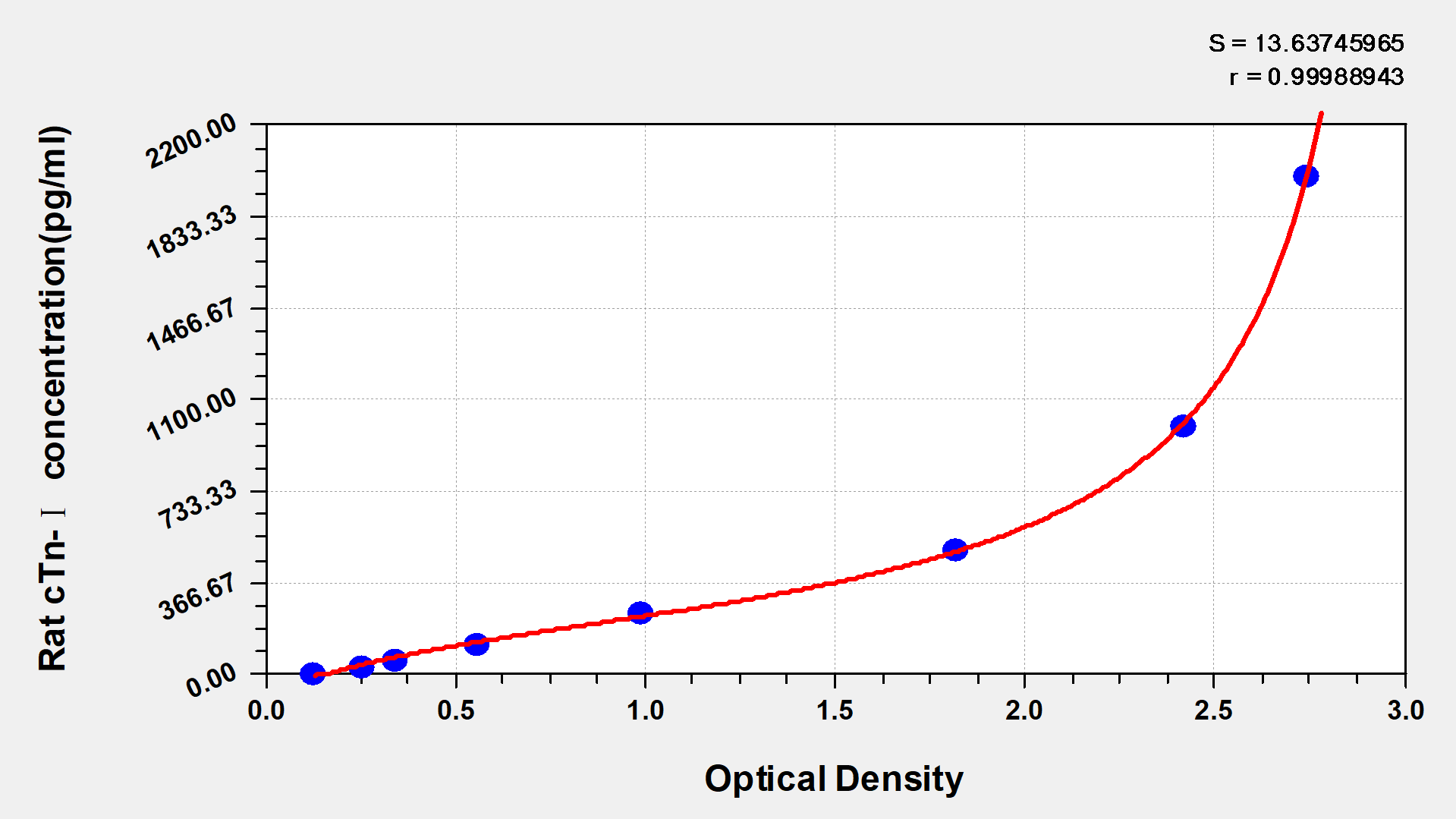 | ||||||
pg/ml | OD1 | OD2 | Average | Corrected | ||
2000 | 2.793 | 2.634 | 2.713 | 2.575 | ||
1000 | 2.422 | 2.367 | 2.394 | 2.256 | ||
500 | 1.825 | 1.778 | 1.802 | 1.663 | ||
250 | 0.992 | 0.979 | 0.986 | 0.847 | ||
125 | 0.568 | 0.551 | 0.559 | 0.421 | ||
62.5 | 0.349 | 0.353 | 0.351 | 0.213 | ||
31.25 | 0.258 | 0.264 | 0.261 | 0.122 | ||
0 | 0.142 | 0.135 | 0.139 |
| ||
To assess the linearity of the assay, samples were spiked with high concentrations of rat cTn-Ⅰ in various matrices and diluted with the Sample Diluent to produce samples with values within the dynamic range of the assay. | ||||||
| Sample | Serum(n=4) | ||||
1:1 | Average % | 92 | ||||
Range % | 85-98 | |||||
1:2 | Average % | 89 | ||||
Range % | 82-96 | |||||
1:4 | Average % | 97 | ||||
Range % | 92-103 | |||||
1:8 | Average % | 106 | ||||
Range % | 100-111 | |||||
The recovery of rat cTn-Ⅰspiked to levels throughout the range of the assay in various matrices was evaluated. Samples were diluted prior to assay as directed in the Sample Preparation section. | ||||||
Sample Type | Average % Recovery | Range | ||||
Serum (n=5) | 93 | 88-99 | ||||
EDTA plasma (n=4) | 99 | 92-106 | ||||