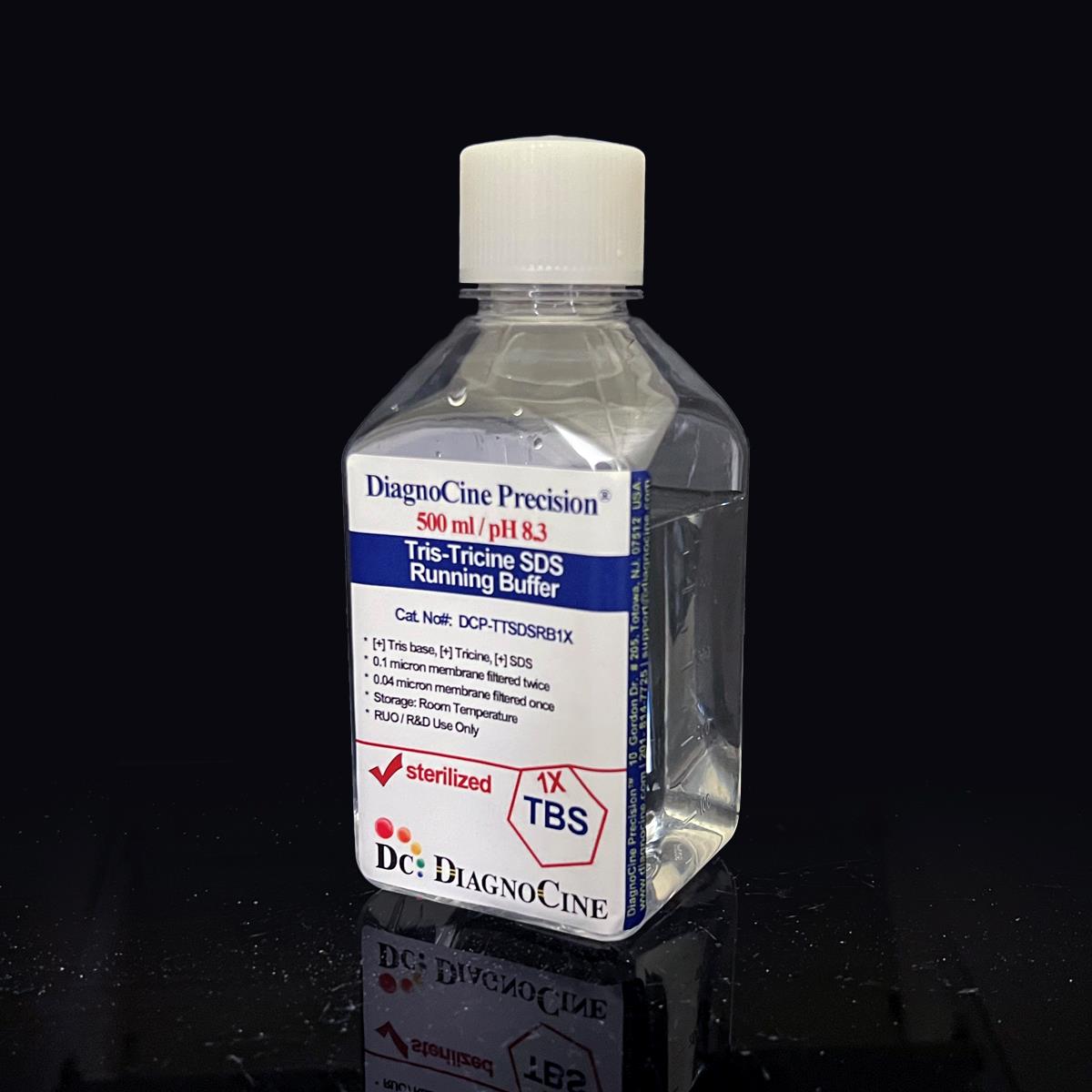
Tris-Tricine SDS Running Buffer [1X]
FluxMPS™ Tris-Tricine SDS Running Buffer [1X]
A ready-to-use, sterile 1X Tris-Tricine SDS running buffer engineered for high-resolution SDS-PAGE separation of low molecular weight proteins and peptides (1-100 kDa) and Western blotting. Buffered at a stable pH 8.3 with defined 100 mM Tris, 100 mM Tricine, and 0.1% SDS, and finished through DiagnoCine's quadruple-stage membrane filtration for MPS-grade, microchannel-safe purity.
- Quadruple-stage filtration — 0.1-micron membrane filtered twice and 0.04-micron membrane filtered twice
- Sterile, ultrapure 1X buffer optimized for 1-100 kDa protein and peptide resolution
- Stable pH 8.3 environment for consistent, reproducible electrophoretic separation
- Ultrapure Type 1 water (18.2 MΩ·cm) formulation base
- ISO Class 5 (Class 100) aseptic fill and finish
- DNase- and RNase-free by direct incubation testing
- Microchannel-safe purity suitable for OoC/MPS-adjacent workflows
- Customization available — concentration, pH, and additive modifications on request
- pH8.3
- Tris100 mM
- Tricine100 mM
- SDS0.1%
- AppearanceClear, colorless liquid
- Filtration0.1 µm x2 + 0.04 µm x2
- SterilityFiltered in sterile environment
- DNase / RNaseNone detected
- StorageRoom temperature
- Shelf Life2 years
Engineered where standard running buffers fall short
Conventional 0.22 µm-filtered running buffers can carry subvisible particulates, inconsistent pH, and background contaminants into sensitive gel and blot workflows. FluxMPS™ buffers are built to a higher purity standard from the first fill.
Microchannel-safe purity
Quadruple-stage 0.1 µm / 0.04 µm membrane filtration reduces particulate load beyond standard single-pass 0.22 µm filtration.
Precise, stable pH
Defined 100 mM Tris and 100 mM Tricine deliver a consistent pH 8.3 environment for reproducible electrophoretic migration.
Ultrapure-grade water
Formulated with Ultrapure Type 1 water (18.2 MΩ·cm) consistent with USP <85> water-quality expectations.
Low background for blotting & assays
Ultra-filtered composition supports clean Western blot transfer and downstream detection of low molecular weight proteins.
Defined, traceable composition
Every lot is prepared to the same Tris, Tricine, and SDS concentrations, tested for DNase and RNase activity before release.
Customization on demand
Alternate concentrations, pH, or additive supplementation available — contact support@diagnocine.com.
Quadruple-stage filtration system
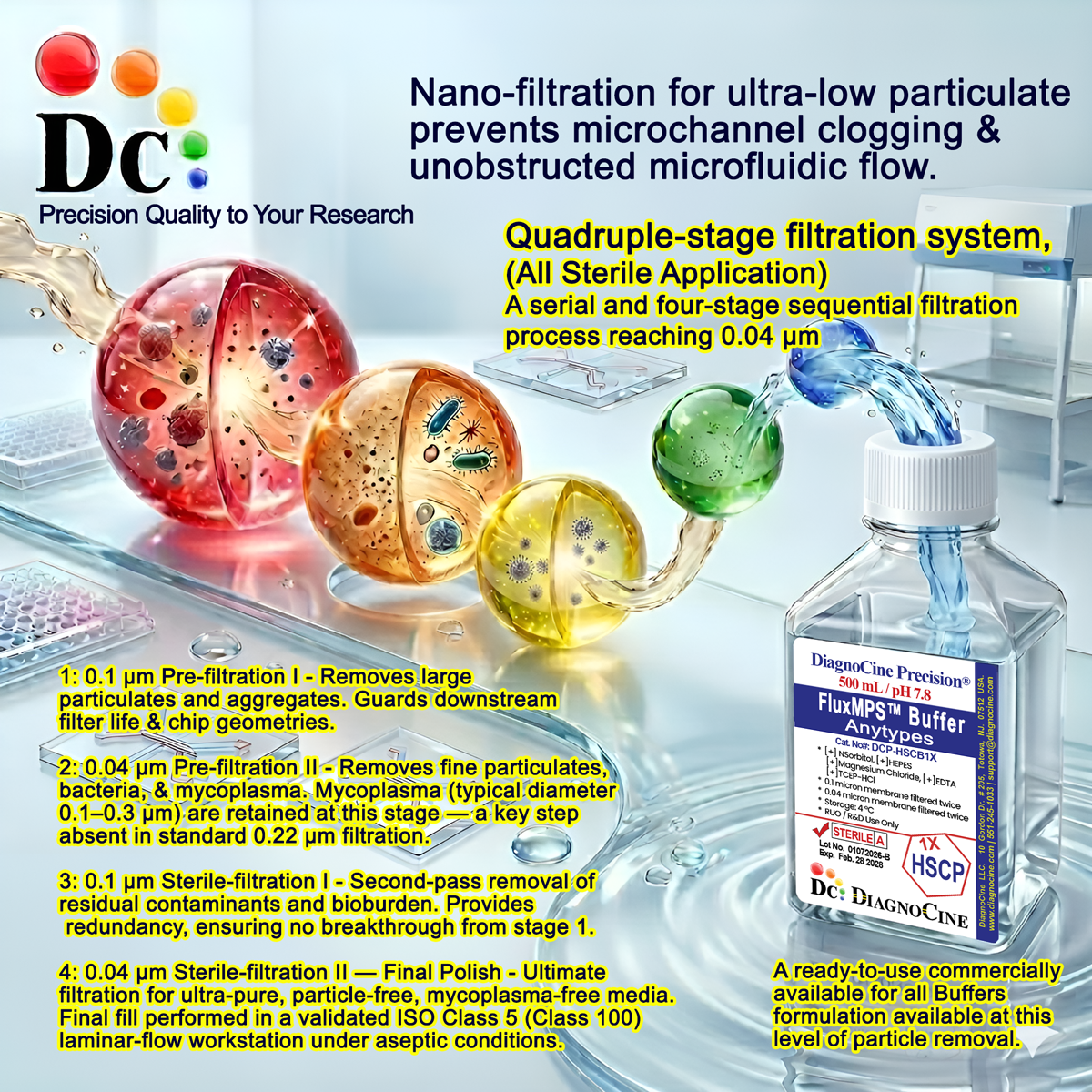
DCP-TTSDSRB1X is filtered with 0.1-micron membrane filtration twice and 0.04-micron membrane filtration twice, delivering a level of particulate control beyond a single-pass 0.22 µm filtered buffer.
-
1
0.1 µm Pre-filtration I
First-pass 0.1 µm membrane filtration removes large particulates and aggregates, protecting downstream filter capacity.
-
2
0.04 µm Pre-filtration II
First-pass 0.04 µm membrane filtration retains fine particulates and bioburden ahead of final sterile filtration.
-
3
0.1 µm Sterile-filtration I
Second-pass 0.1 µm membrane filtration provides redundant sterile-filtration assurance.
-
4
0.04 µm Sterile-filtration II — Final Polish
Second-pass 0.04 µm membrane filtration performed in a sterile environment provides the final polish of the quadruple-stage architecture.
Performance vs. conventional buffer
Sequential 0.1 µm and 0.04 µm membrane filtration, repeated across four passes, removes finer particulates than a single 0.22 µm pass typical of conventional running buffers.
© Diagnocine® — DCP-TTSDSRB1X
Where DCP-TTSDSRB1X performs
READY-to-USE 1X Tris-Tricine SDS running buffer is a specialized electrophoresis buffer for separating and resolving small proteins and peptides, typically 1-30 kDa, and is usable for larger proteins up to approximately 100 kDa with some limitations in resolution compared to Tris-Glycine SDS buffer.
Automated Bioreactors & Robotics
Buffers used on automated liquid handlers and dispensing robots benefit from ultra-filtered chemistry that minimizes valve and sensor fouling. An optional 0.01 µm (10 nm) ultra-filtered variant is available for high-throughput automated bioreactor and robotics platforms — inquire for details.
- Total Particulate Exclusion: Finer membrane polishing reduces particulate carry-over into automated fluidic paths.
- Valve & Sensor Protection: Ultra-clean formulation helps protect precision valves and inline sensors from fouling.
- Extended Perfusion Stability: Consistent chemistry supports stable performance across extended automated runs.
Inquiry Required: Contact support@diagnocine.com to request the 0.01 µm ultra-filtered grade of this buffer for automated bioreactor or robotics platforms.
Micro Physiological System (MPS) & Chip
Ultra-filtered buffer chemistry compatible with wash and preparation steps around microfluidic devices and chips.
Wash, Dilution & Reconstitution
Defined, ultra-clean buffer chemistry suited to sample handling steps preceding electrophoretic analysis.
iPSC-Derived Model Handling
Ultra-filtered, DNase/RNase-free buffer chemistry consistent with the purity expectations of iPSC-derived model workflows.
Endothelial & Primary Cell Perfusion
Consistent, low-particulate buffer chemistry suited to sensitive primary and endothelial cell workflows.
ELISA, Blotting & Blocking
Designed for high-resolution protein transfer in Western blotting of low molecular weight proteins, enabling detailed downstream detection.
Microscopy & Optical Sensing
Ultra-filtered composition supports low-background handling steps in optical and biosensor-adjacent workflows.
Full specification sheet
Measured and declared values for DCP-TTSDSRB1X, as released.
| Parameter | Specification |
|---|---|
| Formulation / Composition | Tris 100 mM, Tricine 100 mM, SDS 0.1% |
| Appearance | Clear, colorless liquid |
| pH USP <791> | 8.3 |
| Parameter | Specification |
|---|---|
| Sterility | Filtered 0.1-micron membrane twice and 0.04-micron membrane twice in a sterile environment |
| DNase Activity | None detected (18 hr incubation with plasmid DNA, room temperature) |
| RNase Activity | None detected (18 hr incubation with ribosomal RNA, room temperature) |
| Water Quality | Ultrapure Type 1 water (18.2 MΩ·cm) |
| Manufacturing Standard | ISO 13485-certified, CE-approved facilities |
| Parameter | Specification |
|---|---|
| Storage Temperature | Room temperature |
| Shelf Life | 2 years |
| Parameter | Specification |
|---|---|
| Raw Material Grade | Ultrapure Tris, Tricine, and SDS |
| Traceability | Final packaging, QA, and testing at the DiagnoCine R&D and Quality Testing Center; customization and assembly at DiagnoCine Precision, Totowa, New Jersey, USA |
| Manufacturing QMS ISO 13485 | ISO 13485-certified supplier facilities |
| Regulatory Alignment | CE-approved facilities |
| Production Method | Sterile 0.1 µm / 0.04 µm membrane filtration, aseptic fill |
| Intended Use | Research Use Only (RUO) |
Full composition
Every component of the 1X Tris-Tricine SDS running buffer, at its declared concentration.
| Component | CAS Number | Concentration |
|---|---|---|
| Tris | 77-86-1 | 100 mM |
| Tricine | 5704-04-1 | 100 mM |
| SDS (Sodium Dodecyl Sulfate) | 151-21-3 | 0.1% |
Manufacturing & compliance
DCP-TTSDSRB1X is manufactured, filled, and released under a controlled quality system.
ISO 13485:2016 QMS
Manufactured under ISO 13485-certified and CE-approved supplier facilities.
Ultrapure Type 1 Water
Formulated with Ultrapure Type 1 water (18.2 MΩ·cm).
ISO Class 5 Fill & Finish
Final filtration and fill performed in a sterile, ISO Class 5 (Class 100) environment.
Micro-Batch Precision
Final packaging, QA, and testing performed at the DiagnoCine R&D and Quality Testing Center; customization at DiagnoCine Precision, Totowa, New Jersey, USA.
DNase / RNase Testing
No DNase activity detected after 18 hr incubation with plasmid DNA at room temperature; no RNase activity detected after 18 hr incubation with ribosomal RNA at room temperature.
Sterility Process
Filtered with 0.1-micron membrane filtration twice and 0.04-micron membrane filtration twice in a sterile environment.
pH Verification USP <791>
Released at pH 8.3.
Documentation / CoA
A Certificate of Analysis is available for this lot — contact support@diagnocine.com.
How DCP-TTSDSRB1X compares
A side-by-side look at filtration architecture and quality attributes versus conventional running buffer.
| Parameter | DCP-TTSDSRB1X (FluxMPS™) | Conventional Buffer | Standard Alternative |
|---|---|---|---|
| Filtration Architecture | 0.1 µm x2 + 0.04 µm x2 | Single 0.22 µm pass | Single 0.22 µm pass |
| Final Filtration Pore Size | 0.04 µm | 0.22 µm | 0.22 µm |
| Number of Filtration Stages | 4 | 1 | 1 |
| DNase / RNase Tested | check_circle | cancel | cancel |
| Ultrapure Type 1 Water | check_circle | cancel | cancel |
| ISO 13485 Manufacturing | check_circle | cancel | cancel |
| Microfluidic / OoC Compatibility | check_circle | cancel | cancel |
| pH Reproducibility (8.3) | check_circle | check_circle | cancel |
| Custom Formulation | check_circle | cancel | cancel |
Frequently asked questions
Common questions about DCP-TTSDSRB1X.
Supporting literature
Key literature supporting Tris-Tricine SDS-PAGE, related electrophoretic transfer methods, and buffer chemistry.
- Schagger H, von Jagow G. Tricine-sodium dodecyl sulfate-polyacrylamide gel electrophoresis for the separation of proteins in the range from 1 to 100 kDa. Anal Biochem. 1987. doi:10.1016/0003-2697(87)90587-2
- Schagger H. Tricine-SDS-PAGE. Nat Protoc. 2006. doi:10.1038/nprot.2006.4
- Laemmli UK. Cleavage of structural proteins during the assembly of the head of bacteriophage T4. Nature. 1970. doi:10.1038/227680a0
- Towbin H, Staehelin T, Gordon J. Electrophoretic transfer of proteins from polyacrylamide gels to nitrocellulose sheets: procedure and some applications. PNAS. 1979. doi:10.1073/pnas.76.9.4350
- Renart J, Reiser J, Stark GR. Transfer of proteins from gels to diazobenzyloxymethyl-paper and detection with antisera. PNAS. 1979. doi:10.1073/pnas.76.7.3116
- Good NE, Winget GD, Winter W, Connolly TN, Izawa S, Singh RM. Hydrogen ion buffers for biological research. Biochemistry. 1966. doi:10.1021/bi00866a011
- Huh D, Matthews BD, Mammoto A, Montoya-Zavala M, Hsin HY, Ingber DE. Reconstituting organ-level lung functions on a chip. Science. 2010. doi:10.1126/science.1188302
- Bhatia SN, Ingber DE. Microfluidic organs-on-chips. Nat Biotechnol. 2014. doi:10.1038/nbt.2989