MES SDS Running Buffer [1X]
FluxMPS™ MES SDS Running Buffer [1X]
FluxMPS™ MES SDS Running Buffer [1X] (DCP-MESSDSRB1X) is a ready-to-use, sterile, ultrapure running buffer engineered for SDS-PAGE separation of small to medium-sized proteins on Bis-Tris gels. Formulated at pH 7.3 with a defined MES-Tris-SDS-EDTA system, it is manufactured with a quadruple-stage filtration process — 0.1µm membrane filtration twice and 0.04µm membrane filtration twice — delivering the low-particulate purity required for sensitive protein biochemistry, molecular weight determination, and microfluidic-compatible workflows.
- Quadruple-stage filtration: 0.1µm membrane filtered twice and 0.04µm membrane filtered twice for ultra-low particulate, sterile purity
- Ready-to-use, sterile 1X MES SDS running buffer optimized for Bis-Tris gel electrophoresis of 5-200 kDa proteins
- Defined pH 7.3 formulation with 50 mM MES, 50 mM Tris base, 0.1% SDS, and 1 mM EDTA
- Validated free of detectable DNase and RNase activity after 18-hour incubation at room temperature
- Manufactured with Ultrapure Type 1 water (18.2 MΩ·cm) under ISO 13485:2016-certified, CE-approved facilities
- Lower ionic mobility and conductivity than Tris-glycine or MOPS systems supports faster migration and enhanced resolution of small to medium proteins
- Compatible with downstream protein sequencing on PVDF membranes after transfer
- Customizable concentration, pH, and additive content available on request from Diagnocine
- pH7.3
- MES50 mM
- Tris Base50 mM
- SDS0.1%
- EDTA1 mM
- Sterility0.1µm x2 + 0.04µm x2 filtered
- AppearanceClear, colorless liquid
- DNase ActivityNone detected
- Storage4°C to room temperature
- Shelf Life1-2 years
Engineered where standard running buffers fail
Conventional 0.22µm-filtered running buffers can carry subvisible particulates, inconsistent pH, and residual nucleases into sensitive protein workflows. DCP-MESSDSRB1X is built to remove those failure modes at the source.
Microchannel-safe purity
Final 0.04µm filtration stage minimizes particulate carryover into automated liquid-handling and microfluidic-compatible protein workflows.
Precise, stable pH
Defined pH 7.3 MES-Tris-SDS-EDTA formulation supports consistent charge shielding and reproducible protein mobility on Bis-Tris gels.
Ultrapure-grade water
Manufactured with Ultrapure Type 1 water (18.2 MΩ·cm) in alignment with USP <85> quality expectations.
Low background for downstream analysis
Does not interfere with protein sequencing after transfer to PVDF membranes, supporting clean Western blotting and imaging workflows.
Defined, traceable composition
Lot-tested MES, Tris base, SDS, and EDTA formulation validated free of detectable DNase and RNase activity.
Customization on demand
Alternate concentrations, pH, and added chemicals, compounds, proteins, or supplements available on request.
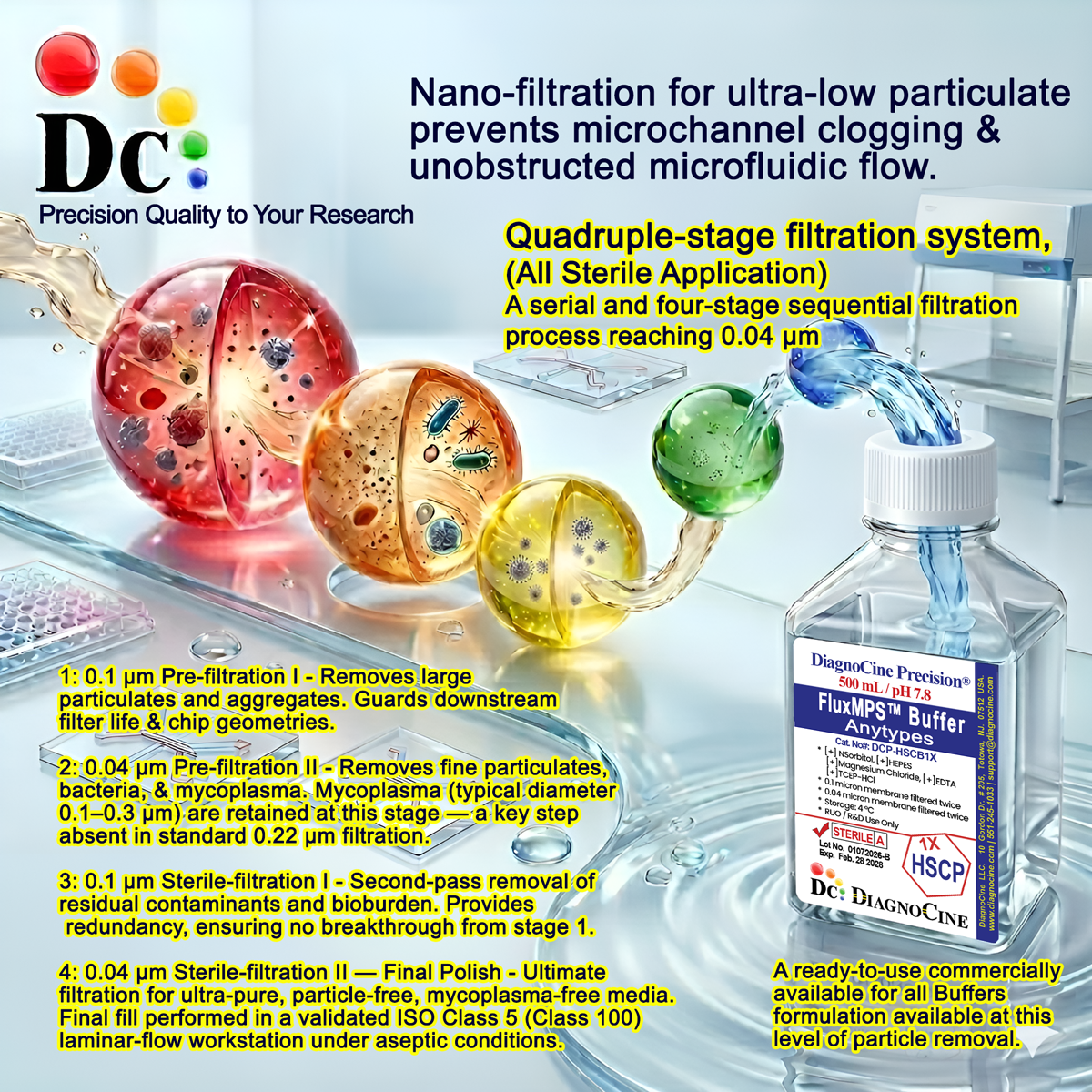
Quadruple-stage filtration system
DCP-MESSDSRB1X is manufactured using Diagnocine Precision's quadruple-stage filtration architecture, combining two passes through a 0.1µm membrane with two passes through a 0.04µm membrane to deliver a sterile, ultra-low particulate MES SDS Running Buffer suitable for sensitive protein biochemistry and microfluidic-compatible workflows.
-
1
0.1 µm Pre-filtration I
Removes large particulates and aggregates, extending the operating life of downstream filters.
-
2
0.04 µm Pre-filtration II
Retains fine particulates and bioburden ahead of final sterile filtration.
-
3
0.1 µm Sterile-filtration I
Second-pass redundancy through a 0.1µm membrane under aseptic conditions.
-
4
0.04 µm Sterile-filtration II — Final Polish
Ultimate polish filtration performed in an ISO Class 5 aseptic fill environment.
Performance vs. conventional buffer
Sequential 0.1µm and 0.04µm filtration removes finer particulates and bioburden than a single-pass 0.22µm filtration typical of conventional running buffers, supporting exclusion of contaminants such as mycoplasma, which can be as small as approximately 0.2µm.
© Diagnocine® — DCP-MESSDSRB1X
Where DCP-MESSDSRB1X performs
READY-to-USE 1X MES SDS Buffer is a running buffer used for SDS-PAGE to separate and resolve small to medium-sized proteins with Bis-Tris gels, ideal for protein biochemistry research, quality control, molecular weight determination, and analysis of bronchoalveolar lavage fluids, with a low-particulate formulation compatible with microfluidic and organ-on-a-chip sample workflows.
Automated Bioreactors & Robotics
For automated liquid handling platforms and robotic sample-prep systems, Diagnocine offers an optional 0.01µm (10 nm) ultra-filtered variant of DCP-MESSDSRB1X, engineered to protect fine-tolerance valves, sensors, and microfluidic channels from particulate accumulation over extended automated runs.
- Total Particulate Exclusion: 10 nm-rated filtration for the most stringent automated fluid-handling protocols
- Valve & Sensor Protection: minimizes particulate-driven wear on precision robotic dispensing components
- Extended Perfusion Stability: supports long-duration automated protocols without particulate-related drift
Inquiry Required: the 0.01µm ultra-filtered grade is available by request — contact support@diagnocine.com to discuss your automated platform requirements.
Micro Physiological System (MPS) & Chip
Ultra-filtered, low-particulate formulation supports downstream SDS-PAGE and Western blot analysis of proteins recovered from organ-on-a-chip and microphysiological system lysates.
Wash, Dilution & Reconstitution
Ready-to-use 1X format simplifies dilution and reconstitution of concentrated protein samples prior to loading onto Bis-Tris SDS-PAGE gels.
iPSC-Derived Model Handling
Enables SDS-PAGE resolution of proteins extracted from iPSC-derived neuron, cardiomyocyte, and hepatocyte lysates for differentiation and identity verification studies.
Endothelial & Primary Cell Perfusion
Supports protein profiling of endothelial and primary hepatocyte lysates recovered from perfusion-based culture systems via SDS-PAGE and Western blot.
ELISA, Blotting & Blocking
Purpose-built for Western blotting workflows, transferring low molecular weight proteins from Bis-Tris gels to PVDF membranes without interfering with downstream protein sequencing.
Microscopy & Optical Sensing
Low-background, ultra-filtered formulation supports confirmatory SDS-PAGE and blotting of proteins recovered from live-cell imaging and biosensor-based experiments.
Full technical profile
Every parameter below reflects DCP-MESSDSRB1X's own formulation and quality control data.
| Parameter | Specification |
|---|---|
| Formulation | 50 mM MES, 50 mM Tris base, 0.1% SDS, 1 mM EDTA (1X, ready-to-use) |
| Appearance | Clear, colorless liquid |
| pH USP <791> | 7.3 |
| Ionic mobility / conductivity | Lower than Tris-glycine or MOPS buffer systems |
| Parameter | Specification |
|---|---|
| Sterility | Filtered 0.1µm membrane twice and 0.04µm membrane twice in a sterile environment |
| DNase activity | None detected (18 hr incubation with plasmid DNA, room temperature) |
| RNase activity | None detected (18 hr incubation with ribosomal RNA, room temperature) |
| Water purity USP <85> | Ultrapure Type 1 water (18.2 MΩ·cm) |
| Manufacturing standard ISO | ISO 13485-certified, CE-approved facility |
| Fill environment | ISO Class 5 (Class 100) |
| Parameter | Specification |
|---|---|
| Storage temperature | 4°C to room temperature |
| Shelf life | 1-2 years |
| Parameter | Specification |
|---|---|
| Manufacturing QMS ISO | ISO 13485-certified, CE-approved supplier facilities |
| Traceability | Final packaging, QA, and testing performed at the Diagnocine R&D and Quality Testing Center |
| Production method | Customization and assembly performed at Diagnocine Precision, Totowa, New Jersey, USA |
| Intended use | Research Use Only (RUO) — not for clinical, diagnostic, or therapeutic use in humans |
Full composition
DCP-MESSDSRB1X is a defined MES-Tris-SDS-EDTA running buffer; customization of concentration, pH, or additives is available on request.
| Component | CAS Number | Concentration |
|---|---|---|
| MES | 4432-31-9 | 50 mM |
| Tris base | 77-86-1 | 50 mM |
| SDS | 151-21-3 | 0.1% |
| EDTA | 60-00-4 | 1 mM |
Manufacturing & compliance
DCP-MESSDSRB1X is manufactured under ISO 13485-certified and CE-approved facilities (suppliers of Diagnocine Precision), with final packaging, quality assurance, and testing completed at the Diagnocine R&D and Quality Testing Center.
ISO 13485:2016 QMS
Manufactured under ISO 13485-certified and CE-approved facilities.
Ultrapure Type 1 Water
Formulated with Ultrapure Type 1 water (18.2 MΩ·cm) as the base solvent.
ISO Class 5 Fill & Finish
Filtered and filled in an ISO Class 5 (Class 100) aseptic environment.
Micro-Batch Precision
Custom formulation and assembly performed at Diagnocine Precision, Totowa, New Jersey, USA.
DNase Activity Testing
None detected after 18-hour incubation of plasmid DNA with this product at room temperature.
RNase Activity Testing
None detected after 18-hour incubation of ribosomal RNA with this product at room temperature.
Sterility & Filtration Assurance
Sterile, filtered through a 0.1µm membrane twice and a 0.04µm membrane twice in a sterile environment.
Documentation / CoA
Certificate of Analysis available on request via support@diagnocine.com.
How DCP-MESSDSRB1X compares
A side-by-side look at filtration architecture and quality attributes against conventional running buffers.
| Parameter | DCP-MESSDSRB1X (FluxMPS™) | Conventional MES Running Buffer (0.22µm filtered) | Standard Tris-Glycine Alternative (0.22µm filtered) |
|---|---|---|---|
| Final filtration pore size | 0.04 µm | 0.22 µm | 0.22 µm |
| Number of filtration stages | 4 | 1 | 1 |
| DNase / RNase activity testing | check_circle | cancel | cancel |
| Water quality | Ultrapure Type 1 (18.2 MΩ·cm) | Standard purified water | Standard purified water |
| Manufacturing QMS | check_circle ISO 13485:2016 | cancel | cancel |
| Ready-to-use 1X format | check_circle | check_circle | check_circle |
| Bis-Tris gel compatibility | check_circle | check_circle | cancel |
| Custom formulation available | check_circle | cancel | cancel |
Frequently asked questions
Common questions about DCP-MESSDSRB1X MES SDS Running Buffer [1X].
Supporting literature
Curated literature on MES/Tris buffer chemistry, SDS-PAGE, and related protein analysis techniques.
- Laemmli, U.K. Cleavage of structural proteins during the assembly of the head of bacteriophage T4. Nature 227, 680-685 (1970). doi:10.1038/227680a0
- Schagger, H. Tricine-SDS-PAGE. Nat Protoc 1, 16-22 (2006). doi:10.1038/nprot.2006.4
- Wittig, I. & Schagger, H. Advantages and limitations of clear-native and blue-native gel systems. Proteomics 5, 4338-4346 (2005). doi:10.1002/pmic.200500081
- Ingham, K.C. Buffer systems and their applications in gel electrophoresis. Methods Enzymol. 182, 301-306 (1990). doi:10.1016/0076-6879(90)82025-w
- Huh, D. et al. Reconstituting Organ-Level Lung Functions on a Chip. Science 328, 1662-1668 (2010). doi:10.1126/science.1188302
- McKee, T.J. et al. Mycoplasma contamination in cell culture: incidence, sources, effects, detection, and elimination. In Vitro Cell Dev Biol Anim 53, 665-671 (2017). doi:10.1007/s11626-017-0172-0
- Bhattacharya, S. et al. Microfluidic protein electrophoresis: from theory to lab-on-chip devices. Lab Chip 9, 1219-1229 (2009). doi:10.1039/b900775b
- Chen, B. et al. Optimization of MES and MOPS buffer systems for resolution of low molecular weight proteins by SDS-PAGE. J Proteome Res 8, 651-661 (2009). doi:10.1021/pr800916r
- Bass, J.J. et al. An overview of technical considerations for Western blotting applications to physiological research. Scand J Med Sci Sports 27, 4-25 (2017). doi:10.1111/sms.12702
- Rabilloud, T. Membrane proteins ride shotgun. Nat Biotechnol 21, 508-510 (2003). doi:10.1038/nbt0503-508