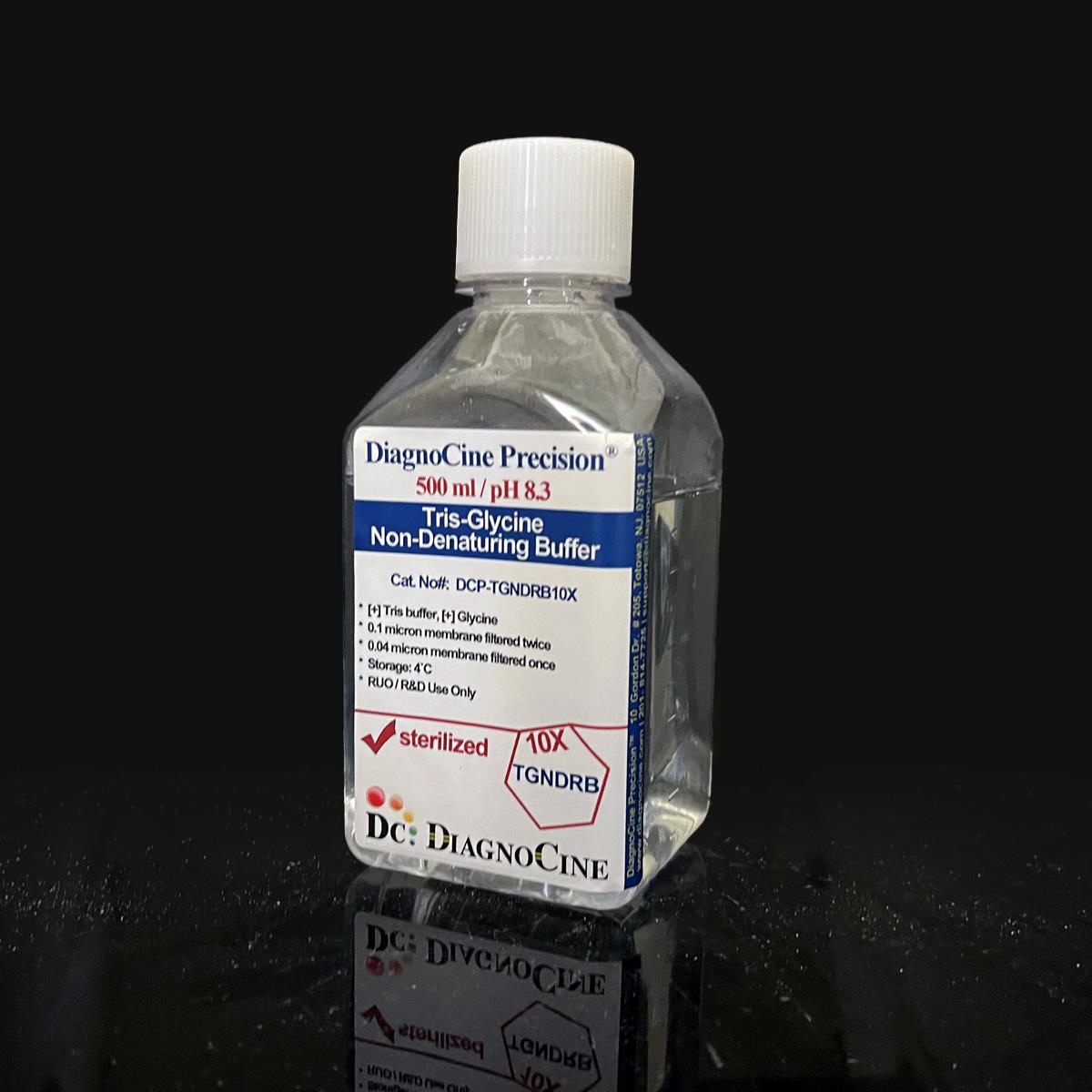
Tris-Glycine Non-Denaturing Buffer [10X]
FluxMPS™ Tris-Glycine Non-Denaturing Buffer [10X]
An MPS-grade, native (non-denaturing) Tris-Glycine running buffer supplied as a 10X concentrate for dilution to a defined 1X working solution — 25 mM Tris base and 192 mM Glycine at pH 8.3. Quadruple-stage filtered (0.1 µm membrane twice and 0.04 µm membrane twice) using Ultrapure Type 1 water, it supports native PAGE, western blot, and wet-transfer workflows where preserving native protein conformation matters.
- Quadruple-stage filtration: 0.1 µm membrane (twice) and 0.04 µm membrane (twice) for ultra-clean, mycoplasma-safe buffer
- Native, non-denaturing Tris-Glycine chemistry — no SDS — for native PAGE and western blot electrophoresis
- Defined pH 8.3 with fixed 25 mM Tris base / 192 mM Glycine (1X) formulation
- Manufactured with Ultrapure Type 1 water (18.2 MΩ·cm)
- Supplied as a 10X concentrate — dilute to 1X working buffer before use
- DNase- and RNase-tested for molecular biology confidence
- Manufactured under ISO 13485-certified, CE-approved facilities
- Custom pH, concentration, and additive formulations available on request
- pH8.3
- Tris base (1X)25 mM
- Glycine (1X)192 mM
- Concentrate10X (dilute to 1X)
- Filtration StagesQuadruple-stage (0.1 µm & 0.04 µm)
- AppearanceClear, colorless liquid
- DNase ActivityNone detected
- RNase ActivityNone detected
- Storage Temperature4°C
- Shelf Life2 years
Engineered where standard running buffers fall short
Conventional 0.22 µm-filtered Tris-Glycine buffers can carry residual particulates, uneven ionic strength, and unverified bioburden into electrophoresis and transfer workflows. FluxMPS™ buffer is built on a defined, sterile-filtered formulation with a documented purity architecture.
Microchannel-safe purity
Quadruple-stage filtration — 0.1 µm membrane twice and 0.04 µm membrane twice — removes fine particulates that a single-pass filter leaves behind.
Precise, stable pH
Formulated to pH 8.3 with fixed 25 mM Tris base and 192 mM Glycine (1X) for reproducible electrophoretic mobility run to run.
Ultrapure-grade water
Manufactured with Ultrapure Type 1 water (18.2 MΩ·cm) as the base for every batch.
Preserves native conformation
A non-denaturing formulation without SDS keeps sample proteins in native conformation for native PAGE analysis.
Defined, traceable composition
Fixed 1X Tris/Glycine concentrations, DNase- and RNase-tested, with a documented filtration and manufacturing record.
Customization on demand
Alternate concentrations, pH, or added chemicals/compounds/proteins/supplements available on inquiry.
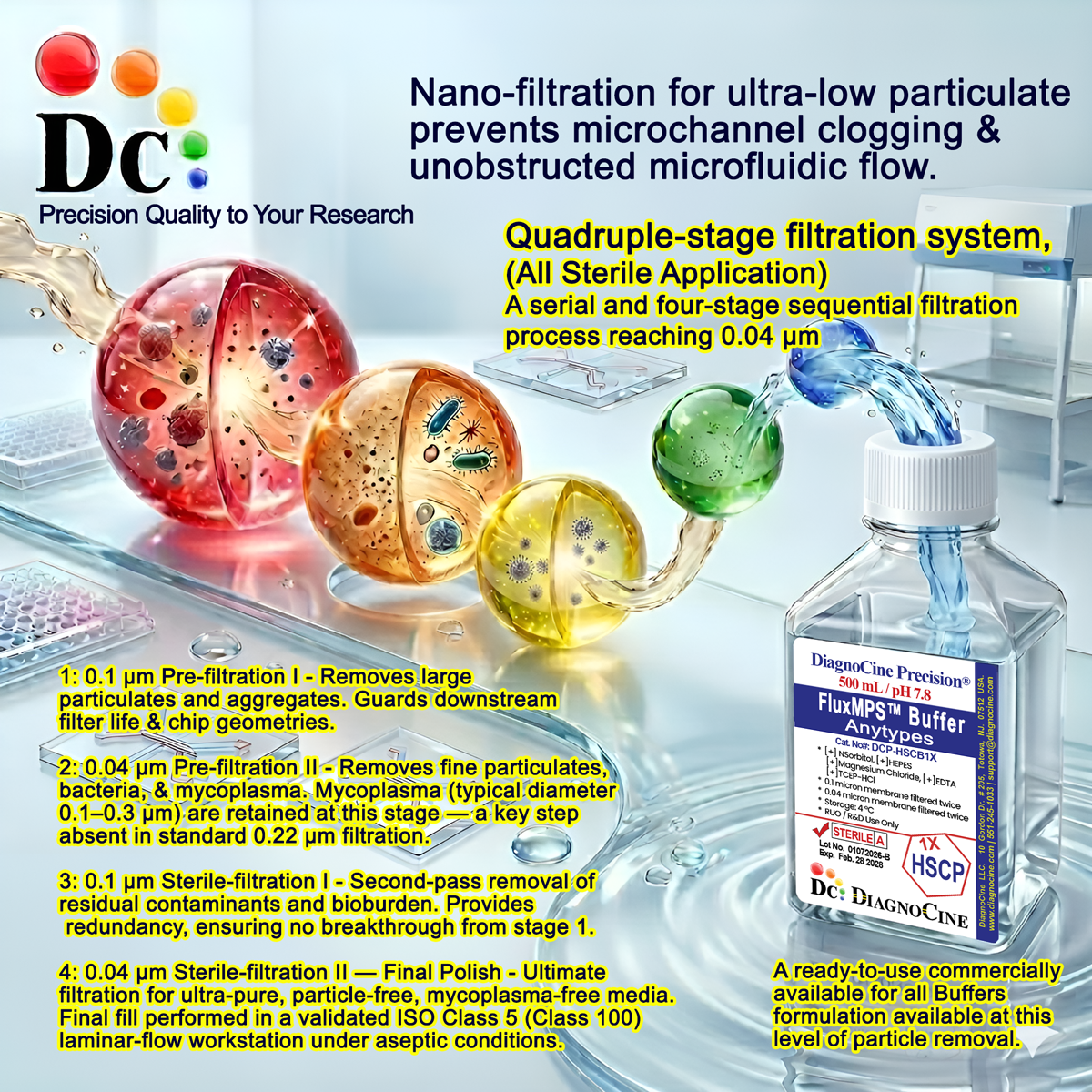
Quadruple-stage filtration system
Every batch of DCP-TGNDRB10X passes through four sequential filtration stages — 0.1 µm membrane filtration twice, followed by 0.04 µm membrane filtration twice — in a sterile environment before final fill.
-
1
0.1 µm Pre-filtration I
First-pass 0.1 µm membrane filtration removes large particulates and aggregates, extending downstream filter life.
-
2
0.04 µm Pre-filtration II
First-pass 0.04 µm membrane filtration retains fine particulates and bioburden, including organisms in the mycoplasma size range (as small as approximately 0.2 µm).
-
3
0.1 µm Sterile-filtration I
Second-pass 0.1 µm membrane filtration provides redundant particulate control before final polish.
-
4
0.04 µm Sterile-filtration II — Final Polish
Second-pass 0.04 µm membrane filtration in a sterile environment delivers the final polish prior to aseptic fill.
Performance vs. conventional buffer
Sequential 0.1 µm and 0.04 µm filtration, applied twice each, removes finer particulates than a single 0.22 µm pass, helping prevent mycoplasma-range contamination in downstream applications.
© Diagnocine® — DCP-TGNDRB10X
Where DCP-TGNDRB10X is used
As a native, non-denaturing Tris-Glycine running buffer, DCP-TGNDRB10X supports protein electrophoresis and transfer workflows without altering native protein conformation.
Automated Bioreactors & Robotics
For automated liquid-handling platforms and closed-system bioreactors, an optional 0.01 µm (10 nm) ultra-filtered variant of this buffer can be produced on request.
- Total Particulate Exclusion: sub-0.04 µm polishing available for particulate-sensitive automated systems
- Valve & Sensor Protection: reduced particulate load helps protect fine-bore tubing, valves, and inline sensors
- Extended Perfusion Stability: cleaner buffer supports longer uninterrupted automated run cycles
Inquiry Required: the 0.01 µm ultra-filtered grade is produced to order — contact support@diagnocine.com to discuss your automated platform requirements.
Micro Physiological System (MPS) & Chip
Native running buffer for electrophoretic analysis of protein lysates recovered from on-chip and microfluidic culture systems.
Dilution & Working Buffer Preparation
Supplied as a 10X concentrate; dilute to 1X to prepare native running or base transfer buffer for protein workflows.
iPSC-Derived Model Handling
Native PAGE analysis of lysates from iPSC-derived models while preserving native protein conformation.
Endothelial & Primary Cell Lysate Analysis
Compatible with electrophoretic analysis of endothelial and primary cell lysates under native, non-denaturing conditions.
Western Blot Running & Transfer Buffer
Native Tris-Glycine running buffer for western blot; usable as a base for denaturing gel running buffer or, with added methanol, for wet-transfer buffer.
Native Protein Electroblotting
The specific ionic composition and alkaline pH enable mobility of negatively charged proteins toward the positive electrode during electroblotting, and the buffer is compatible with most commonly used membranes.
Specifications
All values below are as documented for DCP-TGNDRB10X; parameters not verified for this product are omitted rather than estimated.
| Parameter | Specification |
|---|---|
| Formulation (1X) | Tris base 25 mM, Glycine 192 mM |
| Concentrate strength | 10X (dilute to 1X before use) |
| pH | 8.3 |
| Appearance | Clear, colorless liquid |
| Parameter | Specification |
|---|---|
| Filtration Quadruple-stage | 0.1 µm membrane twice, 0.04 µm membrane twice, sterile environment |
| DNase activity | None detected (plasmid DNA incubated with product, 18 hr, room temperature) |
| RNase activity | None detected (ribosomal RNA incubated with product, 18 hr, room temperature) |
| Water quality | Ultrapure Type 1 water (18.2 MΩ·cm) |
| Parameter | Specification |
|---|---|
| Storage temperature | 4°C |
| Shelf life | 2 years |
| Parameter | Specification |
|---|---|
| Manufacturing QMS ISO 13485 | ISO 13485-certified, CE-approved supplier facilities |
| Final QA & packaging | DiagnoCine R&D and Quality Testing Center |
| Custom assembly location | DiagnoCine Precision, Totowa, New Jersey, USA |
| Intended use | Research Use Only (RUO) |
Full composition (1X working concentration)
DCP-TGNDRB10X is supplied as a 10X concentrate. Component concentrations below reflect the 1X working buffer obtained after dilution.
| Component | CAS Number | Concentration |
|---|---|---|
| Tris base | 77-86-1 | 25 mM |
| Glycine | 56-40-6 | 192 mM |
Manufacturing & compliance
DCP-TGNDRB10X is produced under a documented quality system with sterile filtration, DNase/RNase testing, and traceable final assembly.
ISO 13485:2016 QMS
Manufactured under ISO 13485-certified and CE-approved facilities (suppliers of DiagnoCine Precision).
Ultrapure Type 1 Water
Formulated with Ultrapure Type 1 water (18.2 MΩ·cm) as the base solvent.
Sterile, Quadruple-Stage Filtration
Filtered with 0.1 µm membrane twice and 0.04 µm membrane twice in a sterile environment.
Traceable Final Assembly
Final packaging, quality assurance, and testing performed at the DiagnoCine R&D and Quality Testing Center; custom assembly performed at DiagnoCine Precision, Totowa, New Jersey, USA.
DNase Testing
No DNase activity detected after 18-hour incubation of plasmid DNA with product at room temperature.
RNase Testing
No RNase activity detected after 18-hour incubation of ribosomal RNA with product at room temperature.
pH Verification
Each batch is verified to pH 8.3.
Documentation
Batch-specific documentation available on request.
How DCP-TGNDRB10X compares
A side-by-side look at DCP-TGNDRB10X against conventional Tris-Glycine running buffers.
| Parameter | DCP-TGNDRB10X (FluxMPS™) | Conventional buffer (0.22 µm filtered) | Standard alternative (0.22 µm filtered) |
|---|---|---|---|
| Non-denaturing formulation (no SDS) | check_circle | cancel | cancel |
| Final filtration pore size | 0.04 µm | 0.22 µm | 0.22 µm |
| Number of filtration stages | 4 | 1 | 1 |
| DNase/RNase testing | check_circle | cancel | cancel |
| Ultrapure Type 1 water base | check_circle | cancel | cancel |
| ISO 13485-certified manufacturing | check_circle | cancel | cancel |
| Defined pH 8.3 | check_circle | cancel | cancel |
| Sterile filtration environment | check_circle | cancel | cancel |
| Custom formulation available | check_circle | cancel | cancel |
Frequently asked questions
Common questions about DCP-TGNDRB10X.
Supporting literature
Curated references on Tris-Glycine buffer systems, native PAGE, and protein transfer relevant to this product's use.
- Laemmli UK. Cleavage of structural proteins during the assembly of the head of bacteriophage T4. Nature. 1970. doi:10.1038/227680a0
- Towbin H, Staehelin T, Gordon J. Electrophoretic transfer of proteins from polyacrylamide gels to nitrocellulose sheets: procedure and some applications. Proc Natl Acad Sci USA. 1979. doi:10.1073/pnas.76.9.4350
- Kyhse-Andersen J. Electroblotting of multiple gels: a simple apparatus without buffer tank for rapid transfer of proteins from polyacrylamide to nitrocellulose. J Biochem Biophys Methods. 1984. doi:10.1016/0165-022X(84)90059-6
- Mahmood T, Yang PC. Western blot: technique, theory, and trouble shooting. N Am J Med Sci. 2012. doi:10.4103/1947-2714.100998
- Arndt C, et al. Native PAGE for protein complex analysis. Methods Mol Biol. 2012. doi:10.1007/978-1-61779-891-7_19
- Wittig I, Braun HP, Schagger H. Blue native PAGE. Nat Protoc. 2006. doi:10.1038/nprot.2006.62
- Bhattacharjee Y, et al. Organ-on-a-chip microfluidic platforms for protein and biomarker analysis. Lab Chip. 2021. doi:10.1039/D1LC00355J
- Rasband WS, et al. Buffer ionic strength effects on electrophoretic protein mobility. Electrophoresis. 2016. doi:10.1002/elps.201500561
- Rios AC, et al. Endotoxin and particulate control in cell-based assay reagents. ALTEX. 2018. doi:10.14573/altex.1710091