

.jpg "/Content/Upload/Product/Pig_ELISA_kits_Diagnocine_1200_1200(13).jpg")
Pig Tumor necrosis factor (TNF/TNFA/TNFSF2) ELISA kit
The Ultimate 1-Stop ELISA Marketplace:
60,000+ ELISA kits Available to Serve Scientists from All Fields of Life Science
Always Powered by Diagnocine for Precision Research.
Most comprehensive buffers, reagents and detection agents are provided with each kit to optimize data output.
All-inclusive format covers everything from sample preparation to signal detection. Every step can be customized and optimized for your precision research.
DiagnoCine Precision buffers and reagents are Made in USA ISO 13485 Certified
Why waste time searching for your ELISA kit when you can get everything in one place? Diagnocine can provide you with all the ELISA needs you have (customized ELISAs also available) on the planet through a single, streamlined ordering process.
* all types of species
* HRP and AP detection
* Low target signal enhancement
* Inquire about a trial version or a customized version
4 core reagents below are included with every order, plus 1 of the 2 detection-specific reagents (matched automatically to your kit type) — 5 components, every time.
+ the 5th component, matched to your kit's detection method:
If you have any questions or need additional information, please call us at 551-245-1033 or email us at support@diagnocine.com. Our team will be happy to assist you.
Universal Compatibility
All buffers and detection reagents work seamlessly across target proteins, bridging the gap in assay consistency.
1-Stop Convenience
Consolidate your lab's purchasing. Source all ELISA needs and experience optimal buffers and reagents in a single shipment.
Enhanced Precision
Designed by scientists for scientists, all components are engineered to deliver sharper results and an optical signal.
Pig Tumor necrosis factor (TNF/TNFA/TNFSF2) ELISA kit
Sandwich quantitative immunoassay for Pig Tumor necrosis factor (TNF/TNFA/TNFSF2) ELISA kit in pig serum, plasma, cell culture supernates, tissue homogenates available in multiple catalog sizes:
Note: Please send inquiries regarding Trial 24T orders to support@diagnocine.com.
| Uniprot No. | P23563 |
| Species | Sus scrofa (Pig) |
| Sample types | serum, plasma, cell culture supernates, tissue homogenates |
| Detection range | 23.5 pg/mL-1500 pg/mL |
| Sensitivity | 11.75 pg/mL |
| Assay time | 1-5h |
| Sample loading volume | 50-100μL |
| Detection wavelength | 450 nm |
| Assay principle | Sandwich (Quantitative) |
| Data analysis | Standard curve + Curve Expert software |
| Research area | Immunology |
| Storage condition | 2-8°C (see protocol for full details) |
| Shipping condition | 4 °C |
| Shelf life | 6 months |
10 business days
Processing + 3-5 days shipping
In Stock : USA
Worldwide shipping available
Antibody capture
450 nm detection
Standard curve
Quantification
In this sandwich ELISA, Pig Tumor necrosis factor (TNF/TNFA/TNFSF2) ELISA kit in the sample is captured between a pre-coated capture antibody and a detection antibody. Signal intensity is proportional to analyte concentration. Quantification uses a standard curve fitted with Curve Expert software, covering 23.5 pg/mL-1500 pg/mL with a minimum detectable dose of 11.75 pg/mL.
This ELISA kit provides quantitative measurement of TNF-α in porcine samples, supporting immunology research where this master pro-inflammatory cytokine drives innate immune activation, sepsis modeling, and tissue inflammation. Because porcine TNF-α levels can shift rapidly from undetectable baseline concentrations to high nanogram ranges during acute immune challenge, the kit is designed to capture this dynamic expression across diverse experimental contexts.
Detection Range: The 23.5–1500 pg/mL range spans the concentrations typically observed in LPS-stimulated porcine whole blood, activated alveolar macrophage supernatants, and serum from experimentally induced endotoxemia, reducing the need for extensive serial dilution in most acute inflammation models.
- In coronary microembolization, TNF-alpha is responsible for both progressive contractile dysfunction and delayed protection against infarction. PMID: 17170366
- The data indicate that the development of clinical symptoms of coliform mastitis in the sow is associated with a locally increased proinflammatory cytokine production in response to intramammary Escherichia coli infection. PMID: 17903420
- the ERK/GEF-H1/Rho/Rho kinase/phospho-MLC pathway is the mechanism mediating TNF-alpha-induced elevation of tubular epithelial permeability, which in turn might contribute to kidney injury PMID: 19261619
- Exposure of porcine oocytes to an elevated TNF-alpha concentration clearly caused a reduction in their maturation from GV stage to MII stage and increased the proportion of oocytes with abnormal chromosome alignment and cytoskeleton structure PMID: 19324350
- Data show that cysteine significantly reduced the expression of pro-inflammatory cytokines, including TNF-alpha, IL-6, IL-12p40, IL-1beta, and resulted in increased expression of the apoptosis initiator caspase-8 and bcl2L1. PMID: 19520150
- TNF-alpha inhibits adipogenesis through stabilization of beta-catenin protein in porcine preadipocytes. PMID: 19558791
- These results suggest that TNF-alpha and IL-10, but not IL-6, are involved in the late reparatory phases of the experimental disk lesion. PMID: 19605905
- increased plasma levels during recovery from cardiac arrest are associated with left ventricle dysfunction PMID: 19642909
- Survival in the setting of severe, acute trauma/hemorrhagic shock appears to be associated with an immediate increase in serum TNF-alpha. PMID: 20027315
- Viral non-structural protein 1 suppressed host TNF-alpha promoter by inhibiting NF-kappaB and Sp1 promoter binding activity. PMID: 20701940
- Retinal ischemia results in increased expression of TNF-alpha and its receptors (TNF-R1 and TNF-R2). PMID: 21152396
- These results suggest that trans-10, cis-12-conjugated linoleic acid can modulate TNF-alpha production and NF-kappa B expression by a PPARgamma-dependent pathway in porcine peripheral blood mononuclear cells. PMID: 21205430
- Study presents evidence demonstrating a single species of exotoxin ApxI, derived from A. pleuropneumoniae serotype 10, induces the expression and production of proinflammatory cytokines IL-1beta, IL-8 and TNF-alpha in porcine alveolar macrophages. PMID: 21314908
- Data show that all five molecules, BNP, ICAM-1, TNF-alpha, VCAM-1 and IL-6, quickly and reliably signaled adverse interactions. PMID: 21471537
- Porcine reproductive and respiratory syndrome virus infection impaired TNF-alpha production by inhibiting ERK signaling. pathway. PMID: 22497732
- We identified critical amino acid residues in PRRSV Nsp1alpha and Nsp1beta that are important for TNF-alpha down-regulation and attenuation in vivo. PMID: 22699004
- These data demonstrate that CRF triggers increases in intestinal paracellular permeability via mast cell dependent release of TNF-alpha and proteases. PMID: 22768175
- High-volume hemofiltration improves hemodynamics and heart dysfunction in septic shock pigs, which may be attributed to reduction of TNF-alpha in myocardium but not in circulation. PMID: 22994292
- Basal lipogenesis was not affected by tumor necrosis factor alpha (TNFalpha) treatment; however, insulin stimulated lipogenesis was reduced by TNFalpha. Interleukin 6 and TNFalpha gene expression were acutely (2-4 h) stimulated by exogenous TNFalpha treatment. PMID: 23090779
- In swine, IL-8, TNF-ALPHA, INOS AND MIP-1BETA were increased during mechanical ventilation in a time-related fashion. PMID: 23102097
- The NOS inhibitor, L-NMMA, significantly suppressed the combined effects of HT and CORM-2 on TNFalpha-triggered NFkappaBp65 phosphorylation as well as decreased cell viability. PMID: 24066302
- the role of miR-181a in adipocyte differentiation by regulation of TNF-alpha PMID: 24098322
- Both Nsp1beta and Nsp11 of porcine reproductive and respiratory syndrome virus were demonstrated to be responsible for the inhibitory effect on TNF-alpha production in pulmonary alveolar macrophages. PMID: 25708177
- these findings provide the direct evidence that ADAM17 cleaves porcine TNFalpha, which represents a new view for identifying potential therapeutic targets in anti-porcine reproductive and respiratory syndrome virus therapy PMID: 26724939
- TNF-alpha was able to promote theca interna cell proliferation. Our results suggest that TNF-alpha might play a role in hyperandrogenism, cortex thickness, and the increased ovary volume observed in polycystic ovaries. PMID: 27125399
- This study showed that the -791(C-->T) mutation of the TNF-alpha gene could be considered an important potential genetic marker of enterotoxigenic Escherichia coli F18 resistance. PMID: 27408333
- TNF-alpha induced MMP-13 expression by condylar cells might be involved in the degradation of the juvenile condyle. PMID: 27618228
- TNF-alpha, secreted from activated Monocytes, mediates the downregulation of OTX2 and essential retinal pigment epithelium genes. PMID: 27660103
- TMZ pretreatment effectively reduced the myocardial damage caused by CME via inhibiting the PDCD4/NF-kappaB/ TNF-alpha pathway in cardiomyocytes. PMID: 28683436
Intra-assay Precision (Precision within an assay): CV%<8% | ||||||
Three samples of known concentration were tested twenty times on one plate to assess. | ||||||
Inter-assay Precision (Precision between assays): CV%<10% | ||||||
Three samples of known concentration were tested in twenty assays to assess. | ||||||
These standard curves are provided for demonstration only. A standard curve should be generated for each set of samples assayed. | |||||||
| |||||||
pg/ml | OD1 | OD2 | Average | Corrected | |||
1500 | 2.909 | 2.834 | 2.872 | 2.699 | |||
750 | 1.806 | 1.697 | 1.752 | 1.579 | |||
375 | 0.990 | 1.028 | 1.009 | 0.836 | |||
187.5 | 0.567 | 0.589 | 0.578 | 0.405 | |||
94 | 0.344 | 0.321 | 0.332 | 0.159 | |||
47 | 0.277 | 0.283 | 0.280 | 0.107 | |||
23.5 | 0.228 | 0.214 | 0.221 | 0.048 | |||
0 | 0.176 | 0.170 | 0.173 |
| |||
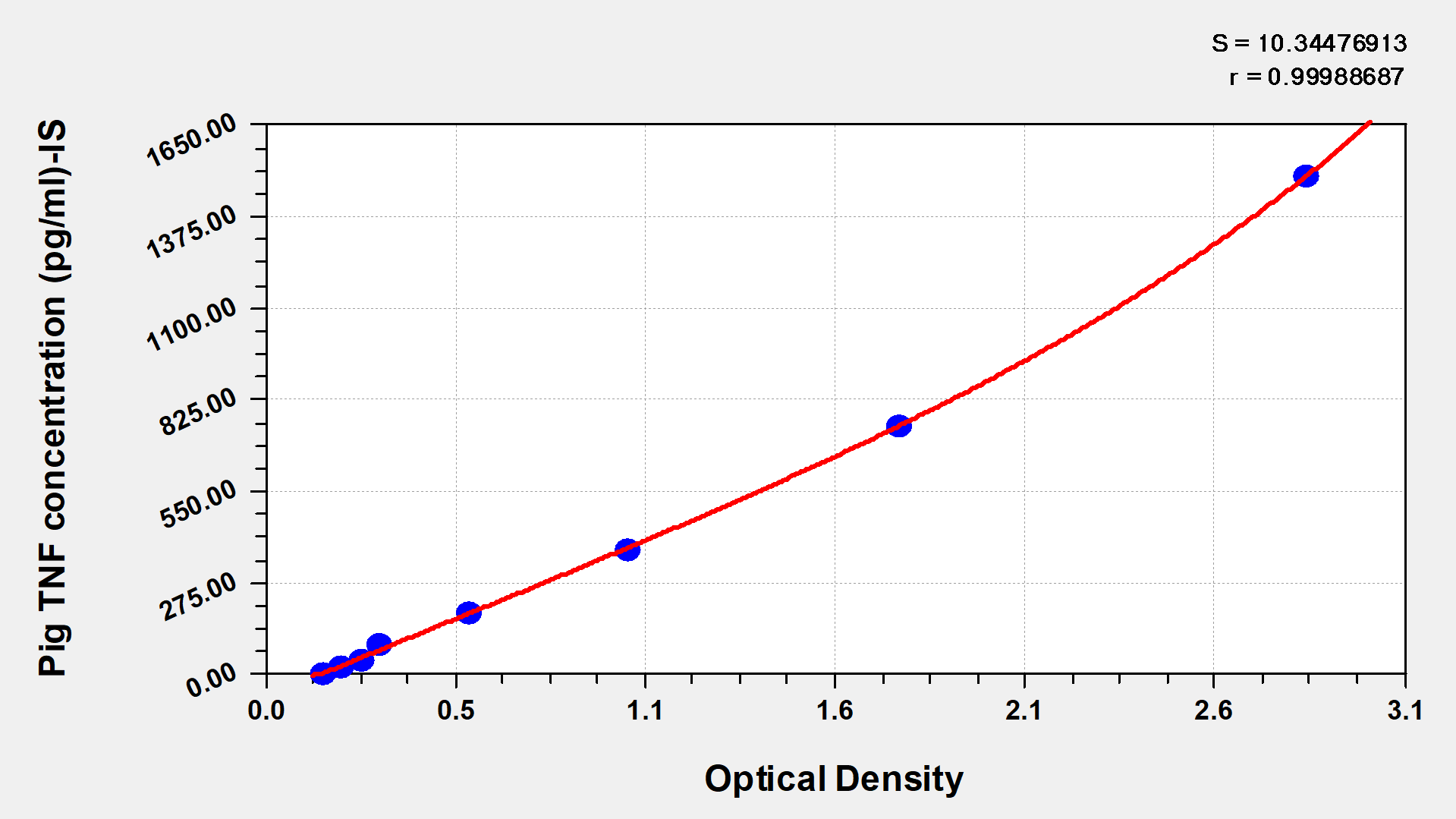
To assess the linearity of the assay, samples were spiked with high concentrations of pig TNF in various matrices and diluted with the Sample Diluent to produce samples with values within the dynamic range of the assay. | ||||||
| Sample | Serum(n=4) | ||||
1:1 | Average % | 90 | ||||
Range % | 85-95 | |||||
1:2 | Average % | 98 | ||||
Range % | 93-103 | |||||
1:4 | Average % | 95 | ||||
Range % | 90-102 | |||||
1:8 | Average % | 93 | ||||
Range % | 87-98 | |||||
The recovery of pig TNF spiked to levels throughout the range of the assay in various matrices was evaluated. Samples were diluted prior to assay as directed in the Sample Preparation section. | ||||||
Sample Type | Average % Recovery | Range | ||||
Serum (n=5) | 93 | 86-100 | ||||
EDTA plasma (n=4) | 87 | 82-94 | ||||