

.jpg "/Content/Upload/Product/Mouse_ELISA_kits_Diagnocine_1200_1200(108).jpg")
Mouse interferon-inducible protein 10,IP-10 ELISA Kit
The Ultimate 1-Stop ELISA Marketplace:
60,000+ ELISA kits Available to Serve Scientists from All Fields of Life Science
Always Powered by Diagnocine for Precision Research.
Most comprehensive buffers, reagents and detection agents are provided with each kit to optimize data output.
All-inclusive format covers everything from sample preparation to signal detection. Every step can be customized and optimized for your precision research.
DiagnoCine Precision buffers and reagents are Made in USA ISO 13485 Certified
Why waste time searching for your ELISA kit when you can get everything in one place? Diagnocine can provide you with all the ELISA needs you have (customized ELISAs also available) on the planet through a single, streamlined ordering process.
* all types of species
* HRP and AP detection
* Low target signal enhancement
* Inquire about a trial version or a customized version
4 core reagents below are included with every order, plus 1 of the 2 detection-specific reagents (matched automatically to your kit type) — 5 components, every time.
+ the 5th component, matched to your kit's detection method:
If you have any questions or need additional information, please call us at 551-245-1033 or email us at support@diagnocine.com. Our team will be happy to assist you.
Universal Compatibility
All buffers and detection reagents work seamlessly across target proteins, bridging the gap in assay consistency.
1-Stop Convenience
Consolidate your lab's purchasing. Source all ELISA needs and experience optimal buffers and reagents in a single shipment.
Enhanced Precision
Designed by scientists for scientists, all components are engineered to deliver sharper results and an optical signal.
Mouse interferon-inducible protein 10,IP-10 ELISA Kit
Sandwich quantitative immunoassay for Mouse interferon-inducible protein 10,IP-10 in mouse serum, plasma, tissue homogenates available in multiple catalog sizes:
Note: Please send inquiries regarding Trial 24T orders to support@diagnocine.com.
| Uniprot No. | P17515 |
| Species | Mus musculus (Mouse) |
| Sample types | serum, plasma, tissue homogenates |
| Detection range | 7.8 pg/mL-500 pg/mL |
| Sensitivity | 3.9 pg/mL |
| Assay time | 1-5h |
| Sample loading volume | 50-100μL |
| Detection wavelength | 450 nm |
| Assay principle | Sandwich (Quantitative) |
| Data analysis | Standard curve + Curve Expert software |
| Research area | Immunology |
| Storage condition | 2-8°C (see protocol for full details) |
| Shipping condition | 4 °C |
| Shelf life | 6 months |
10 business days
Processing + 3-5 days shipping
In Stock : USA
Worldwide shipping available
Antibody capture
450 nm detection
Standard curve
Quantification
In this sandwich ELISA, Mouse interferon-inducible protein 10,IP-10 in the sample is captured between a pre-coated capture antibody and a detection antibody. Signal intensity is proportional to analyte concentration. Quantification uses a standard curve fitted with Curve Expert software, covering 7.8 pg/mL-500 pg/mL with a minimum detectable dose of 3.9 pg/mL.
This Mouse CXCL10 (IP-10) ELISA Kit provides quantitative measurement of CXCL10 in Mus musculus samples, supporting research into interferon-γ-driven immune signaling and chemokine-mediated T cell recruitment. Because CXCL10 levels can shift dramatically between baseline and inflammatory states, the kit is designed to capture this dynamic range without requiring multiple dilution schemes.
Detection Range: The 7.8–500 pg/mL range spans resting-state serum CXCL10 concentrations in naïve mice (typically 20–80 pg/mL) through the elevated levels seen during viral infection or tumor-driven inflammation (often 200–500+ pg/mL), meaning most samples can be run neat or with minimal dilution.
- The chemokines monocyte chemotactic protein 1 (MCP1), MIP1alpha, MIP1beta, interferon gamma-induced protein 10 (IP-10), and eotaxin were induced in Saa1 TG mice. PMID: 25847238
- hepatic expression of the inflammatory CXC chemokine ligands (CXCL)9 and CXCL10 strongly increased whereas homeostatic CXCL12 significantly decreased. PMID: 26052942
- Donor interleukin-22 and host type I interferon signaling pathway participate in intestinal graft-versus-host disease via STAT1 activation and CXCL10. PMID: 26153763
- During hepatocyte lipotoxicity, activated MLK3 induces the release of CXCL10-bearing vesicles from hepatocytes, which are chemotactic for macrophages. PMID: 26406121
- The results suggested that astrocytes contribute to Cerebral Malaria pathogenesis by producing CXCL10 in response to IFN-gamma and LT-alpha. PMID: 26687629
- Neutrophils and inflammatory monocytes were identified as the main cellular sources of CXCL10 responsible for the induction of these processes PMID: 26718341
- MiR-15a contributes abnormal immune response in myasthenia gravis by targeting CXCL10 PMID: 26845678
- CXCL10 and blood-brain barrier permeability enhancement in rabies virus infection PMID: 26895109
- Results suggest that CXCL10(-/-) mice are protected against diet-induced nonalcoholic steatohepatitis (NASH), in an obesity-independent manner. PMID: 27349927
- CXCL10 chemokine levels correlate negatively with gremlin-1 levels in mouse and human lung. PMID: 27428020
- CXCL10 might influence the cellular composition locally in the islet graft, thereby playing a role in the autoimmune destruction. CXCL10 might therefore constitute a potential therapeutic target to prolong islet graft survival PMID: 27797910
- PERK and IRE1alpha/XBP1 in the unfolded protein response differentially regulate the expression of CXCL10 and CCL2 likely through modulation of ER stress-induced NF-kappaB RelA and STAT3 activation. PMID: 28065589
- Collectively, these results suggest that the CXCL10/CXCR3-mediated NF-kappaB signaling pathway plays a role in the control of autonomous regulation of CXCL10 and malignant tumor properties in breast cancer 4T1 cells. PMID: 28209986
- Data provide first evidence for a link between oncogenic JAK2V617F signaling and cell intrinsic induction of CXCL10 induced by activated NFkB signaling. PMID: 28233092
- In lipotoxic hepatocytes, MLK3 activates a MAPK signaling cascade, resulting in the activating phosphorylation of STAT1, and CXCL10 transcriptional upregulation. PMID: 28262979
- CXCL10 plays in the pathogenesis of recurrent Herpetic stromal keratitis, and that CXCL9 displays its importance when CXCL10 is absent. PMID: 28282568
- Increased CXCL10 expression led to decreased tumour burden and malignant ascites accumulation in the ID8 syngeneic murine model of HGSC. PMID: 28318643
- Study revealed that CXCL10 evoked an ionic current mainly carried by Cl(-) channels, suggests that Cl(-) channels are likely key molecular candidates responsible for the CXCL10-evoked neuronal activation and itch-like behaviors in a murine model of allergic contact dermatitis induced by the antigen squaric acid dibutylester. Cl(-) channels may emerge as a promising drug target for the treatment of allergic itch. PMID: 28446581
- CXCL10 has strong inhibitory effects on neovascularization, whereas MMP13 is required for neovascularization in C. albicans-infected corneas. PMID: 28623423
- These findings highlight the importance of CXCL10 signaling in the pathogenesis of rheumatoid arthritis and provide previously unidentified details of the mechanisms by which CXCL10 promotes the development of arthritis. PMID: 28724396
- In conclusion, upregulated CXCL10 in steatohepatitis impairs autophagic flux by reducing autolysosome formation, thereby inhibiting autophagic protein degradation and the accumulation of ubiquitinated proteins, leading to the development of steatohepatitis. PMID: 28824718
- These findings elucidate an NFAT-MAPK signaling paradigm for induction of isletokine expression in beta-cells and reveal IP-10 as a primary therapeutic target to prevent beta-cell-induced inflammatory loss of graft function after islet cell transplantation. PMID: 28855240
- Study shows that circulating interferon- that binds to receptors on brain endothelial cells and induces Cxcl10, is a central link in the signaling chain eliciting inflammation-induced aversion. PMID: 28864260
- A novel function of CXCL10 in mediating monocyte production of proinflammatory cytokines in inflammatory bowel diseases has been described. PMID: 28899907
- The knockout of either CXCL10 or TNF-alpha reduced germ cell apoptosis in the co-cultures of germ cells and Sertoli cells in response to MuV infection. Local injection of MuV into the testes of mice confirmed the involvement of CXCL10 in germ cell apoptosis in vivo. PMID: 29072682
- in vivo experiments show that the CXCL10/CXC chemokine receptor family 3 axis prevents the recruitment of macrophages, reduces inflammation, and halts the progression of the disease; the increased production of IL-1beta highlights the autoinflammatory nature of congenital hepatic fibrosis and may open novel therapeutic avenues PMID: 29140564
- CXCL10, not CXCL9 or CXCL11, induced IL-9 expression in the liver tissue. PMID: 29860220
- This study explored the effect of CXCL10 on COPD induced by cigarette smoke (CS) and its underlying mechanism. PMID: 30118441
Intra-assay Precision (Precision within an assay): CV%<8% | ||||||
Three samples of known concentration were tested twenty times on one plate to assess. | ||||||
Inter-assay Precision (Precision between assays): CV%<10% | ||||||
Three samples of known concentration were tested in twenty assays to assess. | ||||||
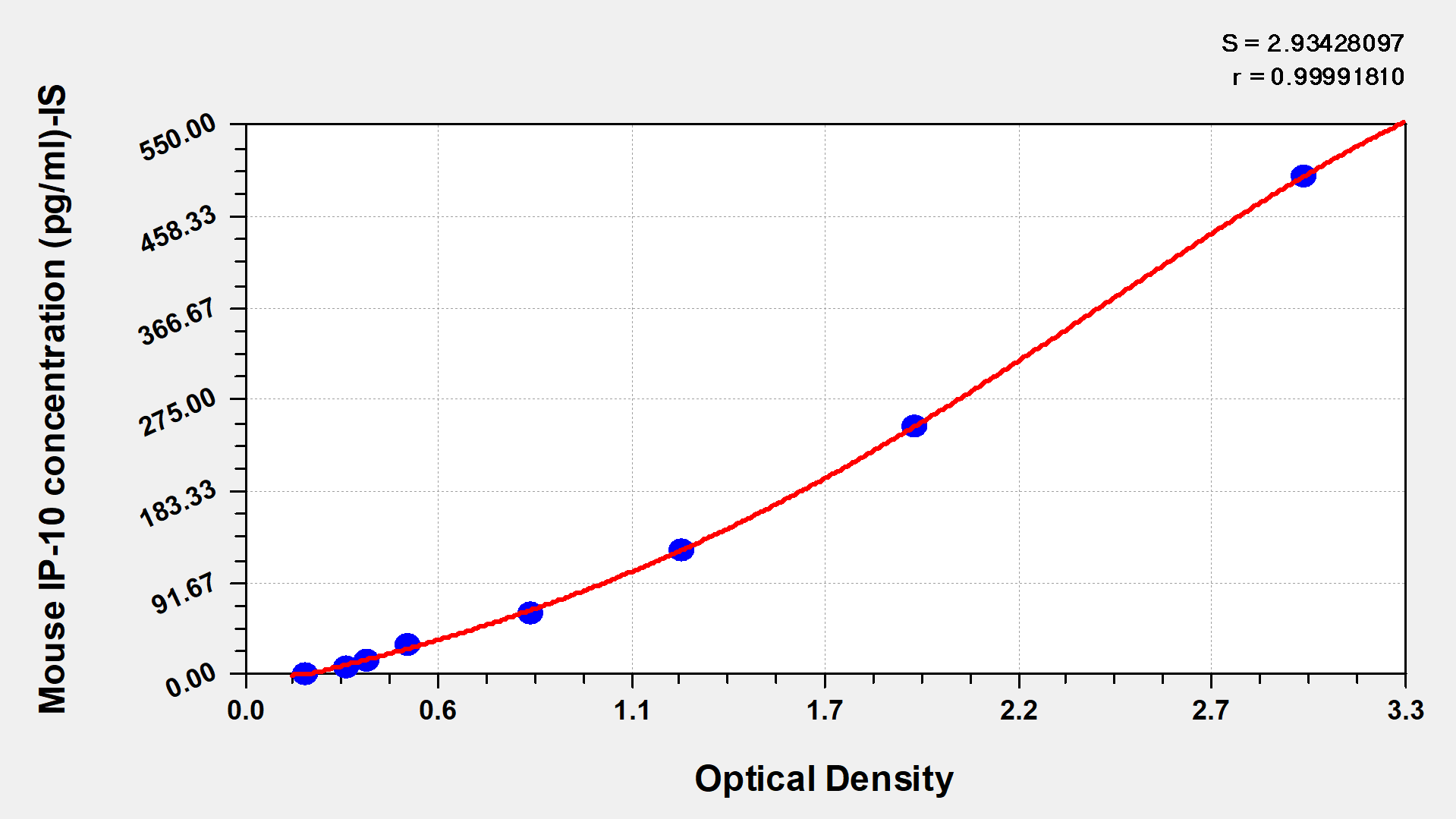
These standard curves are provided for demonstration only. A standard curve should be generated for each set of samples assayed. | |||||||
| |||||||
pg/ml | OD1 | OD2 | Average | Corrected | |||
500 | 3.083 | 2.934 | 3.009 | 2.822 | |||
250 | 1.954 | 1.867 | 1.911 | 1.723 | |||
125 | 1.267 | 1.228 | 1.248 | 1.060 | |||
62.5 | 0.815 | 0.829 | 0.822 | 0.635 | |||
31.2 | 0.482 | 0.471 | 0.477 | 0.289 | |||
15.6 | 0.369 | 0.353 | 0.361 | 0.174 | |||
7.8 | 0.304 | 0.304 | 0.304 | 0.117 | |||
0 | 0.189 | 0.185 | 0.187 |
| |||
To assess the linearity of the assay, samples were spiked with high concentrations of mouse IP-10 in various matrices and diluted with the Sample Diluent to produce samples with values within the dynamic range of the assay. | ||||||
| Sample | Serum(n=4) | ||||
1:4 | Average % | 98 | ||||
Range % | 91-104 | |||||
1:8 | Average % | 94 | ||||
Range % | 89-99 | |||||
1:16 | Average % | 105 | ||||
Range % | 100-111 | |||||
1:32 | Average % | 90 | ||||
Range % | 85-96 | |||||
The recovery of mouse IP-10 spiked to levels throughout the range of the assay in various matrices was evaluated. Samples were diluted prior to assay as directed in the Sample Preparation section. | ||||||
Sample Type | Average % Recovery | Range | ||||
Serum (n=5) | 98 | 91-105 | ||||
EDTA plasma (n=4) | 90 | 85-96 | ||||